
If you play online poker seriously, sooner or later you run into the same question: should you pay for coaching, or should you keep studying alone?
The honest answer is that a coach is not always the next step. Sometimes you need one badly. Sometimes you do not need one yet, because your biggest leaks are still easy to find on your own. And sometimes you need a coach, but only after you have prepared the ground properly so the session is not wasted on vague advice.
The goal of coaching is not to collect opinions. It is to reduce mistakes that cost you real money, faster than you could do alone.
When poker coaching is worth paying for
Coaching is usually worth paying for when all three of these are true:
- You already play enough hands to have a real sample.
- You have a repeatable problem, not just a bad week.
- You can describe the problem with numbers or with a clear set of hands.
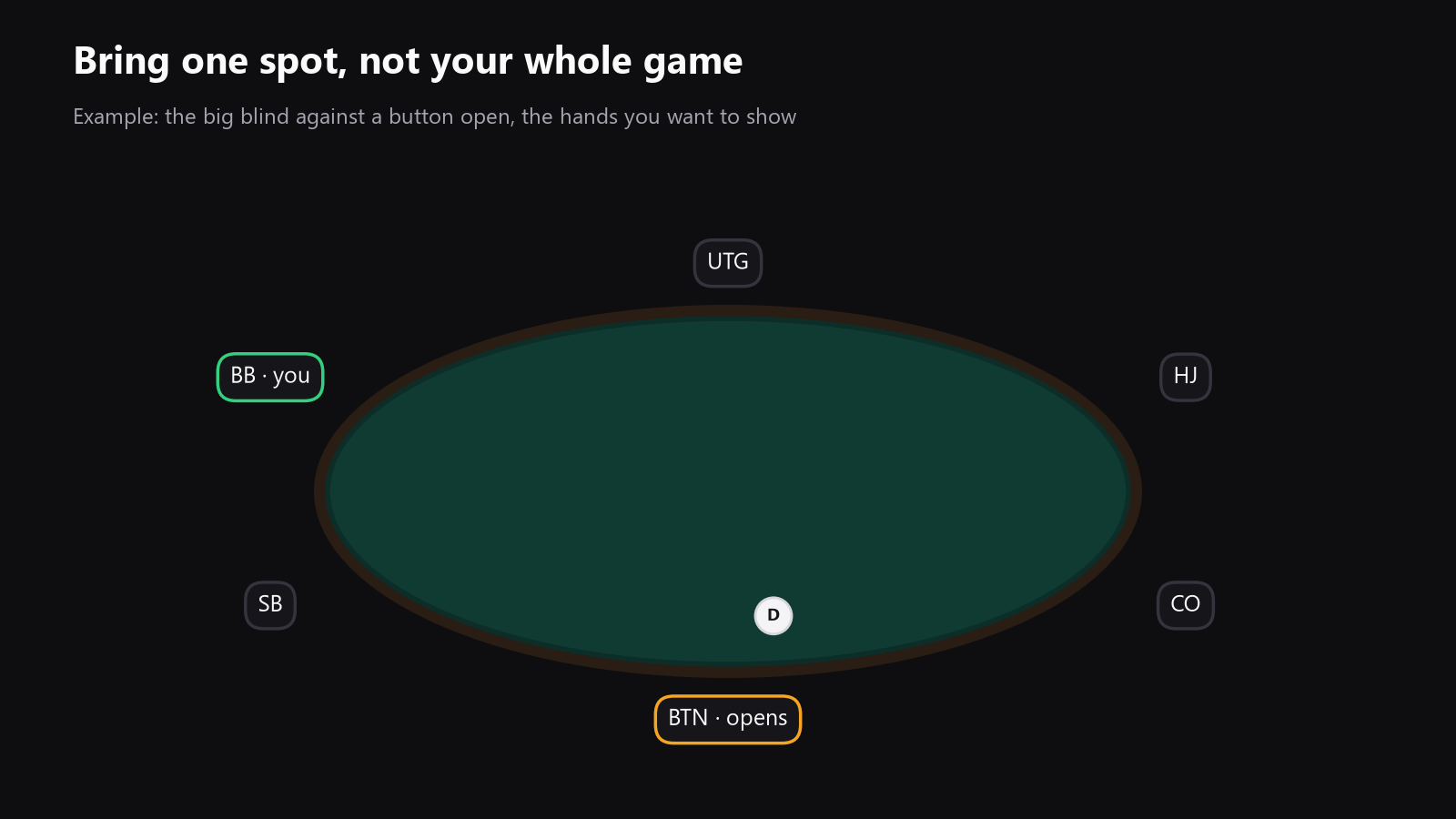
That last point matters. If you only say, "I feel like I am losing too much," a coach has to start from zero. If you can say, "My redline is fine, but I lose too much from the big blind," or "I keep getting stuck in river pots in single raised pots," the hour can go straight to the leak.
A coach is especially valuable when:
- you are stuck at the same stake and do not know why
- you have one obvious leak that keeps coming back
- you need structure, not just theory
- you want to move from random study to a plan
- you play a format with specific pressure points, such as MTTs, spins, or short-stack spots
A simple way to think about it:
- if you do not know what your biggest leak is, coaching can help
- if you know the leak but cannot fix it alone, coaching can help more
- if you already know the leak and you are not acting on it, a coach will not solve that for you
A good coach accelerates the process. They do not replace it.
When you should wait
Do not rush into coaching if you still have basic gaps that you can fix yourself first.
You may be better off studying alone for now if:
- you do not track your results
- you do not know your win rate with a margin of error
- you cannot say where your money goes
- you have not reviewed your own hands in a structured way
- your main issue is volume, discipline, or tilt
- you play too little for the sample to mean much
If you only have a few thousand hands, the result may still be mostly variance. Paying for coaching before you know what the numbers say can be expensive and unhelpful.
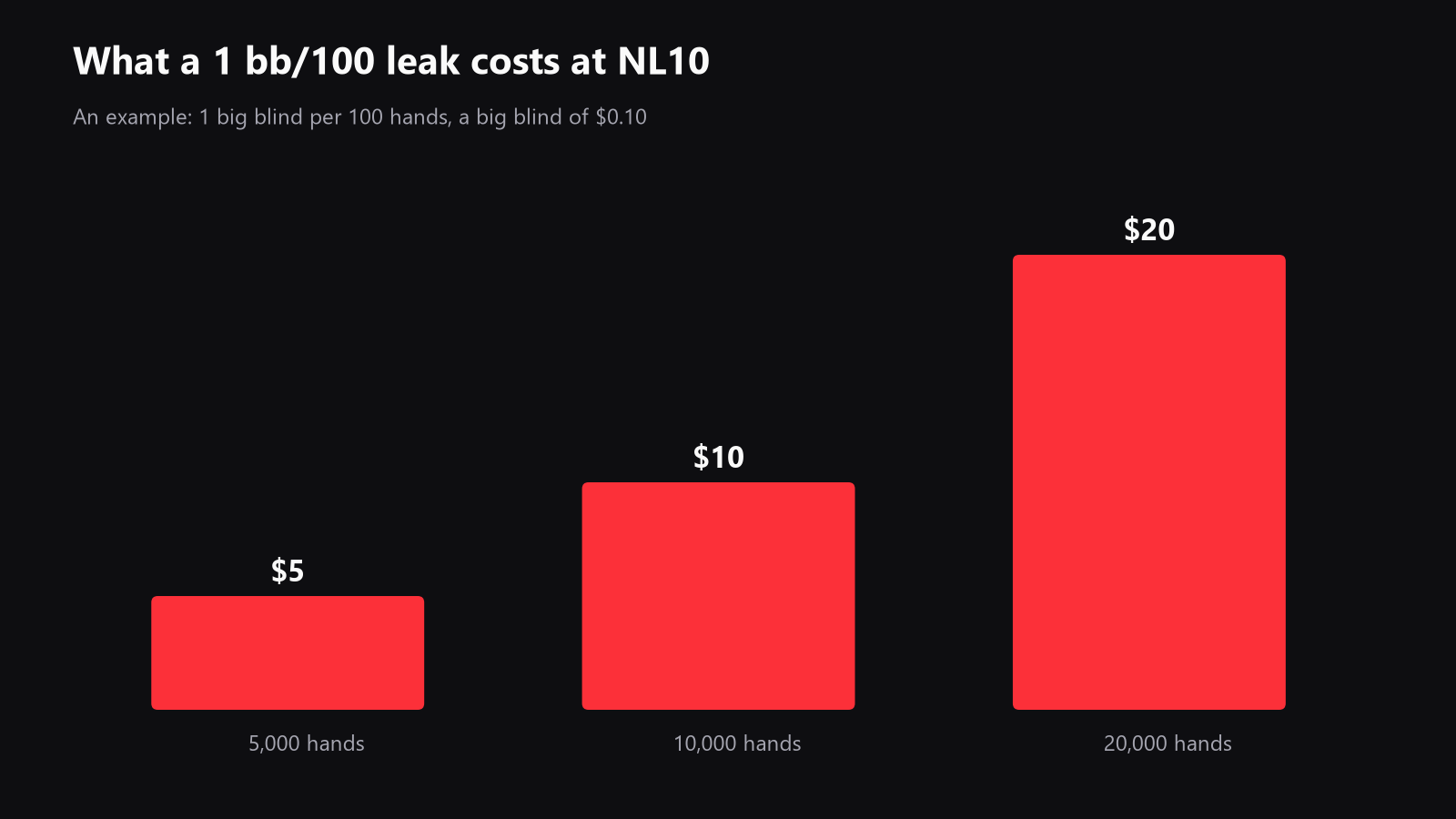
For example, imagine you play NL10 and leak 1 bb/100 over 20,000 hands. That is 200 big blinds, or $20. At that point, the question is not "Can coaching help?" It is "Is this the right problem to solve first, and do I have enough data to prove it?"
If your sample is still too small, the first step is not a coach. It is a better review system.
What kind of poker coach do you need?
Not all coaching is the same. Before you pay, make sure the format matches the job.
1. Hand review coaching
Best for: players with real hands to study, a clear leak, or repeated mistakes.
This is the most practical form of coaching for many players. You bring hands, the coach walks through the decision tree, and you leave with corrections you can actually use.
Ask whether the coach wants:
- hands from your recent sessions
- a range of spots, or just the biggest leaks
- your database stats
- your thought process on each hand
2. Database review coaching
Best for: players who have volume and need pattern recognition.
This format is ideal if your problem is not one bad hand, but a trend across many hands. Maybe you defend too little from the big blind. Maybe you overfold rivers. Maybe you c-bet too often in spots where the pool does not fold enough.
3. Theory coaching
Best for: players who already know where they are losing, but need a stronger framework.
This can be useful, but only if it connects back to your own play. Pure theory with no connection to your pool can become expensive reading.
4. Live sweat or session coaching
Best for: players who tilt or lose structure during a session, and want a coach to watch them play and go over their decisions right after.
This is useful when your technical game is not the only problem. Sometimes the issue is how you manage your energy, your pace, or your table selection.
5. Group coaching
Best for: players on a budget, or players who want a broader overview.
Group sessions can be efficient, but they are less precise. If your leak is personal and specific, a one-on-one review is usually better.
How to choose a poker coach
You do not need to name the "best" coach. You need the right one for your game.
Here is what to check before you pay:
Ask about format
A coach who is strong in cash games is not automatically the right fit for tournaments. A strong MTT coach may not be the best choice for Spins. A solver-heavy approach is not always the best answer for a low stakes pool where population mistakes are large.
Ask:
- What format do you coach most?
- What stakes do you understand best?
- Do you coach players at my exact format and pool?
Ask about method
You want to know how they think.
Ask:
- Do you work from hands, database stats, or both?
- Do you use solver work, exploit work, or a mix?
- How do you decide what matters first?
- How do you measure improvement?
A good answer is specific. A weak answer sounds like general motivation.
Ask about output
A good session should leave you with:
- a clear leak
- a clear fix
- a way to test the fix
- homework you can do alone
If the output is only "play better" or "be less loose," that is not enough.
Be wary of these signs
Be careful if the coach:
- promises a win rate
- talks more about theory than your hands
- ignores sample size
- gives advice that does not fit your stakes
- never tells you what to work on between sessions
- focuses on flashy lines while your biggest leak is obvious and simple
A strong coach should make your game clearer, not more mysterious.
How to prepare a coaching session
The best coaching sessions are not improvised. You should arrive with a clear problem, not a bag of random hands.
Bring your numbers
At minimum, bring:
- your win rate
- your sample size
- your rake, if you can see it
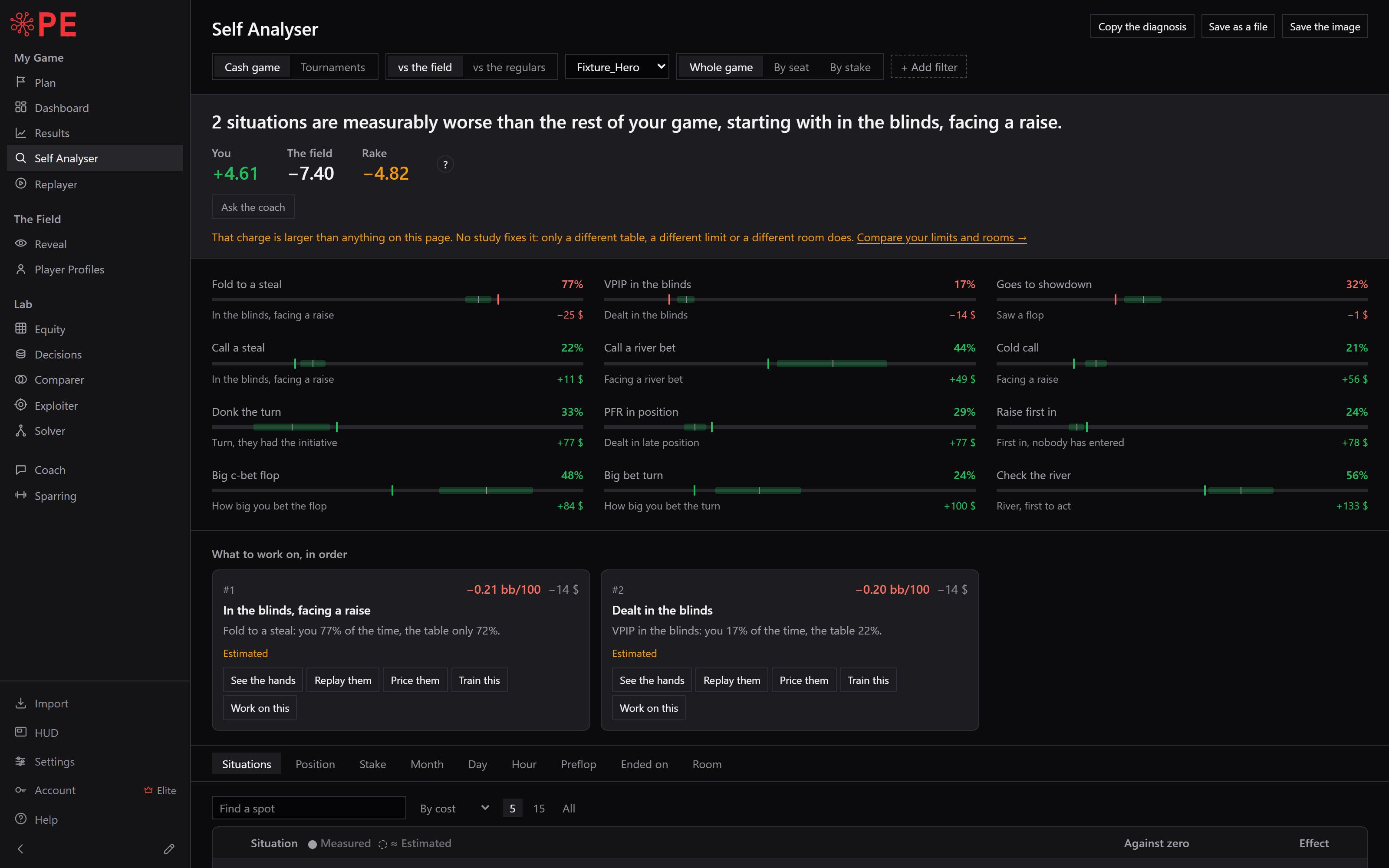
- the positions or spots where you lose the most
- any note about recent changes in your game
If you already use a tracker, bring the spots that cost you the most, not just the hands that felt dramatic.

Bring the right hands
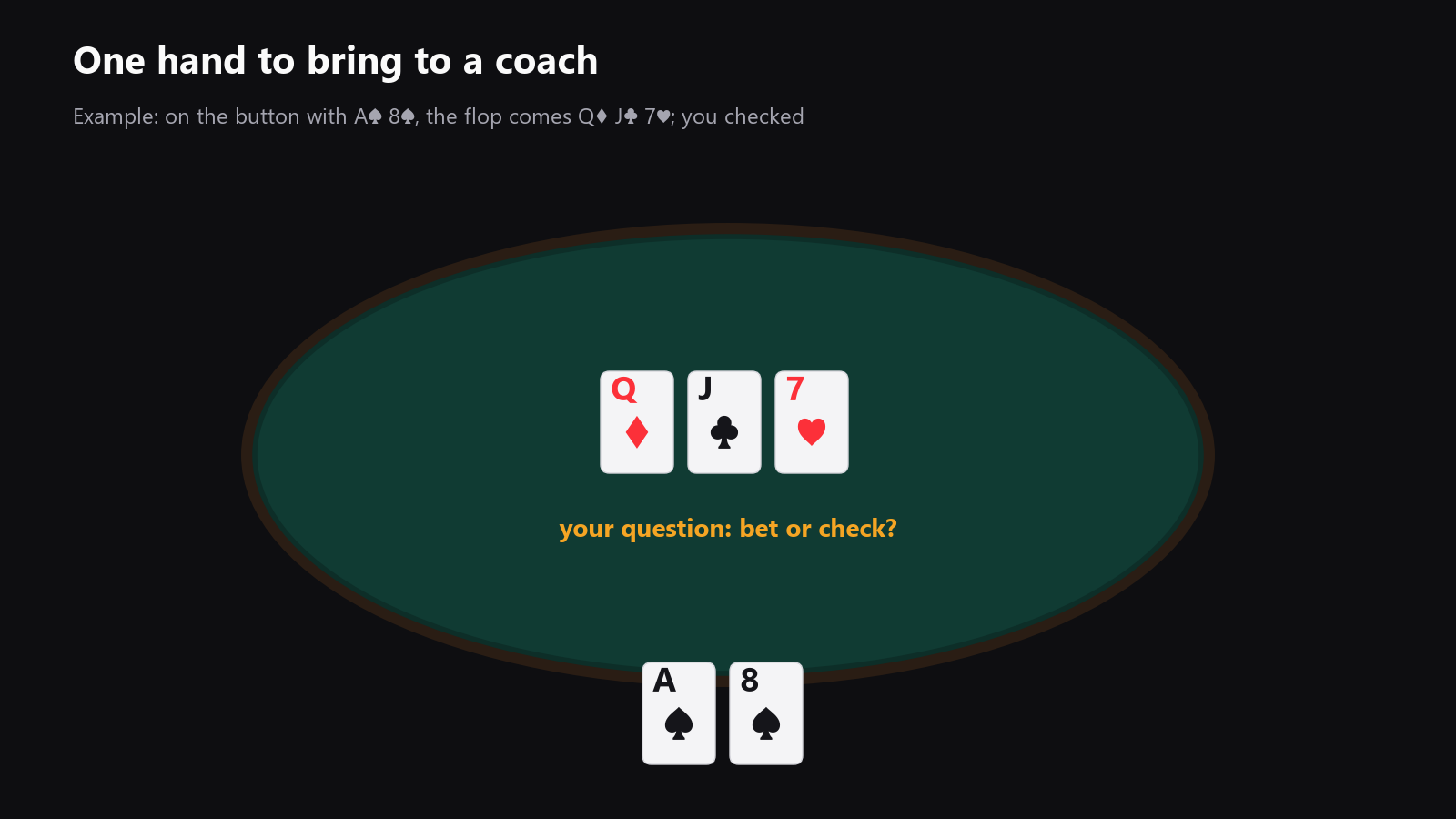
Do not cherry-pick only the most painful hand. Bring a mix:
- one or two obvious mistakes
- a few close decisions
- one or two hands from the same spot if the leak repeats
That helps the coach see whether the problem is structural or just a one-off.
Write down your thought process
For each hand, include:
- what you thought villain had
- what you expected to happen
- why you chose your line
- what you were afraid of
- what you want answered
That saves time and exposes where your logic breaks.
Prioritize by cost
If you can only review a few spots, start with the ones that cost you the most.
A coaching hour spent on a tiny river bluff can feel smart. An hour spent on a repeated preflop leak usually fixes something that costs you far more.
How to run the session well
A strong coaching session has a rhythm.
Start with the biggest problem first.
Then go from broad to specific:
- What is the leak?
- In which spots does it show up?
- What is the correct adjustment?
- How will you know it worked?
If you are playing online poker, your coach should spend time on:
- spot selection
- population tendencies
- your frequencies
- the size of the mistake
- the simplest fix that gives you the most return
You do not want ten small ideas. You want one or two corrections that you can actually execute.
What to do between sessions
This is where most of the value is won or lost.
If your next session starts from nothing, you will keep paying to rediscover the same leak.
Between sessions, do this:
1. Work on one change only
If you change three things at once, you will not know which one helped.
2. Revisit the same spot
Play, review, and tag hands from the same situation. That is how you build pattern recognition.
3. Measure before and after
You need a way to know whether the fix worked.
4. Keep a review notebook
Write down:
- the leak
- the correction
- the spots where you still fail
- the hands that confirm the fix
5. Check whether the problem moved
Sometimes you do not remove a leak. You only shift it somewhere else. For example, you may defend better preflop but then overplay your one-pair hands postflop. Review again after enough hands.
What you can do alone first
Before you pay for coaching, you can do a lot by yourself.
Start with the basics
- Track your results
- Compare your win rate to the margin around it
- Look at your rake
- Find the biggest losing spots
- Review the hands that create those losses
Rank your leaks
The first leak to fix is not the one that annoys you most. It is the one that costs you most.
Separate variance from skill
A bad month is not always a bad game. If your sample is small, do not overreact. If the sample is large and the leak repeats, that is a real problem.
Use your own hands, not generic advice
Poker is too detailed for one-size-fits-all study. Your pool, your stakes, and your leak matter more than a random chart.
A simple rule of thumb
If you can answer the question yourself from your own data, do that first.
If you cannot, or if you can but the leak keeps coming back, coaching becomes much more valuable.
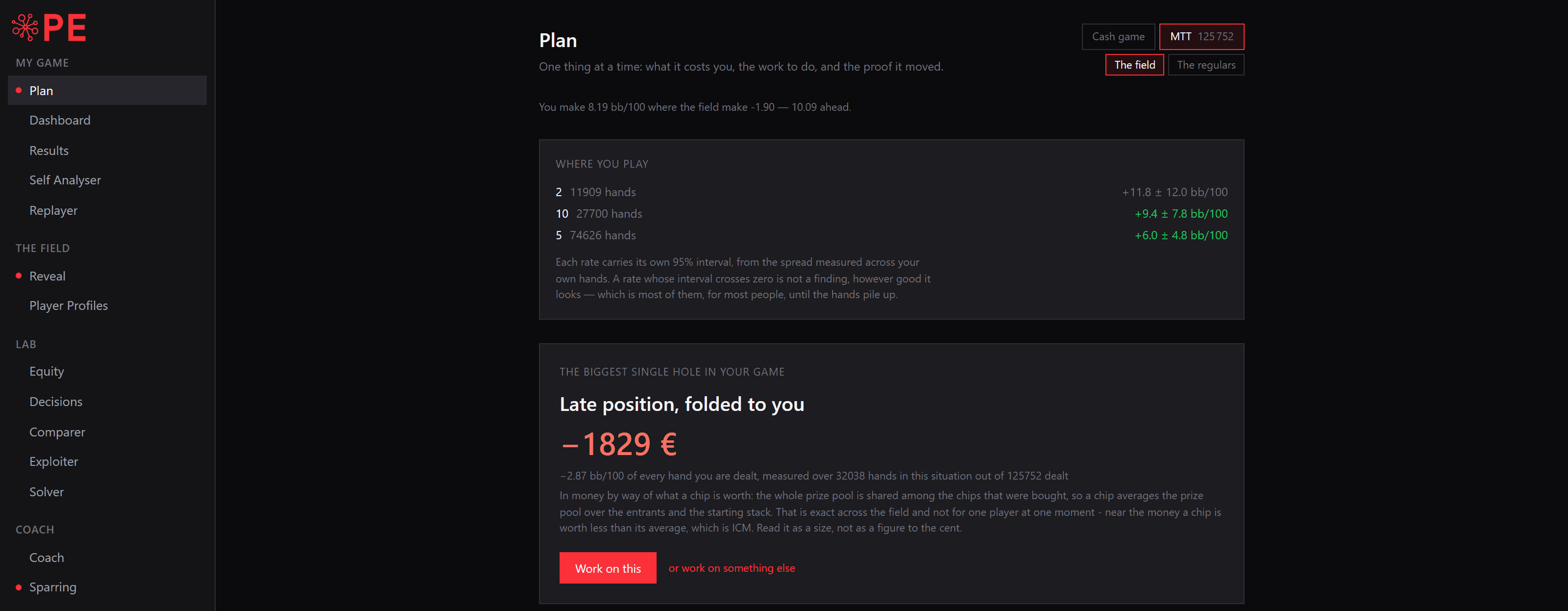
That is why we built the free parts of Poker Exploit around review work. The Results module shows your win rate with its margin and your rake beside it. The Self Analyser module puts the biggest leaks first. The Replayer module helps you collect the exact hands you want to discuss. The Plan module measures one change before and after, so you do not rely on impressions.
If you later book a human coach, that preparation makes the hour much more useful.
The short version
Pay for poker coaching when:
- the leak is real
- the sample is large enough
- the coach fits your format
- the session is tied to your own hands
- the work continues between sessions
Wait before paying when:
- you do not yet track your game
- your sample is too small
- your biggest problems are still obvious and self-correctable
- you do not have a way to measure progress
A good coach should help you spend less time guessing and more time fixing the spots that actually cost you money.
Do it on your own hands.