
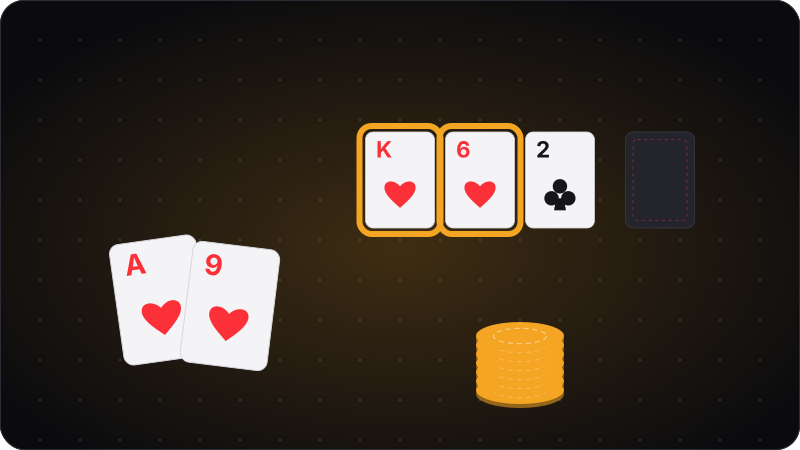
A semi-bluff is one of the most useful ideas in poker because it gives you two ways to win the same pot. You can win now when your opponent folds, or you can win later when your draw improves.
That is why draws matter so much. A flush draw is not only a hand that can hit. An open-ended straight draw is not only a hand that can make a straight. On the right board, these hands can also pressure better made hands and force folds.
If you learn one thing from this article, let it be this: do not ask only, “Do I have a draw?” Ask, “How much equity do I have, how much fold equity do I have, and is betting better than calling?”
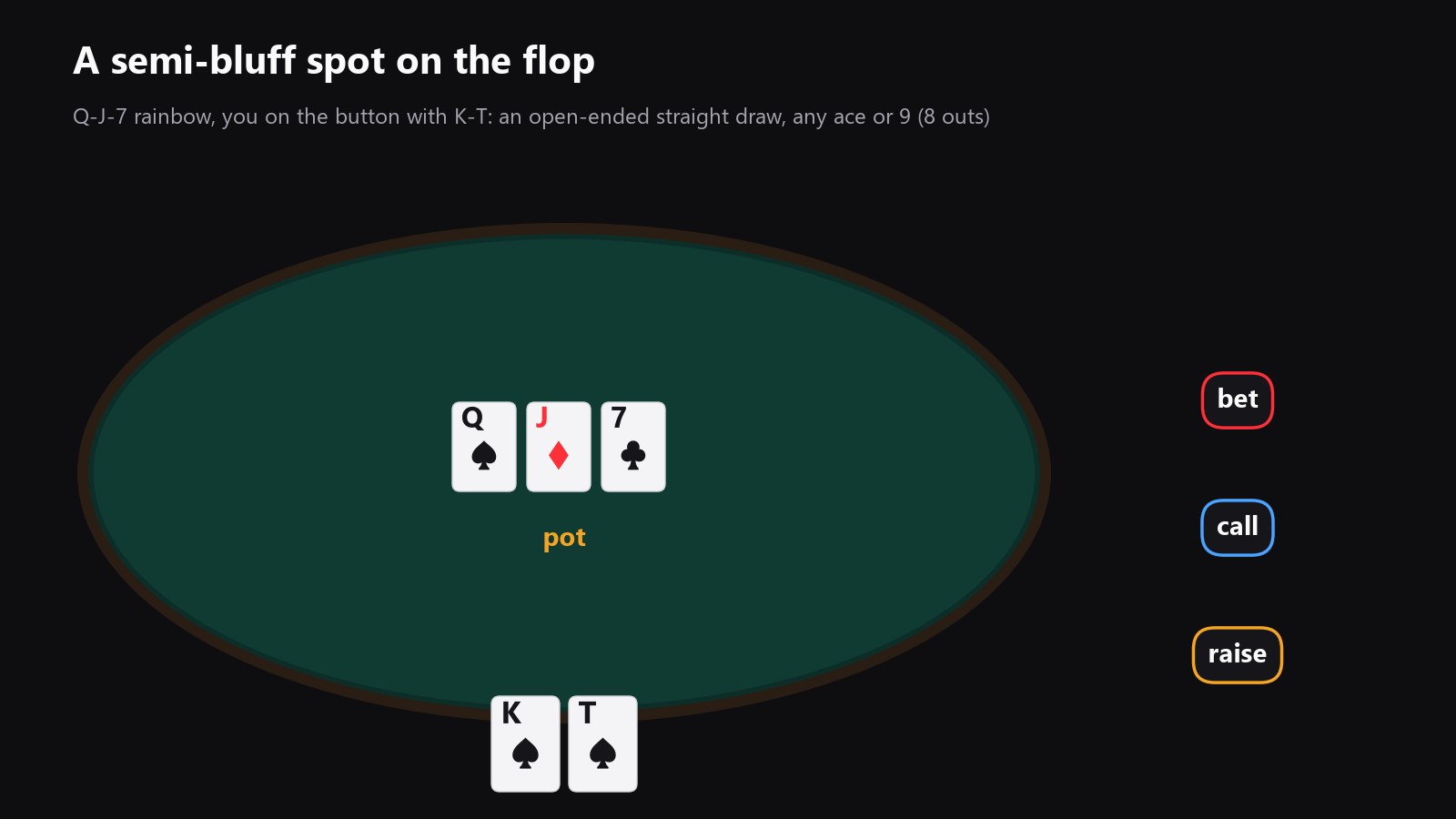
What a semi-bluff is
A pure bluff has little or no equity when called. A value bet is already ahead and wants worse hands to continue. A semi-bluff sits between the two.
You bet or raise with a hand that is not currently the best, but can improve. That improvement gives you equity when called, while the bet or raise gives you fold equity.
That is the core of semi-bluffing:
- you can win immediately if the other player folds, including better made hands
- you can still win later if you get called
- you often force the pot to grow when you have the best drawing hand in the hand
This is why semi-bluffs are stronger than random bluffs. You are not relying only on folds. You are also investing in your own improvement.
The main draws you semi-bluff with
Flush draws
A flush draw usually means you have four cards of the same suit and need one more. On the flop, that is often nine outs, if none of the outs are dirty.
Flush draws are powerful because:
- they usually have enough equity to continue against a bet
- they can improve to a strong made hand by the river
- they often benefit from aggression, especially heads-up
But not every flush draw is equal. A nut flush draw is much better than a non-nut flush draw, because when you make your hand, you are less likely to be second best.
Straight draws
An open-ended straight draw usually has eight outs. A gutshot usually has four outs.
Open-ended straight draws are more valuable than gutshots because they hit more often and often fit better as semi-bluffs. Gutshots can still be good semi-bluffs, but they need more help from fold equity, position, or extra backdoor equity.
Combo draws
A combo draw combines two or more drawing paths, like:
- flush draw plus straight draw
- flush draw plus overcards
- straight draw plus overcards
These hands are often the best semi-bluffs, because they have strong equity when called and strong pressure when you bet or raise.
Backdoor draws
A backdoor flush draw or backdoor straight draw is weaker by itself, but it can matter in the right spot. Backdoor equity is not usually enough to justify a big semi-bluff alone, but it can make a hand playable, especially in position or with the betting lead.
Outs, equity, and why they are not the same thing
An out is a card that can improve you, but not every out is clean.
A clean out is a card that likely gives you the winning hand. A dirty out improves you, but may still leave you behind or vulnerable.
Examples of dirty outs:
- a flush card when the board can pair and make a full house
- a straight card when it completes a board where an opponent can already have a higher straight
- an overcard that gives you top pair, but not a strong enough one in practice
That is why you should not count outs blindly. First count them, then ask whether they are clean.
The quick equity rules
For rough poker arithmetic:
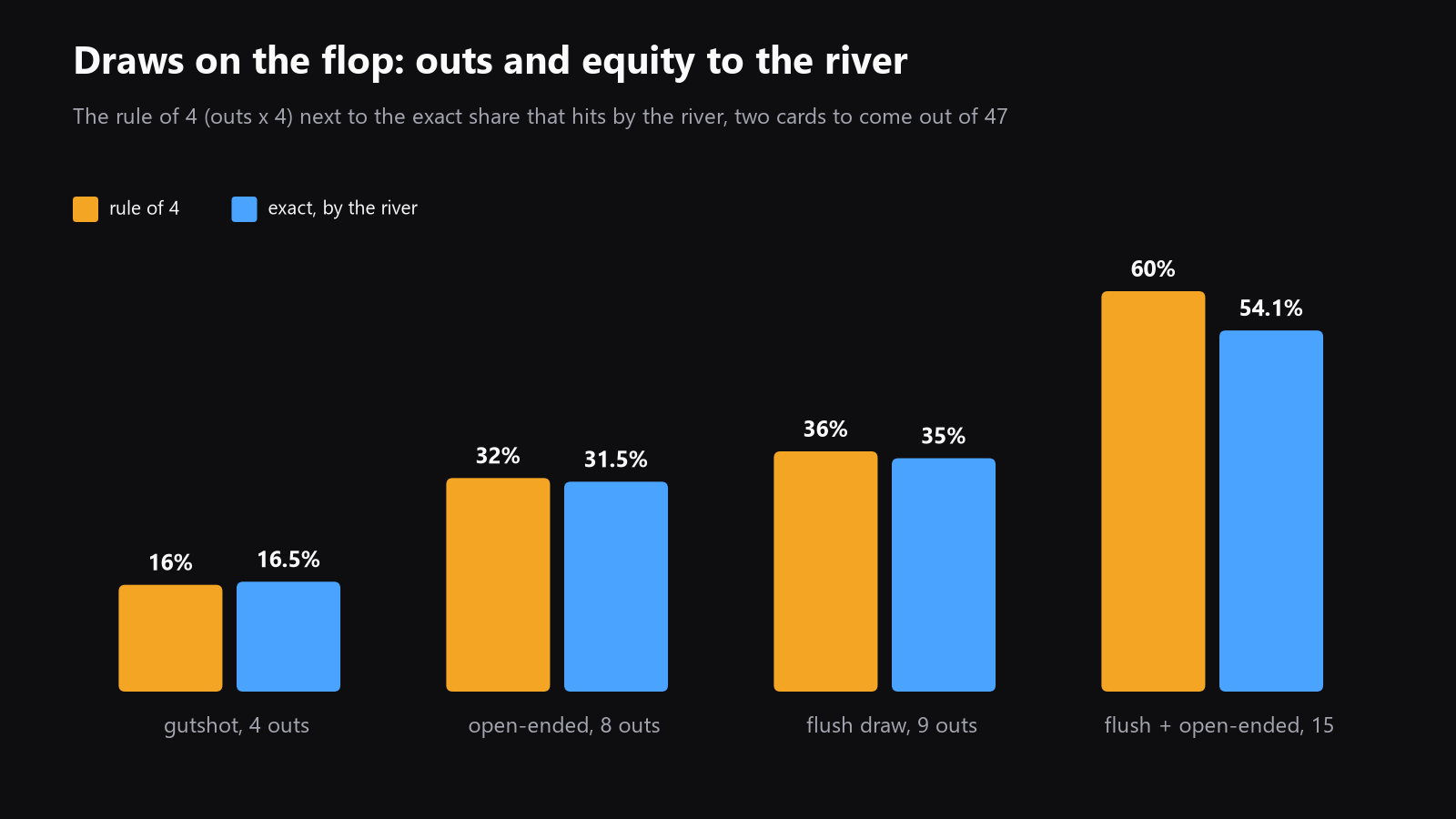
- on the flop, equity is often about outs times 4
- on the turn, equity is often about outs times 2
So:
- 8 outs on the flop is roughly 32% equity to improve by the river
- 9 outs on the flop is roughly 36%
- 4 outs on the flop is roughly 16%
These are approximations, not exact answers. They are useful because they are fast.
Pot odds
Pot odds tell you whether a call is worth it.
If the pot is $10 and your opponent bets $5:
- the pot is now $15
- you must call $5
- you are calling $5 to win $20 total after your call
That means you need about 25% equity to break even on the call, before considering implied odds and reverse implied odds.
So if you have an open-ended straight draw on the flop, a call is often fine against a half-pot bet. If you have only a gutshot, the call is much thinner unless you get extra value from position, future betting, or a very good price.
When to bet or raise a draw
A draw is often at its best when you can combine equity and fold equity.
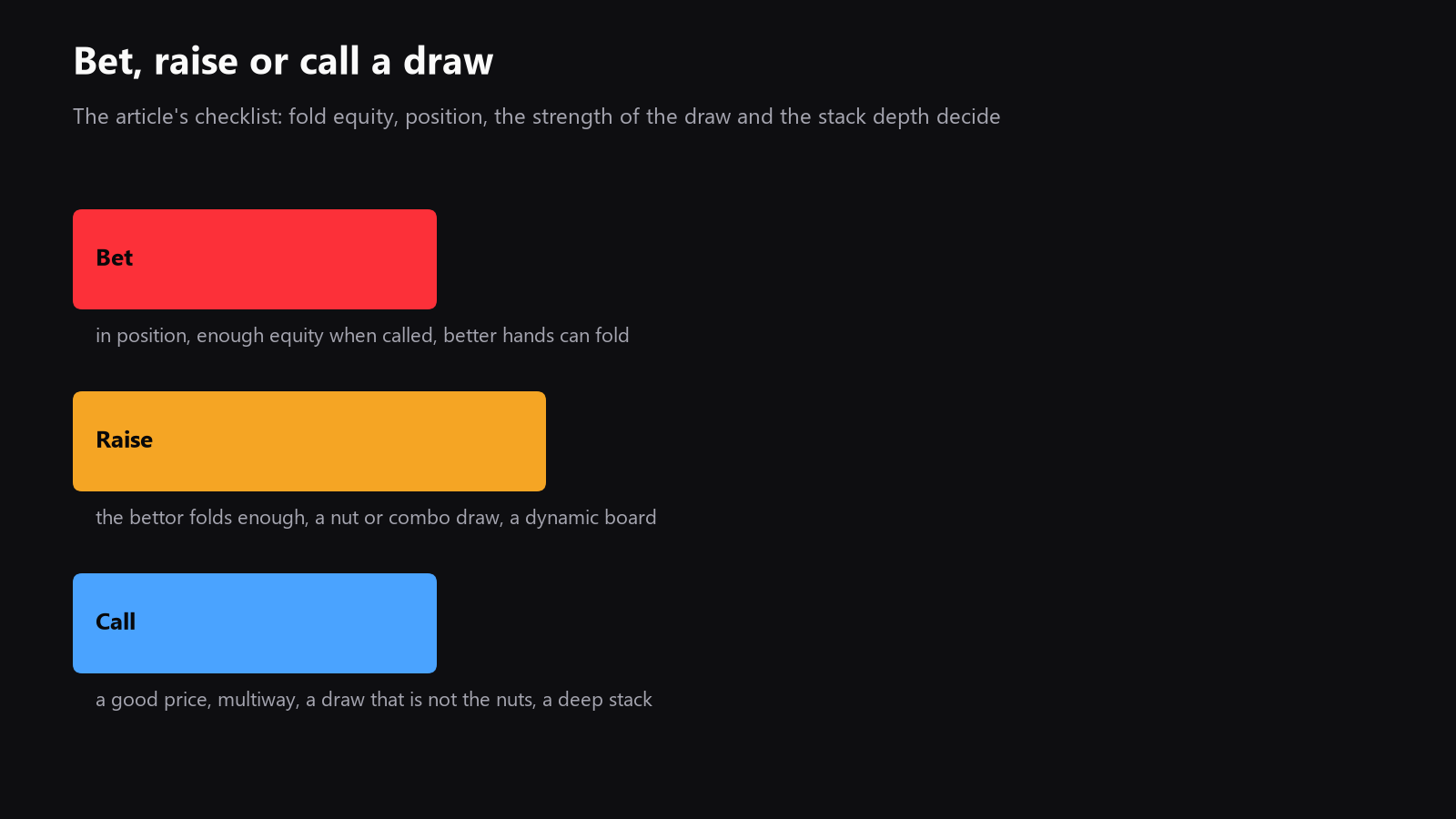
Bet your draw when:
- you have position and can pressure later streets
- the board hits your range well, or at least does not crush it
- you have enough equity when called
- your bet can make better hands fold
- you can continue barreling on many runouts
A bet with a draw does several jobs at once. It can:
- deny equity to overcards and random hands
- build the pot for when you improve
- create fold equity against one-pair hands and weak draws
Raise your draw when:
- the original bettor is likely to fold enough
- your draw is strong, especially a nut draw or combo draw
- the raise protects your equity and may win the pot right away
- the board is dynamic and future cards will change things fast
Raising is especially attractive with:
- nut flush draws
- open-ended straight draws
- combo draws
- strong draws with blockers to the nuts
On the other hand, raising weak draws into a caller who never folds is usually a leak. If nobody folds and your draw is not strong enough, you are just making the pot bigger with an inferior hand.
The real question: what happens when you get called?
A good semi-bluff is not only about folds. It is about what happens if you are called.
Ask yourself:
- Do I still have enough equity?
- Do I know what cards let me barrel again?
- Will my opponent be under pressure on turn or river?
- Am I building a pot that matches my hand strength?
If the answer is yes, the semi-bluff is probably healthy.
When calling a draw is better
Sometimes calling is better than betting or raising.
You should lean toward a call when:
- your pot odds are good
- the pot is multiway and a raise is likely to get action from stronger ranges
- your draw is not the nuts and you risk domination
- you want to keep worse hands in the pot
- the bettor is likely to keep firing, so you can realize equity without inflating the pot too early
Calling is often strongest when:
- you are in position
- you have a strong but not premium draw
- the stack depth does not justify a huge pot
- you expect to win more by realizing equity than by forcing folds
This is important: not every draw should become a big pot. Some draws want a controlled pot, especially when they are vulnerable to reverse implied odds.
A practical example
You face a half-pot bet on the flop with an open-ended straight draw.
- If the pot gives you the right price, calling can be best.
- If you also have a flush draw or overcards, raising may be better.
- If your draw is weak and the field is not folding, folding can even be best.
The board, the stack sizes, and the opponent all matter.
The biggest mistake players make with draws
The most common mistake is overvaluing the word “draw.”
A draw is not automatically a license to continue. You still need:
- enough equity
- enough fold equity
- the right price
- the right stack depth
- the right opponent
Here are the leaks I see most often:
- chasing weak draws without the right odds
- semi-bluffing into players who do not fold
- calling too much when raising would win the pot more often
- raising too much with draws that have little showdown value
- forgetting that some outs are dirty
- ignoring position, which is often the difference between a good and a bad draw
If you want a simple rule, use this:
- strong draw, good fold equity, good position, good stack depth, bet or raise more often
- weak draw, poor fold equity, bad position, bad price, call or fold more often
Combo draws deserve special respect
A combo draw is where your semi-bluff gets dangerous.
If you have, for example, a flush draw plus straight draw, you often have:
- strong equity when called
- multiple turn cards that improve your hand
- real pressure on made hands
- the option to continue on many runouts
These hands are usually the best candidates for aggression, especially in pots that are heads-up and not too deep.
Semi-bluffing in position versus out of position
Position changes everything.
In position
You can:
- control the size of the pot
- pressure later streets
- realize equity more efficiently
- choose whether to take the free card or put more money in
Out of position
You have less control, so you need to be more careful:
- your semi-bluffs need stronger equity or better fold equity
- your bets should have a clear plan
- check-calling is often more attractive with medium-strength draws
- check-raising is stronger when your draw has both equity and pressure
If you are out of position with a weak draw, do not force action just because you “have equity.” Your equity can be real, but your realization can still be poor.
A simple mental checklist for draw hands
Before you act, ask:
- How many clean outs do I really have?
- What is my rough equity?
- Do I have fold equity?
- Am I in position?
- Is my draw nutted or vulnerable?
- Will I know what to do on the turn?
If you cannot answer these quickly, the spot is probably not automatic.
How to study semi-bluffs off the table
This is one of the best spots to review in your own hands, because draw decisions repeat often and the mistakes are measurable.
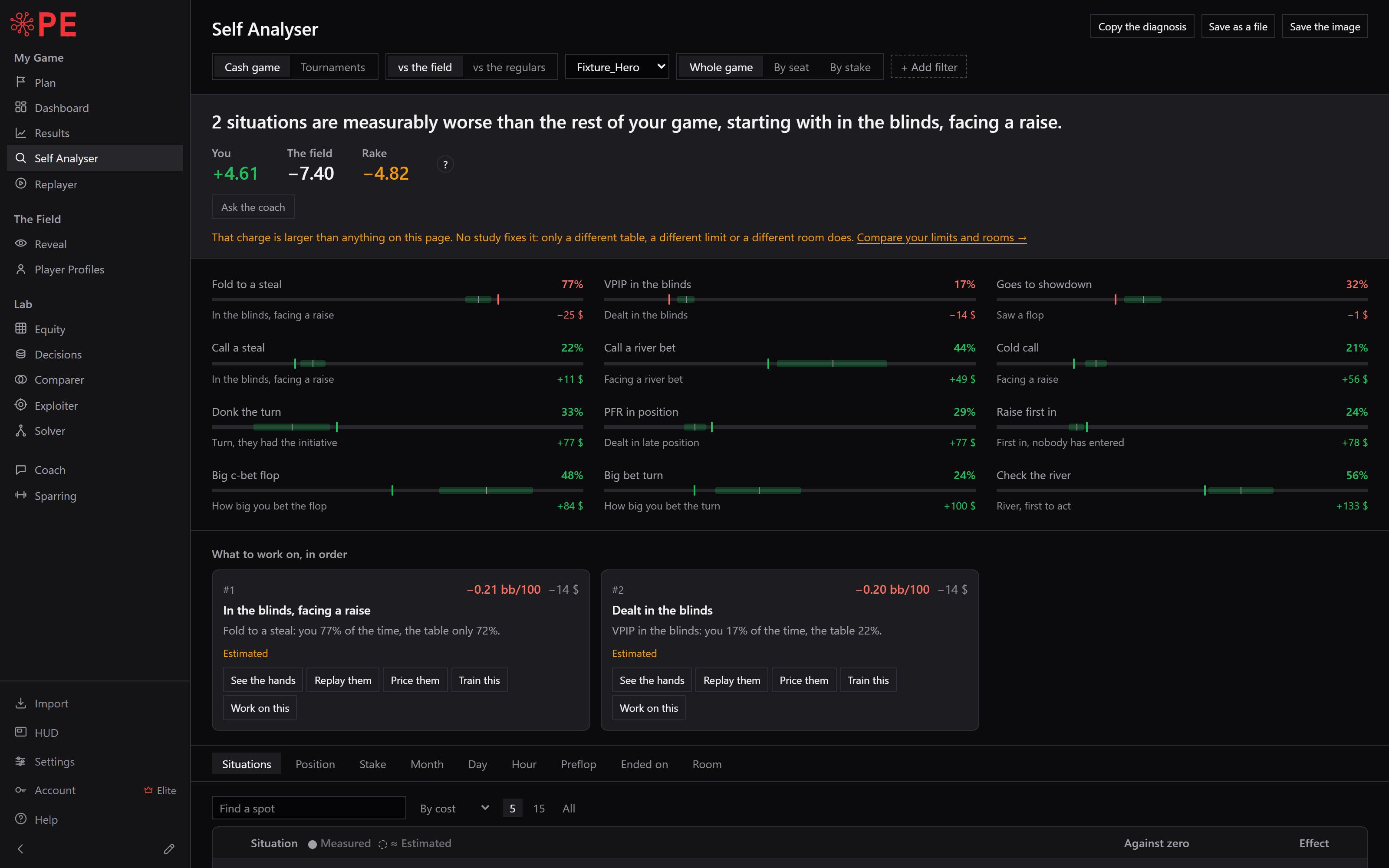
The Self Analyser module can show how your spots compare with the field and with the rest of your game, with gauges that make the leaks visible street by street. If you want to study a specific draw spot away from the table, the Solver module can compute it off-table, and it refuses during a session.
The short version
A semi-bluff is a bet or raise with a hand that can improve and can also make better hands fold now.
With draws, the right question is never just “Do I have equity?” It is:
- how much equity do I have
- how much fold equity do I have
- am I getting the right price
- will I realize my equity well
- does betting, raising, or calling make the most money
If you answer those questions well, your draws stop being guesses. You know when to bet, raise, call, or fold.
Do it on your own hands.