
If you play enough poker, you will run into two lines that often look strange at first glance.
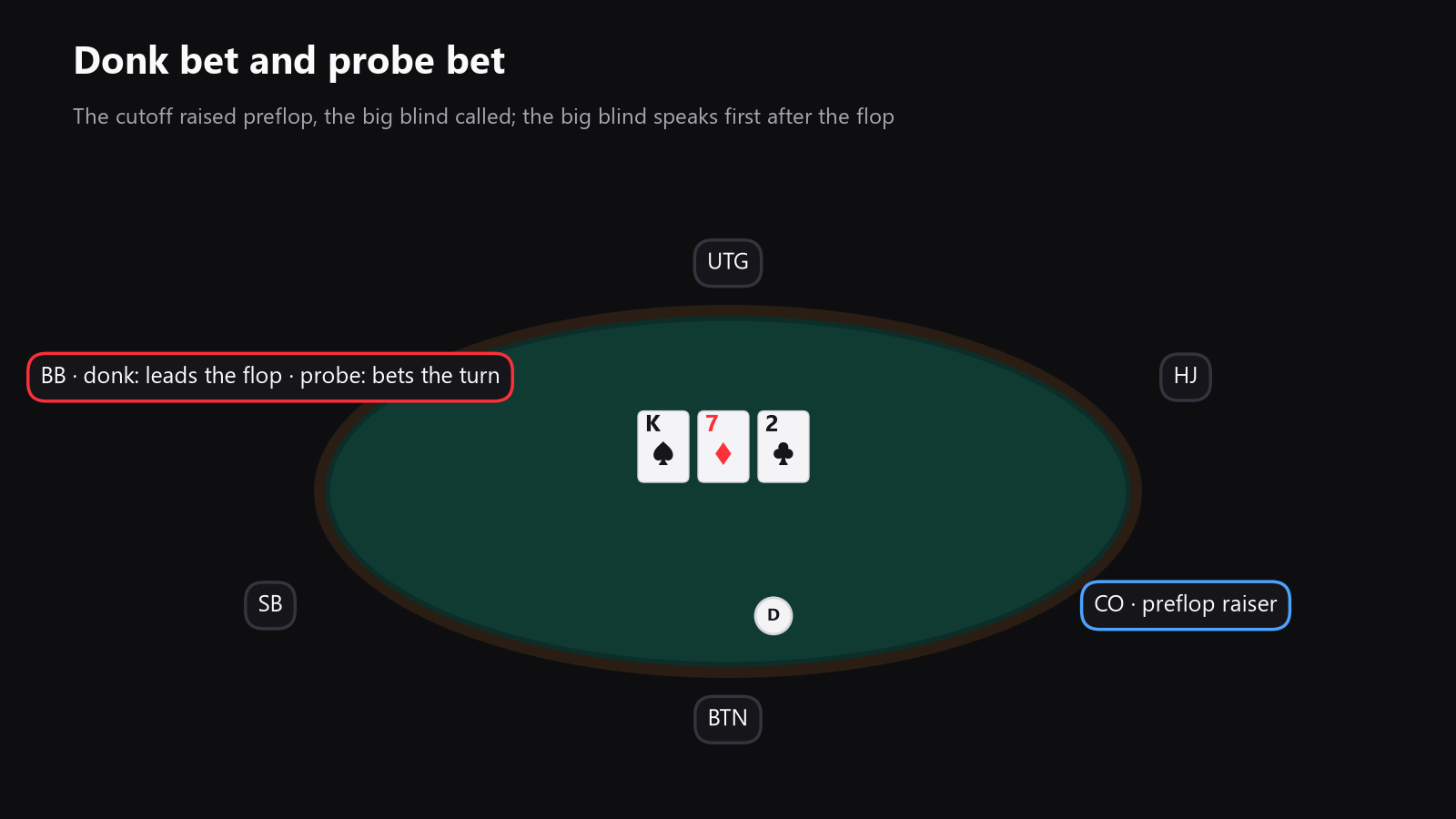
A donk bet is when the preflop caller leads into the preflop raiser on the flop.
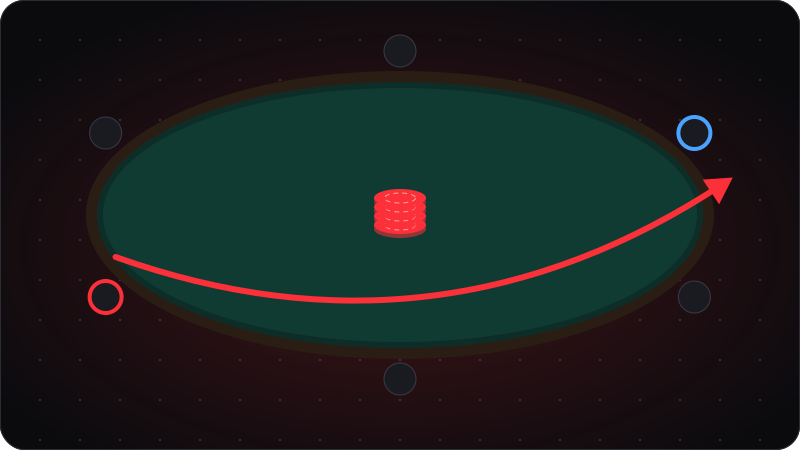
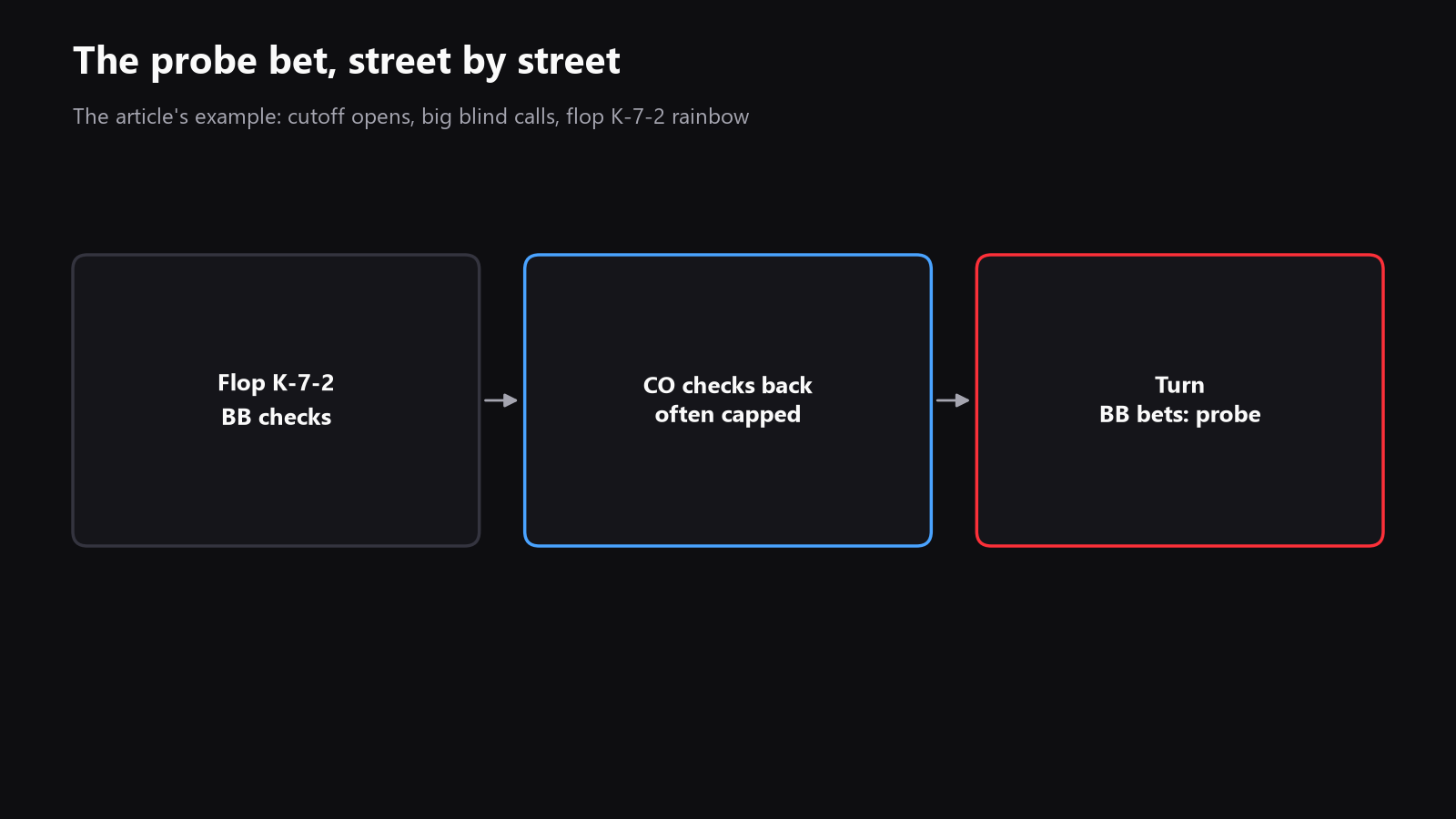
A probe bet is usually the turn lead from the out of position preflop caller after the flop has checked through. In other words, the caller checked on the flop, the raiser checked back, and then the caller bets the turn.
That distinction matters. A turn stab can happen in other ways, but when poker players say “probe bet,” they usually mean that specific line.
Both lines exist for a reason. Neither one is random. And if you understand what they mean, you can make more informed decisions, avoid some bad calls, and read your opponents much better.
Donk bet, in plain English
A donk bet is a lead from the out of position player after calling preflop.
Example: the button raises, the big blind calls, and on the flop the big blind bets first.
That line used to have a bad reputation because many players used it badly. But the idea itself is not bad. In the right spot, a donk bet can:
- deny equity to hands that can check back for free
- protect a range that has many medium strength hands
- charge draws on wet boards
- attack a range that is capped or likely to miss
The key question is not, “Is donk betting good or bad?”
The key question is, “What does this board do to both ranges?”
When a donk bet makes sense
A donk bet makes the most sense when the caller has a better share of the strong hands, or when the board is awkward for the preflop raiser to continue with a normal c-bet plan.
That often happens on:
- wet boards, where many draws and made hands are possible
- paired boards, where one pair and trips interact in strange ways
- multiway pots, where the preflop raiser loses some of the usual c-bet advantage
- boards where the caller has more two pair, sets, straights, or strong draws than the raiser
A simple example
Suppose the button opens and the big blind calls.
The flop is T 9 6 two-tone.
That board connects very well with the big blind's calling range. The big blind can have:
- two pair
- sets
- straights
- many strong draws
- pair plus draw hands that do not want to check and face a big bet
On this kind of texture, a small or medium donk bet can make sense as an exploitative line. It can build the pot with value, charge draws, and stop the preflop raiser from realizing equity too cheaply.
Now compare that with a board like A K 3 rainbow.
Here, the preflop raiser usually has more top pair strength, more strong kicker combinations, and more strong overpairs. A donk bet becomes much less natural.
What sizing often tells you
You should not treat sizing as a pure tell, but it helps.
A small donk bet often means one of three things:
- a merged value range
- a protection bet
- a cheap stab that wants folds without risking much
A bigger donk bet often leans more polarized. It can mean:
- strong value
- strong draws
- a player trying to make your decision uncomfortable
That is not a rule. It is a working assumption. Always compare the size to the board.
A practical read
When you face a donk bet, ask:
- Does this board favor the caller?
- Is this heads up or multiway?
- Does the size look merged or polarized?
- What hands worse than mine can value bet here?
- What worse hands can bluff here?
If you cannot answer those questions, you are guessing.
Probe bet, in plain English
A probe bet is usually a turn bet from the out of position preflop caller after the preflop raiser checked back the flop.
That is the most common meaning of the term.
So the line is not just “someone bets the turn.” It is more specific:
- preflop action creates a raiser and a caller
- the caller checks on the flop
- the raiser checks back
- the caller leads the turn
That sequence matters because the flop check-through changes the ranges.
Why a probe bet works
A probe bet can work for the same reasons a c-bet works. It puts pressure on a capped range.
When the preflop raiser checks the flop, they often keep some strong hands, but they also remove many hands that would have bet for value or protection. That means the turn can become a good spot to attack.
A probe bet is especially attractive when:
- the flop check-through looks weak
- the turn card is bad for the checked-back range
- the caller has good blockers or good equity
- the opponent checks back too often on the flop and gives up too much on the turn
A simple example
Suppose the cutoff opens, the big blind calls, and the flop comes K 7 2 rainbow.
Both players check.
The turn is 9.
If the cutoff often checks back medium strength hands on the flop, then the big blind may have a good probe spot on the turn. The big blind can attack a range that is often full of:
- underpairs
- ace-high hands
- some weak kings
- hands that wanted to see one card cheaply
That does not mean every 9 is a good probe card. But it shows the idea.
What turns are good for probing
Probe bets are strongest on turns that do one of these things:
- improve the caller’s range more than the raiser’s
- reduce the raiser’s ability to value bet thinly
- create new draws or new pressure points
- make the check-back range look capped
The best probe spots are not about one card alone. They are about the whole line.
Donk bet and probe bet are both range stories
If you remember only one thing from this article, remember this:
Both lines are range stories, not hand stories.
A donk bet does not mean “I have something.”
A probe bet does not mean “I am bluffing.”
Each one means, “This board, this line, and this opponent profile make a lead profitable.”
That is why the same line can be strong against one player and terrible against another.
How to read donk bets from opponents
If you want to exploit donk bets, do not start with the size. Start with the player pool.
1. Look at the board texture
A donk bet on a wet, connected board is usually much more believable than a donk bet on a dry board that favors the preflop raiser.
2. Look at the number of players
Multiway donk bets deserve more respect. Heads-up donk bets are often wider, but they can still be strong.
3. Look at the size
A small donk can be merged or protective.
A larger donk is often more polar, especially from weaker players.
4. Look at showdown hands
This matters more than any guess. If you see a player donk top pair on one board, bottom set on another, and a combo draw on a third, you start to learn their pattern.
5. Look for consistency
Do they donk only when they hit hard?
Do they donk draws and strong pairs?
Do they donk flops, turns, or both?
A pattern tells you much more than one hand.
How to read probe bets from opponents
Probe bets are easier to misread because they happen after a flop check-through. That makes them feel like sudden aggression. In reality, they are often a deliberate response to a capped range.
Ask these questions
- Did the flop check-through make sense for this player?
- Does the turn card improve the caller more than the raiser?
- Does this player give up too much after checking back the flop?
- Is this a player who probes thinly, or only with strong hands?
- Is this a player who understands blockers, or one who just tries something?
Watch the river too
Many players who probe the turn are telling a bigger story. Some are value heavy. Some are drawing. Some use the turn as a bluff and give up on the river.
If a player probes turn and fires river only when they improve, you are seeing a more value weighted line.
If a player probes turn and barrels the river on bad runouts, you may be facing a more aggressive bluffing profile.
How to defend against donk bets and probe bets
You do not defend them the same way.
Versus a donk bet
You need to ask:
- Does my hand realize equity well?
- Do I beat enough value bluffs?
- Is a raise better than a call?
- Is this size trying to buy the pot cheaply?
On very draw heavy boards, you will often continue wider.
On boards where the donk range is more value dense, you should fold more of your medium strength hands.
Versus a probe bet
You need to ask:
- Did the turn improve the caller’s range?
- Did the flop check-through cap the aggressor?
- Is this player overbluffing probes?
- Is this a good spot to raise?
A lot of probe bets are small and designed to take down the pot cheaply. That means you can often defend more sensibly by not overfolding. But if the player is underbluffing, your bluff catchers lose value fast.
A useful pot odds reminder
If a player bets one third pot, the bluff needs to work about 25 percent of the time to break even as a pure bluff.
If a player bets half pot, it needs to work about 33 percent of the time.
That does not solve the spot for you. It just tells you how much fold equity the line needs.
Common mistakes players make
Mistake 1: Donk betting because you hit one pair
One pair is not enough by itself.
You need to ask whether worse hands call and better hands fold. If not, your lead is usually too thin.
Mistake 2: Probe betting without a plan
A probe bet is not magic. If you bet the turn and do not know what you do versus a call or a raise, you are guessing.
Mistake 3: Overreacting to one showdown
One player showed you top pair on a donk?
That does not mean their whole range is top pair.
One player showed you a bluffing probe?
That does not mean they probe wide forever.
Mistake 4: Ignoring stack depth
Short stacks and deep stacks change everything. A donk bet or probe bet that is fine with 40 big blinds may be awful with 120.
A quick way to study these lines
If you want to get better fast, build a small notebook for yourself.
For every donk bet or probe bet you see, record:
- position
- stack depth
- pot type, heads up or multiway
- board texture
- sizing
- showdown hand, if any
After a while, the patterns become obvious.
And if you do not want to do that manually, use the tools you already have in your hand histories. The Reveal module shows what players at your limits actually do from your own database, by street and by spot, and the Self Analyser module shows whether you are the one overusing a line yourself.

What this means for your own game
If you are the one donking too often, ask whether you are leading because the board really suits you, or because checking feels uncomfortable.
If you are the one probing too often, ask whether you are attacking weakness, or just clicking buttons after a flop check-through.
Good poker comes from line selection with purpose.
Bad poker comes from repeating a move because you once saw it work.
If you want a second opinion on a specific spot, the Solver module can study it away from the table and show you a strategy grid for that situation.

Bottom line
A donk bet is a lead into the preflop raiser after calling preflop.
A probe bet is usually a turn lead by the out of position caller after a flop check-through.
Both can be very strong when they match the board, the ranges, and the opponent.
If you want to exploit them, do not look only at the line itself. Look at the texture, the size, the number of players, and the player behind the bet.
That is how you stop treating donk bets and probe bets as weird exceptions, and start reading them as information.
Do it on your own hands.