

A satellite is not a normal tournament with a funny payout structure. It is a different game.
In a regular MTT, chips are a path to money, and more chips usually mean more expected value. In a satellite, when every remaining seat wins the same ticket, chips are only useful because they help you survive. Once you are likely to win a seat, extra chips stop being worth much. Once you are in danger of busting, every chip you risk matters a lot.
That single idea changes everything near the end.
What a satellite really pays
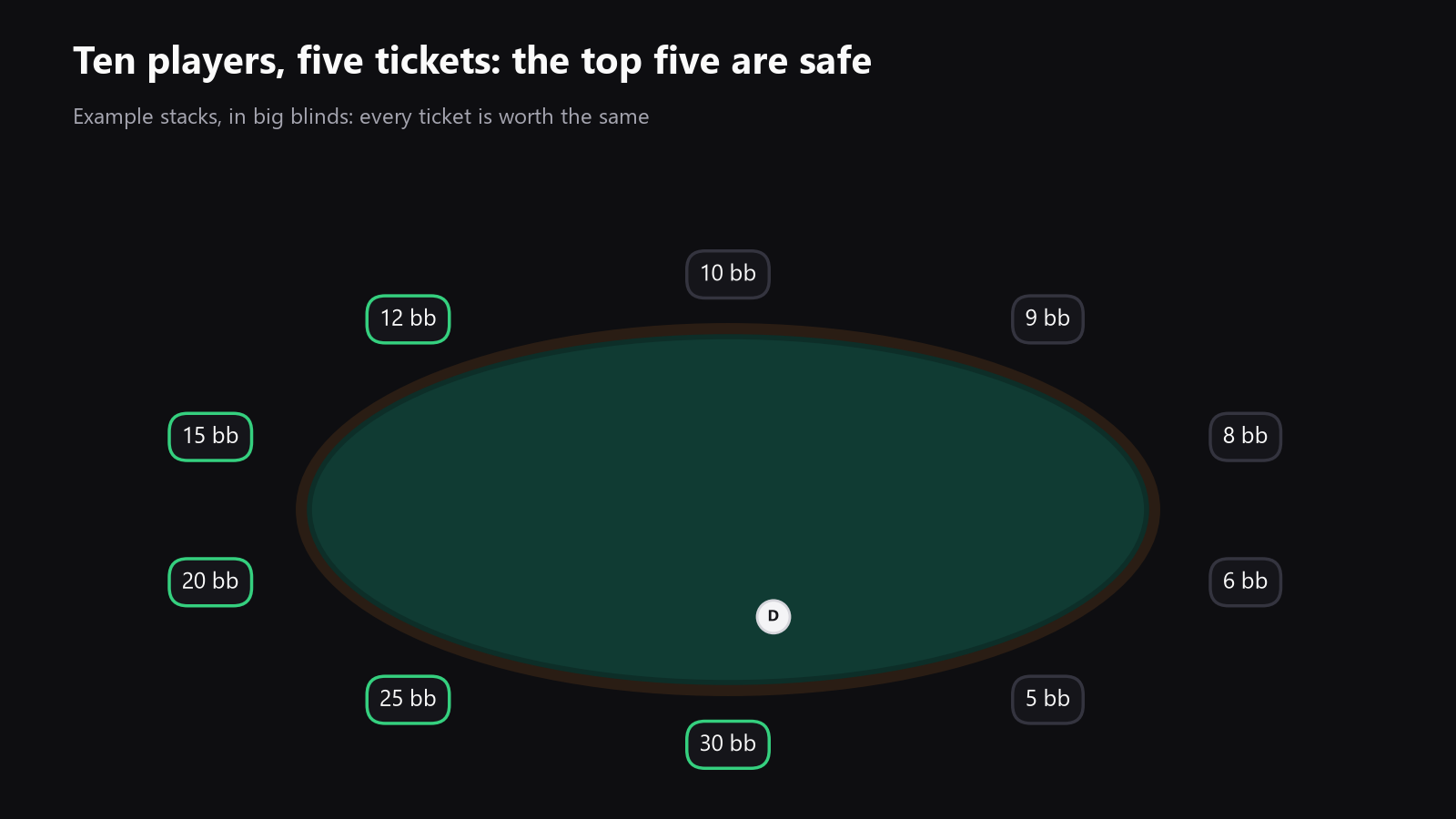
If there are 10 players left and 5 tickets, the question is not, "How do I finish first?" It is, "How do I finish in the top five?"
That is why satellite strategy is built around survival. Not passive survival, not endless folding, but survival first.
A chip you win is not worth the same as a chip in a normal prize pool. In a satellite, the value of a stack is curved by ICM, the idea that each stack has a chance to finish in each place, and that chance depends only on chips, not skill, position, or blinds. When all prizes are equal, the curve gets even harsher near the end. The last few chips you risk can cost you a ticket.
This is the key difference between chip EV and seat EV.
The satellite bubble is not a normal bubble
A normal tournament bubble has ladders. If you survive one bust, you may jump to a better payout, and sometimes that justifies a marginal call or a marginal risk.
A satellite bubble has no ladder. A seat is a seat. First place and last place in the money pay the same ticket. That changes the pressure completely.
Here is the practical difference:
| Situation | Normal MTT bubble | Satellite bubble |
|---|---|---|
| Prize shape | Bigger spots pay more | Every seat pays the same |
| Main goal | Maximize expected payout | Lock a seat |
| Big stack value | Still cares about final position | Mostly cares about survival and leverage |
| Short stack value | Can sometimes wait for pay jumps | Usually must act before the blinds kill it |
| Risk premium | Real, but tied to ladders | Often much bigger, because no ladder exists |
So in a satellite, the bubble is not about climbing a payout ladder. It is about not falling off the cliff.
Big stack satellite strategy: fold more than you think
If you are the big stack, your first instinct may be to bully everyone. That is partly right, but only partly.
A big stack in a satellite should pressure stacks that cannot fight back comfortably. You can open more, especially when shorter stacks need to avoid busting. But when the action gets serious, especially facing an all-in, you must call much tighter than you would in a normal tournament.
Why?
Because your stack already gives you a high chance to win a ticket. You do not need to win every pot. You only need to avoid donating a seat equity chunk to the table.
That is why the big stack often folds a lot in satellites. Not because the hand is always weak, but because the cost of being wrong is huge. Losing a big pot can turn a near lock into a danger stack.
So the big stack rules are:
- Raise hands that apply pressure and can continue if needed.
- Avoid calling off lightly.
- Let medium stacks make the first big mistake.
- Do not turn a comfortable ticket position into a coin flip unless the hand is clearly strong enough.
A good satellite chip leader is not the one who wins the most pots. It is the one who keeps the seat.
Short stack satellite strategy: you cannot wait forever
If you are short, the worst mistake is to wait for a fantasy hand and blind out.
A short stack in a satellite is in a race against time. Each orbit costs a larger share of the stack, and once you become too short, you lose fold equity. That means you can no longer make other players uncomfortable, and that is deadly in a seat race.
Short stack strategy is usually:
- look for first-in shove spots,
- avoid flat calls that trap you in bad ICM spots,
- prefer hands with real fold equity,
- take the spot when it is clearly better than waiting.
The short stack should not become desperate in the sense of gambling wildly. The short stack should become decisive. There is a difference.
If you are 5 bb, you need spots where shoving wins the pot often enough, or where getting called still leaves you with reasonable equity. If you just fold and hope, the blinds will finish the job.
Medium stacks are often the ones in the most danger
This is one of the most important satellite ideas, and many players miss it.
The medium stack is often the worst stack to have.
Why? Because the medium stack is not safe enough to coast, but not short enough to be forced into action. It is caught between the big stack that can pressure, and the short stack that must gamble.
If you are medium, your job is usually to avoid thin stack-off spots. You do not want to be the one who calls off with a hand that looks fine in chips but poor in ticket equity.
Medium stacks should pay close attention to who is behind them, who is ahead of them, and how many players must bust before the seats are locked.
In many satellites, the medium stack should care less about building and more about not becoming the next player everyone targets.
A concrete ICM example
Computed with Poker Exploit, here is a simple example.
Ten players remain. Five equal tickets are left. Stacks are:
30, 25, 20, 15, 12, 10, 9, 8, 6, and 5 bb.
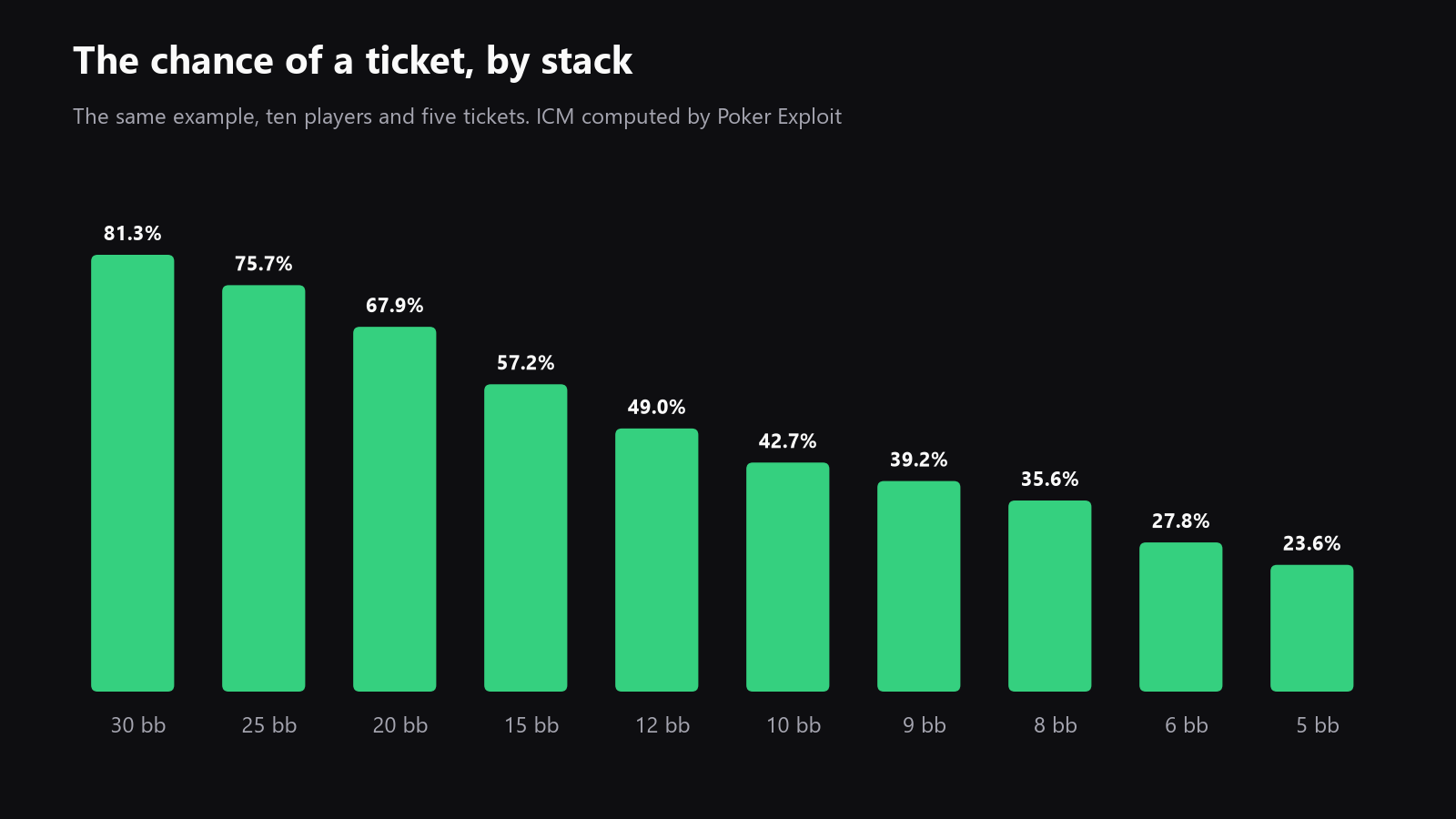
The ICM chance of winning a ticket is:
- 30 bb: 81.3%
- 25 bb: 75.7%
- 20 bb: 67.9%
- 15 bb: 57.2%
- 12 bb: 49.0%
- 10 bb: 42.7%
- 9 bb: 39.2%
- 8 bb: 35.6%
- 6 bb: 27.8%
- 5 bb: 23.6%
That table tells the whole story.
The chip lead is not just "a bit better". It is much safer. The shortest stack is not just "a bit behind". It is in real danger.
Now look at calling equity for an all-in, using the same ICM model, with 50 percent in chips and blinds left aside:
- 30 bb calling the 15 bb stack: 65.9%
- 30 bb calling the 5 bb stack: 54.5%
- 15 bb calling the 5 bb stack: 54.7%
- 5 bb calling the 30 bb stack: 57.1%
Two things stand out.
First, the required equity is not symmetric. A big stack calling a short stack is not the same as a short stack calling a big stack. Here, the 30 bb stack calls the 5 bb stack wider than the 5 bb stack can call the 30 bb stack.
Second, the medium stack carries a calling premium too: the 15 bb stack needs 54.7% to call the 5 bb stack.
That feels strange if you think only in chips. It makes perfect sense in ICM.
How to think about every decision near the end
Before you enter a pot in a satellite, ask yourself three questions:
- If I bust here, what happens to my ticket chance?
- If I win, do the extra chips really matter?
- Can I get a better spot by waiting one orbit?
If the answer to the second question is "not much", then chip accumulation should not drive your decision.
This is why satellite strategy is often tighter than people expect. The goal is not to win the table. The goal is to finish in the ticket zone.
Common satellite mistakes
1. Playing it like a normal tournament
If you treat a flat-ticket satellite like a standard MTT, you will call too wide in some spots and punt too much ICM.
2. Overvaluing chip accumulation
A stack of 80 bb is not twice as good as 40 bb if the ticket is already almost locked. Extra chips beyond survival often have very little added value.
3. Waiting too long as a short stack
A short stack that refuses to take good spots usually dies without fighting.
4. Attaching too much pride to the chip lead
A chip leader is powerful, but only if he preserves that power. Calling off too light destroys the edge.
5. Forgetting who is actually under pressure
Sometimes the player with the most chips is not the one who should panic. Sometimes the medium stack is the one who cannot afford a mistake.
Satellite bubble vs normal bubble, in one sentence
In a normal bubble, you are trying to move up the payout ladder. In a satellite bubble, you are trying not to miss the one and only prize that matters.
That is why satellite play is often more rigid, more ICM heavy, and more about survival than aggression for its own sake.
Where to study this after the session
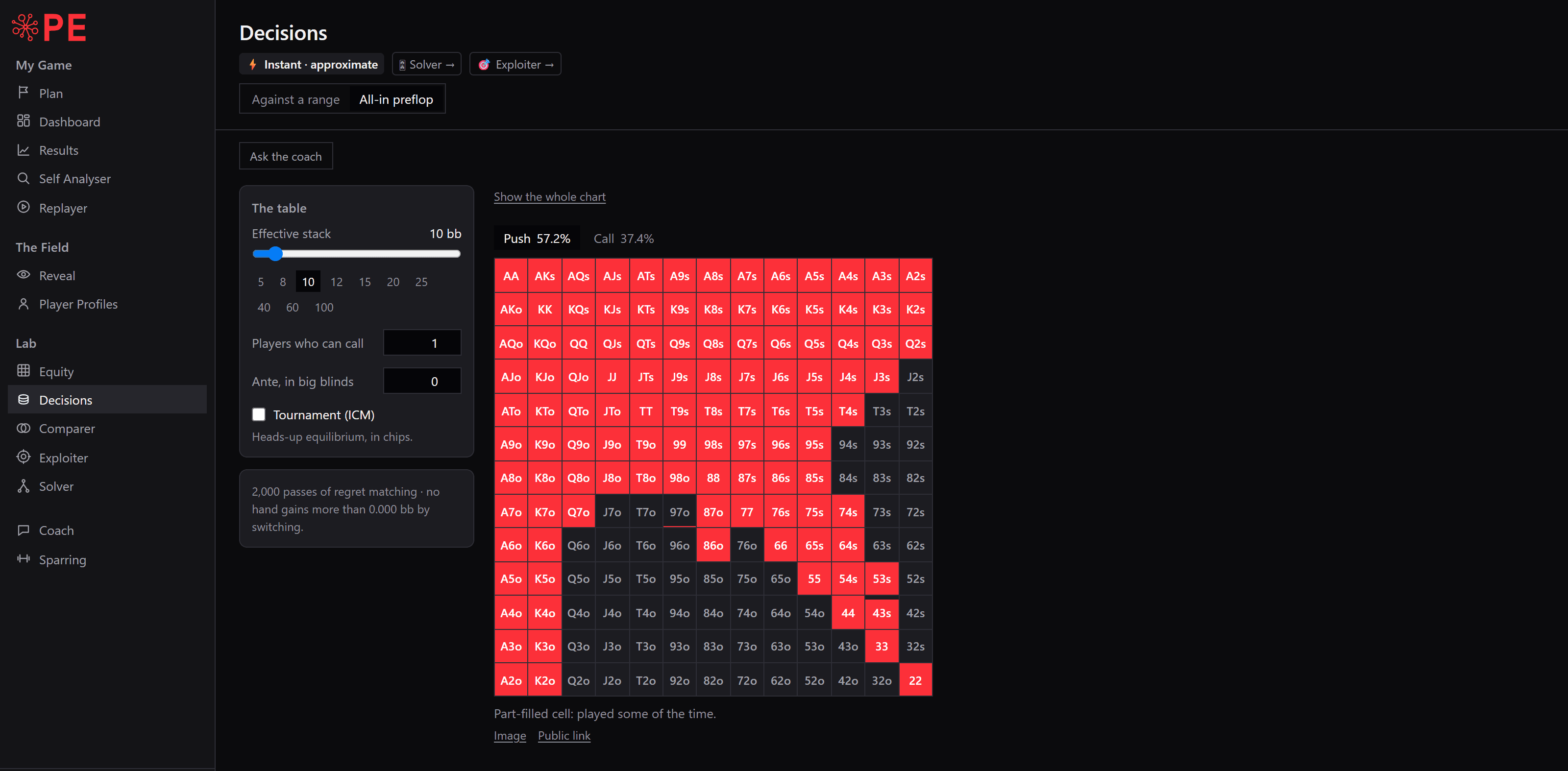
This is a spot you should review away from the table, not during play. If you want to study push fold choices for short stacks, the Decisions module gives you push, fold, and call answers. If you want to see how real opponents at your limits react in tournament spots, the Reveal module is built for that too, including bubble situations, final tables, PKOs, and Spins.
The important thing is to separate study from play. In a satellite, the decision is often simple once you understand ICM. The hard part is having the discipline to follow it.
The bottom line
Satellite strategy is not about winning more chips. It is about turning chips into seats.
That means:
- the big stack should pressure, but call much tighter,
- the short stack should act before the blinds force the issue,
- the medium stack should avoid thin gambles,
- and everyone should remember that in a flat-ticket payout, survival is the whole game.
If you understand that, you already understand the heart of satellite poker.
Do it on your own hands.