
Progressive knockout tournaments, usually called PKOs, are not just normal MTTs with an extra prize on top. The bounty changes the price of every call, the value of every shove, and the way stack sizes interact.
In a regular tournament, chips are usually the main currency of a hand, but not the only one. Near the bubble and the final table, ICM changes the picture. In a PKO, the bounty adds another layer on top of that, so you have to think about chips, prize pressure, and cash value at the same time.
If you understand one thing about PKOs, make it this: a bounty is not a bonus after the fact. It is part of the decision.
What a PKO actually is
In a progressive knockout, part of each buy-in goes to the prize pool, and part becomes a bounty on the player’s head.
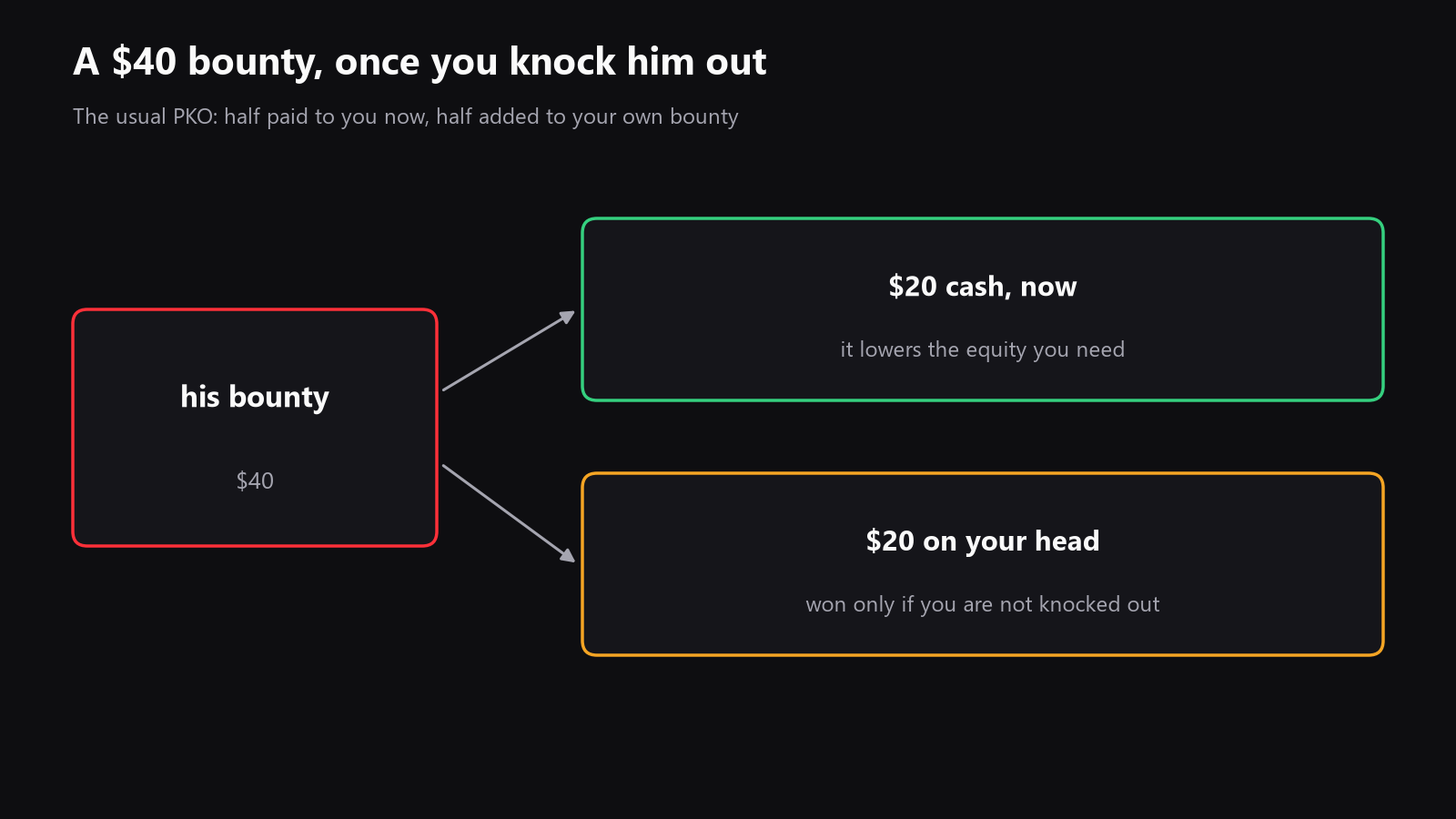
When you knock a player out, you do not take the whole bounty as cash. In the usual PKO structure, half is paid to you immediately, and the other half is added to your own bounty. That is why the bounty is called progressive: every bust-out makes you more expensive to play against.
So there are really two values attached to each KO:
- Immediate cash value, the part you win right now.
- Future bounty value, the part that gets added to your own head.
That second part matters because if you later get knocked out, someone else can collect it from you.
This is why a PKO cannot be played like a normal tournament with a little bonus on the side. The bounty is part of the hand.
Why bounty changes the price of a call
A normal call is based on pot odds and hand equity. A PKO call is the same, except the pot is bigger than it looks, because the knockout has a cash component.
Suppose you face a shove and you are considering a call. In a normal tournament, you compare your equity to the chips you must invest. In a PKO, you also add the cash value of the bounty you can win if you eliminate that player.
That means hands that are folds in a regular MTT can become calls in a PKO, especially when:
- you cover the opponent,
- the opponent has a meaningful bounty,
- your own tournament life is not under extreme pressure,
- and the stack behind you is not likely to trap you with a bigger reshove.
A simple way to think about it is this: the bounty is like extra money in the middle.
If the bounty on the player is worth $40 in total, and you know half is paid now and half is added to your own bounty, the knockout has real cash value immediately. That lowers the equity you need to continue.
Why bounty changes the value of a shove
The same logic works the other way around.
When you shove into players who cover you, your bounty makes your shove easier to call. That means your fold equity falls. If your opponent is getting paid to bust you, they will defend wider than they would in a normal tournament.
That creates two important effects:
- Your value shoves get more action, because weaker hands can justify a call.
- Your bluff shoves get worse, because people are less likely to fold bounty targets.
So in PKOs, the bounty does not simply make everyone loose. It changes who can pressure whom.
If you are the stack that covers others, you can attack more often. If you are the stack that is covered, your all-ins need to be cleaner.
Covering stacks: the key idea many players miss
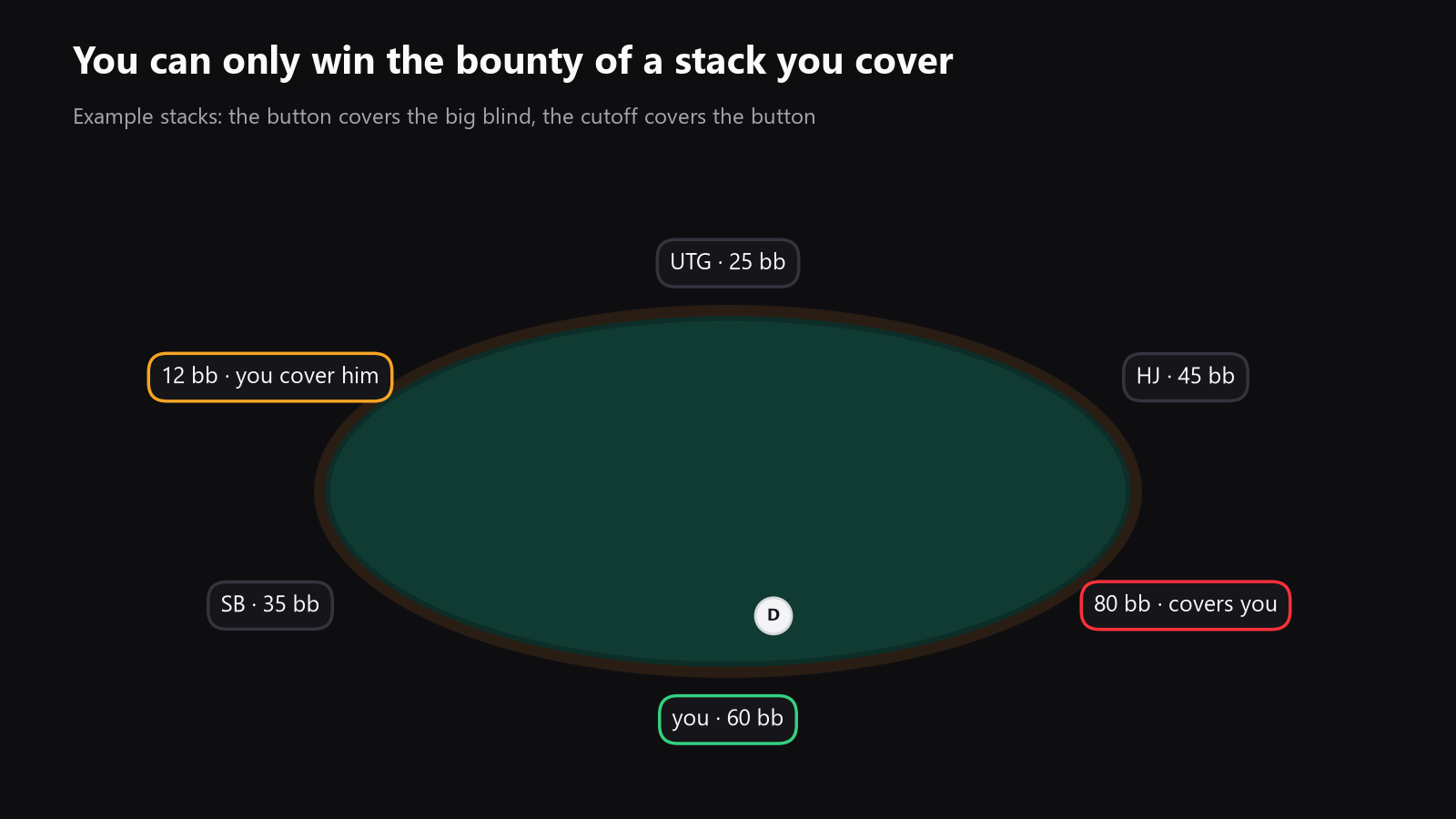
To “cover” a player means you have enough chips to eliminate them.
That matters more in PKOs than in normal tournaments.
Why? Because the player who covers gets paid if the shorter stack busts. The shorter stack does not get the same reward in return, unless they can bust the other player first, which they often cannot.
So coverage creates asymmetry:
- If you cover them, you can win both chips and bounty.
- If they cover you, your bounty becomes a target.
This is why stack order at the table matters so much. A medium stack can feel huge if it covers several shorter players with bounties. The same medium stack can feel fragile if there are bigger stacks sitting behind it.
A big PKO leak is to think only in absolute stack size. You also need to ask:
- Who covers whom?
- Who can eliminate whom?
- Whose bounty is actually live against whom?
That is the real structure of the hand.
Early stages: play closer to chip EV
Early in a PKO, stacks are usually deep and bounties are still relatively large compared with the total chips in play.
That means the bounty matters, but not enough to turn every spot upside down.
In the early stages:
- big pots still need strong hands,
- deep-stack postflop skill still matters,
- and a small bounty rarely justifies wild preflop mistakes.
A good rule is simple: if the bounty is tiny compared with the stack sizes, you should still play mostly like a normal MTT, while keeping the bounty in the background.
The biggest early-stage edge often comes from spotting who overvalues their stack and who under-defends against a short stack with a live bounty.
Middle stages: the bounty starts to bite
As the tournament moves forward, bounties grow and stack depths shrink.
This is where many players start to make expensive mistakes.
At this point, the bounty can become large enough that:
- short-stack shoves get called wider,
- isolation raises become more attractive,
- and marginal calls against covered stacks move from fold to call.
This is also where the “progressive” part of PKO starts to matter more. A player who has already collected a few bounties becomes dangerous, because now they are not just playing for chips. They are playing with a bigger bounty target on their own head.
In other words, success makes you more expensive.
That is why strong PKO players do not only hunt bounties. They also know when their own bounty has turned them into a target.
Late stages: bounty and ICM both matter
Near the bubble, at the final table, and especially when pay jumps are large, the game becomes more delicate.
Now you have two forces pulling in different directions:
- Bounty value, which rewards busting players.
- ICM pressure, which punishes losing chips, especially if you are in a spot where survival matters.
This is where many players go wrong. They see a bounty and call too light, even though busting is very costly because of ICM. Others do the opposite: they become so afraid of pay jumps that they pass on profitable bounty spots.
The correct answer depends on the stack setup.
When you cover
If you cover the shorter stack, the bounty can still make calls and reshoves profitable, because you are not risking elimination in the same way. You can use your coverage to attack.
When you are covered
If the bigger stack covers you, the bounty is a weapon against you. Your jam gets called wider, and your continuation ranges should tighten accordingly.
So at the end of a PKO, stack coverage and payout pressure must be considered together. Neither one alone is enough.
A practical example
Imagine a short stack moves all in and you cover them.
In a normal tournament, you would ask:
- What are my pot odds?
- What is my equity against their range?
- Is calling better than folding?
In a PKO, you ask the same thing, plus:
- What is their bounty worth?
- How often do I get the cash half right now?
- How much value does the future half create if I keep playing with a bigger bounty?
If the bounty is meaningful, a hand that was slightly too weak in a normal MTT can become a good call.
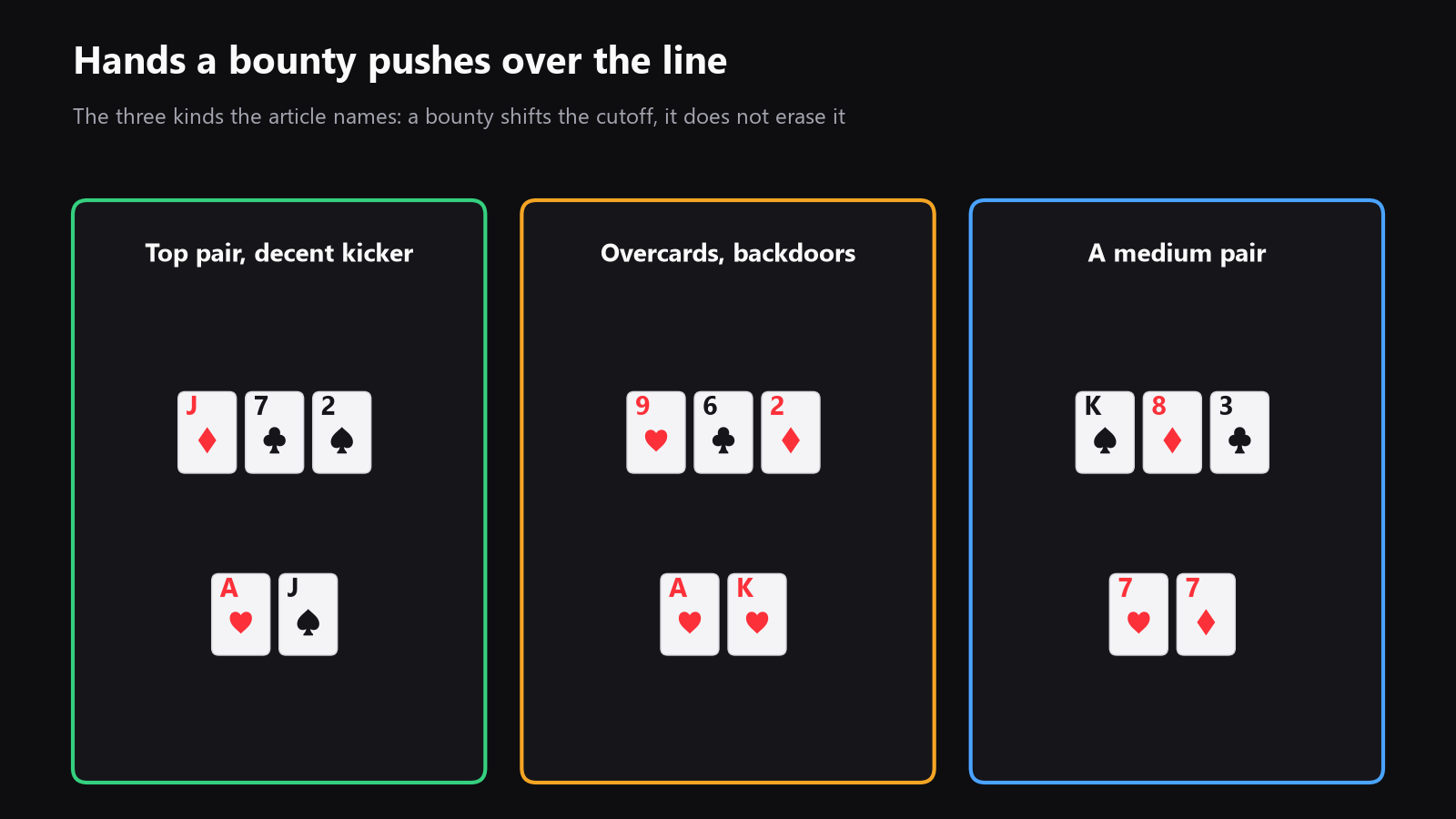
That is why hands like top pair with a reasonable kicker, overcards with backdoors, or medium pairs often gain value in PKO spots, especially against shorter stacks.
But do not overdo it. A bounty does not turn junk into gold. It shifts the cutoff, it does not erase it.
How PKO strategy changes by stack size
Deep stacks
When stacks are deep, the bounty is only one piece of the puzzle. Postflop play matters more, and the bounty mostly affects whether you are happy to put chips in preflop against a covered stack.
Medium stacks
This is the most dangerous zone. You are big enough to apply pressure, but not deep enough to recover from a bad bounty mistake. You need to think carefully about who you cover and who covers you.
Short stacks
Short stacks feel the bounty the most. A short-stack shove does not win the bounty of a player who covers them, so your own bounty can lower your fold equity and make wider calls against you. But if you are the short stack and your own bounty is large, you should expect wider calls against you.
A few rules that hold up well
Here are some practical PKO habits that will save you money:
- Call wider when you cover a short stack with a live bounty.
- Jam tighter when your own bounty is large and opponents cover you.
- Do not ignore ICM near the bubble or the final table.
- Do not treat every bounty as equal. A big bounty on a short stack is often more important than a small bounty on a deep stack.
- Think in coverage, not just in chips. Who can bust whom matters as much as stack size.
How to study PKOs away from the table
If you want to get better at PKO spots, the best work happens off the table.
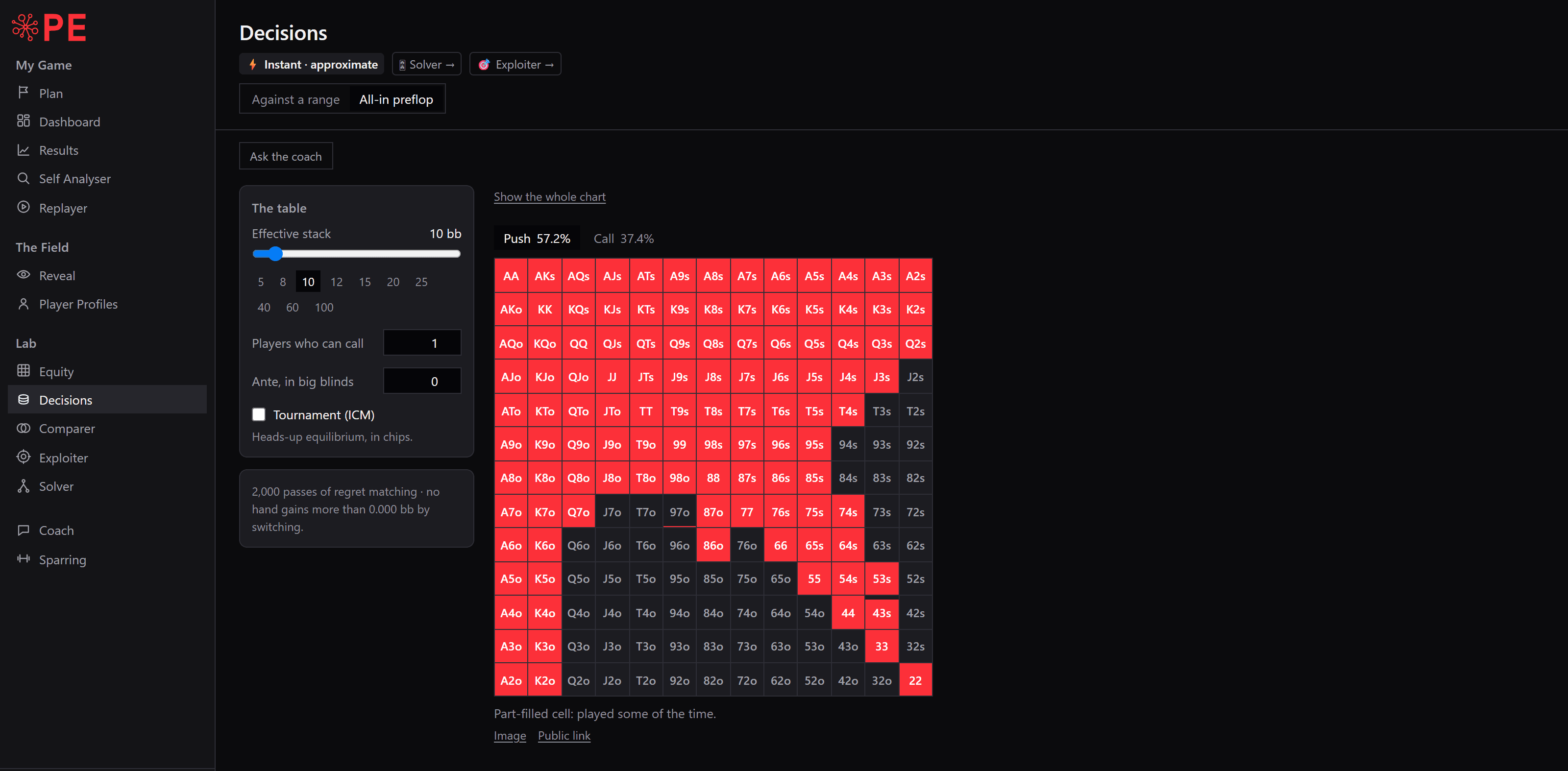
The Decisions module lets you study push, fold, and call spots with short stacks. It gives you the chip-equilibrium baseline, which is useful before you add the bounty arithmetic yourself.
And if you want to understand how real opponents at your limits behave, the Reveal module shows what players actually do in tournament spots, including PKO spots, from your own hand histories.
That combination is useful because PKOs are not won by memorizing one chart. They are won by understanding how real ranges move when a bounty enters the pot.

The main takeaway
PKO strategy is not just “play looser because there is a bounty.”
It is more precise than that:
- a bounty lowers the price of calling,
- a bounty changes who can profitably shove,
- covering stacks create leverage,
- being covered makes your own bounty a liability,
- and as the tournament moves toward the bubble and the final table, ICM starts fighting the bounty for control of the decision.
If you remember only one sentence, make it this:
In PKOs, every chip decision has a cash layer on top of it, and the best players know exactly when that layer matters most.
Do it on your own hands.