

In tournament poker, the buy-in on the lobby is only the first line of the bill.
If the event allows rebuys, re-entries, add-ons, or late registration, then the real question is not just “How much does this tournament cost?” It is also “How many chips do you actually get for that money, at that moment, and what kind of stack are you buying?”
That matters for two reasons. First, it changes the prize pool. Second, it changes your own ROI, because every extra entry and every add-on is part of what you paid to play.
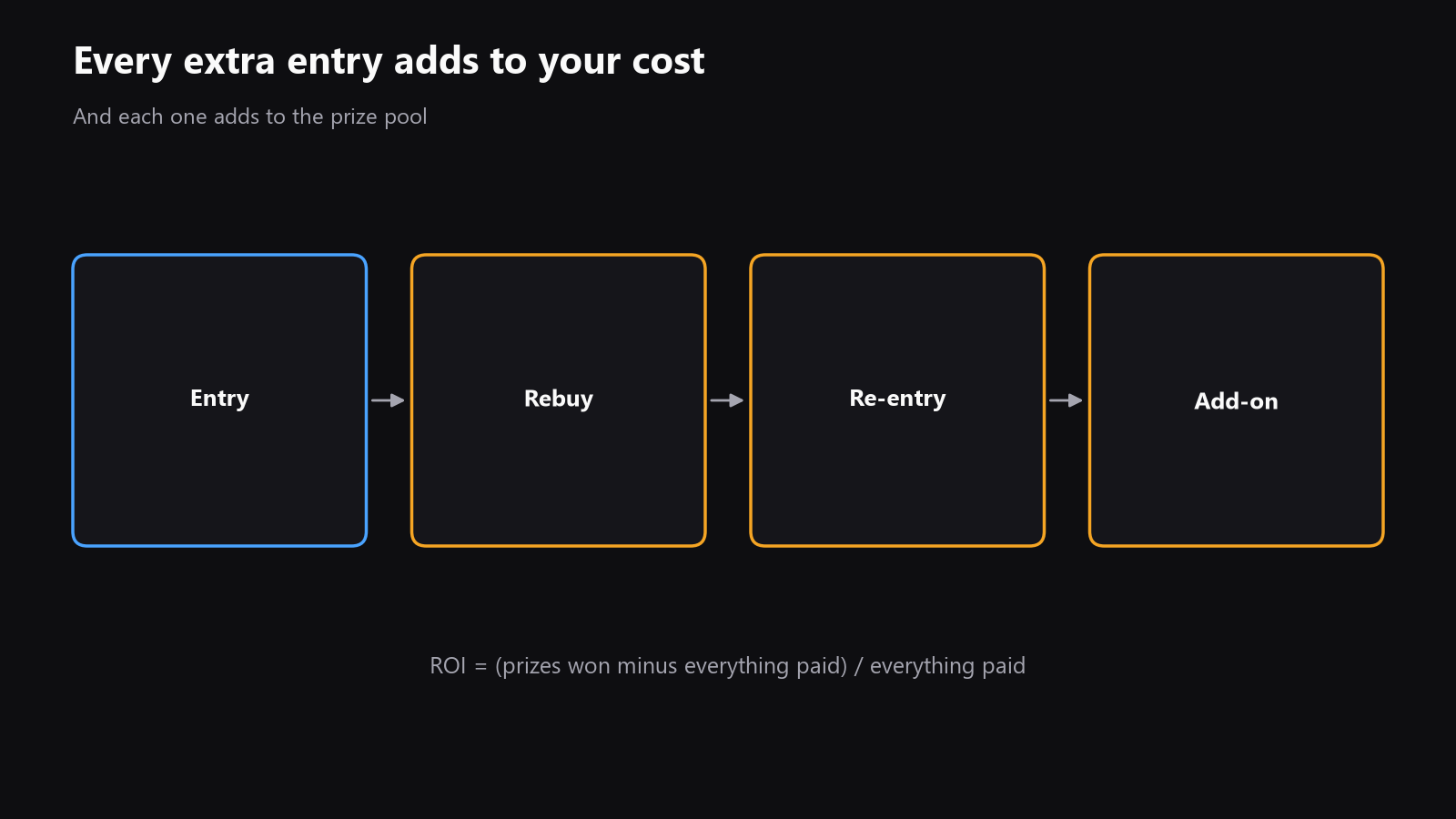
Rebuy, re-entry, add-on: what each one means
These words sound similar, but they are not the same thing.
Rebuy
A rebuy is an extra buy-in during a period where the tournament allows it.
In some events, you can rebuy after you bust. In others, you can rebuy only when your stack falls below a certain threshold. In practice, a rebuy usually means you stay in the same event or return to it without waiting for the whole tournament to end.
What matters for you is simple: a rebuy costs more money, usually gives you another full starting stack or a defined amount of chips, and increases both your total investment and the prize pool.
Re-entry
A re-entry is a fresh entry after you bust.
Economically, it is very close to a rebuy. You pay again, you receive a new stack, and the tournament field grows. The main difference is logistics: you leave the event and come back in as a new entrant.
That distinction matters in practice because a re-entry can change your table, your seat draw, and sometimes the moment at which you come back into the game.
Add-on
An add-on is usually a one-time extra purchase, most often at the end of a rebuy period.
Unlike a rebuy or a re-entry, an add-on does not usually depend on whether you are short or eliminated. If the event allows it, you can often take it even with a healthy stack.
Add-ons are important because they are often the cheapest or most efficient chip purchase in the tournament. Not always, but often enough that you should pay attention.
Late registration
Late registration is the window during which you can still enter the tournament after it has started.
Sometimes late registration is combined with re-entry. That means you can register late for the first time, or bust and re-enter before registration closes.
Late registration is not just a convenience. It is a stack depth decision. If you register late, you are buying fewer big blinds than the early entrants. The buy-in may be the same, but the stack you receive is not.
What these options change in cost and prize pool
The headline buy-in does not tell you the full story.
Suppose a tournament is listed as $100 + $10.
- The $100 goes to the prize pool.
- The $10 is the fee.
If 200 players enter once, the prize pool gets $20,000 and the room collects $2,000 in fees.
Now suppose the same tournament also has 40 rebuys, 30 re-entries, and an add-on that 150 players take.
If each rebuy and re-entry adds another $100 to the prize pool, then those extra 70 entries add $7,000 to the prize pool. If the add-on costs $50 and all 150 players take it, that adds another $7,500.
So the prize pool becomes much larger than the original lobby number suggested.
That is why tournament guarantees and overlays matter. In a guaranteed event, all those extra entries help push the prize pool toward the guarantee. If the tournament still falls short, the room covers the difference. If it exceeds the guarantee, the prize pool grows beyond it.
The lesson is simple: in rebuy and re-entry formats, the true tournament cost is not the first buy-in. It is the sum of all buy-ins and add-ons you actually take.
Every entry counts in your ROI
This is the part many players misread.
ROI means:
ROI = (prizes won minus everything paid to enter, fee included) / everything paid to enter
That means every re-entry and every add-on belongs in the denominator.
Example:
- You enter a $100 + $10 tournament.
- You bust and re-enter once.
- You take the $50 add-on.
- You cash for $390.
Your total cost is:
- First entry: $110
- Second entry: $110
- Add-on: $50
Total paid = $270
Your ROI is:
(390 - 270) / 270 = 44.4%
If you forgot the second entry and the add-on, you might think your ROI was huge. It was not. You just did the math badly.
This is why rebuy and re-entry tournaments can make your results look better or worse than they really are if you only remember the cash and forget the total investment.
ITM is different. ITM means the share of tournaments you finish in the money. It is useful, but it does not tell you how much you paid to get there, or how many times you bought back in before you cashed.
How late registration changes your stack
Late registration is really a way of buying a shorter stack for the same price.
Imagine a tournament with a 30,000 chip starting stack.
| Registration point | Blind level | Stack in big blinds |
|---|---|---|
| Start | 100 / 200 | 150 bb |
| After 4 levels | 200 / 400 | 75 bb |
| After 7 levels | 300 / 600 | 50 bb |
| Near the end of late reg | 500 / 1,000 | 30 bb |
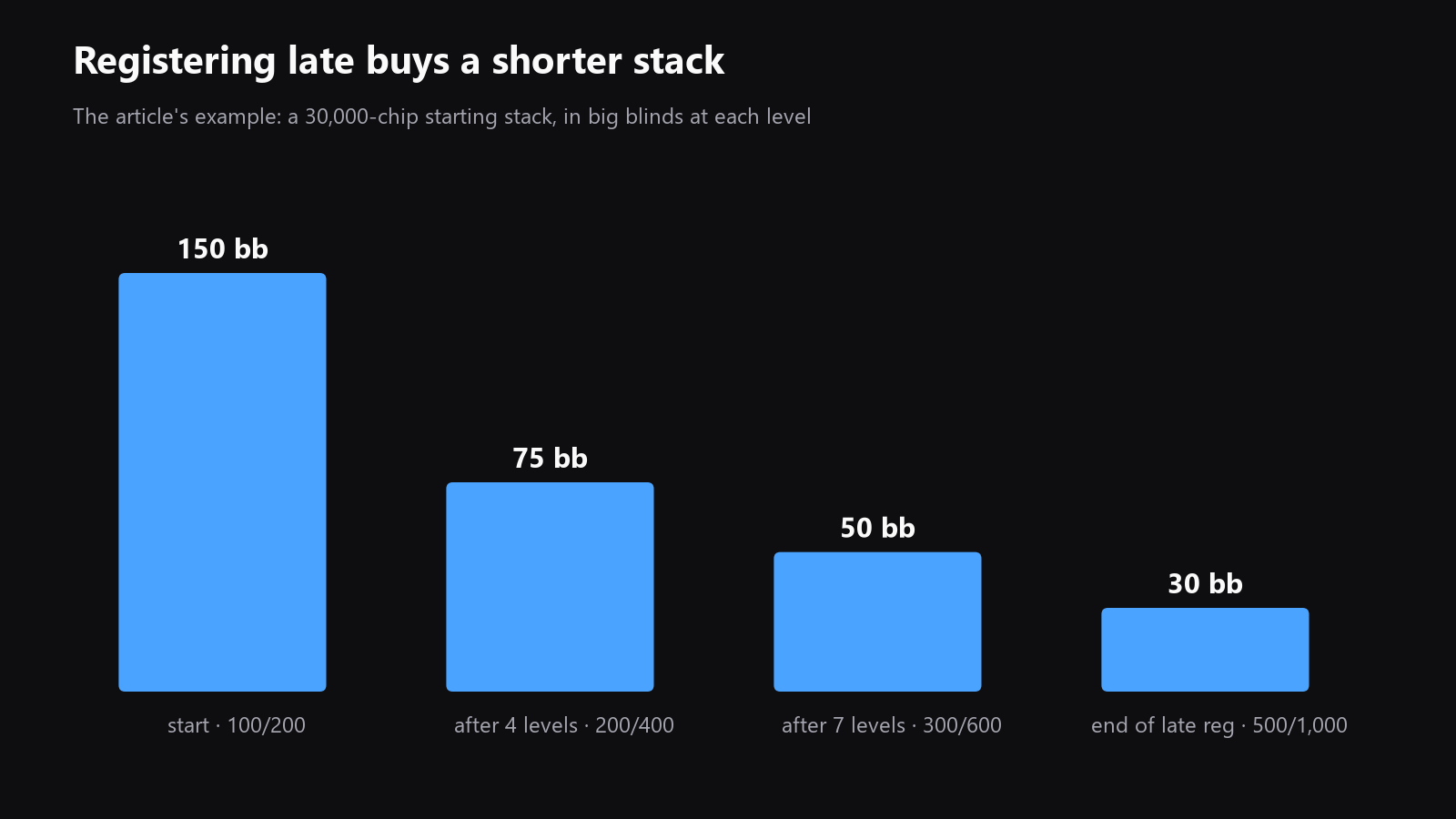
Those numbers are only in big blinds. If antes are already in play, the stack is effectively even shorter, because more chips leave the table every orbit.
That is the key idea: late registration does not just save time. It changes the kind of poker you are buying into.
Early in the tournament, you may get deep-stack spots, more postflop play, and more room to use skill edges that grow over many hands. Late in the tournament, you buy fewer decisions, fewer mistakes from weaker players, and more short-stack pressure.
Neither is automatically better. They are just different.
When late registration makes sense
There is no universal answer, but there are good rules of thumb.
Late reg can make sense when:
- the tournament is fast enough that the early levels are not very valuable,
- you are comfortable with short-stack and push/fold poker,
- the field is soft later than it is early,
- you want to reduce time spent in low-value deep-stack spots,
- you know the stack you are buying and you are fine with it.
Late reg is usually worse when:
- the structure is deep and slow,
- your edge is strongest in postflop play with deep stacks,
- the early field is soft and you are giving up profitable chips,
- late registration leaves you with a stack that is too short for your skill set,
- the tournament is close to the money, where ICM pressure starts to matter more.
A useful way to think about it is this:
If you are a much better deep-stack player than the average field, registering late often means skipping your best opportunity to build a stack. You are paying the same fee for fewer big blinds.
If you are much better at short-stack play than at deep-stack play, late registration can be a reasonable choice.
Re-entry changes the field, not just your seat
A re-entry does more than restore your stack.
It also changes the field composition over time. The later the registration window stays open, the more the tournament becomes a mix of survivors and fresh stacks. That can matter a lot if you are trying to read the room.
In tournament pools, late stages are often more volatile. Some players have long stacks, some have short stacks, and some are still arriving with a fresh stack because the format allows it.
That is one reason tournament study is not only about ranges. It is also about stack depth, field tendencies, and where the money actually sits on the table.
If you want to study those spots, the Reveal module in Poker Exploit is built for tournaments too, including bubble, final table, PKO, and Spin and Go structures. It shows what the players at your limits actually do, so you can compare your pool to your own game.
Add-ons are not optional to your accounting
Many players treat the add-on as an afterthought. That is a mistake.
An add-on is part of your tournament investment. If you take it, it belongs in your ROI calculation.
It can also be a strong chip purchase, because the price per chip is often better than the price you would pay later through a re-entry or through slowly winning chips at the table. That said, the correct decision still depends on stack size, payout structure, and the stage of the event.
If you are short and the add-on gives you a large jump in tournament equity, it is often worth taking. If you are already deep into ICM territory, chip value and dollar value are no longer the same thing, so the answer can change.
A practical checklist before you register
Before you jump into a rebuy, a re-entry, or a late-regged event, ask yourself these questions:
- How many big blinds am I buying?
- How much of the buy-in goes to the prize pool, and how much is fee?
- Will I likely take an add-on?
- If I bust, will I re-enter, and how many times?
- Does my edge come from deep stacks or short stacks?
- Am I measuring ROI with every entry included?
If you cannot answer those questions, you are probably treating the tournament as cheaper or richer than it really is.
A simple rule of thumb
Here is the cleanest way to think about it:
- Rebuy and re-entry increase both the prize pool and your own total cost.
- Add-ons are extra investments and must be counted.
- Late registration buys a shorter stack, not a discount.
- ROI only makes sense if you count every entry and every fee.

If you study tournaments seriously, this is exactly the kind of accounting that keeps your results honest.
The Results module in Poker Exploit shows ROI and ITM for tournaments. And when late registration leaves you with a short stack, the Decisions module gives push, fold, or call options with a short stack, which is the right place to study those spots off the table.
The main lesson is not complicated: in tournament poker, the number on the lobby is not the full price, and the stack in your seat is not always the same stack as the player who registered on time.
Do it on your own hands.