
The river is where a bluff becomes expensive and, when done well, very clear.
On the flop and turn, you still have cards to come. On the river, you do not. If you bet now, you are not buying future equity. You are trying to make better hands fold. That means a river bluff is not a vague feeling. It is a calculation, a story, and a target.
The three questions are always the same:
- What better hands can actually fold?
- What better hands can you credibly represent?
- What size makes the bluff pay, without forcing you to bluff too often?
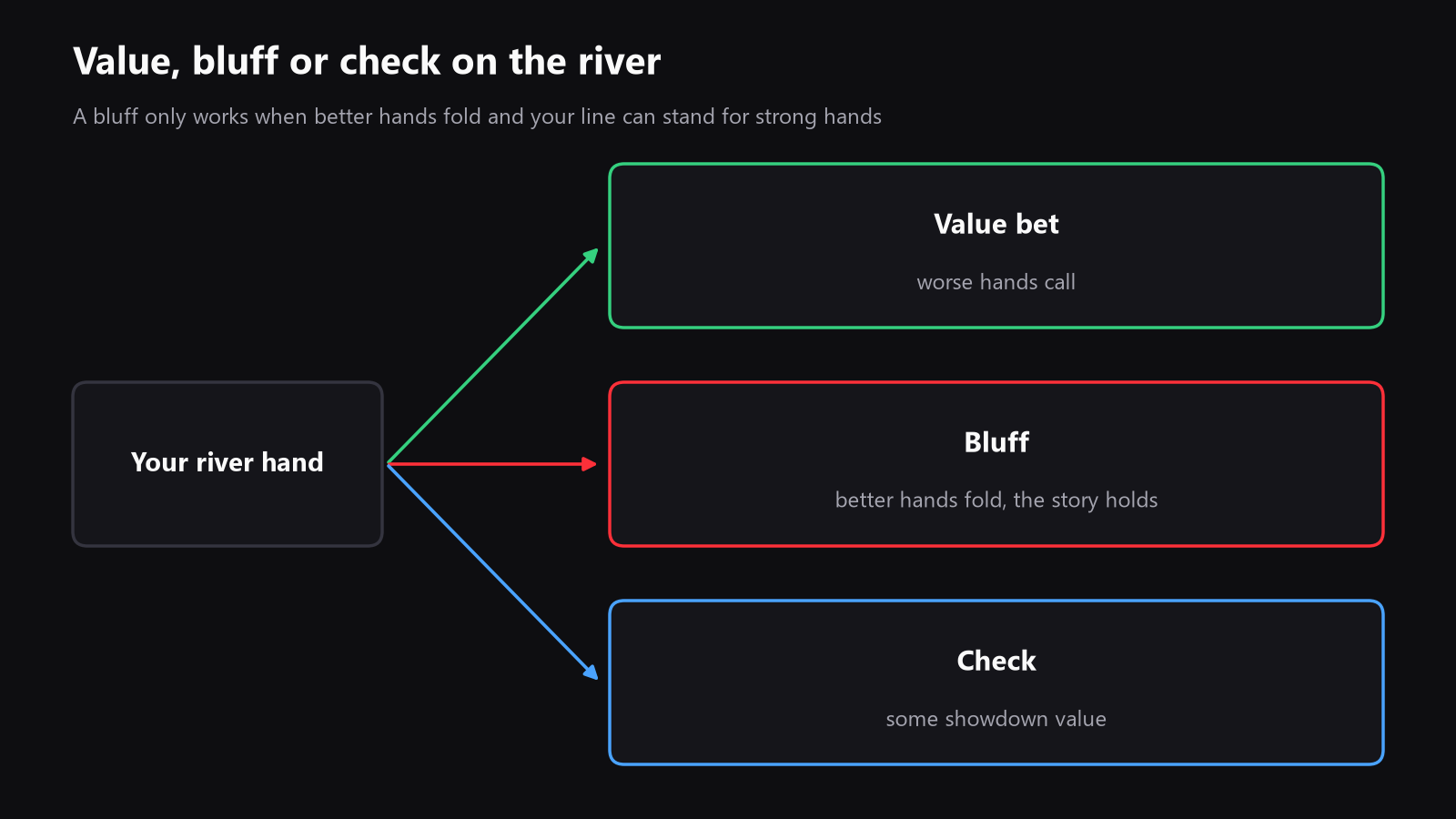
1. What makes a good river bluff
The best river bluffs are not random air.
They usually come from one of these places:
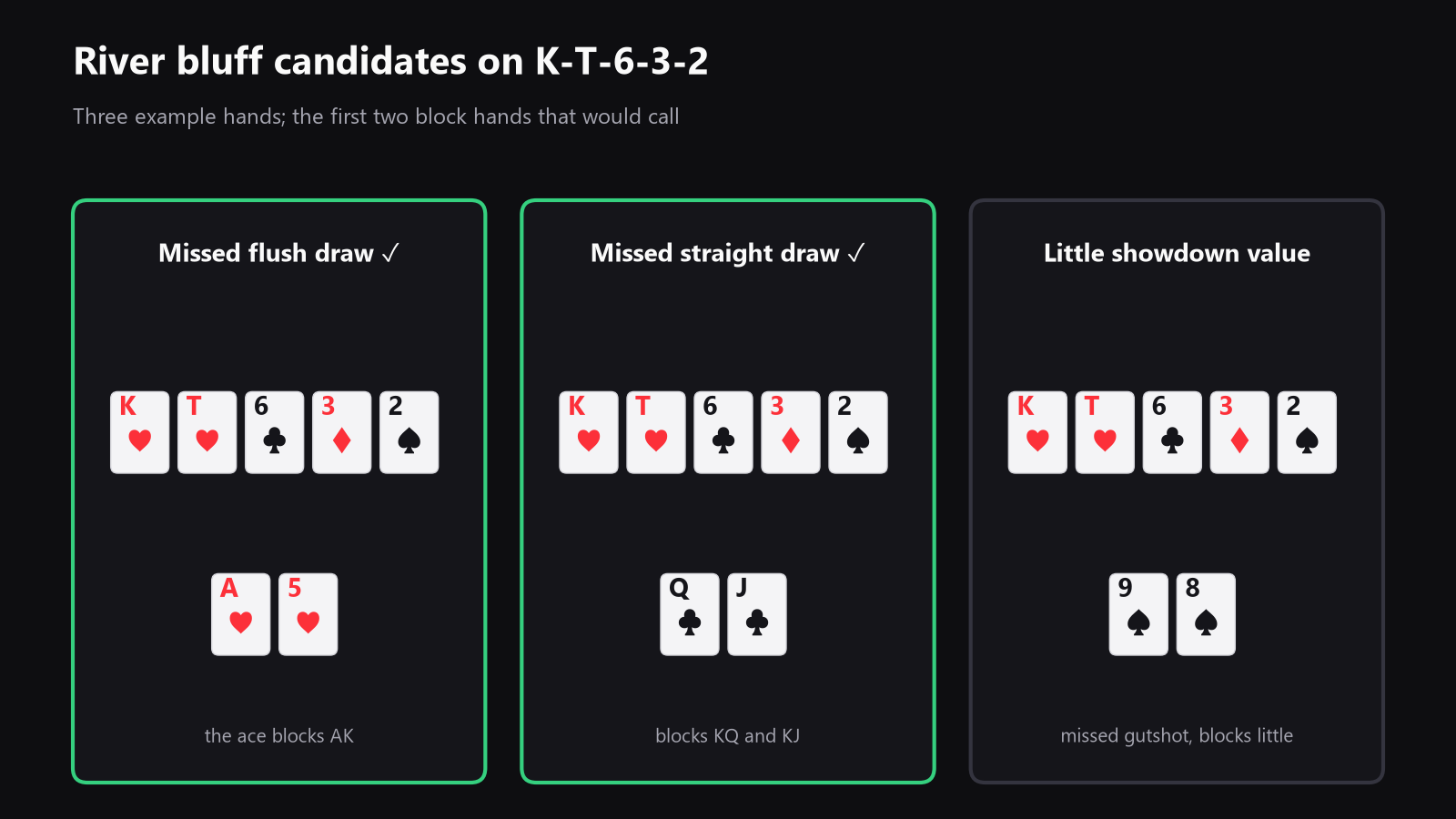
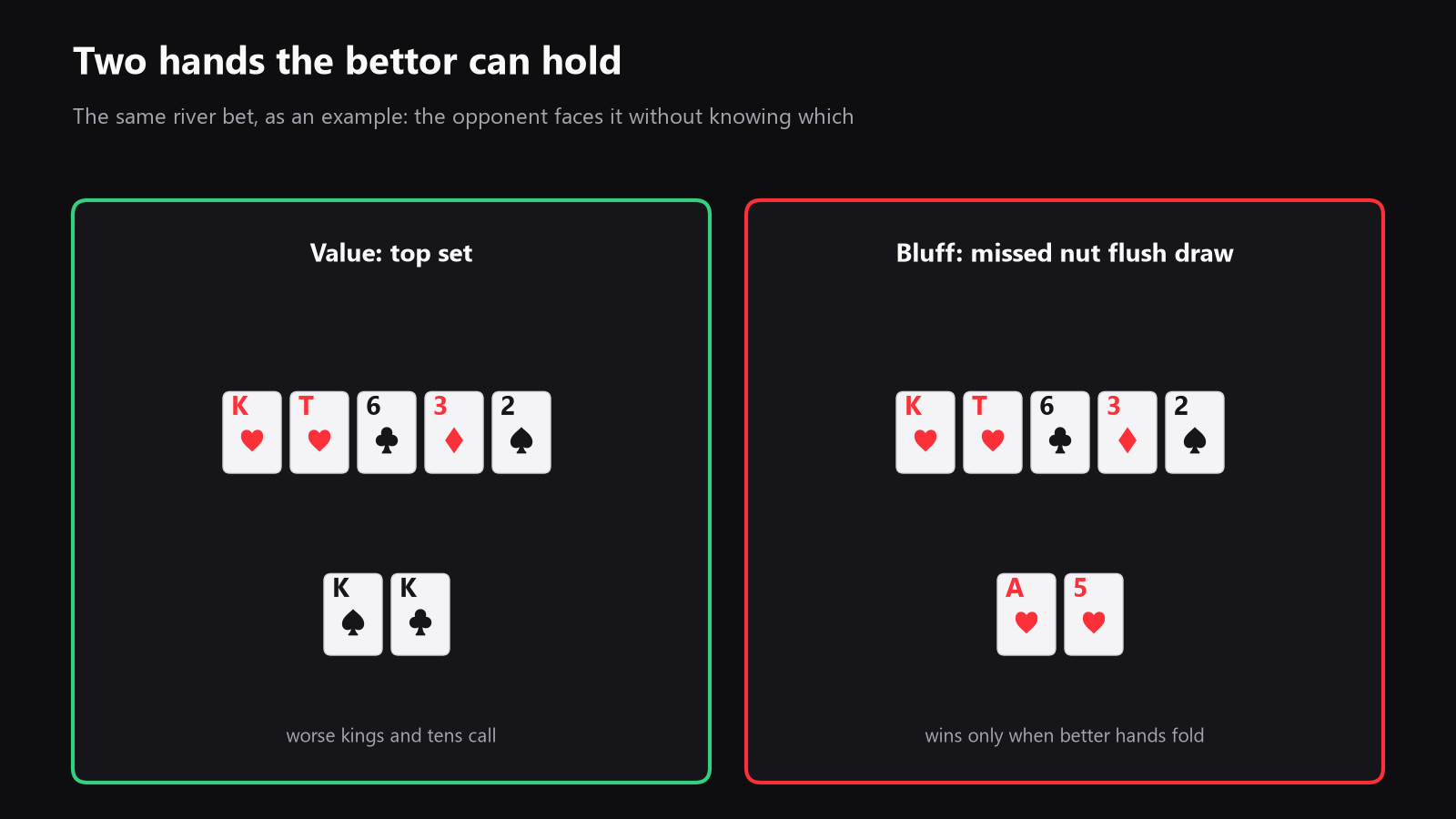
- Missed draws If you have a busted flush draw or straight draw, you often have the cleanest bluff candidate. You already arrived on the river with a hand that looked like it could improve. That makes your bet easier to believe.
- Hands with the right blockers A blocker is a card in your hand that removes part of your opponent’s calling range. If your opponent calls river bets with top pair, two pair, sets, and the nuts, then holding cards that reduce those holdings is valuable.
- Hands with little showdown value A hand that can sometimes win at showdown is often better as a check than as a bluff. If your hand beats enough of your opponent’s missed hands, you may be turning a small winner into a bluff by mistake.
A simple rule helps: the more your hand blocks calls and unblocks folds, the better it is as a bluff.
That means you usually want to block the hands that continue, not the hands that fold.
2. Missed draws are not all equal
A busted draw is a common bluff candidate, but not every busted draw is a good one.
Ask yourself:
- Did the draw make sense on earlier streets? A river bluff is strongest when your line looks like a real draw that missed. If you never represented anything, your river bet looks thin.
- Does your busted draw block the hands that call? For example, a missed nut flush draw can be a better bluff than a random missed gutshot if the nut flush draw blocks strong made hands or strong draws that continue.
- Does your busted draw still have showdown value? If your busted draw catches enough weak pairs or missed overcards, checking may be better than betting.
- Does the board runout help your story? A river brick after a clear draw board is often better for bluffing than a card that improves the obvious calling range.
A bluff is not just "I missed". It is "I missed in a way that makes your opponent’s range uncomfortable."
3. Blockers: the hidden reason some bluffs work
Blockers matter most on the river because there are no more cards to come.
Suppose your opponent calls river bets with:
- Strong value hands
- Bluff-catchers
- A small part of missed draws
Your bluff does not need to beat all of that. It only needs to make his continuing range small enough, and make the fold part large enough.
That is where blockers help.
A good river bluff often has one or more of these features:
- It removes top pair or overpair combos
- It removes two pair or straight combos
- It removes the strongest bluff-catchers
- It does not block the hands you want him to fold
A bad bluff often does the opposite. It blocks the folding part of his range, or it leaves his calling range untouched.
This is why two hands that look equally weak can play very differently on the river.
4. Bet size changes the bluff you should choose
River sizing is not a cosmetic choice. It changes how many bluffs you can profitably include.
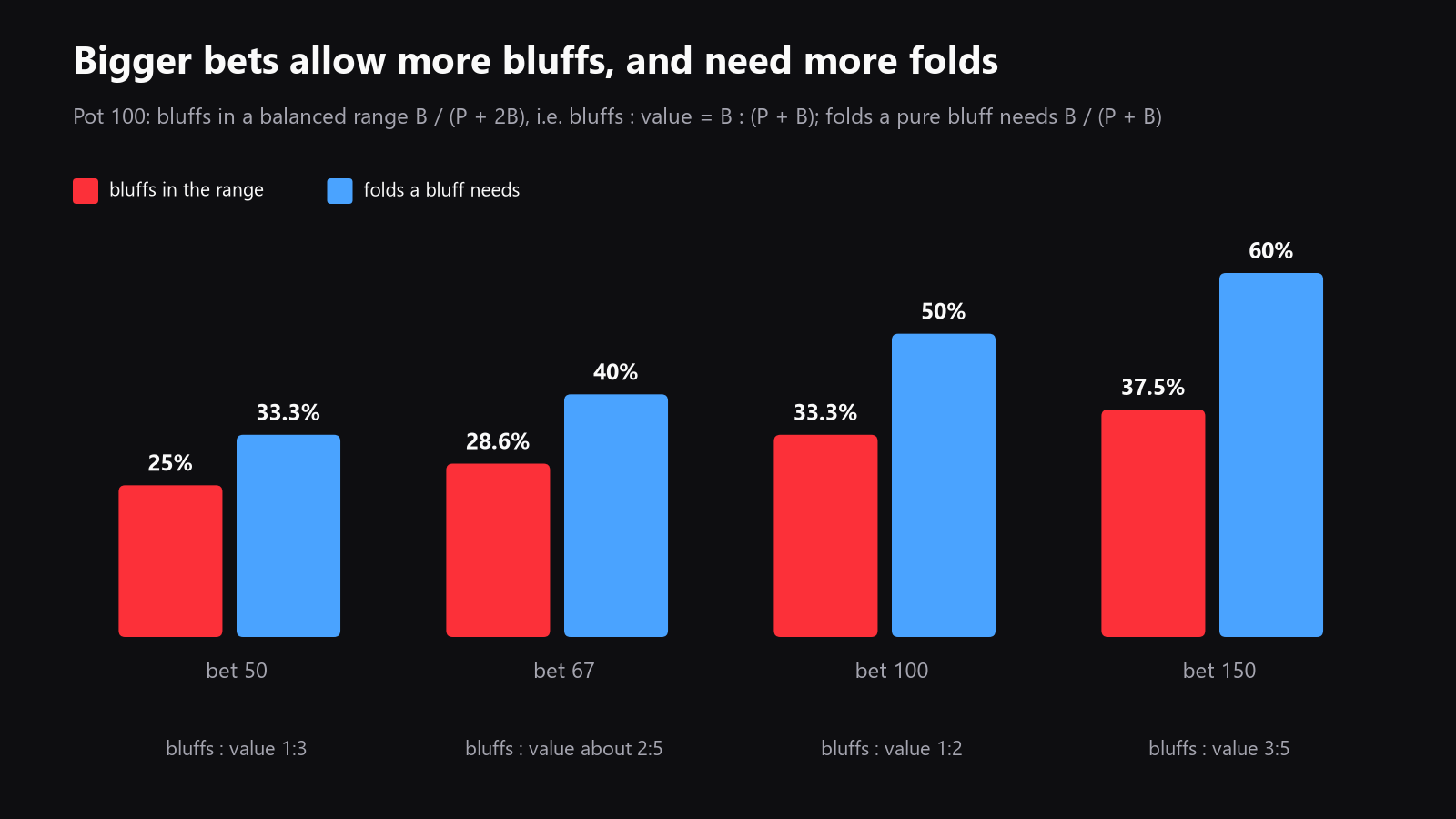
If you bet B into a pot of P, then the bluff-to-value ratio for a polar river bet is:
bluffs : value = B : (P + B)
That is the cleanest way to think about it.
Examples:
- Half-pot bet If the pot is 100 and you bet 50, your bluff-to-value ratio is 1:3. You can have 1 bluff for every 3 value hands.
- Two-thirds pot bet If the pot is 100 and you bet about 67, your bluff-to-value ratio is about 2:5.
- Pot-size bet If the pot is 100 and you bet 100, your bluff-to-value ratio is 1:2.
- Overbet If the pot is 100 and you bet 150, your bluff-to-value ratio is 3:5. A bigger bet allows more bluffs relative to value, but it also asks more from your opponent.
The other useful number is the break-even fold frequency for the bluff itself:
required folds = B / (P + B)
So if you bet 50 into 100, your bluff needs folds more than 33.3% of the time to break even.
If you bet 100 into 100, it needs folds more than 50% of the time.
If you bet 150 into 100, it needs folds more than 60% of the time.
That is the arithmetic. The poker question is whether your opponent actually folds that much.
5. A bigger bet is not always a better bluff
A large river bet can be powerful, but only when your story is strong and your target is the right one.
A bigger size gives you two things:
- More fold pressure
- More room for bluffs in a polar range
But it also does this:
- It makes your mistake more expensive if you are called
- It needs a stronger story
- It forces you to choose your bluff candidates more carefully
If you are betting large on the river, your bluffs should usually be your best blockers, your cleanest missed draws, or both.
If you are betting small, you can sometimes bluff thinner, but you also need to understand that a small river bet is often not trying to make huge hands fold. It is trying to make the bottom of the range fold.
6. Who you can bluff, and who you should not
This matters as much as the hand you hold.
Good bluff targets
You want opponents who:
- Reach the river with too many weak bluff-catchers
- Fold medium strength hands under pressure
- Arrive capped, meaning their line has few strong hands left
- Play fit-or-fold on the river
- Can fold when the runout is scary for their range
These players exist at every stake.
Bad bluff targets
You should be careful, or simply stop bluffing, against opponents who:
- Call too much on the river
- Hate folding any pair
- Turn every showdown into a curiosity call
- Treat the river as a place to "see it once"
- Have a line that is already strong and uncapped
Spots where bluffing is close to useless
Some river situations are almost pure value:
- The board heavily favors your opponent’s range
- Your line does not credibly represent strong hands
- Your opponent’s range is full of bluff-catchers that do not fold
- The runout improved the hands that called you earlier, not the hands you are trying to represent
If you cannot name enough better hands that can fold, your bluff is probably bad.
If you can only imagine better hands folding, but the player never folds them, your bluff is bad too.
7. How to choose between bluffing and checking
A lot of river mistakes happen because players bluff when checking is better.
Use this checklist:
- What better hands fold? If the answer is "almost none", do not bluff.
- What better hands can you represent? If your line does not credibly tell that story, do not bluff.
- Does your hand have showdown value? If yes, checking may keep more money.
- Do your blockers help? If you block calls and unblock folds, bluffing gets better.
- Does the size fit the story? A weak story with a huge bet is usually a leak.
This is where river play becomes real poker, not just pressure.
8. A practical example
Imagine the pot is 100 on the river.
You are considering a 75 bet.
That means:
- Your bluff-to-value ratio is 75:175, or 3 bluffs for every 7 value hands
- Your bluff needs folds more than 75 / 175, which is about 42.9% of the time
Now ask:
- Does your opponent fold that often on the river?
- Does your hand block the hands that continue?
- Does your line credibly represent the value hands you need?
If the answer to all three is yes, you may have a real bluff.
If not, you probably have a leak.
9. River bluffs and population tendencies
At small stakes, many players make two opposite mistakes:
- They overbluff in hopeless spots
- They underbluff in strong spots
The fix is not "bluff less" or "bluff more". The fix is to bluff where the story, blockers, size, and opponent all line up.
As a rule of thumb:
- Bluff more against players who overfold river
- Bluff less against calling stations
- Bluff more when your line is balanced with real value hands
- Bluff less when your line is obviously thin
A river bluff should feel inevitable, not creative.
10. A short river bluff checklist
Before you bet the river, ask yourself:
- What exact better hands am I representing?
- What better hands can actually fold?
- Does my hand block calls or block folds?
- Is my size consistent with my story?
- Is this opponent capable of folding the part of his range I need?
If you do not have a clean answer, checking is often the best bluff.
11. How to study your river bluffs away from the table
If you want to get better at river bluffing, do not guess from memory.
Study your own hands and look for patterns:
- Are you bluffing too often in spots where opponents do not fold?
- Are your bluff sizes too large for the hands you hold?
- Are you missing better bluff candidates because you ignore blockers?
- Are you checking hands that should be betting, or betting hands that should be checking?
That is where the Plan module and the Self Analyser module help you see which river spots cost you the most.
If you want to know how real opponents at your limits behave, the Reveal module is useful because it shows what actually happened in similar spots from your own hands.
And if you want to test a river spot off the table, the Solver module can calculate it for study, without publishing any of that output here.

12. The bottom line
A good river bluff is not about courage.
It is about three things:
- A hand that blocks the right calls or looks like a real missed draw
- A size that matches the range story
- An opponent who can actually fold
If one of those is missing, the bluff gets worse fast.
If all three are present, the river becomes one of the most profitable places in poker.
Do it on your own hands.