
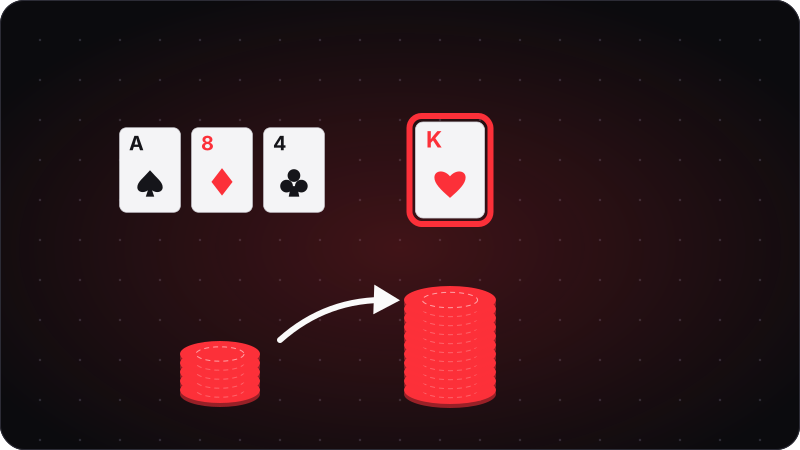
You c-bet the flop, get called, and now the turn asks the real question.
Do you keep telling the same story, or do you give up?
That is the heart of the turn double barrel. On the flop, you had a wide betting range. On the turn, ranges get narrower, equities shift, and the board often changes who is ahead in the hand. If you understand which turn cards help your range, which hands benefit from a second barrel, and which spots should simply go into check, you will make far fewer expensive guesses.
What a double barrel is really trying to do
A turn barrel should do at least one of three things:
- Get called by worse when you have value.
- Make better hands fold when you are bluffing.
- Deny equity to hands that can still realize too much for free.
If your turn bet does none of those, it is usually just noise.
The best second barrels do not come from aggression for its own sake. They come from a board change that improves your perceived range, weakens the caller's continuing range, or both.
A useful mental shortcut is this:
- If the turn card is better for your range than for your opponent's range, you can keep betting more often.
- If the turn card helps your opponent more than you, your bluffs should slow down.
- If the turn card changes nothing, your hand class decides most of the answer.
Which turn cards are good to barrel
Not every scary card is a good barrel card. Some cards look ugly in isolation, but they actually help the caller more than you. The key is range interaction, not vibes.
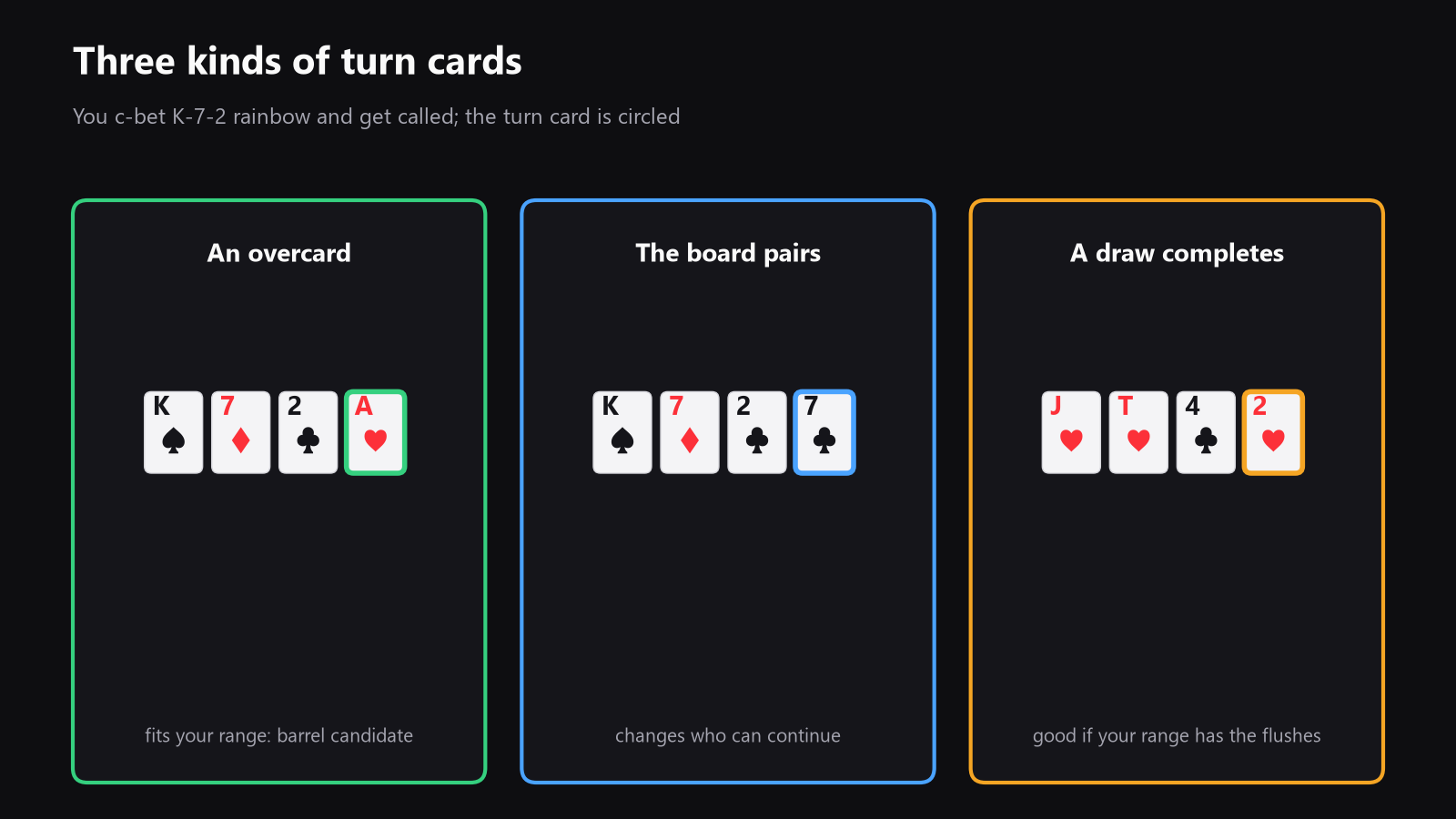
1. Overcards to the flop
On low and medium flops, an overcard to the board is often a strong barrel card for the preflop raiser.
Example idea: you c-bet a K 7 2 rainbow flop, get called, and the turn is an A.
That ace is scary for many one-pair hands, but it is also a card that fits your range very well. You can have more strong Ax, more top pairs, and more overpairs than the caller can. Many hands that called the flop with second pair, pocket pairs, or floats now hate life.
That does not mean you should bet every ace. It means the ace is a good candidate to continue your value range and your best bluffs.
2. Board-pairing turns
When the board pairs, your range can often represent boats, trips, and strong overpairs more credibly than the caller can.
A paired turn can be excellent when:
- you have overpairs,
- you have trips or full houses,
- the caller's range is mostly one-pair and draws,
- and the paired card makes the board texture more static.
But there is a catch. A paired turn can also reduce action from worse hands. If your value hands want calls, and the board pair kills those calls, a check can become better with parts of your range.
So do not think "paired turn means bet." Think "paired turn changes who can continue profitably."
3. Cards that complete one part of the board and miss the caller's range
Some turn cards are excellent because they complete draws that you can credibly represent, while the caller often arrived with hands that are now capped.
For example, a turn that completes the front-door flush can be a great barrel card if you have many flushes in your range and your opponent has too many one-pair hands that must now fold.
The same is true for straight cards, especially when your preflop and flop line can contain more of the straight region than your opponent's range.
But again, context matters. If the turn completes the obvious draw and your opponent is the kind of player who already has that draw a lot, the card may help them too.
4. Cards that reduce the number of strong continues
Sometimes a good barrel card is not "scary" in a dramatic sense. It is simply a card that removes many of the hands your opponent wanted to continue with.
If the turn makes top pair now second pair, or turns a middle pair into a bluff catcher, your bet will often fold out more equity than before.
That is a strong reason to keep firing.
Which hands should you barrel with
A strong turn barrel range usually contains three groups.
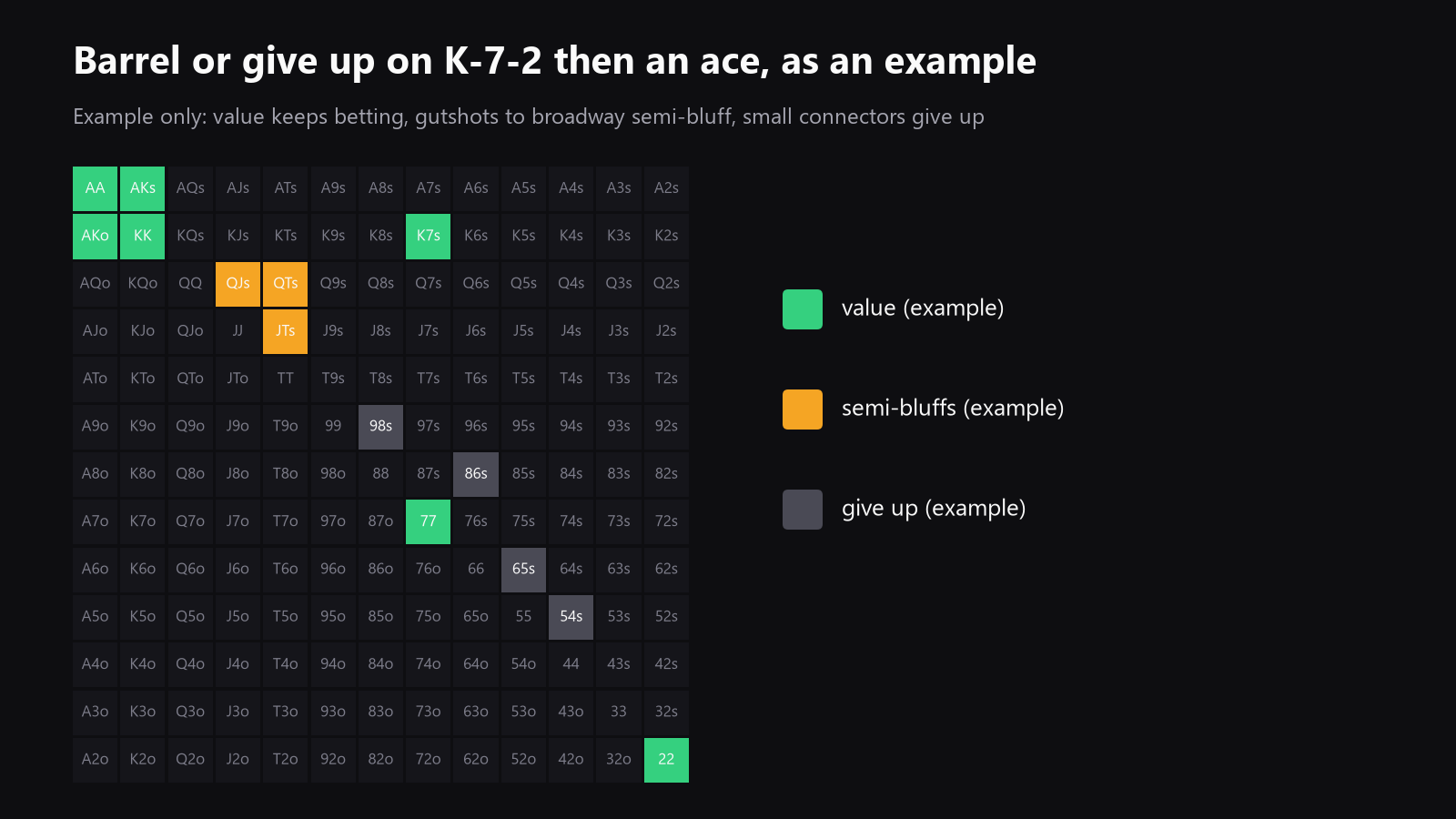
1. Value hands that want to keep building the pot
These are your most natural double barrels:
- overpairs,
- top pair with a strong kicker,
- two pair,
- sets,
- straights and flushes,
- and some thin value hands when worse still calls often enough.
The better your hand, the less you should fear betting a turn card that changes the story. Your job is not just to protect your hand, but to extract value while worse still pays.
Thin value is where many players make mistakes. They either bet too big and scare away worse, or they check and let the river become messy. On many turn textures, a smaller or medium-size barrel gets called by enough worse hands to be best.
2. Semi-bluffs with real equity
These are the hands you want to fire most confidently when you are bluffing with backup:
- nut flush draws,
- open-ended straight draws,
- combo draws,
- strong backdoor draws that picked up extra equity on the turn,
- overcards with a backdoor flush or straight draw,
- hands with useful blockers and enough outs if called.
Semi-bluffs are better than pure air because they can win in two ways. Your opponent folds, or you realize equity when called.
A good turn barrel hand often has at least one of these features:
- enough equity to continue if called,
- a blocker to the top of villain's continuing range,
- or a clear river plan if the bet gets through.
3. Pure bluffs that block continues and unblock folds
Pure bluffs should be chosen carefully.
The best ones usually:
- block strong continues,
- do not block folds,
- and have some chance to pick up equity on the river.
If your bluff blocks the exact hands you want to fold, it is a poor candidate. If it blocks the hands that call and unblocks the weak part of villain's range, it becomes much better.
That is why good turn bluff selection is often less about "what looks aggressive" and more about "what removes villain's calling hands."
When to give up instead of firing again
A lot of leaks come from players who c-bet the flop automatically and then feel obliged to keep going on the turn.
Do not do that.
You should often slow down when:
- the turn helps the caller more than you,
- your hand has no meaningful equity,
- you have no strong blockers,
- villain is a calling station,
- the pot is multiway,
- or your line has no credible river barrel.
The sticky opponent problem
Against a player who calls too much, your bluffing threshold gets much higher.
If someone does not fold to turn aggression, then a second barrel with no equity is just donating chips. In those spots, value bet harder and bluff less.
The bad card problem
Some turns are terrible for your bluffs because they improve the caller's most natural continues.
If the flop was dynamic and the turn lands a card that clearly fits the calling range, you should not force a barrel just because you started betting on the flop.
The no-river-plan problem
Ask yourself one simple question:
If you get called, which river cards help you continue, and which river cards force you to give up?
If the honest answer is "almost none," your turn bluff is probably not good.
A practical turn double-barrel checklist
Before you bet the turn, run this quick checklist:
- Did the turn improve my range more than villain's range?
- Does my hand have value, equity, or useful blockers?
- What worse hands can call?
- What better hands can fold?
- If called, do I have a believable river plan?
- Is villain the type who folds enough, or calls too much?
If you cannot answer at least three of these clearly in your favor, checking is often better.
Sizing: small, medium, or big?
Your turn size should match your story.
- Smaller bets work well when you want to keep worse hands in and pressure capped ranges.
- Bigger bets make more sense when your range is more polar, or when the turn is a major shift that puts serious pressure on one-pair hands.
- If the turn improves your value range and your bluff range in a clean way, a medium size often captures the most value without overcommitting.
Do not think of sizing as decoration. It is part of the message.
A simple example
Imagine you open preflop, get called, c-bet a flop that favors your range, and the turn lands an overcard that is also good for your strong top-pair hands.
That is usually a strong spot to keep betting:
- your value hands can get paid,
- your best semi-bluffs still have equity,
- and many of the caller's flop continues are now uncomfortable.
Now imagine the turn is a blank that changes nothing, and villain is a loose caller who hates folding. That is a much worse spot to keep bluffing.
Same size, same line, different result.
That is why turn double barreling is not about aggression. It is about card removal, range shifts, and who is actually under pressure.
The fastest way to improve your turn barrels
Review your turn c-bets by board class, not hand by hand only.
Look for spots where you:
- barrel too often on bad cards,
- give up too quickly on good cards,
- or keep firing with hands that have no equity and no blockers.
The Self Analyser module in Poker Exploit is built for exactly that kind of review. It shows which situations you play badly and where your frequencies drift away from the field and from the rest of your game. If you want to test a tricky spot more deeply, the Solver module can compute the turn node away from the table, while the program stays out of the live hand.
Final thought
A good double barrel is not "bet the turn because you bet the flop."
It is "bet the turn because this card, this range, and this hand class make betting better than checking."
Once you start thinking that way, your turn aggression gets quieter, stronger, and much more profitable.
Do it on your own hands.