
If you play enough poker, you will feel the pull of results-oriented thinking.
You make a good call and lose. Your brain says, "Bad call." You make a terrible call and win. Your brain says, "Great hand."
That instinct is human, but it is one of the fastest ways to learn the wrong lesson.
Poker is not scored hand by hand. It is scored by the quality of your decisions, repeated over and over, in situations where you do not know the future. A single result is only one runout. It is not a verdict.

What results-oriented thinking is
Results-oriented thinking is judging a decision by what happened after the decision, instead of by what was known when you had to act.
A few examples:
- You shove 100 big blinds with top pair and get called by a better hand. You lost, but that does not automatically mean the shove was wrong.
- You fold a hand and the board runs out in a way that would have made you a winner. You folded, so you think you made a mistake. Maybe you did, maybe you did not. The river card does not decide that for you.
- You lose three all-ins in a row and assume your game is broken. It may just be variance.
The problem is that poker gives you emotional feedback immediately, but the truth is often delayed.
A good decision can lose. A bad decision can win. A small sample can lie.
That is why you need to separate three things:
- The decision
- The result
- The sample size
If you keep those three apart, you will review hands much better.
Expected value, in plain English
Expected value, or EV, is the average money a decision is worth if you could repeat it many times in the same spot.
That sounds abstract, so use this simple idea:
- If a move wins a little often and loses a little rarely, it can be good.
- If a move wins a lot rarely but loses a little often, it can still be good.
- What matters is the average, not the latest outcome.
Here is a small worked example.
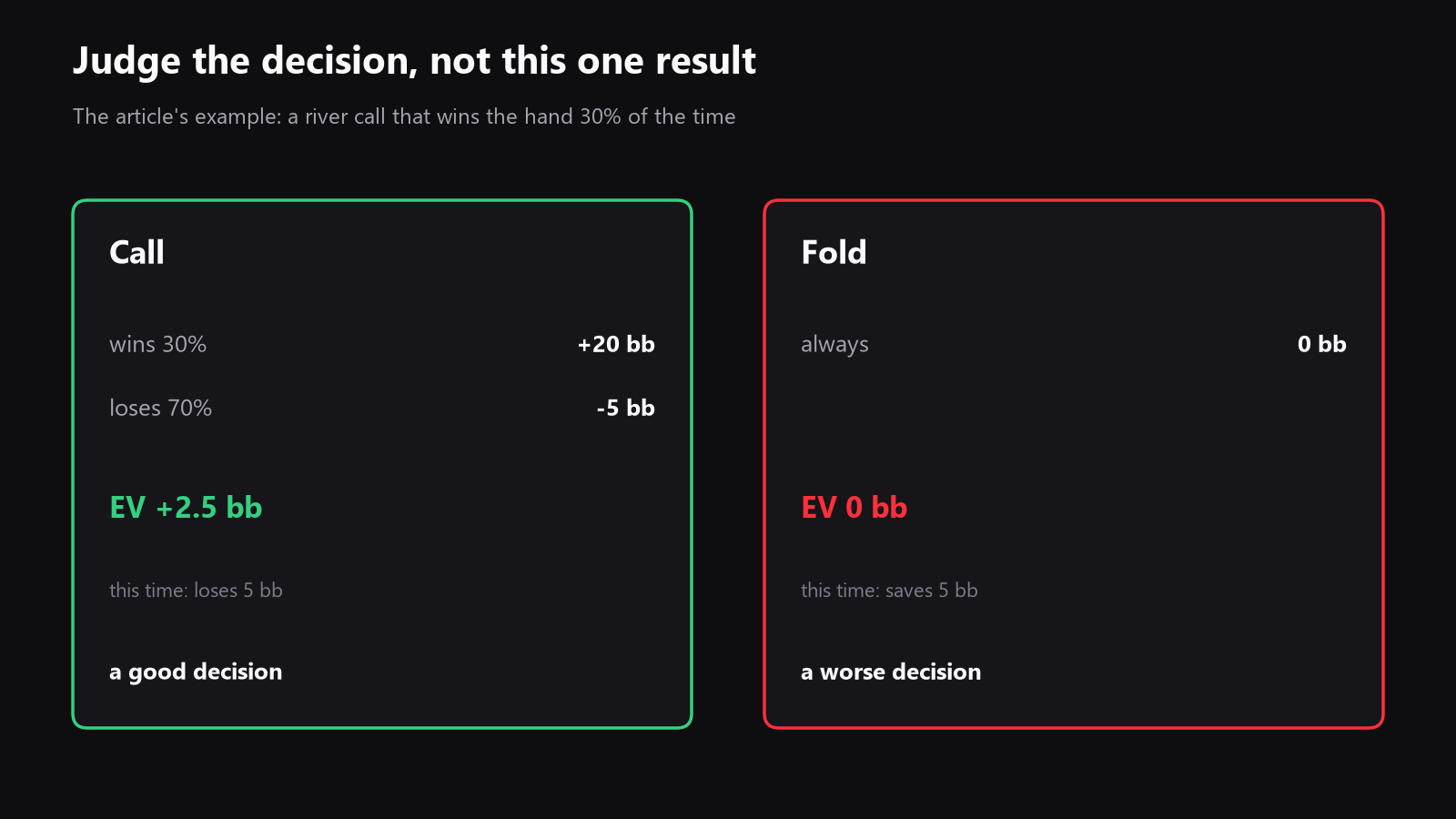
Imagine you face a river bet and the choice is call or fold.
If you call, two things can happen:
- You win the pot and make +20 bb net
- You lose your call and lose -5 bb
Now suppose your hand wins 30% of the time.
Your EV is:
0.30 x 20 bb + 0.70 x (-5 bb) = 6 bb - 3.5 bb = +2.5 bb
So the call is profitable, even though you lose 70% of the time.
That is the key idea.
A decision is not good because it wins. A decision is good because it wins enough, often enough, against the price you are paying.
Why your brain keeps making this mistake
Your brain is built to learn from outcomes.
That is useful in everyday life, but poker is a game of incomplete information. You do not see your opponent's cards. You do not see the future board. You do not see the full distribution of outcomes, only one of them.
So your mind tries to cheat. It says:
- "I lost, so I played badly."
- "I won, so I played well."
- "The river was ugly, so my flop play must have been fine."
- "I got punished, so the decision was bad."
That shortcut feels natural, but it is often wrong.
A stronger habit is to ask:
- What did I know when I acted?
- What range did I assign?
- What were the pot odds?
- What was my equity?
- Was the play better than the alternatives?
If you answer those questions honestly, the result becomes less important.
A good decision can still lose
This is where many players get stuck.
They think the phrase "judge the decision, not the result" means "ignore the result."
That is not quite right.
The result still matters in the long run. It tells you whether your decisions are paying off over many hands. But one result, by itself, is too noisy to judge a hand.
For example, suppose you get all the money in preflop with 60% equity.
That means:
- You win this all-in 60 times out of 100
- You lose it 40 times out of 100
So losing the all-in does not mean the decision was bad. It means you were on the 40% side of the distribution this time.
The correct question is not "Did I win?" The correct question is "Was I happy to get the money in here?"
If the answer is yes, the result is just one runout.
A bad decision can still win
This is the other side of the trap.
You can make a poor call, get lucky, and walk away with chips. That does not repair the mistake.
For example, imagine you call a river shove with a bluff-catcher because you "feel" villain is full of it. He happened to have missed draw. You win.
If your read was not supported by the range, the pot size, or the population tendency, the call may still be a losing decision in the long run.
Winning does not clean the logic.
That is why players who only review by results tend to keep mistakes alive. A bad play that wins feels harmless, so they repeat it.
All-in EV versus results
One of the simplest ways to reduce results-oriented thinking is to look at all-in EV.
All-in EV asks a narrow question: once the chips went in, what was the decision worth at that point?
It is not perfect, but it is very useful.
Here is a simple example.
You get all-in for 100 bb effective with 55% equity.
If you win, your net result is +100 bb. If you lose, your net result is -100 bb.
Your all-in EV is:
0.55 x 100 bb + 0.45 x (-100 bb) = 55 bb - 45 bb = +10 bb
So the all-in was worth +10 bb in the long run.
But your actual result in a single hand can still be:
- +100 bb if you win
- -100 bb if you lose
The difference between result and EV is variance.
That is why the all-in EV line is so useful. It helps you see whether the money went in well, even when the cards were cruel.

What all-in EV does not tell you
All-in EV is helpful, but do not overuse it.
It does not tell you:
- Whether your preflop range was too loose
- Whether your turn bluff was good
- Whether your river check was better than a thin value bet
- Whether you should have avoided the spot entirely
It only helps once the money is already committed.
So use it as one tool, not as the whole truth.
If your all-in EV is fine but your results are still poor, the problem may be elsewhere:
- bad non all-in lines
- poor pool adjustments
- too much rake
- leaks in early streets
- bad table selection
- bad review habits
That is where hand review matters.
How to review a hand the right way
When you review a hand, do not start with "Did I win?"
Start with the decision point.
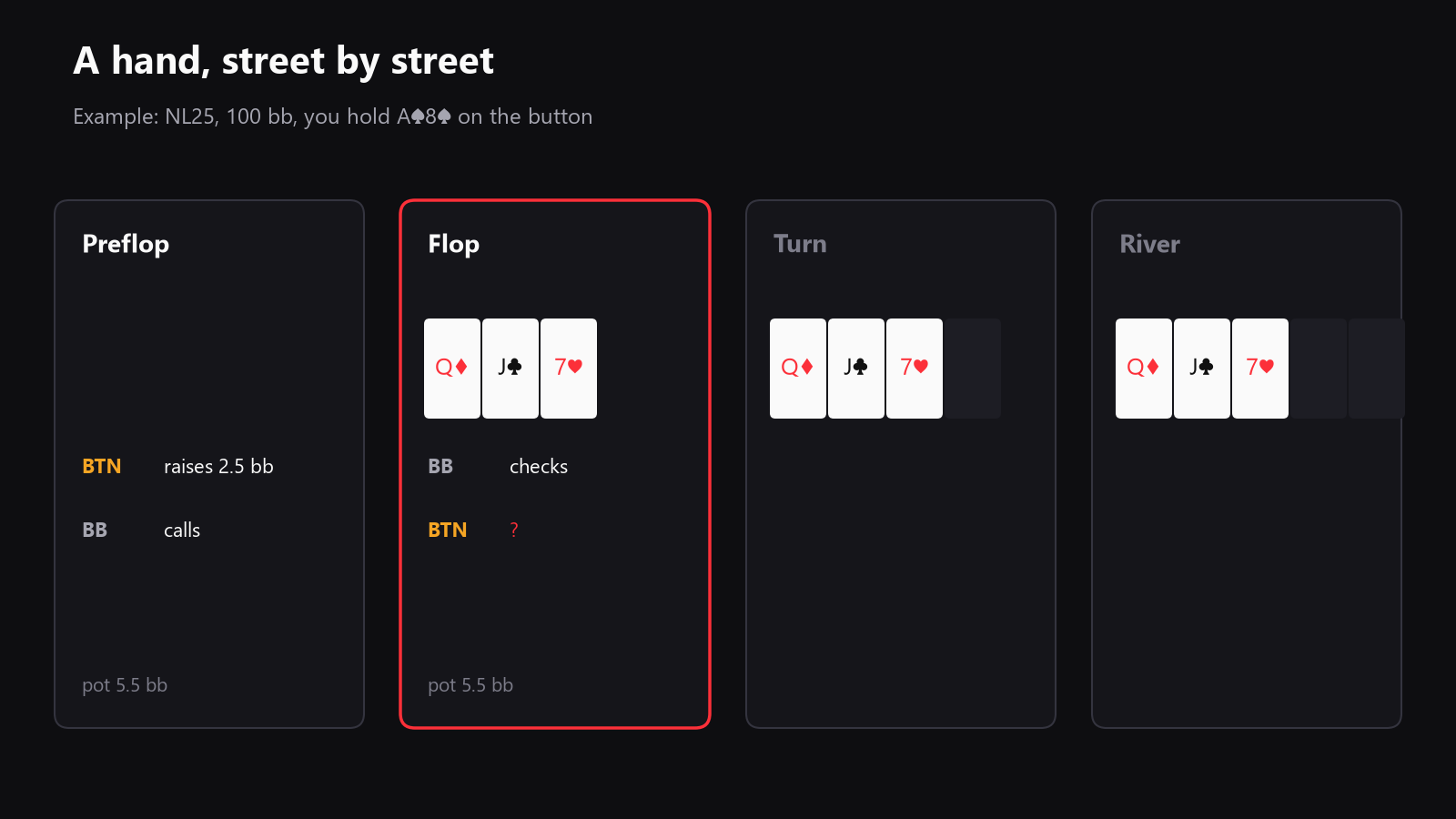
1. Freeze the hand at the moment you had to act
Look at the exact street where the decision mattered.
Ask:
- What was the pot size?
- What was the stack depth?
- What was the board?
- What was villain's line so far?
- What hands do I think villain has?
If you already know the result, hide it for a moment in your mind. Pretend the river card has not been dealt yet.
2. Define the options
What could you have done?
- Fold
- Call
- Raise
- Bet smaller
- Bet bigger
- Check
Do not review a hand with only one possible line in your head. That usually means you are not thinking clearly.
3. Compare the options by value, not by emotion
Ask which line had the best expectation.
That means comparing:
- your equity
- fold equity
- pot odds
- villain's tendencies
- the stack sizes
- rake, when it matters
If you do not know the exact number, that is fine. You can still compare directionally.
For example, if a call needs 20% equity and you think villain is value-heavy, the call may be bad even if you hit the card you needed.
4. Separate luck from logic
If you made the right play and lost, write "good decision, bad runout."
If you made the wrong play and won, write "bad decision, good result."
That one sentence helps more than most players expect.
5. Repeat only the spots that matter
Do not try to review everything with equal intensity.
The point is to find the spots that cost you the most.
A small mistake repeated often is worth more than a dramatic mistake you make once a month.
Use your review tools after the session
This is where a good workflow helps.
The free Dashboard module shows your win rate with its margin, tells you whether the sample settles anything, and draws your run inside its cone of variance. That is useful when you start wondering whether a short stretch proves anything at all.
The free Results module shows your curve and your money by month and over your career, by room, stake, position and hour of the day. It also shows the rake next to the result, and the all-in EV line.
The free Replayer module lets you replay a hand street by street, which is ideal when you want to stop the result from fogging the decision.
The free Self Analyser module helps you see which situations cost you the most in big blinds per 100 hands, and whether those costs are real or still inside noise.
A simple review checklist
If you want a practical routine, use this after each session:
- What was the key decision?
- What range did I give villain?
- What did I need in terms of equity or fold equity?
- Did I choose the best line given the information I had?
- Did the result change my opinion unfairly?
- Is this a real leak, or just variance?
If you want to go one step further, the free Plan module picks the situation that measurably costs you the most compared with the players at your limits, then runs a cycle: where you stand before, what to change, and a verdict after enough new decisions are in. That is a good way to stop studying random hands and start studying the hands that matter.
The mental shift that matters most
The real shift is this:
You stop asking, "Did I win this hand?" You start asking, "Was this the right decision?"
That change sounds small, but it changes everything.
It makes you calmer after a lost pot. It makes you less arrogant after a lucky win. It improves your review. It keeps your study honest. It protects you from rewriting history.
Poker rewards players who can live with uncertainty long enough to make good decisions.
If you want to improve, that is the habit to build.
And if you want to check your own hands with tools built for review, not for in-hand help, the free modules are there for exactly that.
Do it on your own hands.