
A downswing is a long stretch where your actual results run below expectation. It is not proof that you suddenly forgot how to play poker, and it is not a moral judgement. It is what happens when skill and variance mix, and variance gets a loud voice over a short sample.
That is the first thing to accept: even a winning player can lose for a long time.
If you only remember one idea from this article, make it this one:
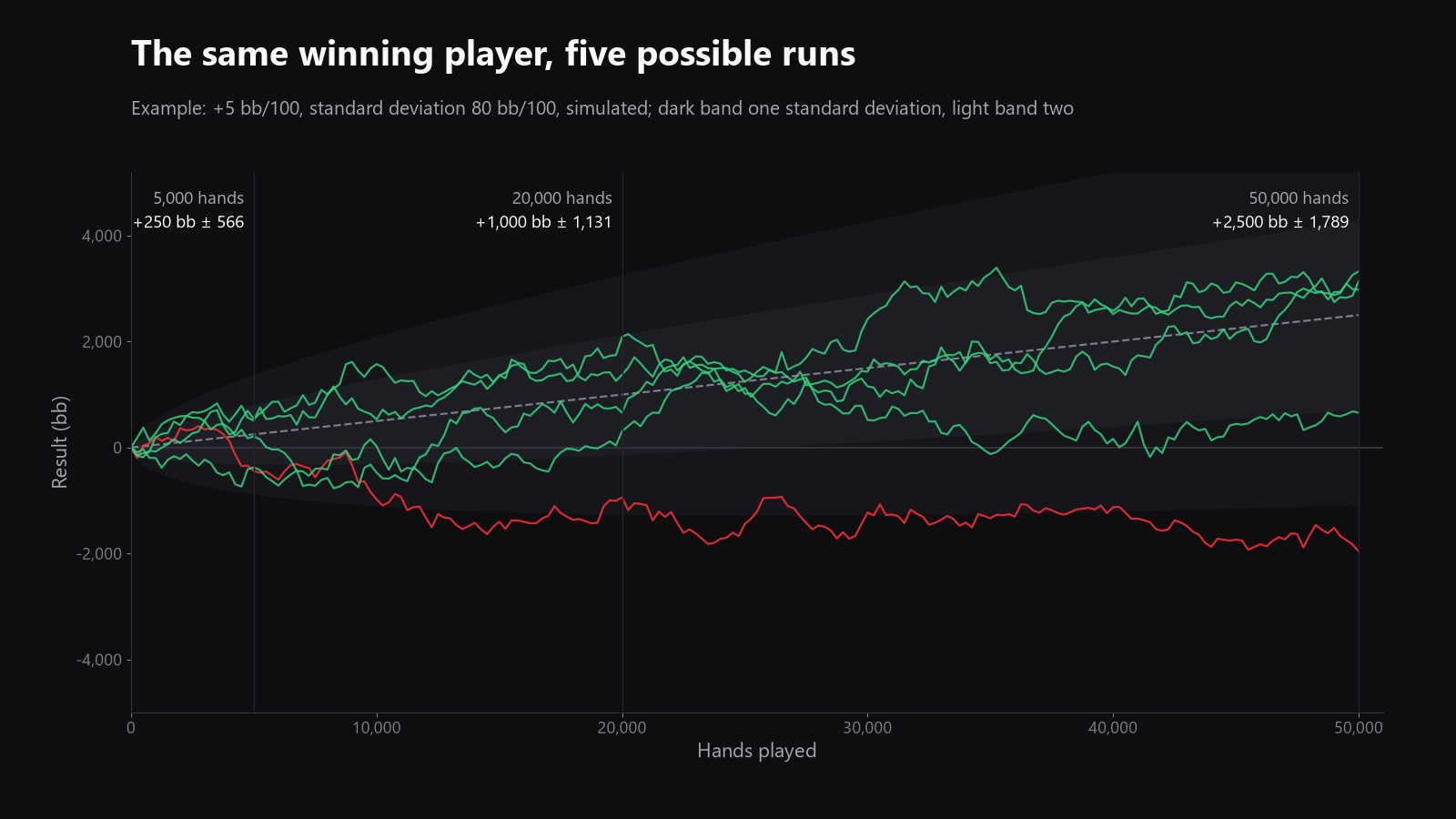
- your expected result grows linearly with hands
- the noise around that result grows with the square root of hands
So when your sample becomes four times larger, your uncertainty is only twice as large, not four times as large. Poker does not reward intuition here, it rewards arithmetic.
What a downswing looks like in numbers
Let’s use a simple example.
Suppose your true win rate is +5 big blinds per 100 hands, and your standard deviation is 80 big blinds per 100 hands. That is a reasonable teaching example for a cash-game player.
Now look at three sample sizes:
| Hands | Expected result at +5 bb/100 | One standard deviation of noise | What it means |
|---|---|---|---|
| 5,000 | +250 bb | 80 × √50 = 566 bb | You can be losing and still be a winner |
| 20,000 | +1,000 bb | 80 × √200 = 1,131 bb | The graph can still look ugly |
| 50,000 | +2,500 bb | 80 × √500 = 1,789 bb | A serious downswing is still possible |
A few things stand out.
First, the expected profit is real, but it is often smaller than the short-term noise.
Second, the spread gets bigger in absolute terms as the sample grows, even though the result becomes more reliable.
Third, a bad stretch that feels huge to you may still be perfectly normal on the math.
For a 100 bb buy-in game, that 1,789 bb spread over 50,000 hands is about 17.9 buy-ins. A result two standard deviations below expectation over 50,000 hands would be about 3,578 bb from expectation, so the 50,000-hand result can land that far below its +2,500 bb expectation, leaving the player about 1,078 bb down overall. That is a lot of money, but it is still not some statistical miracle. It is what variance can do.
This is why poker players often misread the graph. They think, “I am down, so I must be playing badly.” Sometimes that is true. Often it is not.
How long can a poker downswing last?
Long enough that you should stop using your feelings as the main source of truth.
A downswing can last:
- a few thousand hands
- several weeks
- months in a low-volume or high-variance game
- much longer in tournaments than in cash games, because tournament variance is bigger by nature
In MTTs, Spin & Gos, and other top-heavy formats, you can play well for a long time and still spend a brutal stretch below expectation. That is one reason bankroll requirements are larger in those games.
The right question is not, “How bad does this feel?”
The right question is, “Is this within normal variance, or is a leak showing up?”
Downswing or leak: how to tell the difference
This is where many players go wrong. They see a red line and assume the game is the problem. Or they see a loss and assume it is all variance. Both mistakes happen.
A downswing usually has these traits:
- it affects many parts of your graph at once
- it does not point to one clear spot
- it can appear even when your decisions are fine
- it often feels random, because it is random
A leak usually has these traits:
- it is concentrated in one or a few spots
- it repeats in the same situations
- it shows up by position, stack depth, street, or table type
- it stays there after the sample gets larger
This is where a good review tool matters.
The free Dashboard module shows your win rate with its margin, whether the sample settles anything, and your run inside its cone of variance.

If the dashboard says something like 4.61 ± 8.2, that is not a green light to declare victory. It means the interval is still wide. If it also says “Not enough hands to call it yet.”, believe it.
A sample can feel convincing long before it is actually convincing.
What to check before you call it a downswing
Use the results, not your mood.
The free Results module is useful here because it breaks the curve down by month and by career, by room, stake, position, and hour of day. It also shows the rake next to the result, and the all-in EV line.

That is important because the shape of the loss matters.
Ask yourself:
- Is the loss broad, or does it cluster in one spot?
- Is it worse in one position?
- Is it worse at one stake?
- Is it worse at one room?
- Does the all-in EV line explain part of it, but not all of it?
- Is rake eating a bigger share of your win rate than you expected?
If the result is poor everywhere, you may simply be in a downswing.
If the loss is local, you may have found a leak.
A very useful rule
A downswing usually explains the shape of the graph.
A leak usually explains the shape and the location of the graph.
That difference matters.
What to do during a downswing
A downswing is not the moment to improvise your entire strategy. It is the moment to protect your bankroll and keep your decision quality intact.
1. Respect your bankroll
If your bankroll rules say you should not play a certain stake, do not break that rule because you are frustrated.
If your bankroll has shrunk enough that your current limit is uncomfortable, move down.
That is not failure. That is risk management.
2. Keep volume only if your A-game survives it
More hands are good only if you still play well.
If you start clicking buttons faster, making thin calls out of frustration, or drifting into autopilot, extra volume is not helping. It is just producing more bad decisions.
3. Review after the session, not during it
Your mental game work belongs before and after a session. It does not belong in the middle of a hand.
If you are tilted, stop. The right response to a downswing is not to “get even” with the game. The right response is to keep your process clean.
4. Study what is actually costing you money
Do not study randomly.
The free Self Analyser module breaks your game into about 35 situations, from preflop to river, by position, and shows each one’s cost in big blinds per 100 hands, then says whether it separates from noise.
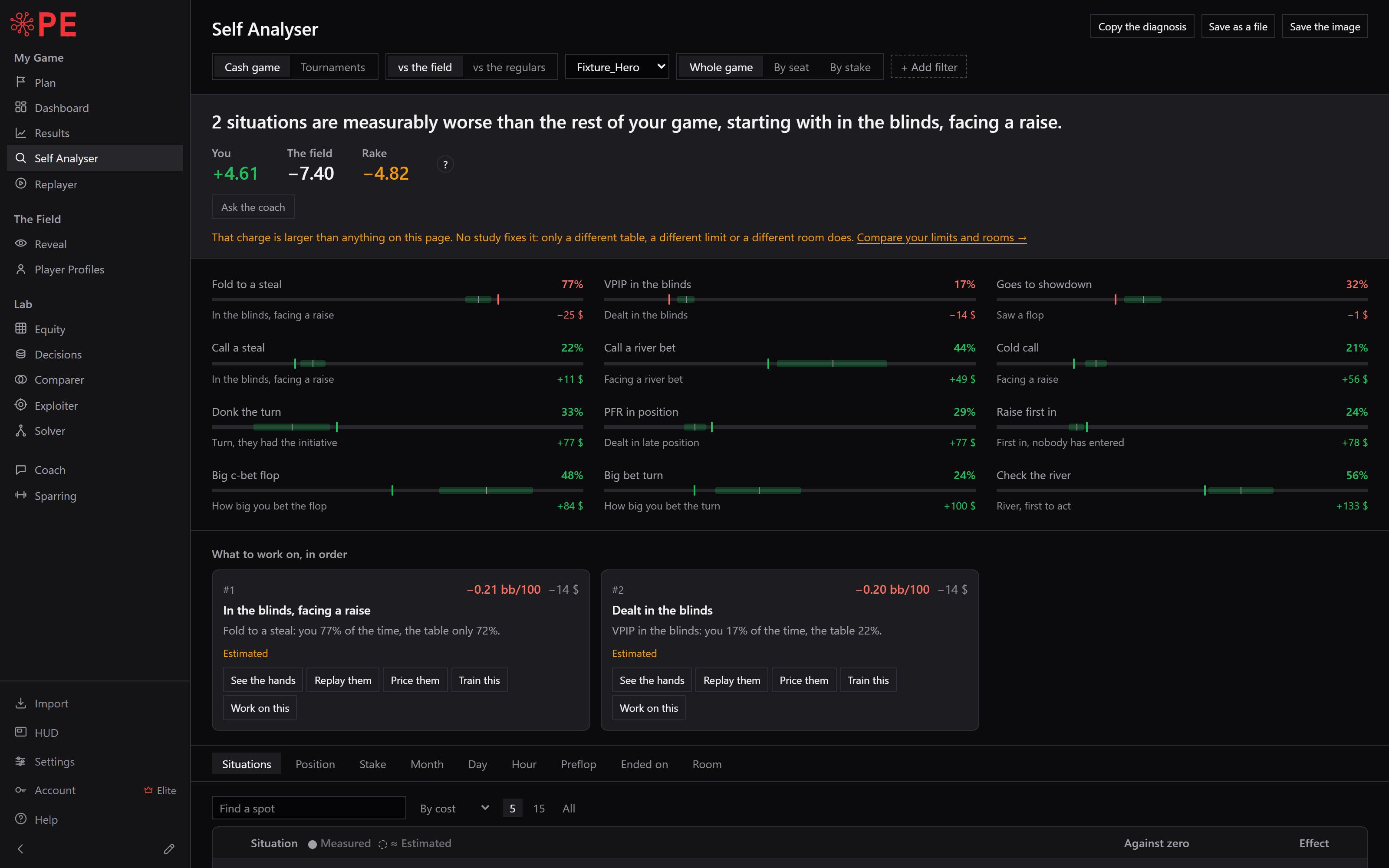
That is the right way to study during a downswing. You do not need more emotion. You need better targeting.
If you want a stronger study order, the free Plan module picks the situation that measurably costs you the most, compares it with the players at your limits, and runs a cycle: your statistic before, five training sessions, 150 new decisions in that situation, then a verdict.
That is much better than guessing what feels wrong.
What not to do during a downswing
A downswing is when players make expensive emotional mistakes. Avoid these.
Do not move up to win it back
This is one of the fastest ways to turn variance into a bankroll problem.
If you move up because you want to recover losses, you are not making a poker decision. You are making a feeling decision.
Do not overhaul your whole game after one bad stretch
A few bad sessions can make a good player look terrible.
That does not mean your ranges are broken. It means the sample is still noisy.
Do not trust all-in EV as a full explanation
The all-in EV line is useful, but only for all-in spots.
It does not explain everything else, such as bad sizings, missed value, wrong folds, or poor river decisions. It is a clue, not a verdict.
Do not ignore rake
At micro and small stakes, rake can be a silent killer.
Sometimes you are not just running badly, you are running into a structure that leaves too little room for your edge. If the rake is a large part of your cost, the answer may be a different room, a different stake, or a different game selection.
Do not keep playing in a bad mental state
If you are angry, tired, or desperate, the graph is not the main problem anymore.
Your decisions are.
A simple downswing checklist
When the results go wrong, run this checklist:
- Check sample size Is the dashboard still saying the sample is not settled?
- Check whether the loss is broad or local If it is local, look for a leak.
- Check your bankroll If the current stake is no longer safe, move down.
- Check rake In some pools, rake is a bigger problem than the technical leak.
- Check your all-in EV line Useful, but only as one clue.
- Review one or two spots, not your whole identity A downswing is not a reason to panic-edit everything.
- Use a targeted study plan Work on the biggest measurable cost first.
The practical mindset
A down run can make you feel like you are losing twice, once in money and once in confidence. The first loss is variance. The second loss is often your reaction to variance.
The good news is that you can handle both.
If you know the math, you stop treating every bad stretch as a mystery.
If you know how to separate a downswing from a leak, you stop changing the wrong things.
If you use your own hands to review the spots that matter, you stop guessing.
And if you want the numbers from your own game instead of a vague feeling, the free Dashboard, Results, and Self Analyser modules on Poker Exploit are built for that. They show you whether the sample says anything, where the money goes, and which situations are actually costing you.
Do it on your own hands.