
A reshove, also called a resteal or a 3-bet shove, is when you go all-in over someone else's open raise. In tournament poker, it is one of the most important preflop weapons once stacks get short enough that postflop play loses value, but not so short that everyone is already forced into push/fold.
The sweet spot is often somewhere around 12 to 25 big blinds. In that zone, a reshove can win in two ways at once: by making better hands fold, and by making worse hands pay you when they continue.
What a reshove actually is
A reshove is not just a big bluff. It is a pressure play with real showdown value.
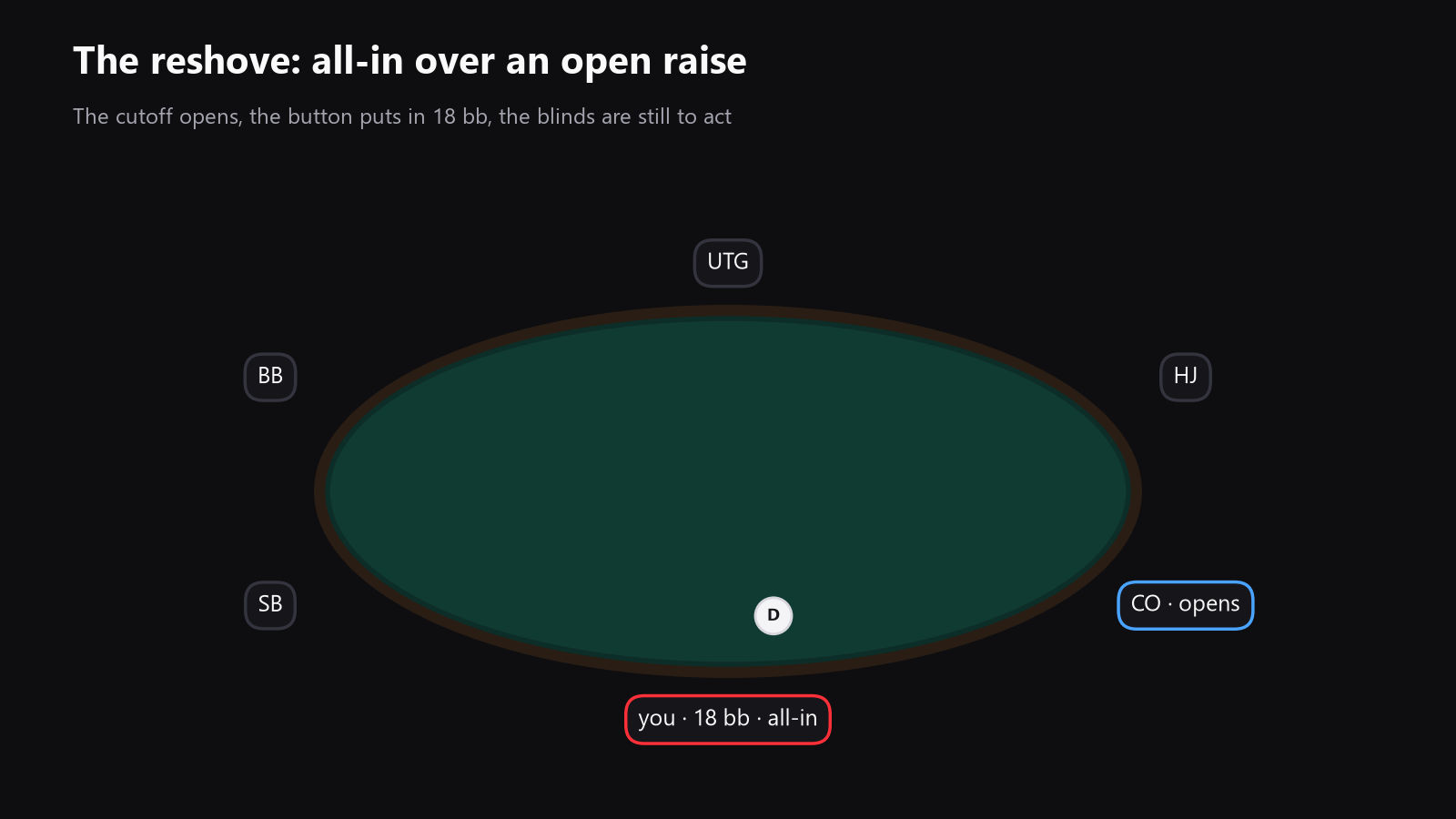
When you shove over an open raise, you are attacking money that is already in the pot. That is the key idea. The opener has put chips in. The blinds may be in the middle too. If they fold, you win all of it without seeing a flop. If they call, you still have equity with many hands, especially pairs, suited aces, and strong broadways.
That is why reshoves are so powerful in tournaments. They do not rely on outplaying someone after the flop. They rely on stack pressure, position, and dead money.
Why the reshove works
There are two parts to a profitable reshove.
1. Fold equity
Fold equity is the chance that the opener folds and gives you the pot.
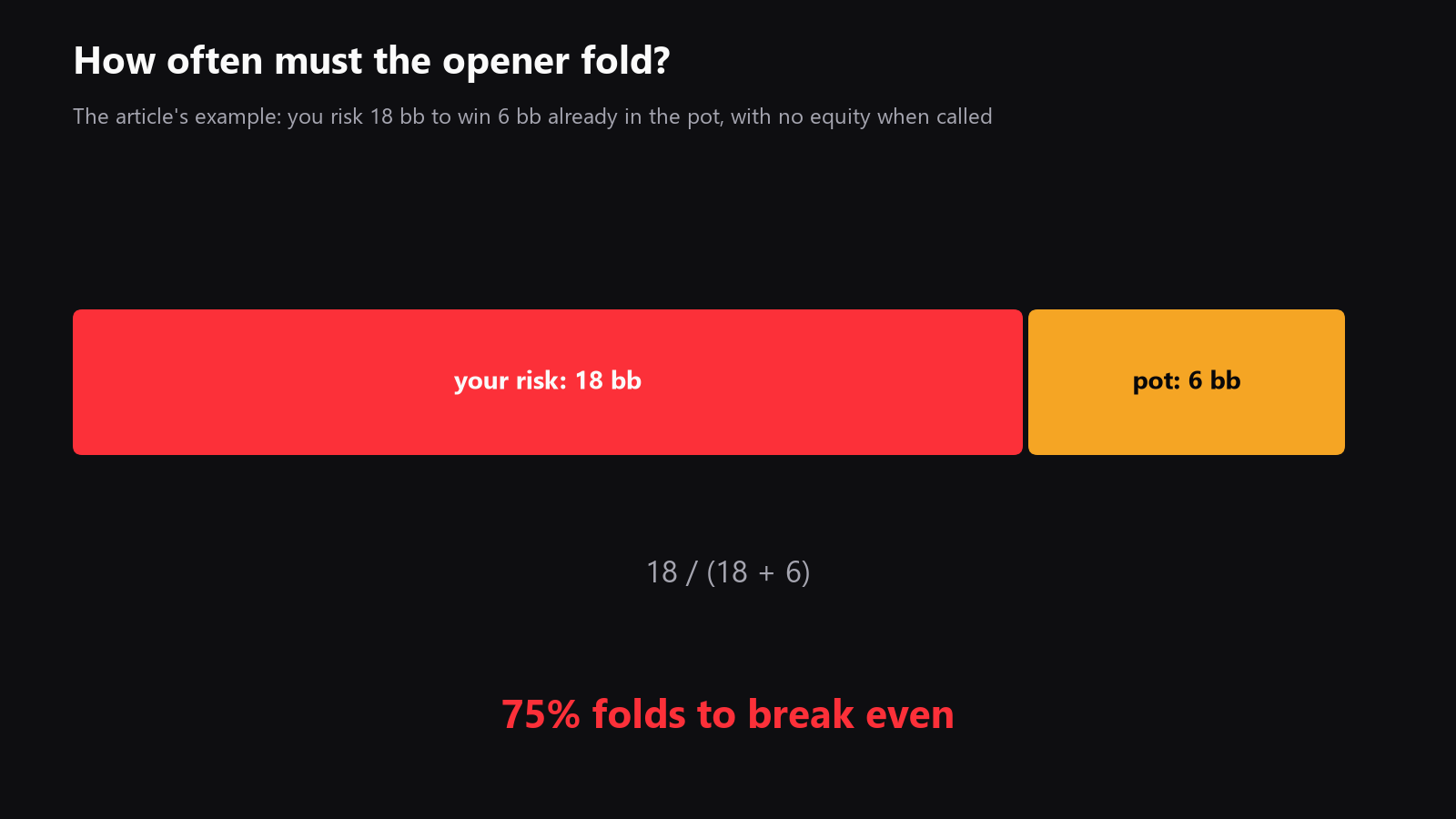
If you risk 18 big blinds to win 6 big blinds of dead money and your hand had zero equity when called, you would need folds 18 / (18 + 6) = 75% of the time just to break even.
That is the simplest way to understand the spot. The more dead money there is, the less often you need a fold. The smaller your risk, the easier it is to make the play work.
2. Equity when called
You are not dead when called. That changes everything.
A hand like A5s, 77, or KQs may be behind some calling ranges, but it still has enough equity to win a share of the pot when called. That equity lowers the fold frequency you need. In other words, the shove does not have to get through every time, because when it gets looked up, you still have a real chance to win.
That is why reshove spots are not the same as pure bluffs. A good reshove has both fold equity and equity when called.
Which openers you should target
Not every open raise is a good reshove target. The best ones usually have three things in common:
- they open from late position,
- they open too wide,
- they do not want to continue with a mediocre hand.
Best targets
The classic reshove targets are:
- cutoff opens
- button opens
- small blind opens when you are in the big blind
- late position openers who steal a lot and fold too much to pressure
Those players often open a lot of hands that cannot continue comfortably against an all-in. That is where your reshove prints.
Worse targets
Be much more cautious against:
- early position opens
- tight players who open a strong range
- players who call too much
- very short stacks who are already close to push/fold
- spots with heavy ICM pressure, especially near bubbles and final tables
If someone opens from under the gun in a tournament, their range is usually much stronger than a button open. If they are the type who hates folding, your fold equity collapses.
Open size matters too
A small open from late position is the cleanest target. A min-raise or 2x open gives you a spot where the opener can still be wide, but does not have to invest much before facing your shove.
A larger open can increase the dead money, but it also usually means a stronger range. So do not think only in terms of pot size. Think about how wide they are opening and how often they will continue.
Stack sizes: when a reshove is good, and when it is not
Your stack depth is the biggest factor.
Around 12 to 15 big blinds
This is one of the best reshove zones.
You are short enough that your all-in threatens a large chunk of the opener's stack, but deep enough that fold equity still matters. In this range, hands with good blockers and decent equity when called become very valuable.
This is where pairs, suited aces, and strong broadways start to shine as reshoves.
Around 15 to 20 big blinds
Still very strong, but more selective.
At these stacks, not every playable hand becomes a reshove. You want to be more careful about who opened, from where, and how likely they are to call. If the opener is tight, do not force the spot. If they are loose and positionally overactive, you can attack them hard.
Around 20 to 25 big blinds
This is the top end of the reshove zone.
You can still reshove profitably here, but only against the right opener and the right stack dynamic. The jam is bigger, so you need more fold equity or stronger equity when called. If the opener is strong, or if calling ranges are sticky, a smaller 3-bet or even a flat call may be better.
Below 12 big blinds
Now you are drifting toward pure push/fold territory.
You can still reshove over some opens, but many spots become very thin because your stack is already so short that you may prefer a direct shove when first in, or a more value-heavy reshove range over raises.
Above 25 big blinds
The reshove becomes much less automatic.
Once stacks get deeper, the all-in is expensive. You need a very good reason to risk that much as a preflop bluff. At that point, many hands that were clear reshoves at 15 or 18 big blinds become better as smaller 3-bets or folds.
The opener's stack matters too
A reshove is not only about your stack. It is also about the opener's stack.
The classic sweet spot is often a player with roughly 15 to 30 big blinds who opens from late position. That player can still open wide, but a call against your shove costs them a lot of tournament life.
If the opener is very short, they may be closer to open-jam territory already, which reduces your fold equity.
If the opener is much deeper, they may open wider, but they can also continue more confidently in some lineups, so the spot is no longer automatic. You want the opener to be wide enough to have weak hands in range, but not so committed that they can call off freely.
And in tournaments, ICM can change the answer sharply. A reshove that looks fine in chips can become too thin when payout jumps matter, especially if you are covered and the opener is not the shortest stack at the table.
Which hands make the best reshoves
You do not need a memorized chart to understand the logic.
The best reshove hands usually have at least one of these properties:
- they are strong enough to be called and still have equity
- they block the top of the opener's continuing range
- they do both
Good reshove families
As a practical starting point, think about:
- medium and strong pocket pairs
- suited aces
- strong broadways
- some suited broadways and connector type hands when the opener is very wide
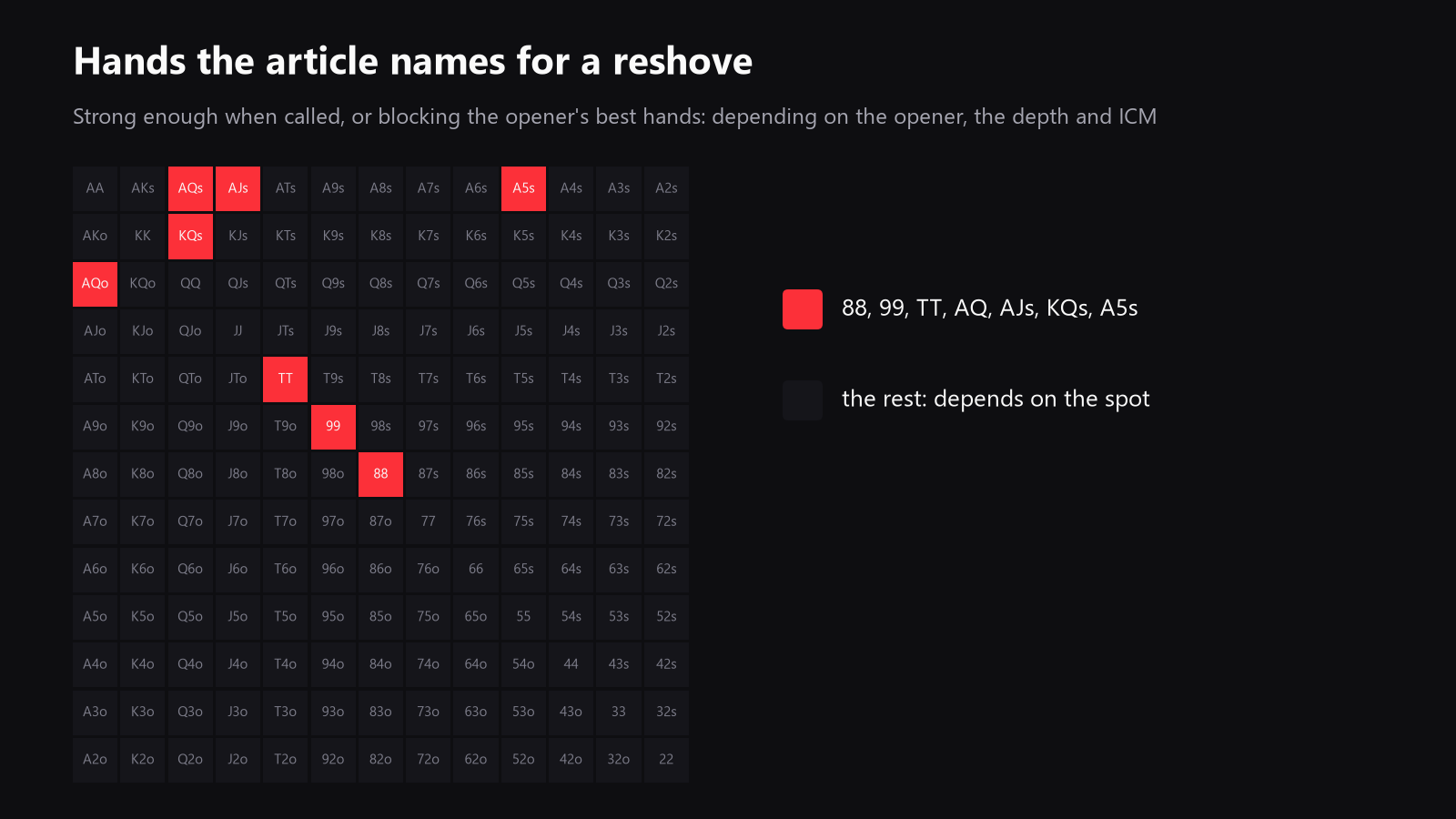
Hands like 88, 99, TT, AQ, AJs, KQs, and A5s are the kind of hands that often do well in reshove spots, depending on position, opener tendency, and stack depth.
Why blockers matter
Blockers are huge in reshoves.
If you hold an ace, you reduce the chance that the opener has AA, AK, AQ, and some of the strongest continuing hands. That increases fold equity.
That is why hands like A5s often play better as reshoves than their raw hand strength might suggest. They are not just pretty. They remove strong combos from the opener's range and still have real equity when called.
Hands that look tempting but are often bad
Be careful with hands that look playable but do not block much and do not realize enough equity when called.
That often includes:
- weak offsuit broadways
- dominated aces without the right blocker value
- pretty suited hands that are too weak versus a continue range
KJo, QJo, and similar hands can look close, but they are often poor reshove candidates against tighter opens, especially when ICM is in play.
A few practical rules you can actually use
Here is the simplest way to think about reshoves in tournaments:
- Target late position.
- Target wide openers.
- Prefer stacks around 12 to 20 big blinds.
- Go wider when you have blockers and decent equity when called.
- Tighten up when the opener is strong, sticky, or protected by ICM.
A reshove is usually best when the opener wants to open a lot of hands, but does not want to play for their stack with many of them.
That is why late position is so important. The wider the opening range, the more weak hands are sitting in it. Your all-in punishes that weakness.
How tournaments change the answer
In cash games, you can sometimes pressure people with deep stacks and keep play going after the flop.
In tournaments, chip preservation changes the whole picture.
Near the bubble, near big pay jumps, and at final tables, reshove ranges get tighter when you are covered. That is because busting matters more than chip gain.
If you cover the opener, the reshove often gets better.
If they cover you, it often gets worse.
If there are shorter stacks still waiting to bust, the reshove can get much worse again because your stack has more tournament value than pure chip EV would suggest.
That is why a good tournament player does not just ask, "Is this plus chips?" They ask, "Is this good for my tournament life?"
How to study reshoves away from the table
This is a study spot, not an in-game improvisation spot.
If you want to learn reshoves properly, you need to look at position, stack depth, opener tendencies, and ICM together. That is exactly the kind of spot you review after the session, not during it.
The Decisions module is for push, fold, or call when everyone before you has folded. It is not a reshove chart over an open raise.
For reshove study, the Reveal module is useful because it shows what real players at your limits actually do in tournament spots, and the Exploiter module includes ICM, which matters a lot once payout pressure starts to shape the decision.

The short version
A reshove in tournament poker is a preflop all-in over an open raise. It works because you win dead money often enough, and because your hand still has equity when called.
The best reshove spots are usually:
- around 12 to 25 big blinds
- against late position openers
- against players who open wide and continue too tightly
- with hands that block strong calls and still play well when looked up
If you remember only one idea, remember this: a good reshove is not about being brave. It is about attacking a weak opening range at the right stack depth with a hand that wins both before and after the call.
Do it on your own hands.