
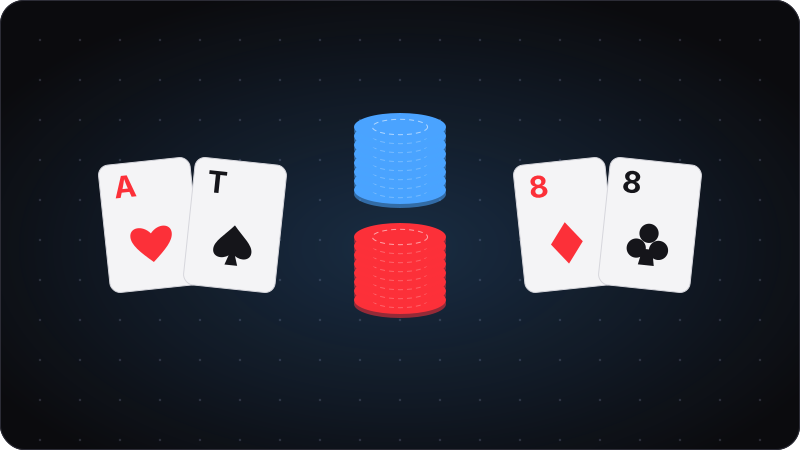
When you face an all-in in a tournament, the first mistake is to think only in terms of your hand. The real question is larger than that:
- What is the price of the call?
- What range is the shover likely to have?
- How much tighter should your calling range be than their shoving range?
- How do stack depth, the number of players behind, and ICM change the answer?
If you get those four ideas right, your calls stop being hopeful guesses and start becoming decisions.
1. Start with the price of the call
Before you think about hand strength, think about the pot.
If the small blind shoves X big blinds effective and you are in the big blind, you already have 1 big blind posted. You must add X - 1 more to win a pot of 2X.
So the chip-EV break-even equity is:
(X - 1) / (2X)
That gives you:
- 5 bb shove: call needs 4 / 10 = 40%
- 10 bb shove: call needs 9 / 20 = 45%
- 20 bb shove: call needs 19 / 40 = 47.5%
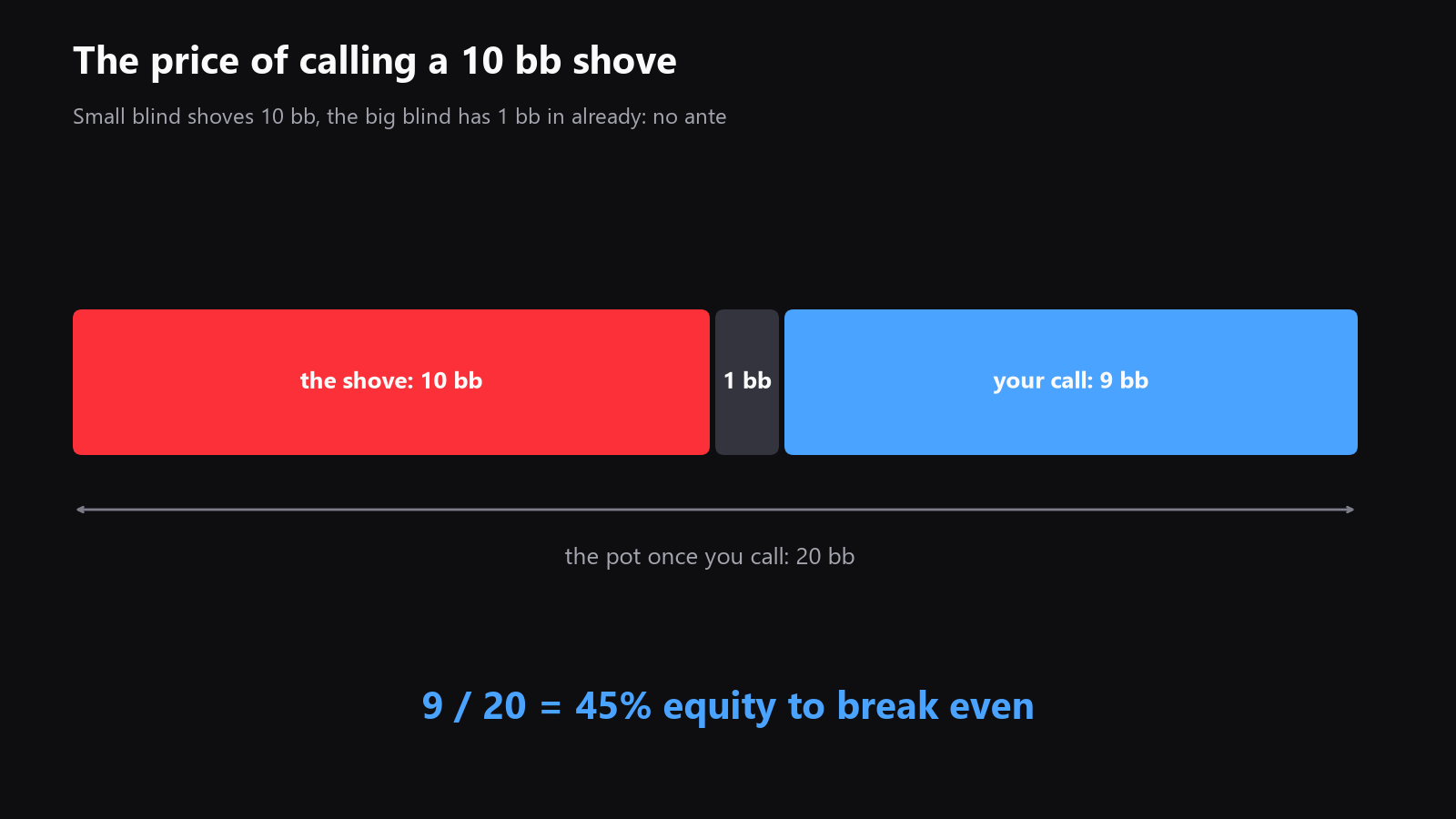
That formula is the floor. It is not yet a range, and it is not yet a correct tournament answer. It only tells you the raw price in chips.
If there are antes, the pot is larger and the price gets a little better. But the big idea stays the same: the call has a cost, and that cost is fixed before you even look at your cards.
2. The shover’s range is not random
A shove is always a range, not a hand.
A short stack pushing first in can profit from fold equity, dead money, and pressure on players who do not want to risk their tournament life. That means the shover can use many hands that would be too weak for a normal raise.
That is why you should never ask only, “Does my hand have equity?” You should ask, “What part of their range am I actually up against?”
A few examples of what changes that range:
- Position: early position shoves are usually tighter than late position shoves.
- Stack depth: the shorter the stack, the wider the shove can become.
- Payout pressure: on a bubble or near a pay jump, ranges shift fast.
- Who is behind: more players left to act means a shove faces more danger.
A strong calling hand against a wide late-position shove can become a bad call against a tighter early-position shove, even when the raw pot odds look similar.
3. Why your calling range is much tighter than the shoving range
This is the key concept.
The shover can win the pot without showdown. You cannot.
That one difference explains most of the gap between shoving and calling ranges.
When you shove, you get:
- the chance to make everyone fold
- the dead money already in the pot
- showdown equity when you get looked up
When you call, you get only the third part.
That means your call needs to be stronger than the shove that provoked it. You are paying full price for a hand that has no fold equity at all.
In practice, that is why many players overcall and under-shove. They feel the price is “not that expensive,” but they forget that a call is the most honest action in poker. You pay, and then you see.
A good rule of thumb is this:
- Shoving range: built from fold equity plus showdown equity
- Calling range: built mostly from showdown equity alone
So even when both decisions happen at the same stack depth, the calling range should be tighter.
4. Stack depth changes everything
Short-stack poker is not one thing. A 5 bb spot and a 20 bb spot may both look like “all-in poker,” but they play very differently.
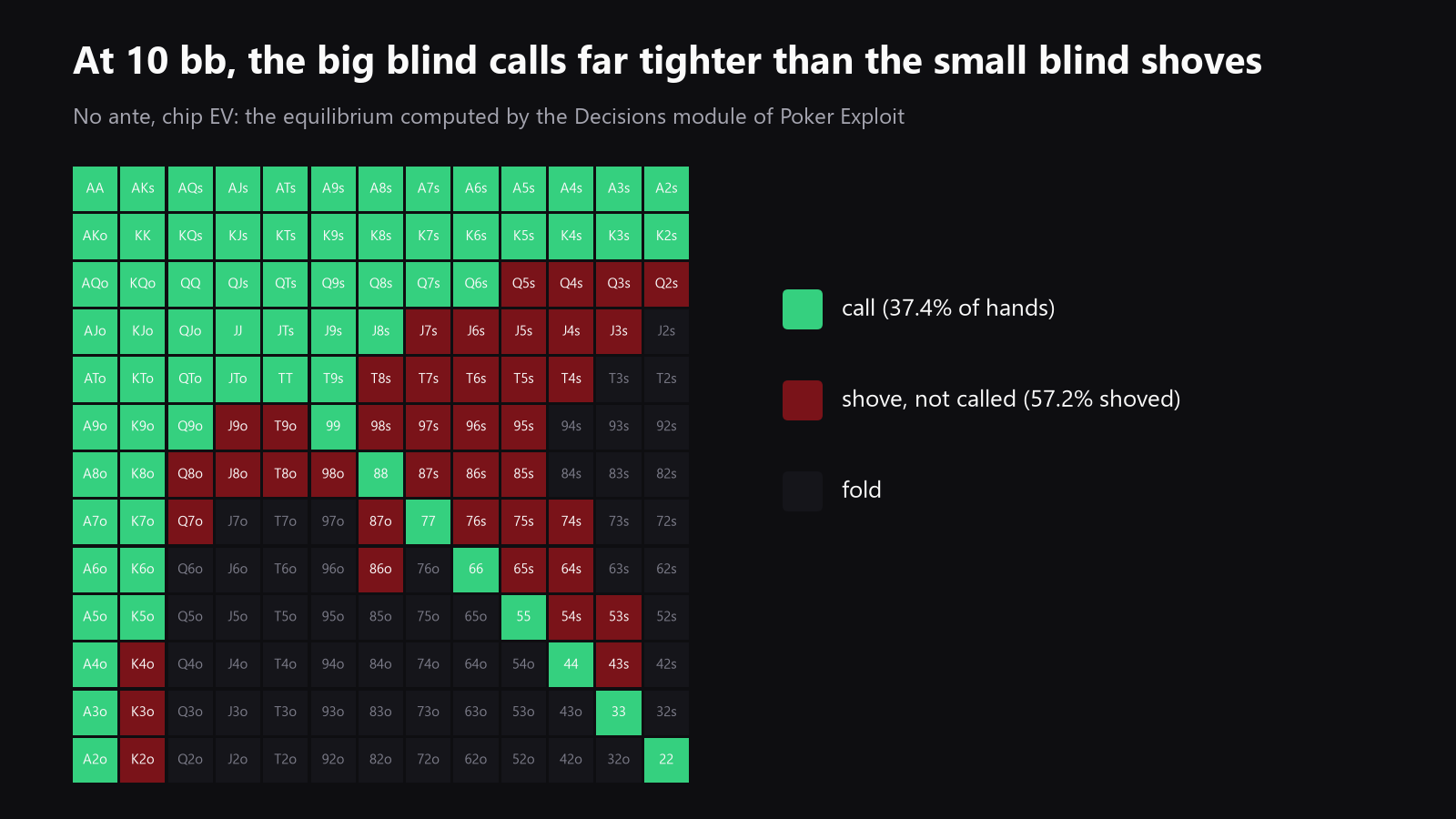
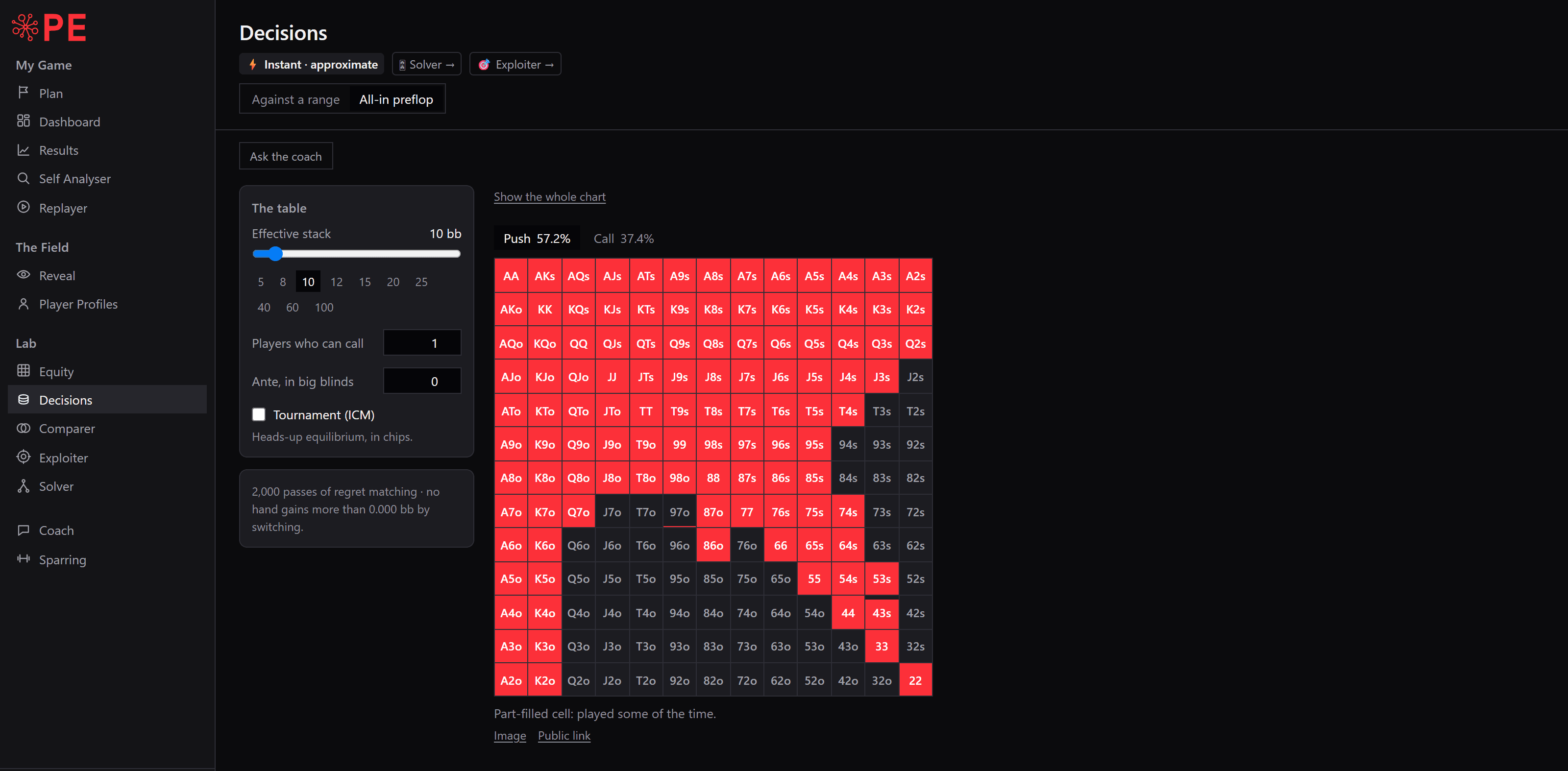
With Poker Exploit, the push/fold figures below were computed in chips. In a simple heads-up small blind shove versus big blind call spot, no antes, the equilibrium figures are:
- 5 bb: small blind shoves 72.6%, big blind calls 61.4%
- 10 bb: small blind shoves 57.2%, big blind calls 37.4%
- 15 bb: small blind shoves 44.6%, big blind calls 27.9%
- 20 bb: small blind shoves 40.3%, big blind calls 21.7%
Those numbers show two things clearly:
- The shove range is always wider than the calling range.
- As stacks get deeper, both ranges tighten, but the call tightens a lot.
That is exactly what you should expect. At 5 bb, you are close to pure push/fold poker. At 20 bb, most good tournament players are no longer thinking in terms of automatic all-in calls. There is more room for raises, folds, and future streets.
5. The number of players behind matters
If there are players still to act after you, your call gets worse, and your shove gets worse too.
Why?
Because action is not finished.
A call that looks fine heads-up can become a mistake when two more players are waiting behind you with strong ranges of their own. Even if you are not the one shoving, you are still exposed to overcalls, and that makes your hand much less comfortable.
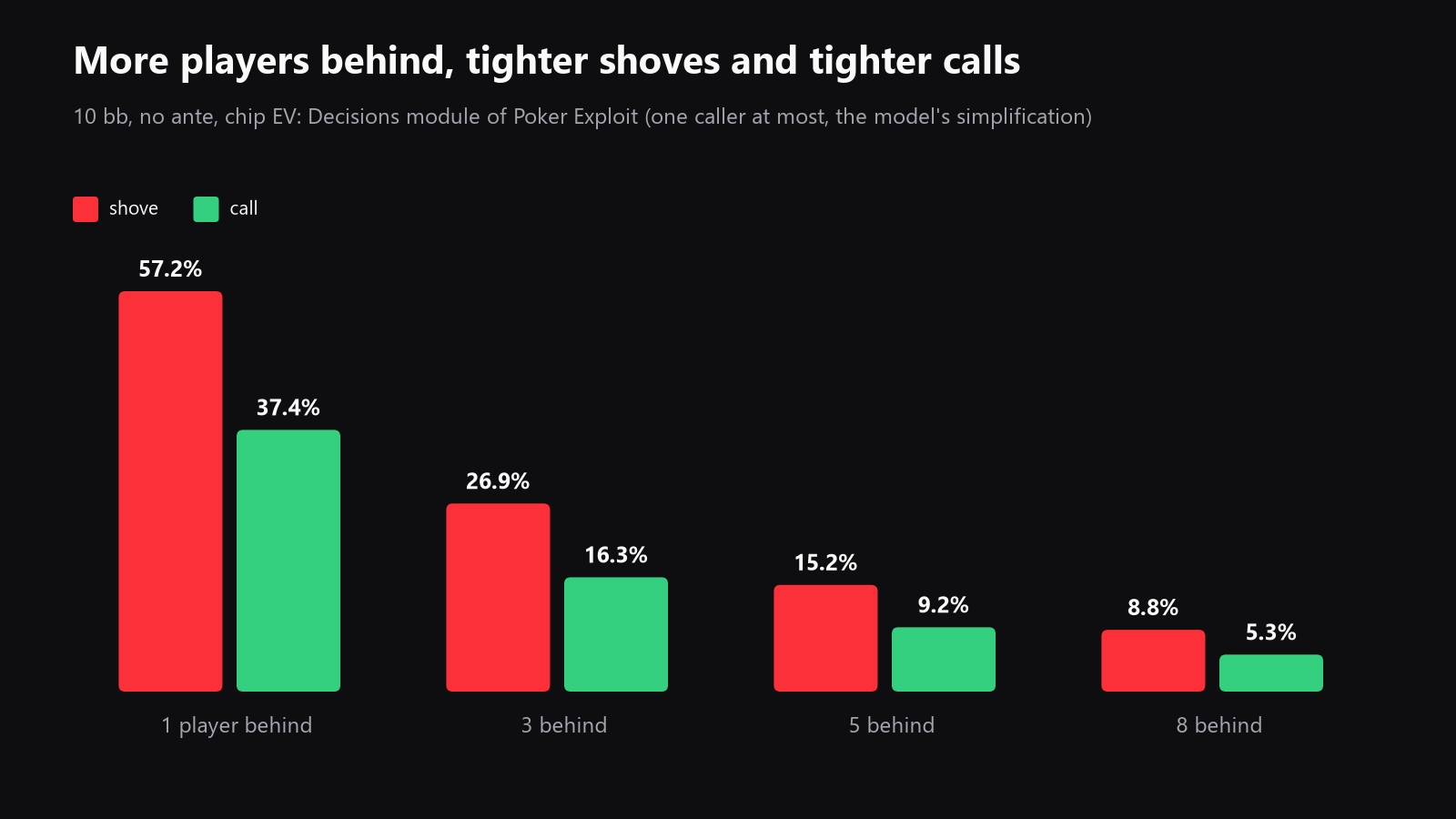
This is also where simple push/fold charts need context. Many charting models simplify multiway reality by letting only one player call with the same range. That understates how often a shove gets called in real play. In other words, the real table is usually less forgiving than the model.
So if you are using a chart:
- make sure it matches the exact seat order
- make sure it matches the stack depth
- make sure it matches the number of players left to act
If not, tighten up.
6. ICM can turn a call into a fold
Chip EV is not tournament EV.
That is the part many players learn too late.
On a payout bubble, your chips are not linear. Losing chips hurts more than winning the same amount helps. That is what ICM captures.
With Poker Exploit, the ICM model is the classic one: prize pool share is based on the chance each stack has of finishing in each place, from chips alone.
Here is a very simple example:
- four players
- each has 10 bb
- three places paid
- payouts are 50%, 30%, 20%
In the same small blind versus big blind spot:
- in chips, the big blind calls 37.4%
- on the bubble, with ICM computed with Poker Exploit, the big blind calls 2.7%
That is not a small adjustment. That is a completely different game.
The reason is simple: on the bubble, survival is valuable. A call that is okay in chips can destroy too much tournament equity if you bust.
The same logic applies whenever pay jumps matter:
- near the bubble
- near the final table
- at satellite-like stages
- in PKOs, where bounty value changes the balance too
If you are short and covered, your calling range usually shrinks. If you cover the other stack, the pressure is different, but the ICM logic still has teeth.
7. How to use push/fold calling charts the right way
Push/fold charts are useful, but only if you use them as a map, not as a crutch.
Use them when:
- the stacks are short enough for push/fold poker
- the action is simple
- the table situation matches the chart
- you know whether the chart is chip EV or ICM-based
Do not use them blindly when:
- there are many players behind
- pay jumps are large
- the table is not really in push/fold mode
- the spot is close enough that population tendencies matter
A chart should tell you two things:
- which calls are clearly profitable
- which calls are too thin once ICM or action behind is included
If you want a fast way to study these spots away from the table, the Decisions module in Poker Exploit gives push, fold, or call answers with a short stack, plus push/fold charts. The Reveal module is built for tournament pools too, so you can see what players at your limits actually do in spots like these. That makes it much easier to learn the shape of real tournament ranges, not just memorize a few hand labels.
8. A practical checklist before you call
When someone shoves, run this checklist in order:
- What is the exact price? How much are you calling, and how much are you trying to win?
- What range can they have? Position, stack depth, and tournament stage matter.
- How many players are behind you? More players behind means more danger and a tighter call.
- Is ICM active? Bubble, final table, and pay jumps can change everything.
- Is this a chart spot? If yes, use the right chart. If not, think.
If you do this consistently, you will stop making two common errors:
- calling too wide because the price looks cheap
- folding too much because the shove feels strong
The real skill is not “always call” or “always fold.” The real skill is knowing when the caller’s range has to be much tighter than the shover’s range, and why.
9. The short version
If you want the whole article in one sentence:
A tournament call against an all-in is a price, a range, and a payout problem at the same time.
Get the price right. Estimate the shove range correctly. Tighten up when players are still behind you. And respect ICM whenever chips are not worth chips anymore.
That is how you stop bleeding chips in the wrong places, and how you start making the calls that actually belong in your range.
Do it on your own hands.