
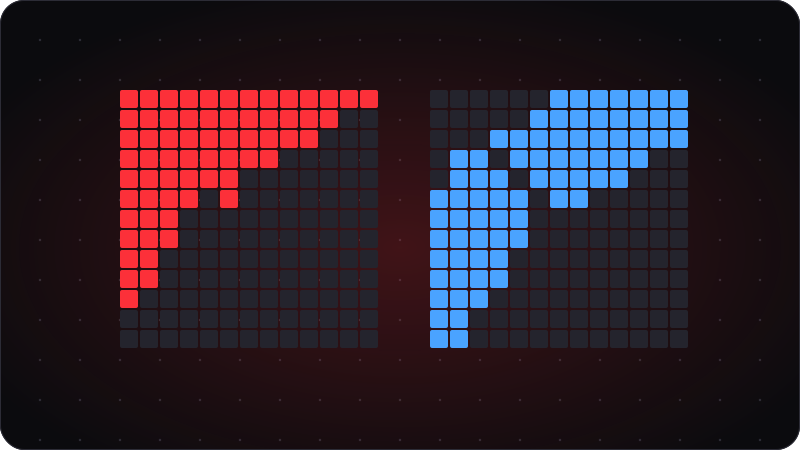
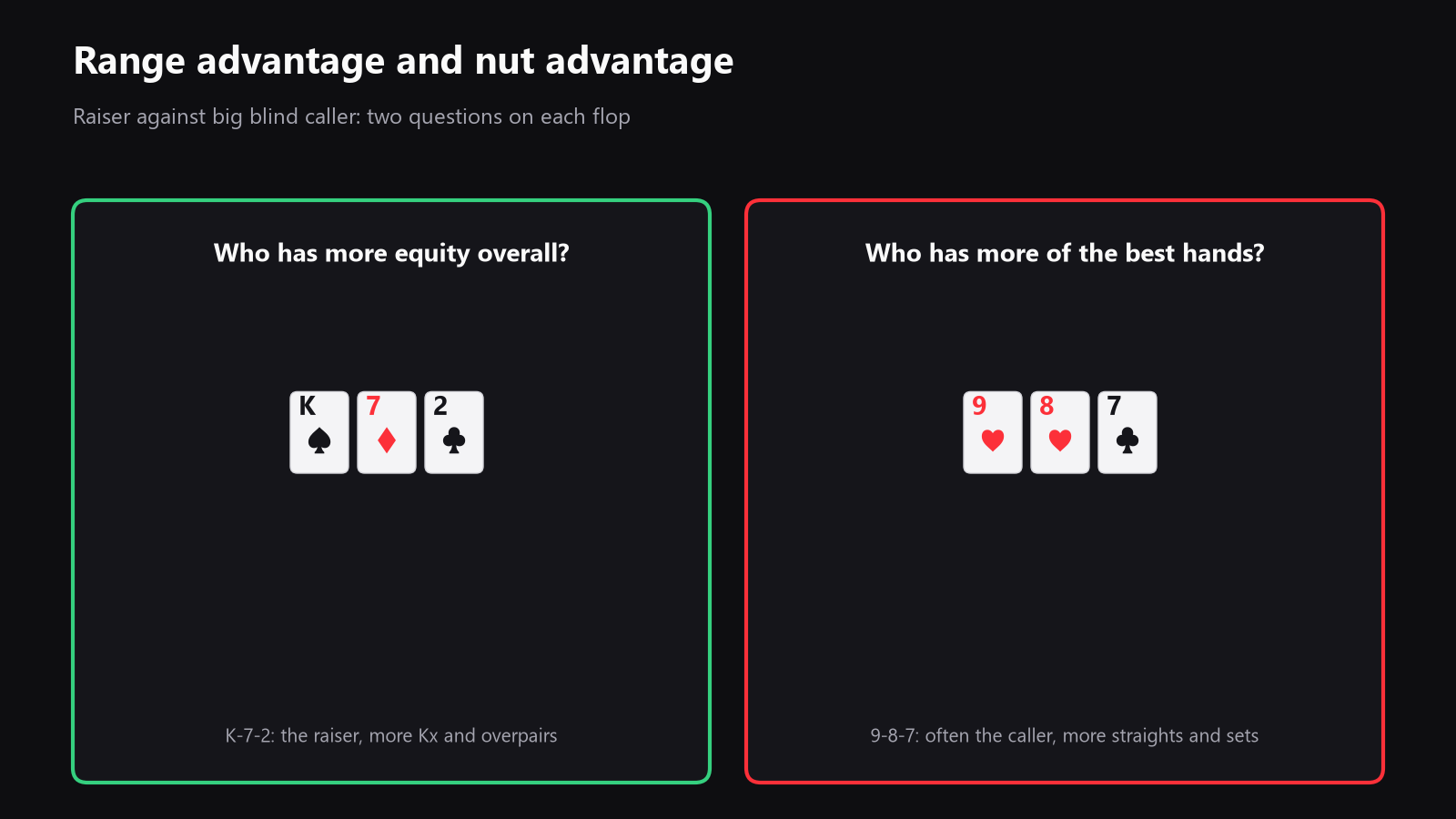
When a flop falls, the first question is not, “Do you have a hand?” It is, “Which range is better on this board?” Then comes the second question, which is just as important, “Which range contains the very best hands?”
Those are not the same thing.
- Range advantage is about overall strength, who has more equity across the whole range.
- Nut advantage is about the top of the range, who has more of the strongest hands, the hands that are closest to the nuts.
If you mix them up, your flop strategy gets blurry. You may fire too often on a board where the caller has the monsters, or you may check too much on a board where your range can apply real pressure.
Range advantage in plain English
Range advantage means that, on this specific board, one player’s full range does better against the other player’s full range.
It is not about one hand. It is about the whole bucket of hands you can have.
For example, if you raise preflop and the big blind calls, then the flop often helps you more on high cards and dry boards, because your range contains more strong aces, kings, broadways, and overpairs. The caller still has plenty of hands, but their range is usually more spread out and less concentrated at the top.
That does not mean you always have the nuts. It means your whole range is often ahead more often, or has more total equity.
A useful way to think about it:
| Question | What it tells you |
|---|---|
| Who has more range advantage? | Who has more total equity on this board |
| Who has more nut advantage? | Who has more of the strongest hands |
| What does that change? | How often you bet, and how big you can bet |
Nut advantage is different
Nut advantage means something narrower and more explosive.
It asks: which player has more of the very best hands, the hands that can stand a lot of heat, the hands that crush the board?
On a connected flop like 9-8-7, nut advantage often shifts toward the caller. Why? Because the caller reaches that flop with more hands like 65, JT, 98, two pair, and sets. The preflop raiser may still have good hands, but the caller usually has more of the absolute monsters.
That matters because nut advantage controls how much punishment a range can take and how much punishment it can give back.
If you have the nut advantage, you can often:
- bet larger,
- use a more polar range,
- put the other player in more difficult continue-or-fold decisions,
- and threaten stacks earlier on dynamic boards.
If you do not have the nut advantage, large bets get riskier, because your opponent can continue with more of the hands that beat you or dominate your value range.
Why the two are not the same
A range can have more overall equity without having the strongest top end.
That is the key idea.
Imagine two ranges on a flop:
- Range A has many medium-strong hands, top pairs, second pairs, overpairs, and decent draws.
- Range B has fewer medium-strength hands, but more sets, two pair, and straights.
Range A may have the range advantage. Range B may have the nut advantage.
That difference is why you sometimes see the preflop raiser c-bet small and often on dry boards, but check more on connected boards where the caller can smash the flop with more of the best hands.
How board texture changes everything
You can often guess who has range advantage and who has nut advantage just by looking at the board texture.
1. Dry high-card boards
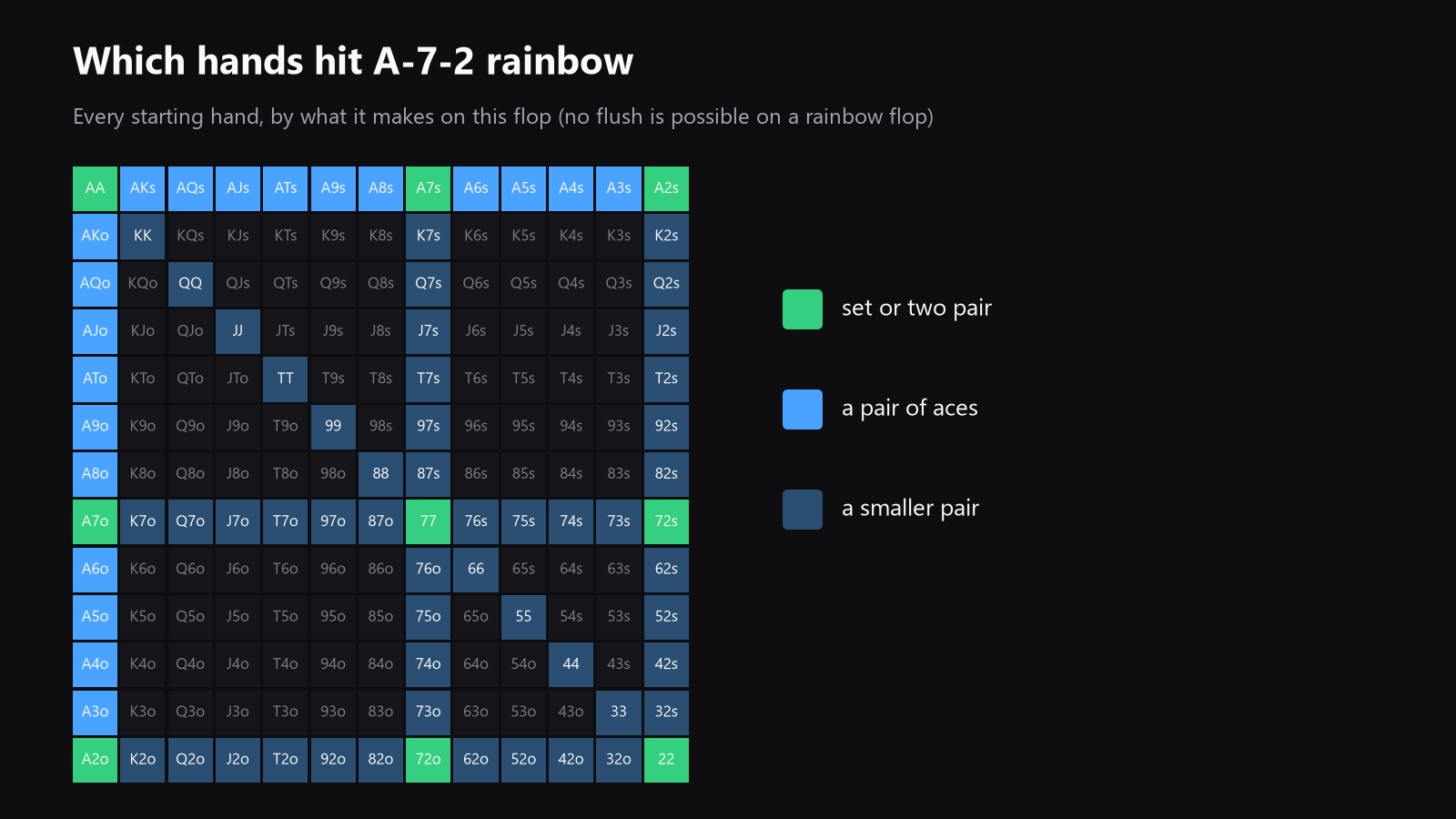
Example: A K 5 rainbow, or K 7 2 rainbow.
These boards often favor the preflop raiser.
Why?
- The raiser has more strong aces, kings, and broadways.
- The caller has more middle pairs, suited connectors, and random floats.
- The board does not give many cheap two-pair or straight combinations to the caller.
On these flops, the raiser often has both:
- a range advantage, because the whole range is stronger,
- and at least some nut advantage, because the top of range is very strong.
That is why small c-bets are common on dry boards. You do not need a huge size to make the caller uncomfortable. A small bet can attack the caller’s many mediocre hands while still keeping your own range wide.
If the pot is 10 bb and you bet 5 bb, the caller needs 25 percent equity to continue. That is not much. It suits a board where you want to bet often and keep the price manageable.
2. Connected middling boards
Example: 9 8 7 two-tone.
This is where nut advantage often shifts.
The caller usually has more:
- straights,
- two pair,
- sets,
- strong draws with real equity.
The preflop raiser may still have strong overpairs and big cards, so range advantage can be closer than people think. But the top of the caller’s range is often much stronger.
That means large bets become harder to justify unless you have a strong polar range of your own. You may need to check more, or bet with hands that are strong enough to continue against a raise and strong enough to value-bet big.
If the pot is 10 bb and you bet 10 bb, the caller needs 33.3 percent equity to continue. That bigger price is much more useful when you are representing a very strong, polarized range.
3. Paired boards
Example: Q Q 4, or 8 8 3.
Paired boards can look simple, but they are sneaky.
Sometimes the preflop raiser has a range advantage because their overpairs and high cards hold up well. Sometimes the caller has more trips or boats in the lower part of the pairing structure. The exact preflop ranges matter a lot.
The key point is that paired boards often reduce the number of natural strong combinations. That makes blockers, position, and stack depth more important. They also change how easy it is to represent the nuts.
4. Monotone boards
Example: A spade, 9 spade, 4 spade.
On monotone boards, the pure top of range is often shaped by flush blockers and the ability to continue with strong flushes or strong one-card flush blockers.
These boards can look like they belong to one player, but they often force you to think more carefully about:
- who can have the nut flush,
- who can have the second nut flush,
- and who is capped to weaker flushes or non-flush hands.
What range advantage changes in practice
Range advantage usually pushes you toward:
- betting more often,
- betting smaller,
- keeping your range wide,
- and putting pressure on many weak continues.
Nut advantage usually pushes you toward:
- betting less often, but with more purpose,
- betting larger,
- polarizing your range,
- and using hands that can stand a raise or a call from a strong continuing range.
That is the real strategic link.
Range advantage says, “I can attack a lot of your range.” Nut advantage says, “When I attack, I can do it with the hands that matter most.”
A simple betting framework you can use
Before you c-bet the flop, ask yourself these four questions:
- Who has more top pairs and overpairs?
- Who has more sets, two pair, and straights?
- Who has more strong draws that can continue against pressure?
- If I bet, what worse hands actually call?
If the answers point to you having the overall edge but not a huge nut edge, a small bet often makes sense.
If the answers point to the caller having more of the strongest hands, you usually need a more cautious strategy, or a more polarized one.
Three practical examples
Example 1: A K 5 rainbow, preflop raiser versus big blind caller
This board usually leans toward the raiser.
Why?
- Strong ace-x and king-x hands are common in the raiser’s range.
- The board is dry, so the caller has fewer natural monsters.
- Many of the caller’s hands have only weak showdown value.
Here, range advantage is the main story. Small bets work well because you can pressure the caller’s middling hands without needing a huge size.
Example 2: 9 8 7 two-tone, preflop raiser versus big blind caller
This board often shifts nut advantage toward the caller.
Why?
- The caller arrives with more connected hands.
- Straights and two pair appear more often in the caller’s range.
- The raiser still has overpairs and big cards, but the very top of the board is often not theirs.
Here, the caller can often continue more comfortably against pressure, so the raiser usually slows down more, checks more, and uses stronger, more selective bets.
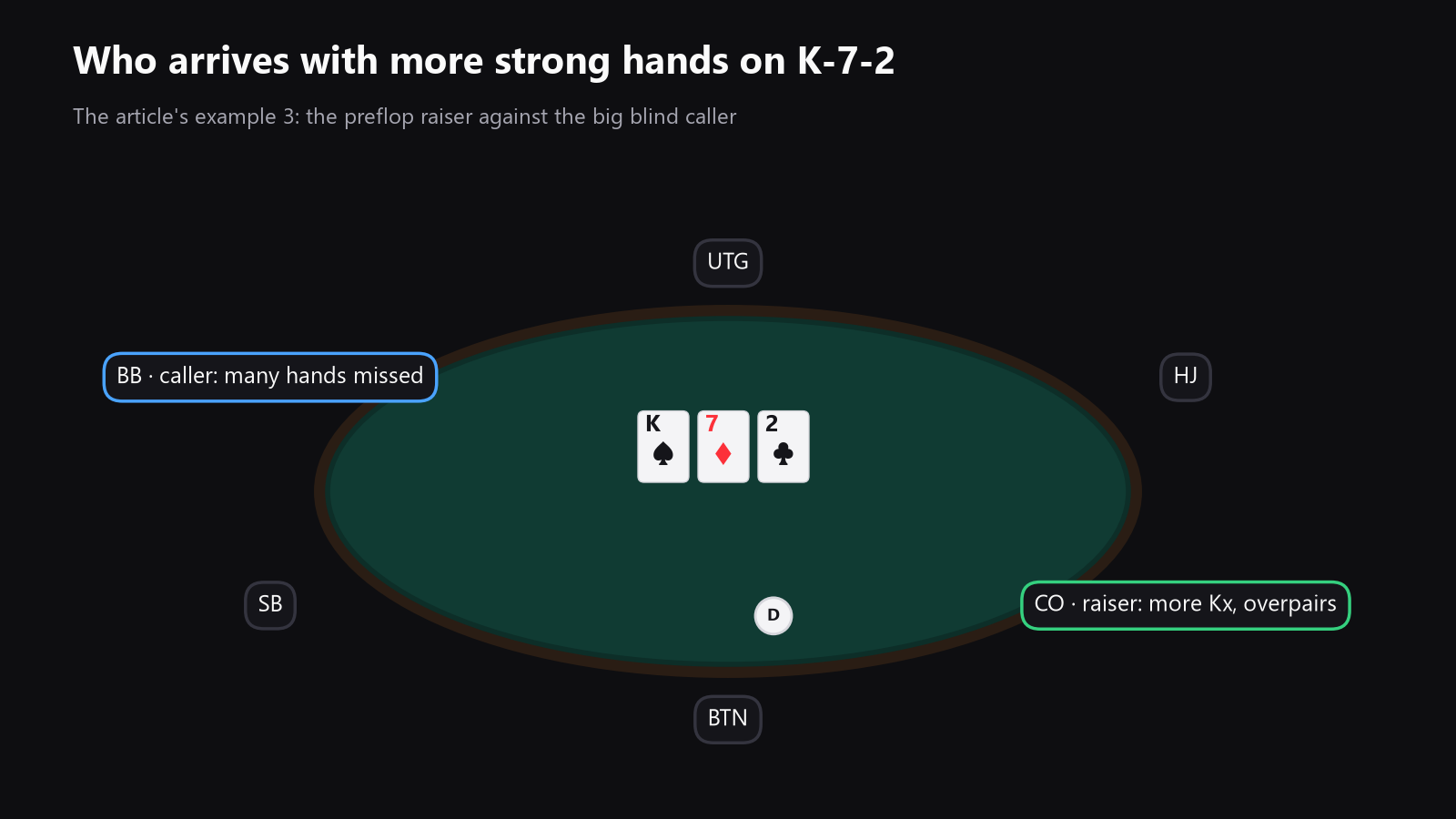
Example 3: K 7 2 rainbow, preflop raiser versus big blind caller
This is another board that usually favors the raiser.
It is a classic example of range advantage:
- The raiser has more K-x that gets there strongly.
- The caller has many hands that missed.
- The board is not very connected, so there are not many hidden monsters.
That makes it a good board for frequent c-bets. It is not just about having one strong hand. It is about how often your whole range can continue to apply pressure profitably.
Why bet size follows the advantage
Bet size is not random.
It should match the shape of your range.
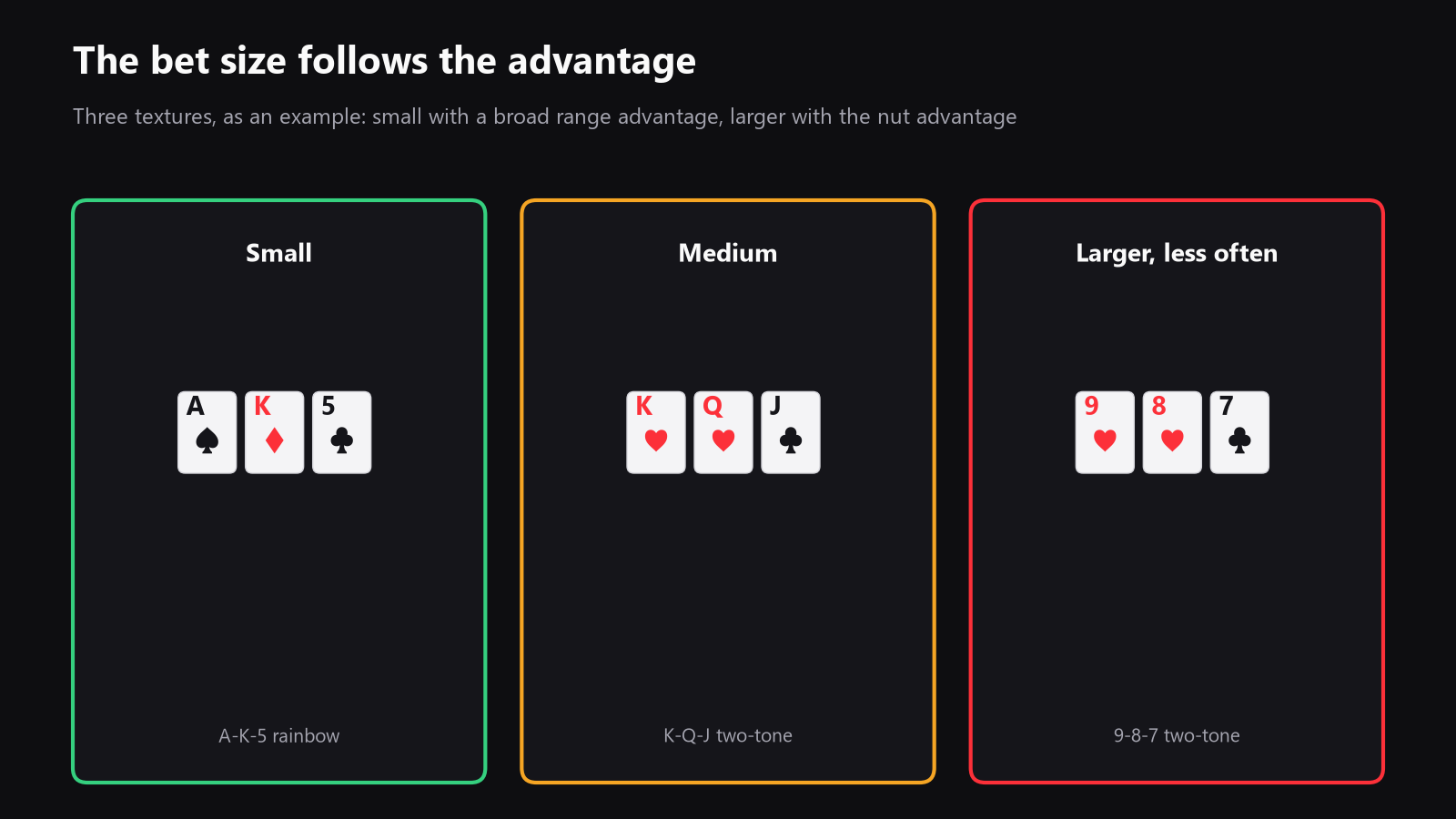
- Small bets work best when you have a broad range advantage and want to attack many weak hands at low risk.
- Medium bets work when you want more fold equity, but the board still gives the other player enough continues.
- Large bets work best when you have a strong nut advantage and can credibly represent a very strong, polarized range.
That is why the same player can c-bet small on one flop and much bigger on another, even with a similar preflop range.
The board changed. So the leverage changed.
A quick mistake to avoid
Do not think, “I have range advantage, so I should always bet.”
That is too simple.
Sometimes you have range advantage, but the board is dynamic enough that your opponent’s nut advantage matters a lot. In that case, you may still bet, but less often, and usually for a size that fits your range.
And do not think, “I have nut advantage, so I should always blast.”
That is also too simple.
If your overall range is weak, or if the board is one where you do not have enough medium-strength hands to back up your value bets, your big bets can become easy to attack.
The best flop strategy usually comes from combining both ideas:
- who has the stronger whole range,
- and who has the strongest top end.
How to study this away from the table
This is a good spot to use tools off the table, not during a session.
The Reveal module helps you see what the field at your limits actually does on these flop textures, from your own hand histories. That is useful because theory and population tendencies are not always the same thing.
If you want to test a specific flop later, the Solver module can study the spot away from the table. And if you want to see where your own flop play leaks compared with the rest of your game, the Self Analyser shows that too.

The short version
If you remember only one thing, remember this:
- Range advantage tells you who is better across the whole range.
- Nut advantage tells you who owns the strongest hands.
- Range advantage usually drives frequency.
- Nut advantage usually drives size.
When both point the same way, betting becomes much easier. When they split, you need to slow down, think in ranges, and choose your size with care.
That is the real skill behind c-betting well on the flop.
Do it on your own hands.