
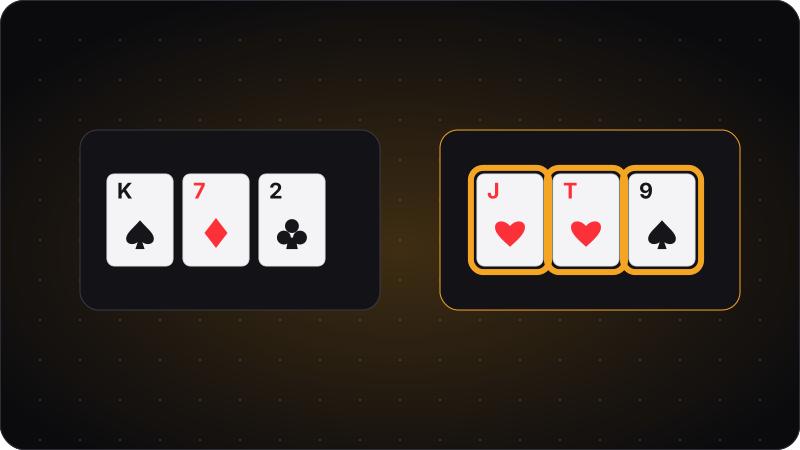
Board texture is one of the simplest poker ideas to name and one of the easiest to use badly.
You see three flop cards, but the real question is not just what they are. It is how those cards interact with the ranges that arrived there. A flop can be dry or wet, paired or unpaired, monotone or rainbow, high or low, connected or disconnected. Those labels are useful because they tell you who is more likely to have the strongest hands, who has the better draws, how often a continuation bet makes sense, and whether a small size or a big one fits the spot.
If you understand board texture, you stop thinking, “This flop looks scary,” and start thinking, “Whose range hits this board hardest, whose nuts are here more often, and how much does the turn usually change things?”
What board texture means
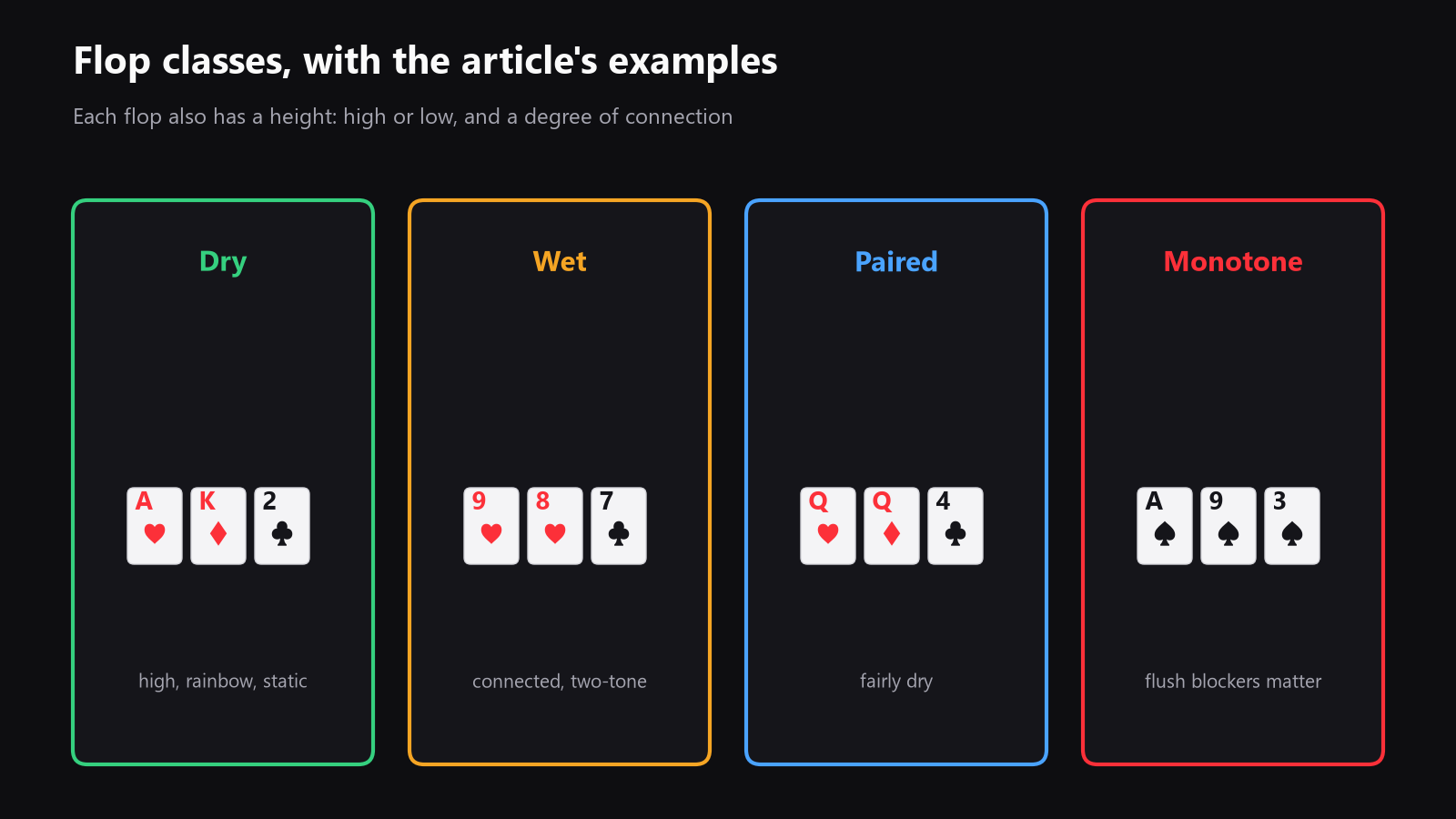
Board texture is the relationship between the flop and the ranges in the hand.
A flop is not dry or wet in a vacuum. It is dry or wet relative to the two ranges that reached the flop. The same board can play very differently depending on positions, stack depth, opening range, calling range, and even tournament ICM.
For example:
- A-K-2 rainbow is often dry and high.
- 9-8-7 two-tone is wet and connected.
- Q-Q-4 rainbow is paired and fairly dry.
- A♠ 9♠ 3♠ is monotone, and texture changes because flush blockers matter much more.
Two ideas sit behind almost every texture discussion:
- Range advantage: which player has the stronger overall range on this board.
- Nut advantage: which player is more likely to have the very best hands, the monsters that can keep betting for big pots.
Board texture matters because it changes both.
Dry boards and wet boards
A dry board has few obvious draws. Straight draws and flush draws are limited, and hand strength changes less on later streets.
Typical dry boards:
- A-K-2 rainbow
- K-7-2 rainbow
- Q-Q-4 rainbow
On dry boards, ranges are often more separated by top pair, overpairs, and ace-high hands. Because there are fewer draws, many hands are already close to their final value. That makes these boards more static.
A wet board has many draws and many ways for equities to change.
Typical wet boards:
- 9-8-7 two-tone
- J-T-9
- 6-5-4
- T-8-7 with two suits on board
On wet boards, there are many straight draws, flush draws, pair-plus-draw hands, and overcards with equity. These boards are dynamic. A turn card can swing the hand much more than on a dry board.
That difference changes everything. On a dry board, a small continuation bet can work well because many hands have missed and the board does not offer many easy continues. On a wet board, the same small bet often gives too much price to hands that can continue with equity, so checking more or betting larger becomes more attractive.
A useful shortcut
Ask yourself one question: how much does the turn change the board?
- If the answer is “not much,” the board is probably dry or static.
- If the answer is “a lot,” the board is probably wet or dynamic.
That shortcut is not the whole story, but it is a good start.
High boards and low boards
High cards and low cards also matter.
A high board has cards like A, K, Q, or sometimes J. These boards often favor the preflop raiser because opening ranges usually contain more top pairs, better kickers, and more overpairs.
Examples:
- A-K-2
- K-Q-5
- Q-J-4
A low board uses lower ranks like 9, 8, 7, 6, 5, 4, 3, 2. These boards often interact more with calling ranges, especially if the caller can defend many connected and suited hands.
Examples:
- 9-8-7
- 7-5-3
- 6-4-2
But texture is relative. A low board can still favor the raiser if the caller does not defend wide enough, and a high board can still favor the caller if the caller has the right top pair and two pair combinations.
So do not memorize “high is good, low is bad.” Instead, ask which range has more strong made hands and strong draws on this exact board.
Paired boards
A paired board repeats one rank.
Examples:
- K-K-4
- Q-Q-2
- 8-8-3
Paired boards are interesting because they reduce the number of natural two pair combinations and often reduce the number of obvious draws. That can make the board feel quieter than a connected board, even when it is not especially dry in the traditional sense.
Paired boards often do one of two things:
- They make the board more static, because fewer turn cards radically change the texture.
- They create strong polar spots, where the best hands are trips, boats, or very strong kickers, while many medium hands become bluff catchers.
A high paired board like K-K-4 often favors the player with more strong kings and overpairs. A low paired board like 8-8-3 can be more awkward, because many ranges contain overcards and one-pair hands that dislike big pots.
The key point is that paired boards compress the value of many hands. A second pair or weak top pair often means less than it would on an unpaired board.
Monotone boards
A monotone board has three cards of the same suit.
Examples:
- A♠ 9♠ 3♠
- K♥ 7♥ 2♥
- Q♦ J♦ 4♦
Monotone boards change the game because flushes and flush blockers become central. A hand that would be strong on a rainbow board can become much less comfortable when one suit dominates the flop.
On monotone boards:
- Made flushes matter immediately.
- Nut flush blockers gain value.
- Bluffing ranges need care, because many hands continue with at least one card of the suit.
- Small mistakes in sizing can be expensive, because equity often sits closer together than it looks.
A player holding the ace of the suit has a major blocker advantage. A player without that blocker may need to be more selective with aggression.
Monotone boards are not automatically “bet less” boards. They are “think harder” boards. The better question is not whether the board is monotone, but which player is more likely to have the nut flush and the better flush blockers.
Connected boards
A connected board has cards close in rank, which creates many straight possibilities.
Examples:
- 9-8-7
- T-9-8
- 6-5-4
- J-T-9
Connected boards are usually wet, dynamic, and difficult. One pair is often fragile, overpairs lose some comfort, and many hands have strong draws.
These boards often give the caller more playability, especially if the caller defended hands like suited connectors, one-gappers, and middle pairs. That is why connected boards frequently produce more checking, more semi-bluffing, and bigger bets when someone does choose to apply pressure.
Connected boards also punish passive lines. If you give too many free cards on a board like 9-8-7, you let too many turns improve the other range.
Why texture changes who bets
Board texture changes betting because it changes three things at once:
- Who has more strong hands
- Who has more strong draws
- How much the board can change later
When you have both range advantage and nut advantage, you can usually bet more often. When the board is static, small bets often do the job well. When the board is dynamic, checking more or sizing up becomes more attractive.
A simple way to think about it:
- Dry, high, static boards often reward frequent small bets.
- Wet, connected, low boards often reward more checking, more polar betting, or larger sizing.
- Paired boards often create condensed ranges where a small bet can still be effective, but big value hands and bluffs need to be chosen carefully.
- Monotone boards make blockers and suit coverage much more important.
This is also where position matters. In position, you can realize your equity better, control pot size, and pressure capped ranges more efficiently. Out of position, you often need to defend more carefully against boards that favor the caller.
Why texture changes bet size
Bet size is not random. It is a response to texture.
A small bet usually says one of three things:
- Your range is ahead, but the board is not so wet that you need to charge hard.
- You want fold equity from missed hands without bloating the pot.
- You have enough medium-strength hands that benefit from keeping the pot manageable.
A bigger bet usually says one of three things:
- The board is wet and you need to charge draws.
- You have a strong value range and want to build a pot.
- You are polarizing, meaning you bet with strong hands and bluffs, not with the whole range.
Here is the basic arithmetic that often sits behind the decision.
If the pot is 10 bb:
- A 3.3 bb bet is about one third pot, and the defender needs to continue with about 75 percent of hands to avoid folding too much.
- A 5 bb bet is half pot, and the defender’s minimum defense frequency is 67 percent.
- A 7.5 bb bet is three quarters pot, and the defender needs about 57 percent.
- A 10 bb bet is pot size, and the defender needs 50 percent.
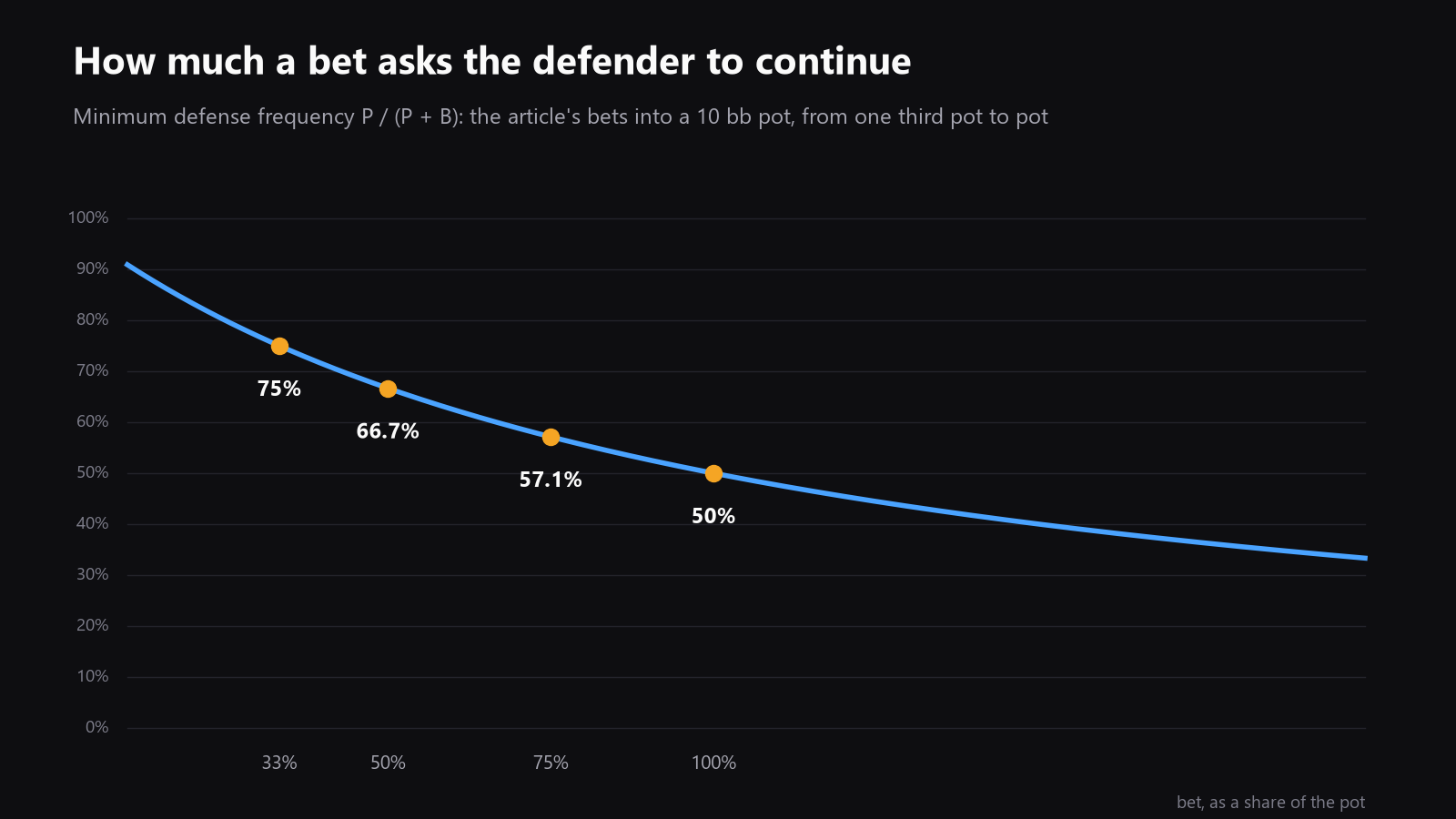
That arithmetic does not tell you what to do by itself, but it shows why size matters so much. The smaller the bet, the more hands can continue. The bigger the bet, the more pressure you put on the range, but the more careful you need to be about your own hand mix.
Small bet or big bet?
A small bet often fits:
- Dry boards
- Boards with strong range advantage
- Spots where you want to keep weaker hands in
- Situations where your bluffs do not need much fold equity
A big bet often fits:
- Wet boards
- Boards with many draws
- Spots where you need to protect strong made hands
- Polar ranges, where you bet with the top of range and the best bluffs
But do not turn this into a slogan. Some dry boards still deserve bigger bets if ranges are polarized. Some wet boards still deserve small bets if the betting range is merged and the texture allows thin value.
A few concrete flop examples
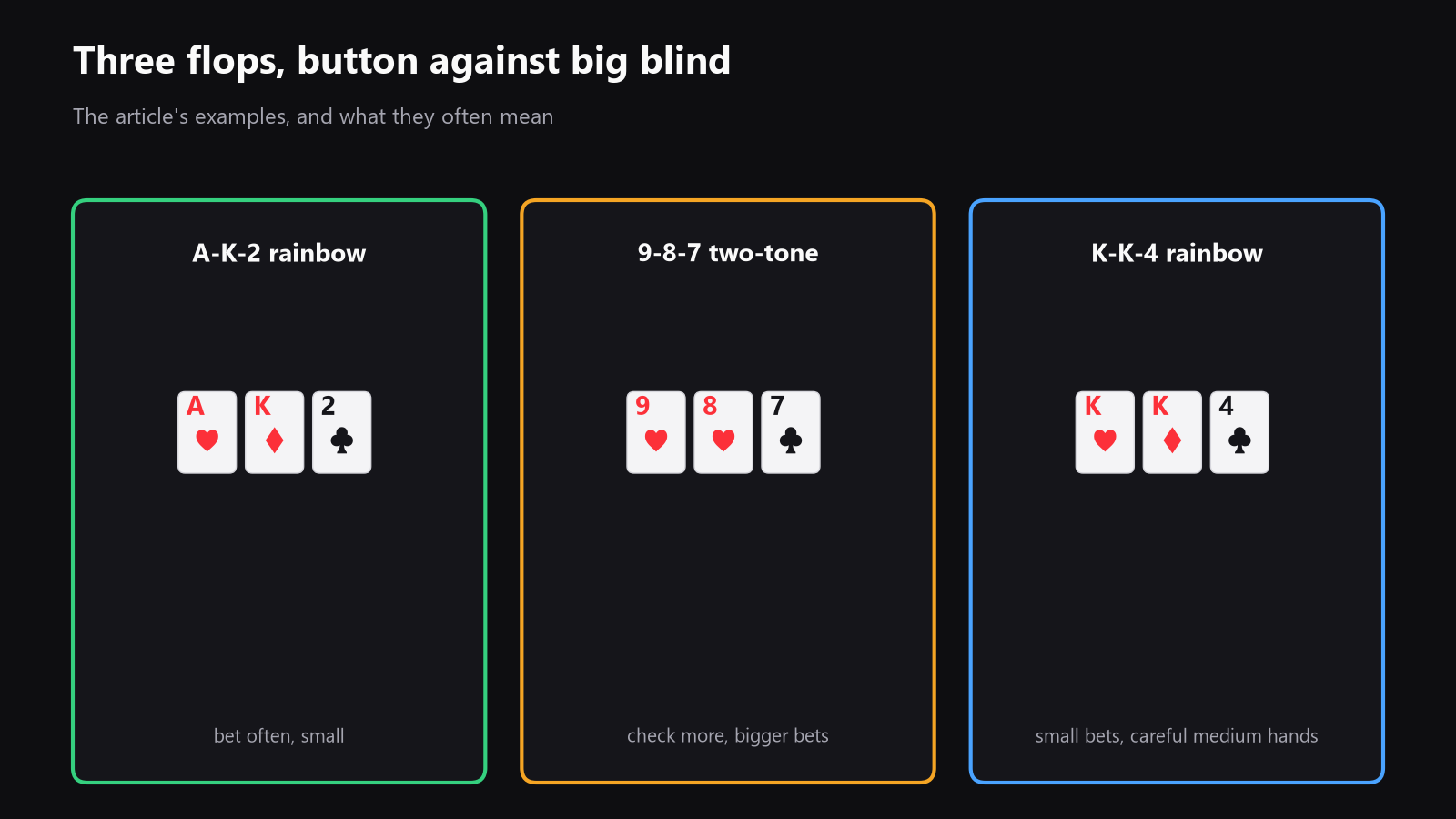
Let’s look at four examples.
1. A-K-2 rainbow
This is a classic high, dry, static board.
Why it matters:
- Many top pairs exist.
- Strong aces (AK, AQ) and sets are common.
- There are not many draws.
- Later streets do not change things much.
What this often means:
- The preflop raiser can bet frequently.
- Small sizing is often enough.
- Medium-strength hands can continue comfortably.
2. 9-8-7 two-tone
This is a classic wet, connected board.
Why it matters:
- Many straights and straight draws are possible.
- Pair-plus-draw hands are common.
- Equities are closer together.
- The turn can change everything.
What this often means:
- More checking.
- More selective aggression.
- Bigger bets when strong value or strong semi-bluffs are present.
3. K-K-4 rainbow
This is paired and fairly dry.
Why it matters:
- Trips are possible, but not common.
- Many hands become bluff catchers.
- The board does not develop much on later streets.
What this often means:
- Small bets can work well.
- Strong made hands can trap or bet.
- Medium hands need to be careful about overcommitting.
4. A♠ 9♠ 3♠
This is monotone and high.
Why it matters:
- Flushes and flush blockers dominate.
- Top pair is not as simple as it looks.
- Many hands have at least some suit interaction.
What this often means:
- Suit blockers matter a lot.
- Betting ranges need to be chosen carefully.
- A naked high card can be much weaker than it looks.
A quick checklist you can use on any flop
When you see the flop, ask these questions in order:
- Is the board dry or wet?
- Is it high or low?
- Is it paired?
- Is it monotone?
- Is it connected?
- Who has the stronger range overall?
- Who has the stronger nut hands?
- How much can the turn change this board?
- Do I want to bet often, bet big, or check more?
If you can answer those questions, you already understand most of board texture.
Common mistakes
1. Treating texture as a label instead of a relationship
A board is not good or bad by itself. It only matters in relation to the ranges that arrived there.
2. Thinking dry means small and wet means big, every time
That shortcut helps at first, but it is not a rule. Range composition and nut advantage matter too.
3. Ignoring turn cards
Some boards are static. Some are not. If the turn can dramatically alter straight or flush possibilities, you should not play the flop as if the hand is almost over.
4. Overvaluing one pair on dynamic boards
On connected and wet flops, one pair often loses value fast. You need to think about redraws, blockers, and how often better made hands exist.
5. Using fear instead of structure
A scary-looking board is not a reason by itself to check or fold. The board may look dangerous, but the ranges may still favor you.
How to study board texture in your own game
If you want to improve fast, do not study board texture only in theory. Look at your own hands.
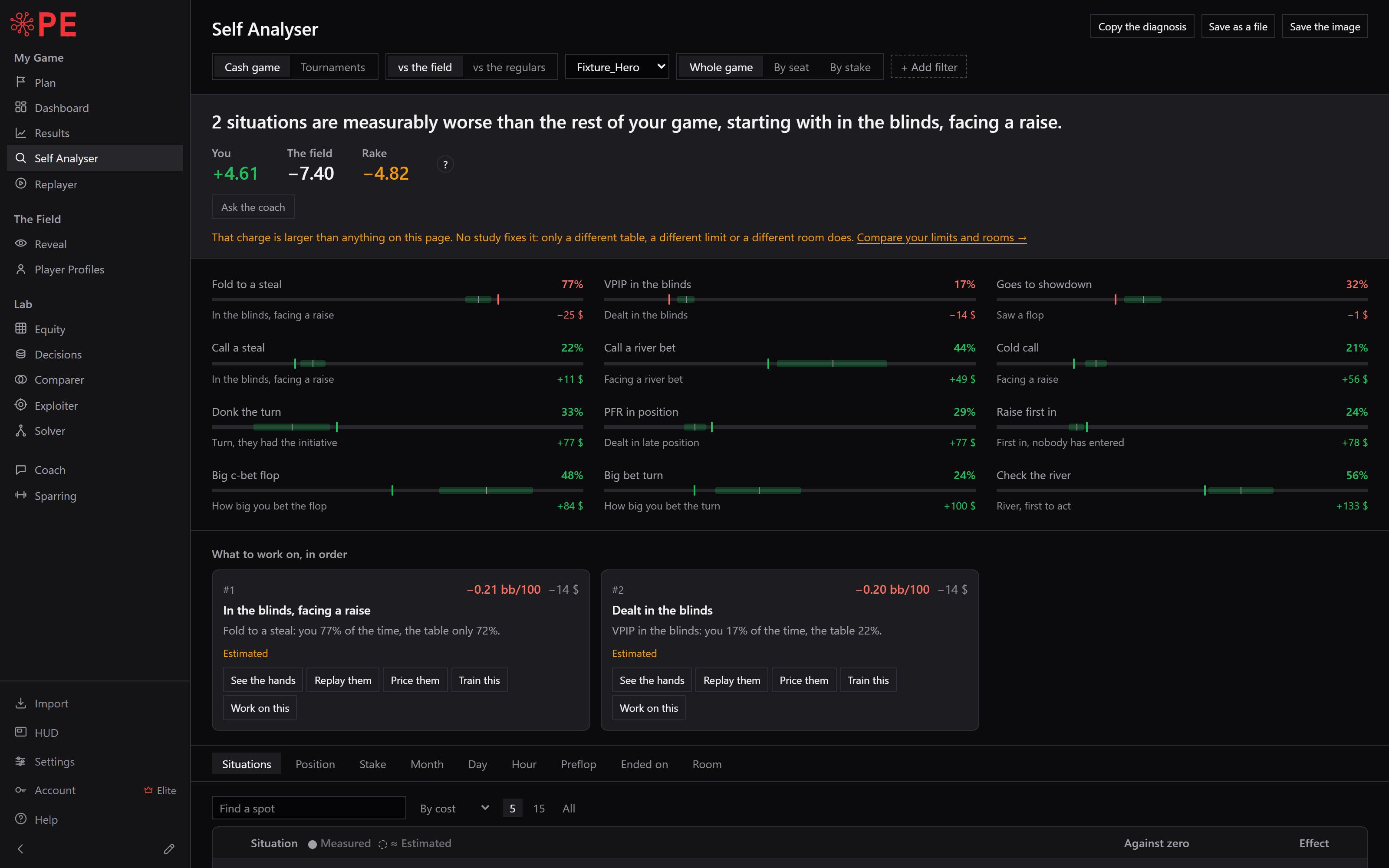
Start with the Self Analyser module, then sort the situations where you lose the most bb/100 and look for patterns. You will often find one of three things: too many c-bets on boards that favor the caller, too much checking on boards where you can pressure, or the wrong size on static flops.
If you want to compare one spot to another away from the table, the Solver module can help you test a board class and then a different one. That is often the fastest way to see how strategy changes when the flop moves from dry to wet, or from paired to connected.
And if you want to know how your pool reacts, the Reveal module shows what real players at your limits actually do from your own hand histories. That matters because board texture is not only about cards, it is also about the people you face.
The main idea to remember
Do not ask only, “Is this flop dry or wet?”
Ask instead:
- Which range hits this board harder?
- Which range has the nuts more often?
- How much will the turn and river change the hand?
- Does this board want pressure, patience, or a smaller size?
That is board texture.
Once you start reading flops that way, you stop guessing at c-bets and start making them for a reason.
Do it on your own hands.