
Bet sizing after the flop is one of the most important decisions in poker.
A good size changes the price you give, the range your opponent can continue with, and the way the hand develops on later streets. A bad size can leave value on the table, give draws a cheap price, or force your bluffs to risk too much.
If you want to improve postflop poker strategy, you need to understand what each sizing family is trying to do:
- small bets
- medium bets
- big bets
- overbets
You also need to know when to stay balanced and when to exploit the player pool in front of you.
What a bet size actually does
Every postflop bet does several things at once:
- It asks folds from weaker hands.
- It charges draws and bluff catchers.
- It builds or controls the pot for later streets.
- It tells a story about the strength of your range.
That means bet sizing is not just about “big for strong hands, small for weak hands.” It is about choosing the size that makes the most money against the range in front of you.
The math starts with pot odds.
If the pot is 100 and you bet 50, your opponent must call 50 to play for a final pot of 200. That call needs 25% equity to break even.
More generally, if you bet B into a pot of P, the opponent’s break-even equity for a call is:
B / (P + 2B)
So:
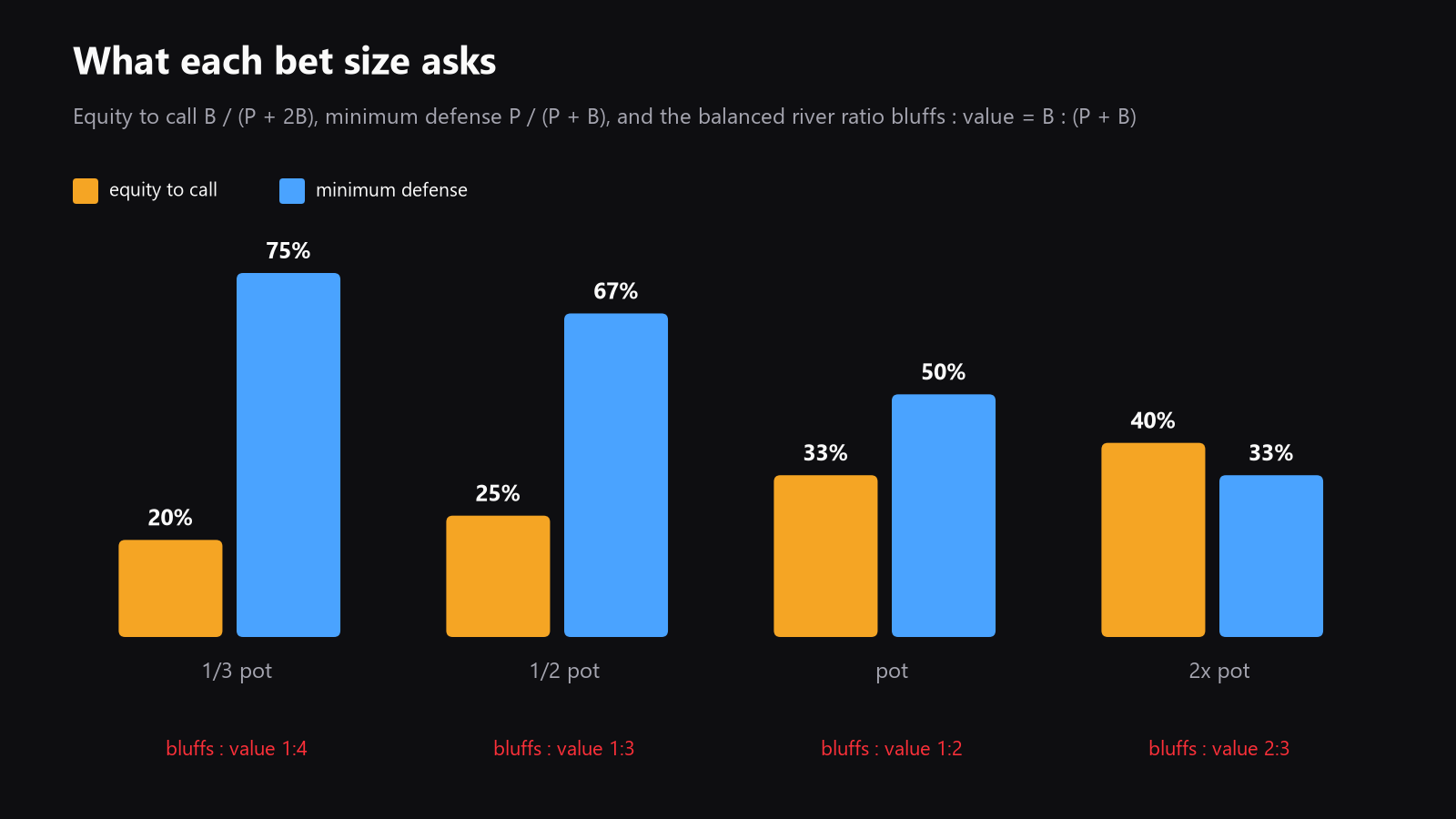
- bet 1/3 pot, call needs about 20% equity
- bet half-pot, call needs 25% equity
- bet pot, call needs 33% equity
- bet 2x pot, call needs 40% equity
For defense, the useful baseline is the minimum defense frequency, or MDF. If you bet B into P, an unexploitable defender continues with about:
MDF = P / (P + B)
So the bigger your bet, the more folds you force:
- 1/3 pot bet, defender continues about 75%
- half-pot bet, defender continues about 67%
- pot bet, defender continues 50%
- 2x pot bet, defender continues 33%
On the river, there is another useful piece of arithmetic: your bluff-to-value ratio.
For a bet of B into P, the balanced bluff-to-value ratio is:
bluffs : value = B / (P + B)
Examples:
- half-pot bet: 1 bluff for 3 value hands
- pot bet: 1 bluff for 2 value hands
- 2x pot bet: 2 bluffs for 3 value hands
These numbers are starting points, not magic answers. They help you understand what the sizing asks from the opponent.
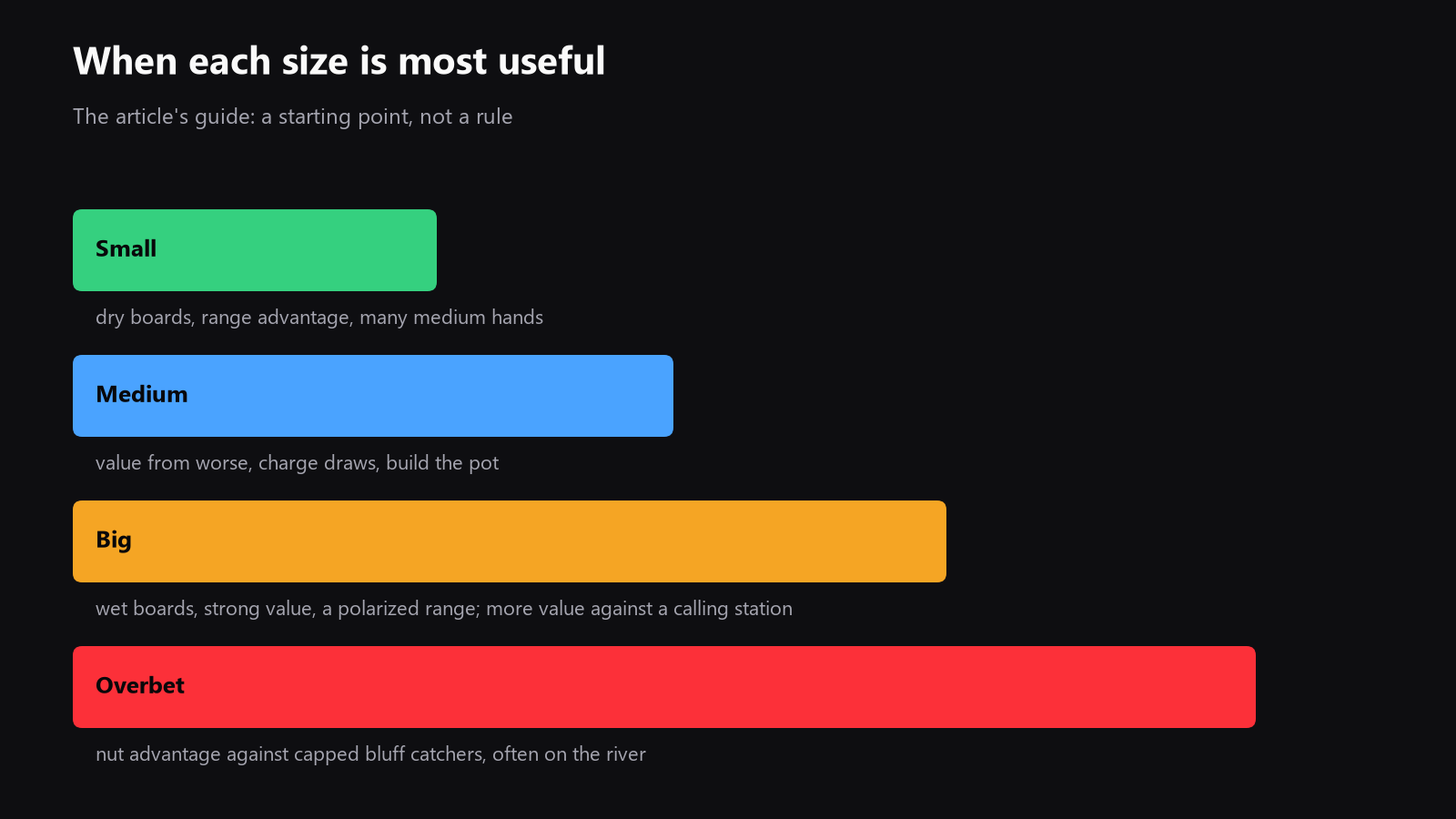
Small bets: cheap pressure and range protection
Small bets are usually around 20% to 33% of the pot.
They are often used when you want to apply pressure without risking much. A small bet can be the right choice when:
- your range has more hands that connect with the board than the caller’s range
- the board is dry and not very volatile
- you want to keep your range wide
- you want to realize equity with many medium-strength hands
- you do not need to build a huge pot yet
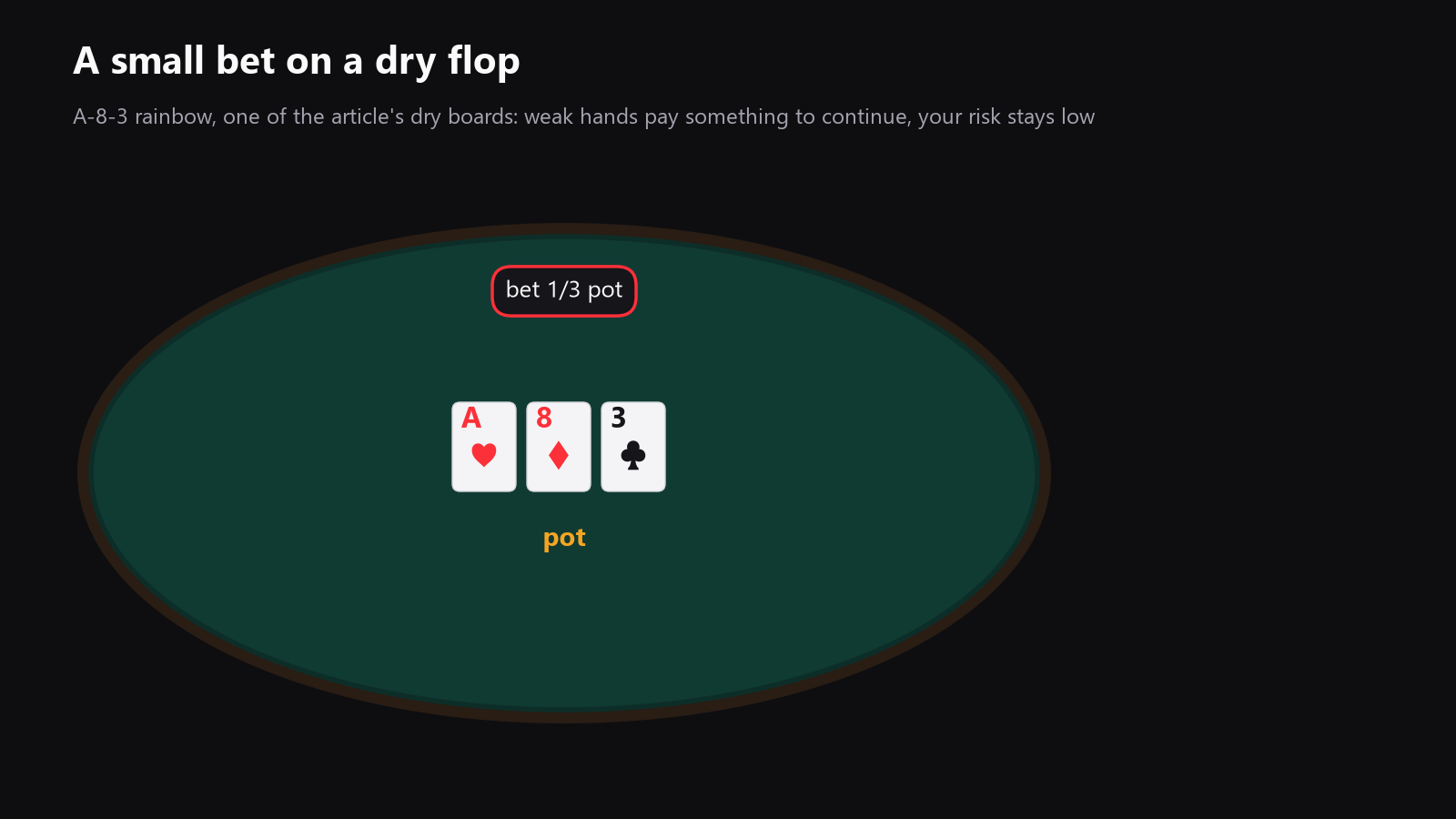
Small flop bets work especially well on boards like A83 rainbow, K72 rainbow, or other dry textures where one player misses a lot and the other player can represent many top-pair-plus hands.
The small bet is not about forcing huge folds. It is about making weak hands pay something to continue, while keeping your own risk low.
Small sizing is also useful when you have many value hands that want action from worse, but do not want to bloat the pot too early. It can also be a good bluff size because your bluffs risk less.
But small does not mean automatic. On wet boards, a tiny bet can be too easy to continue against. If the opponent’s range contains many draws and pair-plus-draws, a small bet may fail to put enough pressure on them.
Medium bets: the workhorse size
Medium bets are usually around 50% to 75% of the pot.
This is the sizing family you will use a lot after the flop, especially on turns and rivers. It is flexible enough to work for both value and bluffing, while still applying real pressure.
Medium bets are strong when you want to:
- get called by worse hands
- charge draws and weak made hands
- build the pot for strong holdings
- make bluff-catching less comfortable for the opponent
A medium bet is often better than a tiny bet when the board becomes more connected, or when future cards may be uncomfortable for the caller. It is also useful when you expect the opponent to continue too wide against a small size.
Think of medium sizing as the practical middle ground. It does not look as extreme as an overbet, but it creates meaningful pressure and still gives you room to barrel later if needed.
If you are value betting, medium size is often enough to get paid without scaring away everything worse. If you are bluffing, it forces more mistakes than a tiny stab.
Big bets: pressure and polarisation
Big bets are usually 75% pot to pot-sized.
At this point, your range starts to look more polarised. That means you are usually representing either strong value or credible bluffs, with fewer medium-strength hands in between.
Big bets work well when:
- you have a strong range or a strong top end
- the board becomes worse for the caller
- you want to charge draws hard
- you expect small sizing to invite too many bluff catches
Big bets are useful when your hand class is strong enough that you want to deny equity, but not so strong that you are happy with only tiny action.
They also shine on coordinated boards, because medium-strength hands often become expensive to continue with. A pair that can call a small bet may struggle much more against three-quarters pot or full pot.
But do not overuse big bets. If your range is capped, or if the opponent’s range is strong and sticky, large sizing can burn money quickly. Big bets are best when your story is credible.
Overbets: maximum pressure, maximum polarisation
An overbet is any bet larger than the pot.
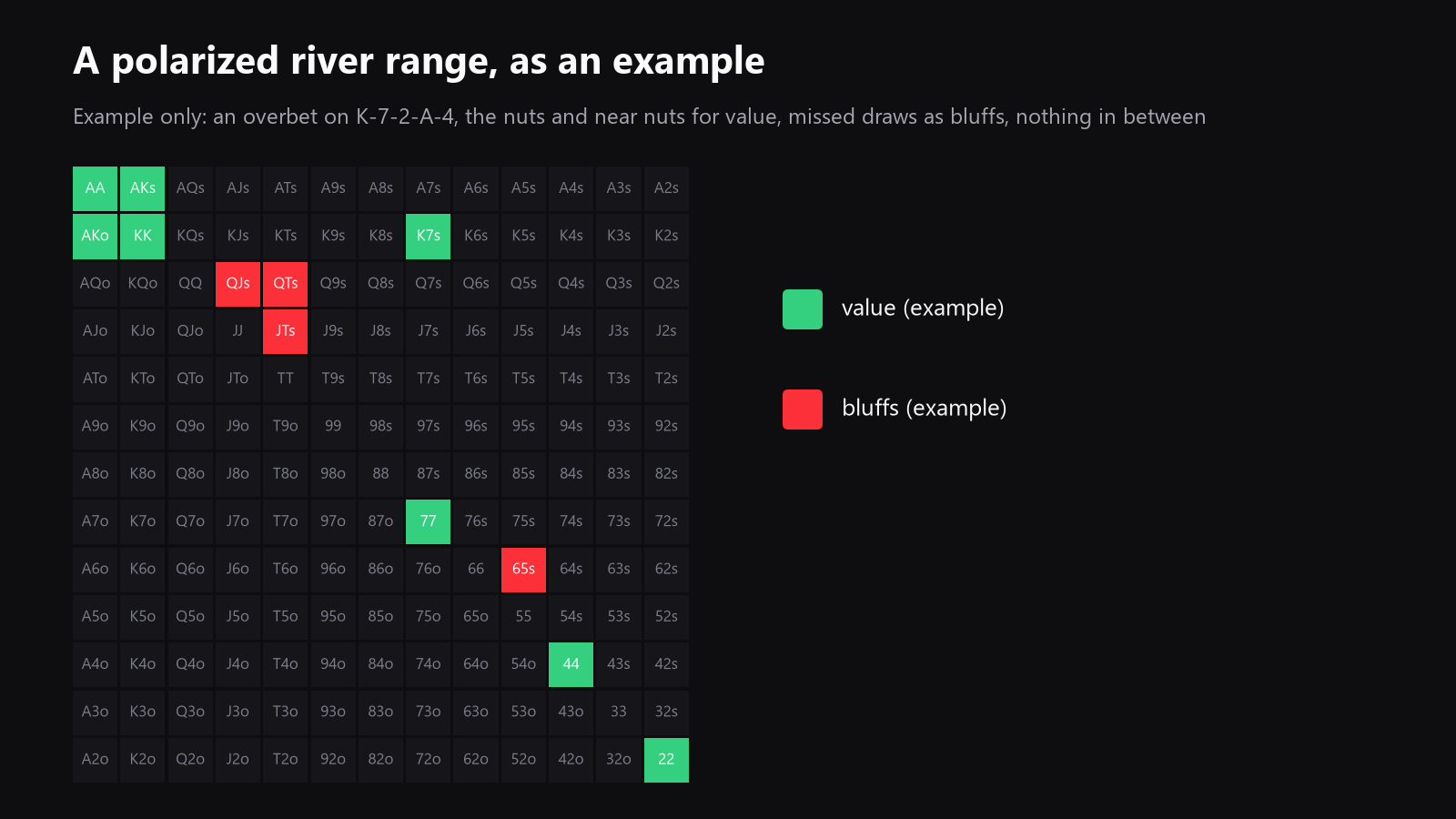
It is one of the most misunderstood bet sizes in poker. An overbet is not just a fancy bigger bet. It is a deliberate polarised action. You are usually representing a narrow band of very strong hands, and you are asking the opponent to continue only with part of their strongest range.
Overbets are strongest when:
- you have nut advantage
- the opponent has many bluff catchers but few monsters
- the runout improves your range more than theirs
- the line you took earlier makes the overbet believable
That is why overbets often show up on rivers. By then, the ranges are narrower, the hand is more defined, and the value of attacking capped bluff catchers becomes much higher.
Overbets can also work when the board creates a lot of one-pair bluff catchers for the other player, but your own range contains many hands that are happy to put a lot of money in.
The danger is obvious: if you overbet without enough value or without enough fold equity, you turn a powerful line into an expensive leak.
How to choose the right size
A good bet size is rarely random. Usually it answers four questions.
1. What do you want this bet to do?
Ask whether you want:
- folds from better hands
- calls from worse hands
- protection against free cards
- value from draws
- pot control
Small bets lean toward cheap pressure and cheap denial. Medium bets balance value and pressure. Big bets and overbets lean toward polarisation and maximum fold equity.
2. What does your range look like?
If your range has more strong hands than your opponent’s range, you can usually size up more often. That is range advantage.
If you also have more of the very strongest hands, you have nut advantage. That matters even more for big bets and overbets.
If you are capped, meaning your line makes your range look incomplete, large bets become harder to support.
3. How sticky is the opponent?
Against an opponent who overfolds, bigger sizing can print money, especially with value hands and credible bluffs.
Against a calling station, you usually want less bluffing and more value, often with larger sizings. If they call too much, make them pay.
Against a player who raises too aggressively, small and medium bets can sometimes keep the pot under control and let you continue with a wider part of your range.
4. How many streets are left?
On the flop, your size often needs to leave room for future betting. On the turn and river, the sizing can become more decisive because the hand is more defined.
Deep stacks usually reward more careful sizing earlier in the hand. Shorter stacks often push you toward sizes that make the stack-to-pot ratio work in your favour.
Balance versus exploit
If you want to be hard to play against, your sizing should not be too value-heavy or too bluff-heavy.
On the river, the simple baseline is useful:
- half-pot bet: 1 bluff for 3 value hands
- pot bet: 1 bluff for 2 value hands
- 2x pot bet: 2 bluffs for 3 value hands
That is the kind of arithmetic that keeps your range honest.
But real poker is not played in a vacuum. Many players do not defend perfectly. Many pools overfold in some spots and overcall in others.
That is where exploitative sizing comes in.
If the pool folds too much to flop c-bets, your small and medium bluffs become better. If the pool calls too much, your value bets should size up more often, and your bluffing frequency should drop. If the population overdefends small bets but overfolds big bets, the answer is not always to use one size everywhere. The answer is to attack the weakness you actually see.
The Reveal module helps here, because it shows what the players at your limits actually do, not what they should do in theory. That matters a lot when you are choosing between a small size that keeps hands in and a bigger size that gets more folds.
Common mistakes with bet sizing
Here are the leaks I see most often:
- using the same size on every board
- betting small without a plan for later streets
- sizing up with hands that do not want a big pot
- overbetting without nut advantage
- forgetting that a bigger bet also changes your bluff-to-value requirements
- ignoring how often the field actually folds or calls
- choosing a size before deciding what range you are targeting
A good sizing decision is not “small or big?” It is:
- what range am I targeting?
- what does this size cost them to continue?
- what happens on the next street?
How to study bet sizing away from the table
If you want to improve this part of your game, do not just memorize a few board patterns. Review your own hands.
The Self Analyser module can show you where your flop, turn, and river decisions are leaking compared with the rest of your game. You can see whether your small bets are getting called too often, whether your big bets are under-bluffed, and whether some textures are costing you more than others.
If you want to test a specific spot away from the table, the Solver module can compute it for you after your session. It refuses during a session, which is exactly what you want if you are trying to study, not get help while playing.
That is the right way to use sizing in practice: learn the arithmetic, understand the board, watch the pool, and then verify your assumptions on your own hands.


The takeaway
Poker bet sizing after the flop is about asking the right question in the right way.
A small bet asks for cheap folds and cheap protection. A medium bet asks for a broader response and often fits the middle of your range. A big bet asks for real strength or real equity. An overbet asks your opponent to continue only with a narrow part of their range.
If you remember one thing, remember this: the best size is not the size that looks strongest. It is the size that earns the most money against the range in front of you.
Do it on your own hands.