
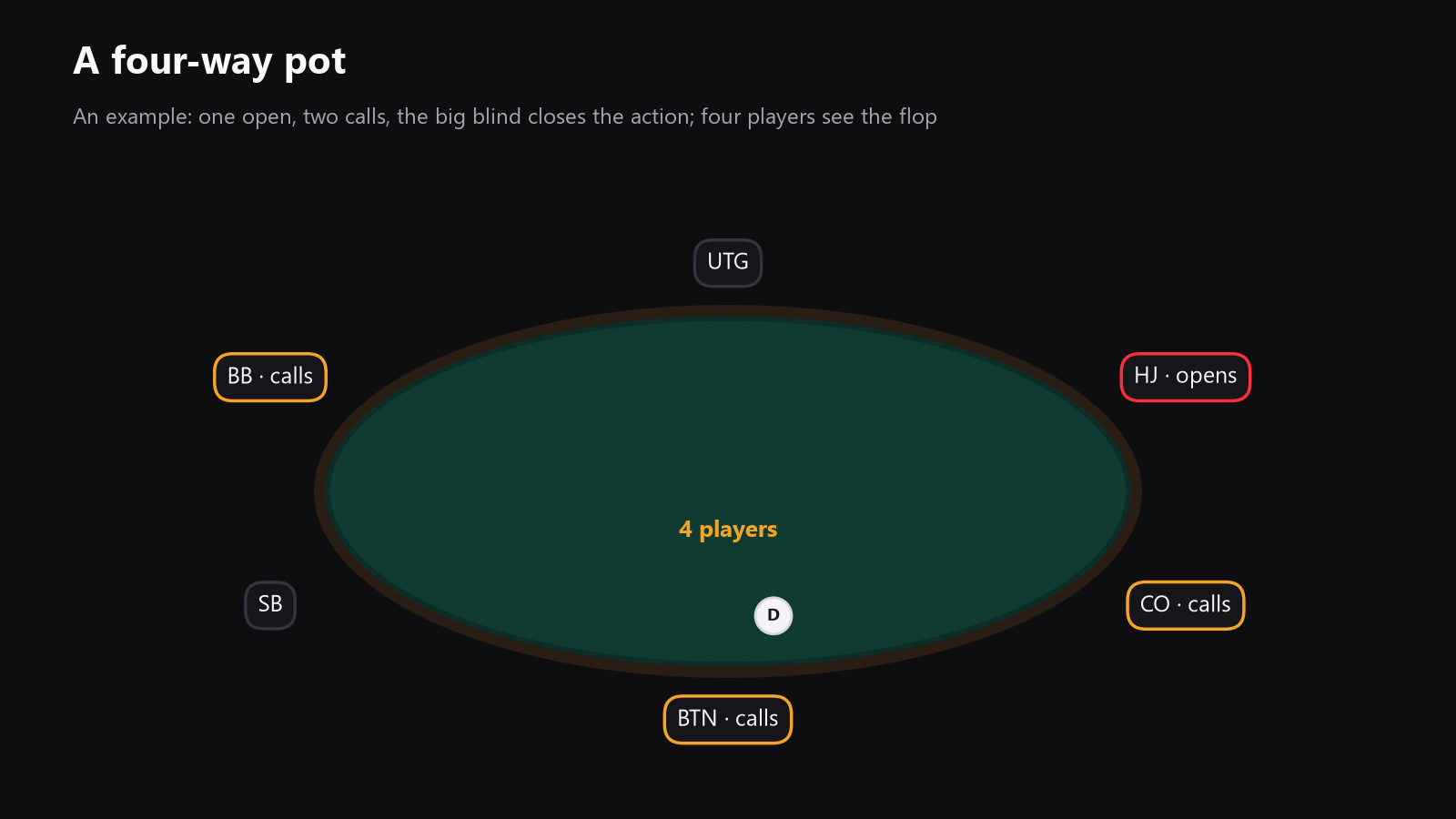
A multiway pot is any pot with three or more players seeing the flop. That sounds simple, but it changes almost every part of poker strategy.
If you have only one opponent, your bet can win the pot when they miss, and your hand often keeps its value through several streets. When there are two or more opponents, that logic weakens fast:
- someone is much more likely to have connected
- your bluff needs more folds to work
- one pair is worth less
- strong draws go up in value
- thin value bets matter more, but so does discipline
If you only remember one thing, remember this: multiway pots reward hands that can win at showdown, and punish hands that rely on fold equity.
Why your bluff gets worse with more players
In heads-up pots, a bluff only has to get through one player.
In a multiway pot, it has to get through everyone.
That is a huge difference.
A simple example:
- the pot is 10 bb
- you bet 5 bb as a bluff
- in a heads-up pot, your bluff can work if one player folds
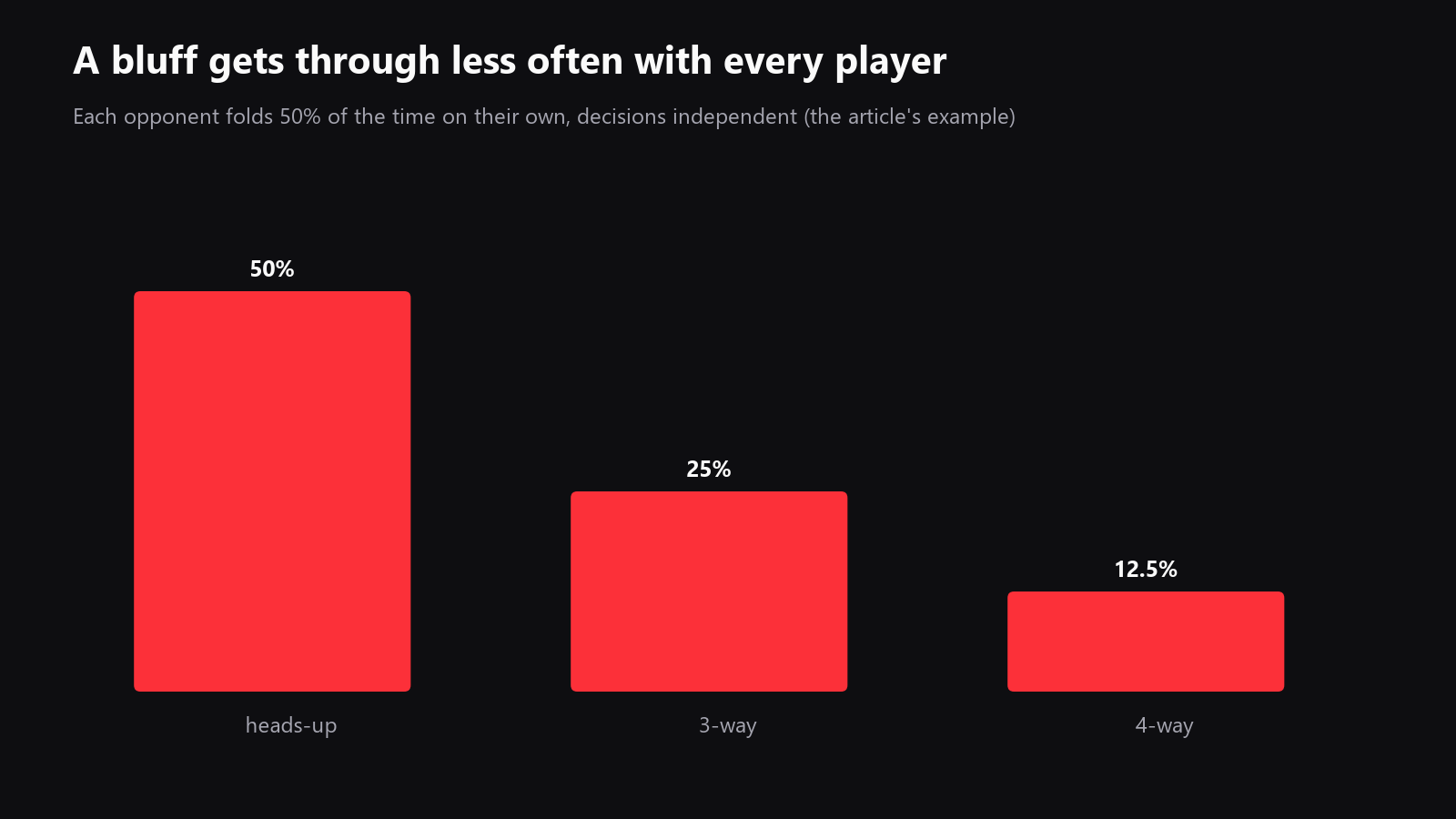
- in a 3-way pot, it works only if both opponents fold
If each opponent would fold 50% of the time on their own, then your bluff gets through only about 25% of the time if their decisions are independent. Real poker is often even worse than that, because ranges interact. If one player continues, the other players often continue more cautiously too.
This is why multiway pots are a bad place for pure air.
Bluffs still exist, of course. But they need a better reason:
- strong blockers
- real equity when called
- board textures that miss both opponents often
- pressure against capped ranges, not against a field of random hands
What happens to hand value in a multiway pot
Some hands become better when more players see the flop. Others become worse.
Hands that gain value
These hands usually improve in multiway pots:
- sets
- two pair
- straights
- flushes
- overpairs on dry boards
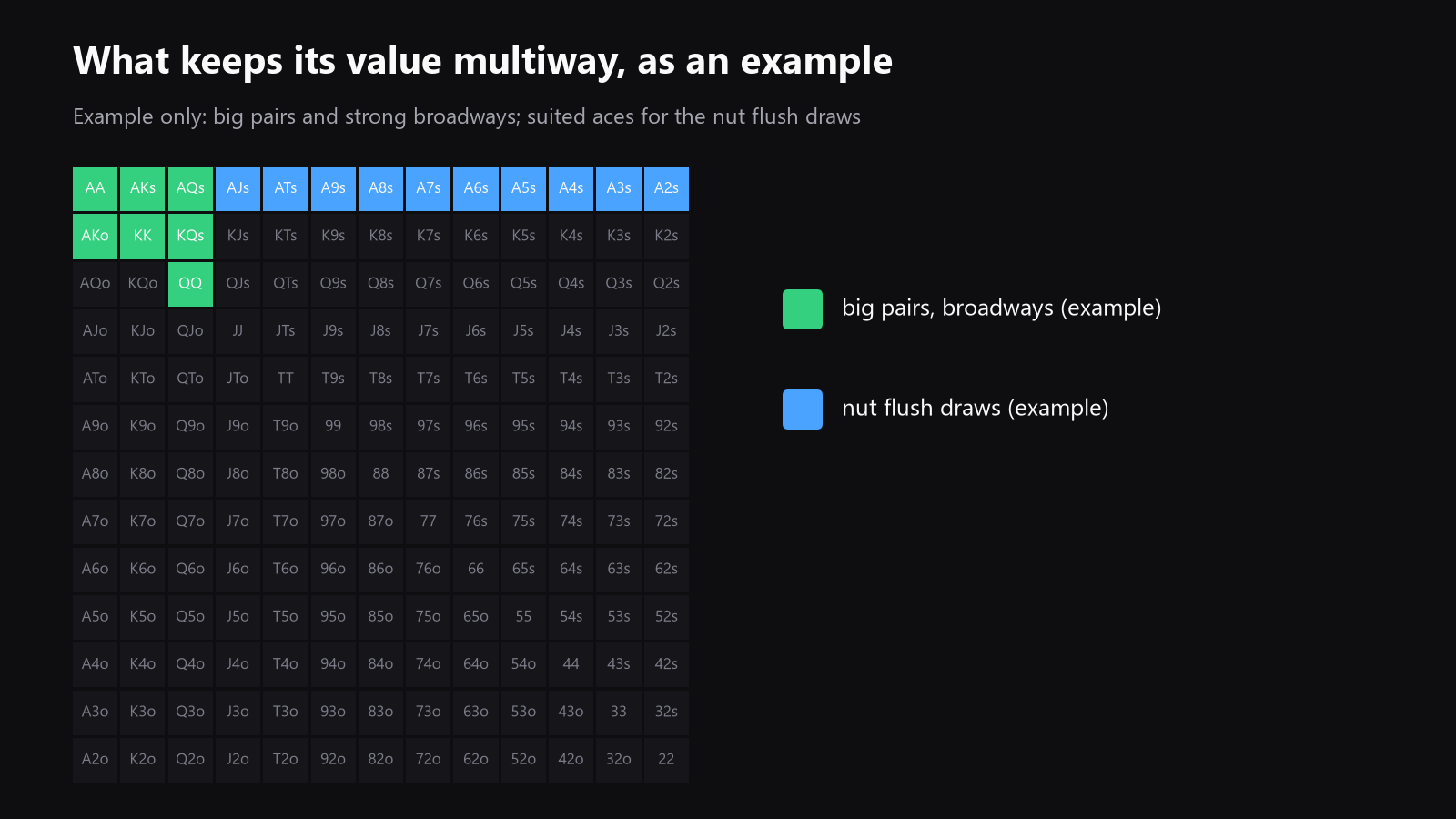
- nut draws
- combo draws
Why? Because these hands either already crush most ranges, or they can improve into the nuts.
Hands that lose value
These hands usually lose value:
- weak top pair
- second pair
- bare overcards
- weak gutshots
- weak flush draws
- hands with poor kicker and poor redraws
Why? Because when you make one pair, someone is often ahead of you, or can continue with better equity.
A pair of queens is not the same hand in a heads-up pot and in a 4-way pot. In the first case, it is often a clear value hand. In the second case, it is more fragile and more often a bluff catcher.
How bet frequencies change
When more players see the flop, you should usually bet less often.
That does not mean you never bet. It means your bets should be more selective.
In multiway pots, ask yourself three questions before betting:
- What worse hands call?
- What better hands continue?
- Do I have enough equity when called?
If the answer to the first question is weak, the bet is often too thin. If the answer to the second is strong, your fold equity is poor. If the answer to the third is no, you are often turning a hand into a bluff with little chance to win.
A useful rule of thumb
In heads-up pots, you can often c-bet wide on favorable boards. In multiway pots, that same board is usually not as favorable anymore, because one extra caller means one extra range that can connect.
So your continuation betting range should usually be:
- stronger
- more value-heavy
- more draw-driven
- less full of pure air
Board texture matters even more
Multiway strategy is not just about the number of players. It is also about the board.
Dry boards
Example: A 7 2 rainbow
Dry boards are easier for the preflop aggressor to represent, but multiway still reduces bluffing value. One player may have a pocket pair, an ace, or a random showdown hand that refuses to fold.
On these boards, you can still bet strong overpairs, strong top pairs, and some high-card hands with good blockers. But you usually do not want to fire range-wide just because the board looks clean.
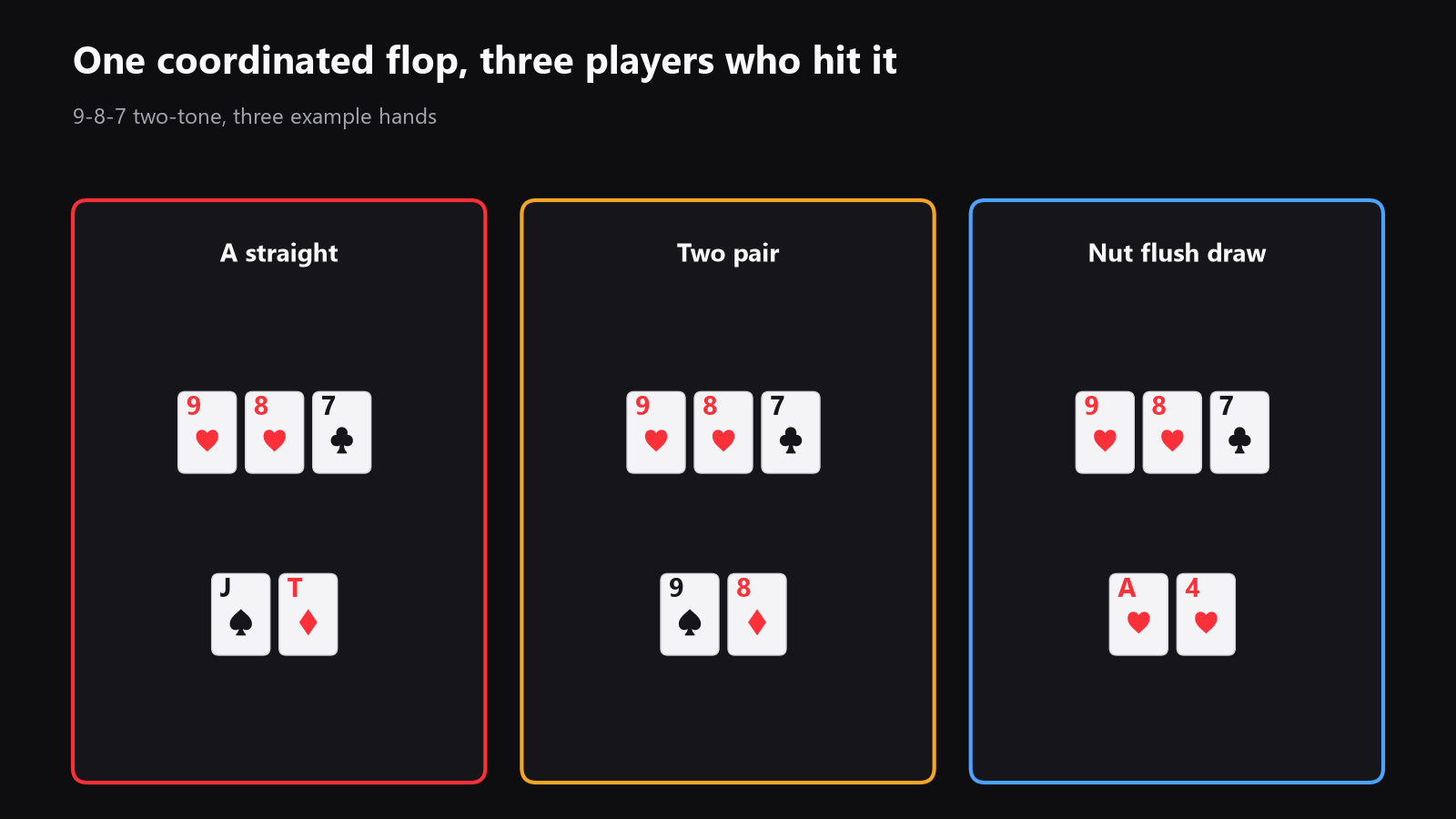
Coordinated boards
Example: J 10 8 two-tone
These boards favor the field much more in a multiway pot. Someone can have:
- top pair
- two pair
- a straight draw
- a flush draw
- a made straight already
Here, betting air is expensive. Value hands matter. Strong draws matter. Marginal one-pair hands often prefer checking.
How to play top pair in multiway pots
Top pair is often the hand that causes the most mistakes.
You see top pair and want to bet big, because it is probably best right now. But in multiway pots, “probably best right now” is not always enough.
Good top pair
Top pair with a strong kicker on a board that does not smash the field can still value bet.
Examples:
- top pair top kicker on A 7 2 rainbow
- top pair strong kicker on K 8 3 with few draws
These hands often want value and protection, but not necessarily huge pots against several continuing ranges.
Medium top pair
Top pair with a weaker kicker, or on a board with many draws, becomes much more delicate.
Examples:
- A 9 on A J 8
- K 10 on K J 9
These hands can still be ahead, but they are much more vulnerable to better top pairs, two pair, sets, and strong draws.
A good question is: If I get called on the flop, am I happy to continue on many turns?
If the answer is no, a check is often better than a bet.
Rule for top pair
In multiway pots, top pair is often a value hand, not a stack-off hand.
That means:
- bet for value when worse hands can call
- size your bet with the board in mind
- be ready to slow down when action continues
- do not auto pile chips in just because you have top pair
How to play draws in multiway pots
Draws are not all equal.
Strong draws
These can play aggressively:
- nut flush draws
- open-ended straight draws
- combo draws
- draws with overcards and backdoor equity
Why they work better:
- they often have enough equity when called
- when they hit, they can make the best hand
- they can sometimes benefit from fold equity, even if that fold equity is lower multiway
Weak draws
These should usually be played more carefully:
- weak flush draws
- gutshots with poor side equity
- dominated straight draws
- draws that make second-best hands too often
Why they are weaker:
- less equity when called
- worse implied odds
- more reverse implied odds when they hit
- less bluff equity because several players can continue
Betting or calling with draws
A useful split is this:
- strong draws can often bet, raise, or semi-bluff
- medium draws often prefer pot odds and realization
- weak draws often need a cheap price and a plan
In multiway pots, pure semi-bluffs lose some power. So if your draw does not have good equity, nut potential, or a backup plan, you should be much more cautious.
Value betting becomes more important
Because bluffs work less often, your value hands need more attention.
That does not mean bet bigger automatically. It means:
- value bet more clearly
- stop trying to “represent” too much
- extract value from worse hands that can still call
- do not trap so often that you miss streets
A common leak in multiway pots is slowplaying too much. Players think, “There are more people, so someone will catch up.” Sometimes that is true. But often you are also giving free cards to a worse hand that would have paid you.
A better approach is:
- bet your strong hands when worse hands can continue
- check when your hand is strong but vulnerable and wants pot control
- choose lines that protect your equity and your stack
A practical way to think about multiway pots
Before you act, sort your hand into one of these buckets:
1. Strong made hand
Bet for value, but respect continued action.
2. Medium made hand
Value bet or check, depending on board texture and how many players remain.
3. Strong draw
You can often continue aggressively.
4. Weak draw or air
Check much more often.
That simple filter will save you many mistakes.
A quick example
Imagine you raise preflop, get two callers, and see a flop like Q J 7 with two suits.
In a heads-up pot, many players would c-bet a lot here. In a 3-way pot, you should slow down.
Why?
- the callers hit this board often
- top pair is not as clean as it looks
- straight draws and two pair are more common
- pure bluffs have less fold equity
Now compare that to an A 7 2 rainbow flop.
You still do not want to bet everything, but your strong aces and overpairs gain value, and your weaker hands can be checked more often.
The board changes the story, but the number of players changes the whole script.
Common multiway mistakes
Here are the biggest leaks to avoid:
- c-betting too wide just because you are the preflop raiser
- overvaluing one pair
- bluffing with hands that have no equity
- checking too much with strong value hands
- using the same sizing you would use heads-up
- ignoring how many players remain behind you on later streets
If you want to spot that kind of leak in your own pool, the Self Analyser module can help you compare your frequencies by spot, and the Dashboard makes it easier to see where the money goes. If you want to study a specific hand away from the table, the Solver module can help after the session.

Final takeaway
Multiway pots change poker in a very direct way:
- ranges get stronger
- bluffs get weaker
- one pair loses value
- draws with real equity gain value
- thin value bets matter more
- board texture matters even more than usual
If you adjust properly, you will stop burning chips in pots that were never good bluff candidates in the first place.
And if you keep a record of your own hands, the patterns become obvious much faster than memory alone.
Do it on your own hands.