
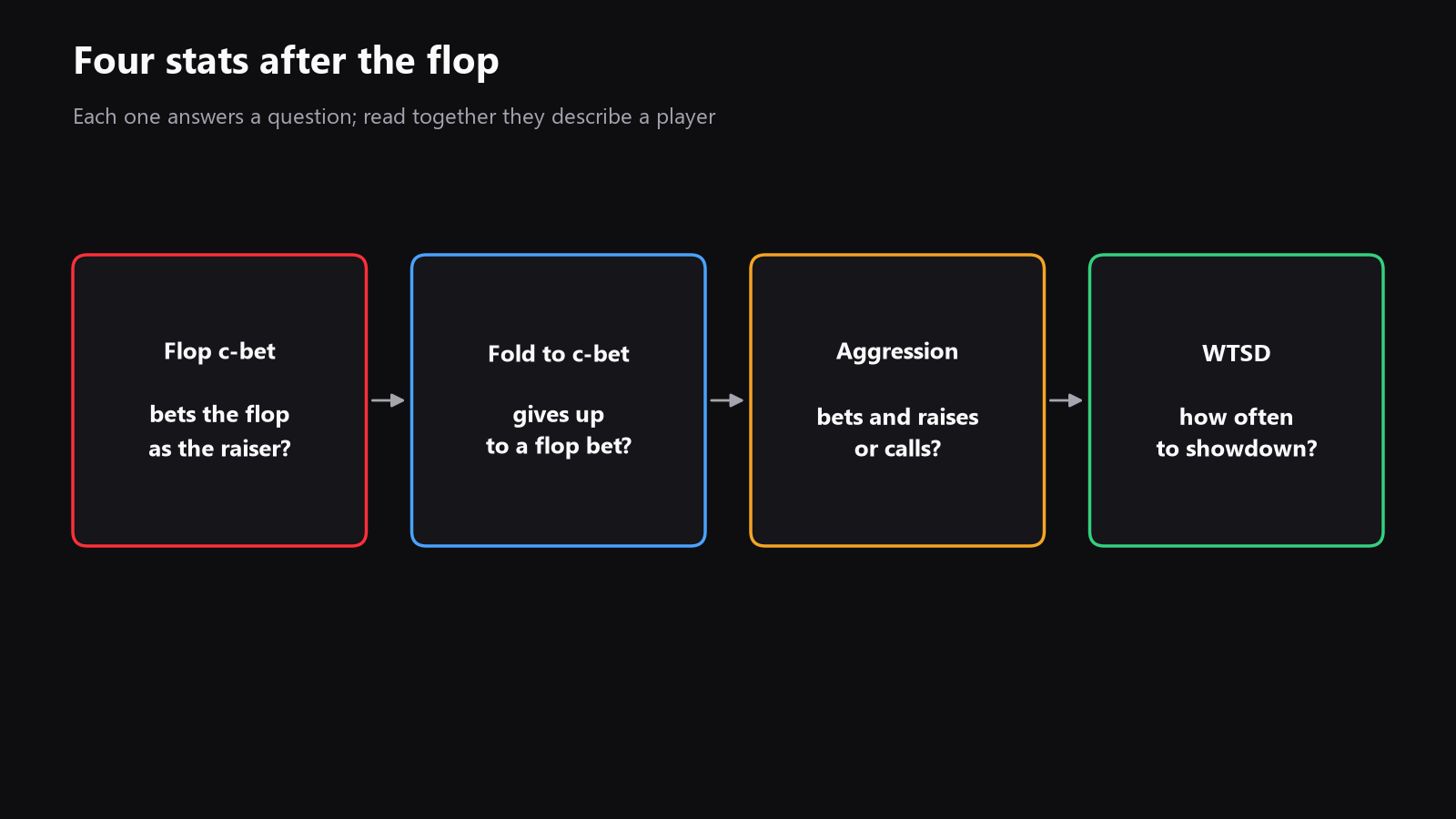
If you want to understand a player after the flop, these four stats are a strong starting point:
- flop c-bet
- fold to flop c-bet
- aggression
- WTSD, or went to showdown
Each one tells you something different. None of them is enough on its own. Together, they start to draw a profile.
That is the key idea of postflop HUD stats: you are not trying to label someone from a single number. You are trying to answer a practical question, which is always the same:
How does this player behave once the flop is out?
What each stat measures
1. Flop c-bet
C-bet means continuation bet.
It measures how often a player bets the flop after they were the preflop raiser. In other words, once they entered the hand with initiative, how often do they keep pressing on the flop?
A high c-bet usually means one of three things, or a mix of them:
- they like to use position and initiative
- they attack dry boards a lot
- they do not like checking and giving up the betting lead
A low c-bet often means the opposite:
- they check back more
- they choose their spots more carefully
- they are less willing to bluff the flop without a clear reason
But be careful. A low c-bet is not automatically passive, and a high c-bet is not automatically wild. Board texture matters. A player can c-bet very often on A-high and K-high boards, then slow down on connected flops.
2. Fold to flop c-bet
This stat measures how often a player folds when facing a flop c-bet.
It is a defender stat. It tells you how sticky or how fit-or-fold the player is when they do not have the preflop lead.
A high fold to c-bet means they surrender a lot of flops. They may be over-folding, especially on boards that miss their range.
A low fold to c-bet means they continue more often. They may call with pair plus draws, float lighter, or simply hate folding top pair, underpairs, and backdoor equity.
This stat is one of the cleanest ways to spot easy flop pressure targets, but only when the sample is large enough and the board type makes sense.
3. Aggression
Different trackers define this differently.
Some show aggression factor, some show aggression frequency. The label changes, but they are not the same thing: aggression factor is a ratio, (bets + raises) / calls, ignoring checks, while aggression frequency is a percentage of actions.
Aggression is useful because it adds shape to the profile.
- Low aggression usually points to a player who checks and calls too much.
- High aggression means the player prefers to take the betting lead.
But high aggression does not always mean a player is bluff-heavy. Some players are aggressive only with strong hands. Others are aggressive as a pure pressure strategy. A third group mixes both.
So if you see aggression, do not jump straight to "loose bluffer" or "maniac". Ask what the aggression is made of.
4. WTSD
WTSD means went to showdown.
It tells you how often a player reaches showdown after seeing the flop.
This is a very important stat because it sits near the end of the hand. It does not tell you what they did on the flop alone. It tells you how far they are willing to go.
A high WTSD often means the player:
- calls too much
- hates folding pairs
- pays off too often
- or plays value-heavy lines that naturally reach showdown
A low WTSD often means the player gives up more, bluffs less, or avoids marginal spots.
WTSD is powerful, but it can mislead you if you read it alone. A player can have a high WTSD because they are a station, or because they are a good value caller in the right games. You need the rest of the picture.

How to read these stats together
The real value starts when you combine them.
High c-bet, high fold to c-bet
This is a player who likes initiative when they have it, but surrenders too often when someone fires back.
That profile says a lot.
When they are the preflop raiser, they are likely to put pressure on the flop. When they defend, they may give up too much to a flop bet.
Against this type, you do not need to fight every pot. You need to choose the right direction:
- defend properly against their c-bets when the board lets you continue
- attack them when they check and show weakness
- do not overfold just because they bet the flop a lot
This is one of the easiest profiles to exploit, because the player is comfortable betting, but less comfortable facing resistance.
High c-bet, low fold to c-bet
This player continues aggressively when they are the preflop raiser, and they do not give up easily when they are defending.
In practice, this often means a player who likes to play pots and likes to keep range pressure on both sides of the hand.
You should think carefully before bluffing them off one pair or air on the flop. They are more likely to continue, especially on boards that hit their range or their calling range.
Against this type, value betting becomes more important. If they continue too much, you want hands that can stand some resistance.
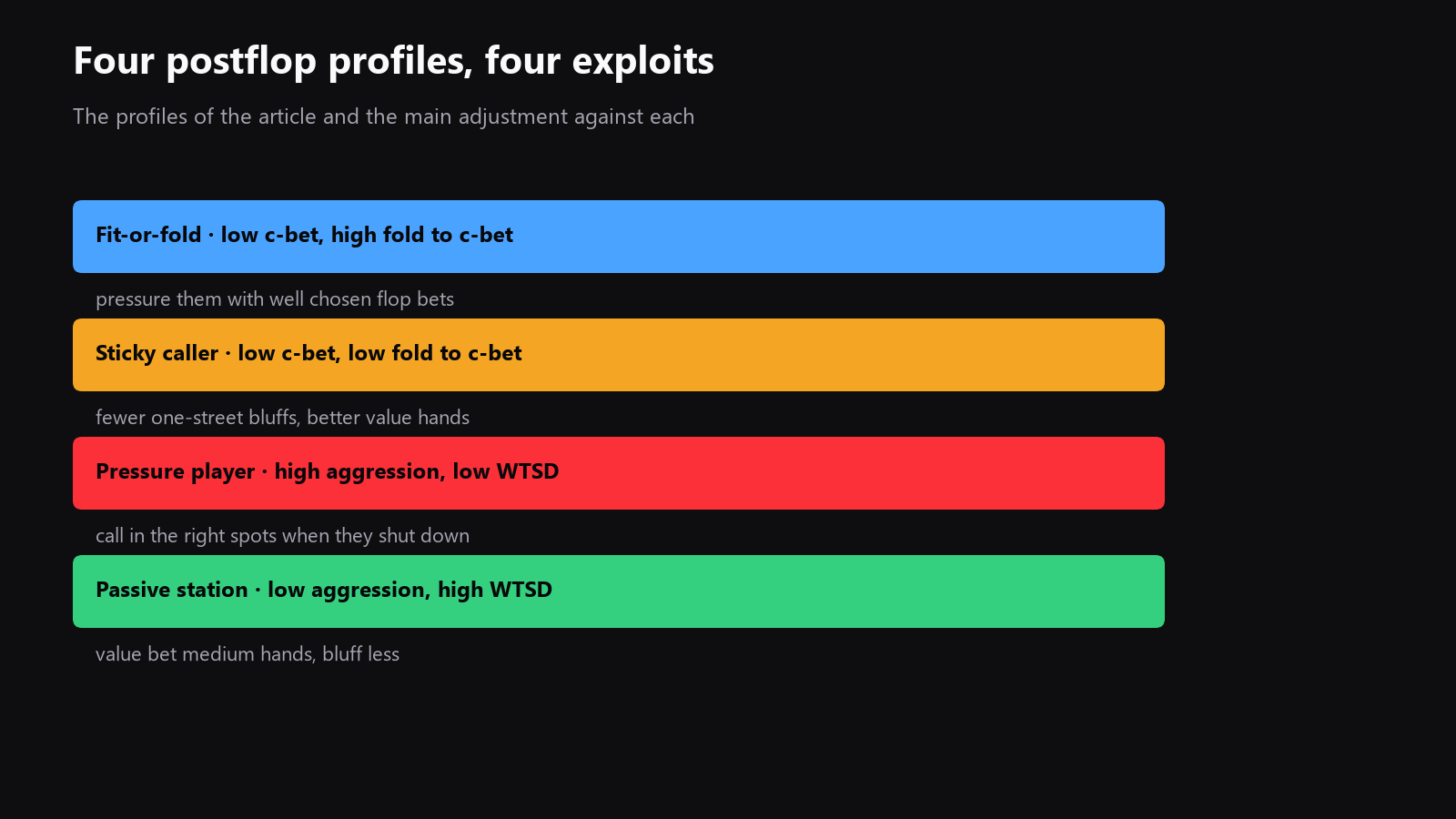
Low c-bet, high fold to c-bet
This is often a straightforward fit-or-fold profile.
They do not always keep betting when they have the lead, and they surrender too much when they face a flop bet.
That does not mean they are weak in every spot. It means they are uncomfortable without a hand or a strong draw.
Against this player, a well chosen flop c-bet can print. You still need to respect board texture, because some boards connect with callers much better than others. But if the stat is backed by sample, you can pressure them often.
Low c-bet, low fold to c-bet
This profile is more stubborn and less straightforward.
A player like this may check back more often when they are the aggressor, but once they defend, they also refuse to fold easily.
That can mean several things:
- they are cautious with the betting lead
- they are sticky as a defender
- they like to see turns and rivers
- they play many one pair hands that keep going
Against them, one-street bluffs are less attractive. You want better value hands, and you want a clearer plan for later streets.
High aggression, low WTSD
This is often a player who likes to put money in the pot, but does not often arrive at showdown.
That can mean they bluff a lot, or it can mean they make people fold before the river, so their WTSD stays low. Those are not the same thing.
The question is not "Are they aggressive?" The question is "What happens after they become aggressive?"
If they apply pressure and then shut down too much, you can catch them by calling in the right spots. If they keep barreling, you need a stronger continuing range.
Low aggression, high WTSD
This is the classic passive caller profile.
They do not usually drive the action, but they keep putting chips in, and they reach showdown often.
That often means one thing for you: value bets matter.
Against this player, thin bluffs lose value quickly. Medium strength hands become better betting candidates, because they call too much and raise too little.
This is the type of opponent who makes you earn your folds.
Why board texture changes everything
A stat only makes sense inside a board context.
A high flop c-bet on A-high dry boards is not the same as a high flop c-bet on coordinated boards with straight and flush draws. The first can be standard. The second can be much more revealing.
The same is true for fold to c-bet.
Some players fold a lot on dry boards because those boards miss them. The same players may continue much more often on wetter boards because they pick up pair plus draw, gutshot, or backdoor equity.
So when you read a HUD stat, ask:
- what board are we on?
- who had the preflop lead?
- is the pot heads-up or multiway?
- are we deep enough for later streets to matter?
If you skip those questions, you will misread a good number of players.
How much sample do you need?
Always more than you think.
A tiny sample can point you in the right direction, but it should not run your strategy. A few hands can be noise. A larger sample starts to show habits.
This matters even more for postflop stats, because postflop decisions depend on board type, position, stack depth, and whether the hand is heads-up or multiway.
Use the stat as a clue first, then confirm it with hands you remember. If you can, look at the actual lines, not just the number.
A simple practical framework
When you see a player, ask yourself these four questions:
- Do they c-bet too much or too little?
- Do they fold too much or too little when facing a c-bet?
- Are they passive or aggressive after the flop?
- Do they actually go to showdown often, or do they give up?
That gives you a quick profile:
- pressure player
- sticky caller
- fit-or-fold defender
- passive station
- aggressive but unstable barrel player
Once you have the profile, your strategy follows naturally.
- Against high fold to c-bet players, c-bet more often when the board and range support it.
- Against high WTSD and low aggression players, value bet more and bluff less.
- Against aggressive players with low WTSD, be prepared to continue more often when your hand is strong enough, and do not auto-fold just because they fire.
- Against players who mix high c-bet and high fold to c-bet, attack both sides of the hand, when they are the aggressor and when they defend.
The main mistake to avoid
Do not turn HUD stats into labels you stop questioning.
A player is not "a 70% c-bet reg" or "a 40% WTSD station". That is too shallow.
The right use of postflop HUD stats is to build a working hypothesis:
- what parts of the hand they like
- what parts of the hand they avoid
- where they surrender
- where they keep going
Then you confirm it with the board, the action, and the sample.
That is how HUD stats become profitable instead of decorative.
Where a tool helps
If you want to build these reads from your own hands, the Poker Exploit HUD shows VPIP, PFR, 3-bet, fold to 3-bet, flop c-bet and fold to flop c-bet beside each opponent, and the Self Analyser helps you see where your own postflop game leaks the most. The Replayer is useful too when you want to check the actual hand, not just the number.
That is the whole point of postflop HUD stats: not to admire numbers, but to play better decisions.
Do it on your own hands.