
Preflop poker is built on pressure and resistance.
A raise asks a question. A 3-bet answers it with more pressure. A fold to 3-bet stat tells you how often a player gives up when that pressure comes back at them.
If you understand these two numbers, you understand a large part of preflop poker strategy, and you also understand where many easy chips come from.
What a 3-bet is
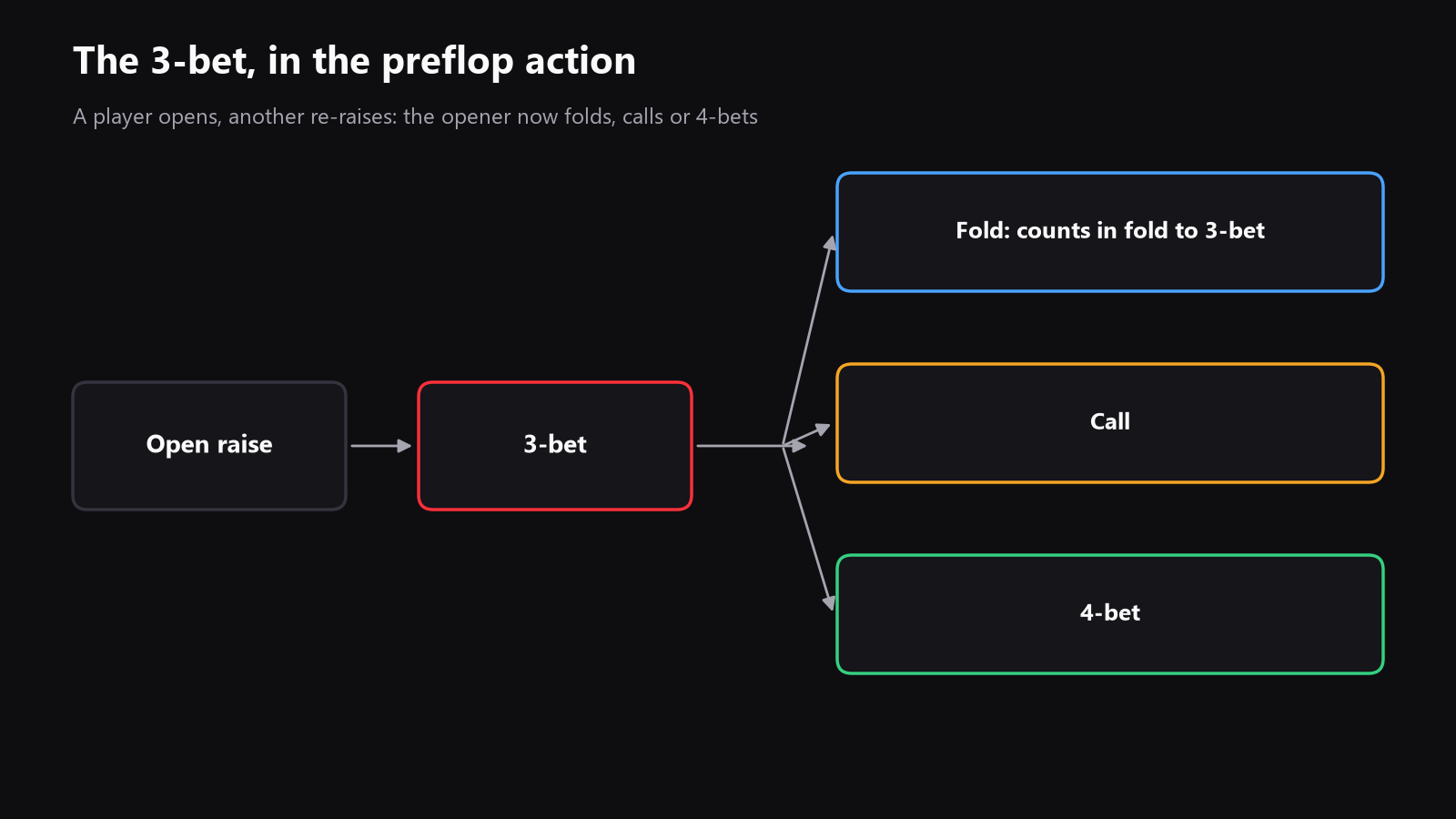
A 3-bet is the first re-raise preflop.
Example:
- one player opens the pot
- another player re-raises
- that re-raise is the 3-bet
In cash games and tournaments, this is one of the most important stats you can track, because it tells you how aggressive a player is before the flop.
A high 3-bet usually means one of two things:
- the player has a strong value range and likes to build pots with premium hands
- the player is using a lot of light 3-bets to apply pressure and win pots without showdown
A low 3-bet usually means one of two things:
- the player only 3-bets strong hands
- the player avoids preflop confrontation and prefers to call or fold
The stat alone does not tell you which one it is. You need context, especially position.
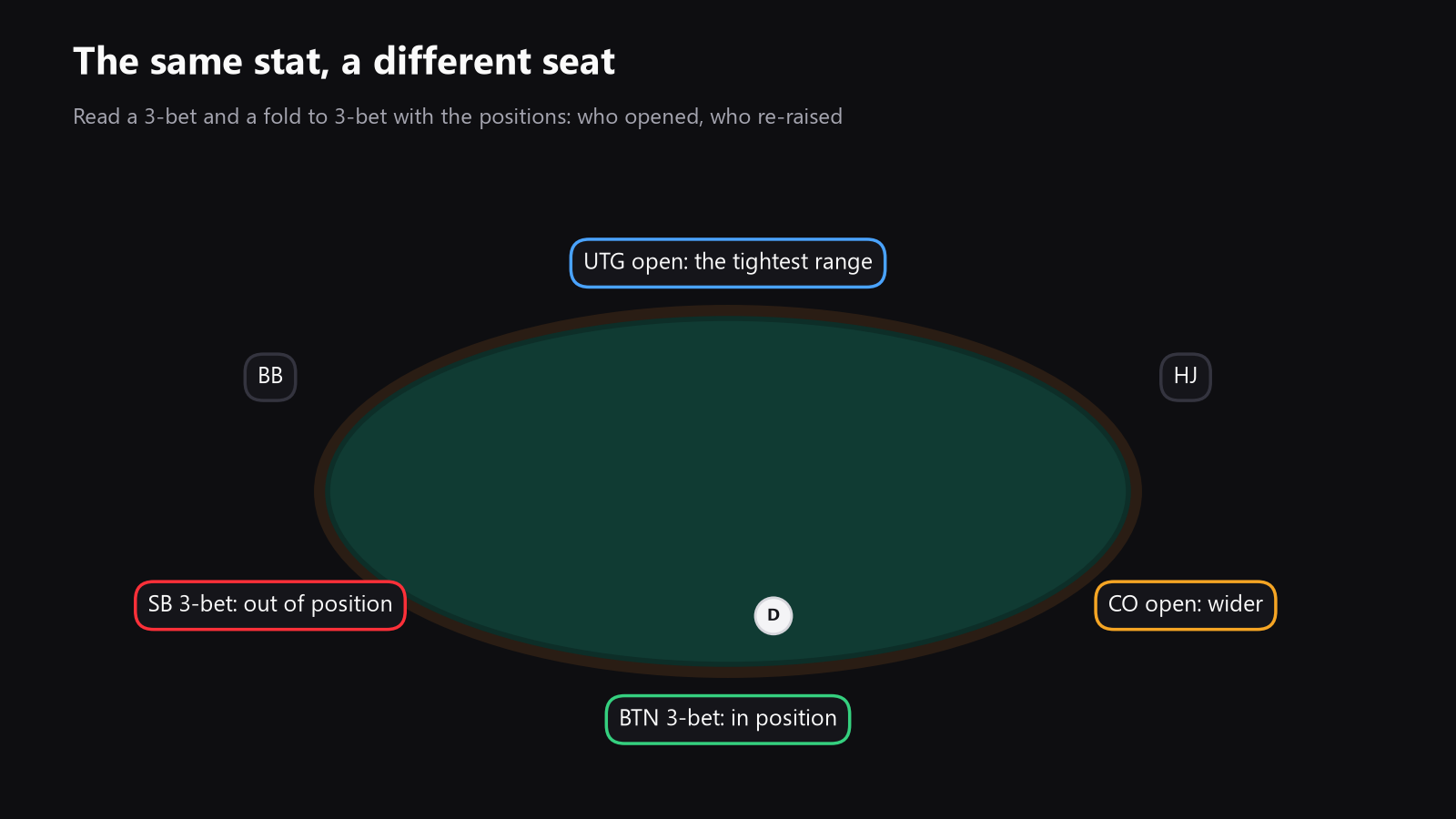
A 3-bet from the blinds is not the same as a 3-bet from the button. A 3-bet against an early-position open is not the same as a 3-bet against a cutoff open.
What fold to 3-bet is
Fold to 3-bet measures how often a player opens the pot, then folds when someone 3-bets them.
This stat matters because it tells you how sticky a player is before the flop.
If a player folds to 3-bets a lot, they are giving up too much of their opening range.
If a player folds to 3-bets rarely, they are continuing a lot, which means they may be defending well, but it can also mean they are calling too wide or 4-betting too little.
Just like with 3-bet, context matters.
A player can fold a lot to 3-bets from the blinds and defend more often in position. That is normal.
A player can also have a low fold to 3-bet number because they open very tight and continue with a strong range. That is not a leak by itself.
The question is not only, “Do they fold a lot?” The question is, “Do they fold too much for the situation?”
High and low 3-bet values
When you see a high 3-bet stat, do not jump straight to “maniac”.
A high 3-bet can mean:
- strong value hands
- light pressure
- a positional advantage
- a player attacking weak opens
- a player in the blinds trying to recover dead money
To tell which one it is, look at where the 3-bets happen.
If a player 3-bets often from late position against late opens, that can be a sensible, aggressive strategy.
If they 3-bet often from early position against very strong opens, that is a much stronger signal, because they are choosing to put money in with a range that has to survive more resistance.
A low 3-bet can mean:
- a tight, value-heavy range
- a passive style
- a player who prefers calls
- a player who is uncomfortable playing big pots before the flop
Again, the number is only a starting point.
High and low fold to 3-bet values
A high fold to 3-bet stat usually means the player opens hands that are not willing to continue under pressure.
That makes them exploitable.
A low fold to 3-bet stat means the player continues often after opening, which can happen in different ways:
- they call a lot
- they 4-bet often
- they open strong ranges and do not want to fold them
Those are very different situations.
A player who continues correctly is not the same as a player who refuses to fold out of stubbornness.
That is why the stat should never be used alone.
How to exploit a player who folds too much to 3-bets
This is one of the cleanest preflop leaks.
If an opponent opens and then folds too often to 3-bets, you can attack them more often, especially when you have position.
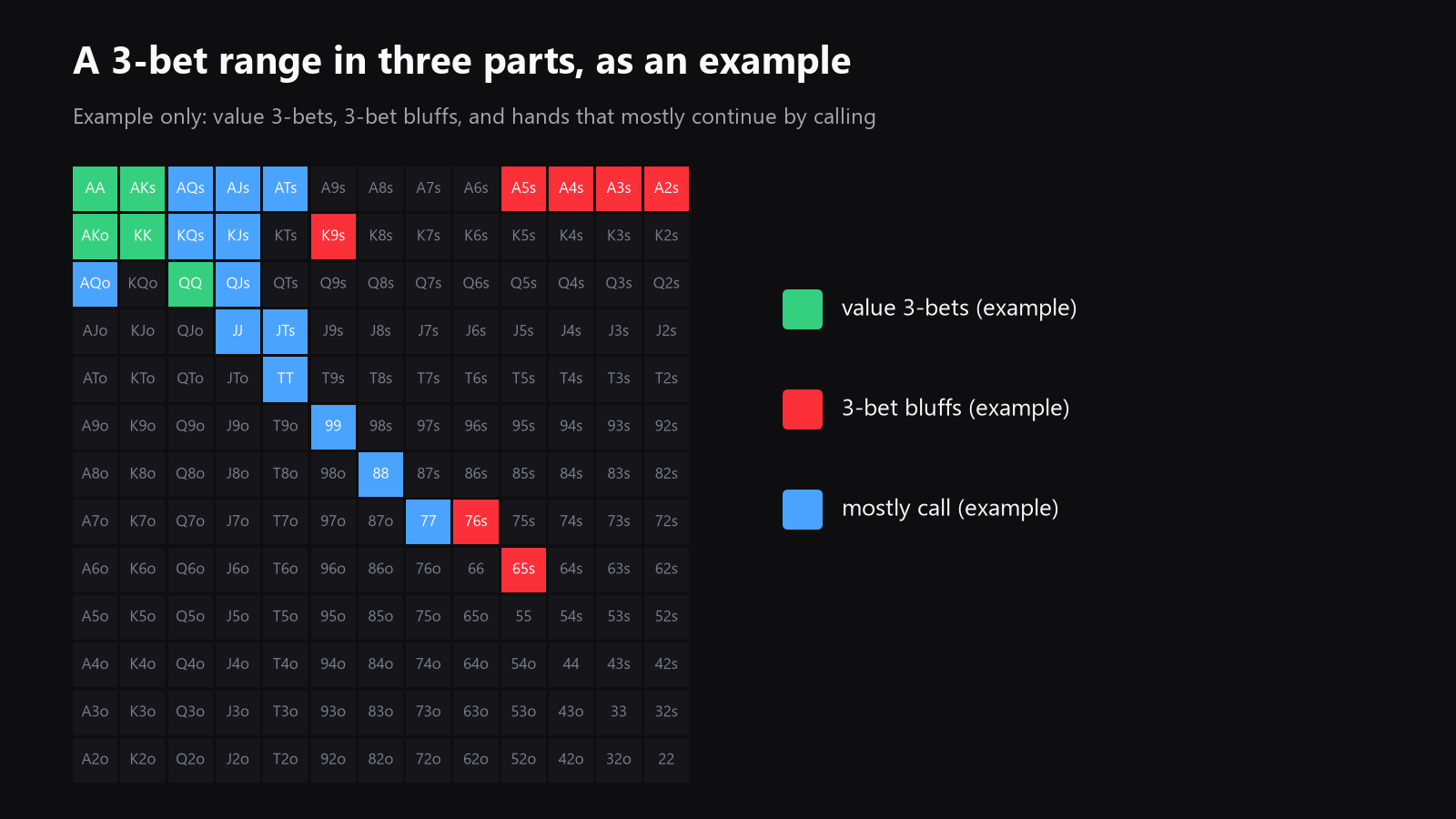
Widen your 3-bet bluff range
You do not need to 3-bet only premium hands. Add hands that have:
- blockers to strong continuing ranges
- decent playability when called
- enough equity to avoid pure trash
Good bluff candidates are usually hands that are not beautiful opens, but can still function well as 3-bets because they make it harder for your opponent to continue.
Increase your 3-bet frequency against late opens
A player who opens wide from the cutoff or button and folds too much to 3-bets gives you room to attack.
The later the open, the more pressure you can usually apply.
Tighten your value 3-bet range
If they continue too narrowly, your value range should be tighter and stronger.
Hands that are ahead of their continuing range, even if they are not monsters, become strong value 3-bets.
Do not overdo it
If you 3-bet too much, even a weak player will adjust eventually, or you will bloat pots with too many marginal hands.
Exploit the leak, but keep the rest of your range coherent.
How to exploit a player who folds too little to 3-bets
Some players do the opposite. They open and then continue too often.
That changes your strategy in two ways.
Bluff less
If they are not folding, pure bluff 3-bets lose value.
You do not want to build big pots with hands that rely on fold equity if the fold equity is not there.
Value 3-bet more
If they continue too wide, your strong hands print more money.
Premium hands become even better, and hands that dominate their continuing range become attractive value 3-bets too.
Play better postflop ranges
When a player continues a lot, you should be more aware of how their calling range interacts with the flop.
You will often face more postflop resistance, so hands that make top pairs and strong draws gain value relative to hands that only rely on preflop folds.
Watch for trap ranges
Some players continue a lot because they are strong, not because they are loose.
If their opening range is tight and their fold to 3-bet is low, you may be running into a stronger range than you think.
In that case, do not force bluffs just because the stat looks attractive.
How to face a player who 3-bets too much
A high 3-bet stat can create easy mistakes in the other direction.
You do not have to fold everything and surrender the pot.
Tighten your opens, but not too much
If someone 3-bets aggressively from behind you, weak opens lose value.
Cut the weakest parts of your opening range, especially hands that do poorly against re-raises and do not play well postflop.
Continue with hands that realize equity
Hands that can continue profitably against a wide 3-bet range should stay in.
That includes hands that can call and navigate postflop, as well as hands that can 4-bet for value or as a bluff, depending on the matchup.
Mix calls and 4-bets
If the opponent’s 3-bet range is too wide, you often want to respond in more than one way.
Some hands call to keep the pot manageable and to use position.
Some hands 4-bet for value.
Some hands 4-bet as bluffs, especially when they block the strongest parts of the opponent’s continuing range.
The exact mix depends on stack depth, position, and the type of player you face.
Do not let the stat scare you into passivity
A high 3-bet stat does not mean every hand is a disaster.
It means you must build a plan, not panic.
How to face a player who 3-bets too little
This is the quieter leak, but it is often very profitable.
If a player rarely 3-bets, they are under applying pressure before the flop.
That gives you more room to open wide and take control.
Open wider against them
If they do not punish opens often enough, you can attack their blinds and unopened pots more freely.
Value hands go up in value
If their 3-bet range is small, when they do 3-bet, their range is strong.
That means your value opens can still perform well, but you should respect the fact that when they finally 3-bet, they often have it.
Fold more when they wake up
A player who almost never 3-bets is not the person you want to level into huge preflop wars with weak holdings.
Against them, discipline is valuable. Let them have their rare strong range, and take the many pots they give you before that.
3-bet and fold to 3-bet together
These stats work best as a pair.
A player can have:
- a high 3-bet and a high fold to 3-bet
- a high 3-bet and a low fold to 3-bet
- a low 3-bet and a high fold to 3-bet
- a low 3-bet and a low fold to 3-bet
Each combination tells a different story.
High 3-bet, high fold to 3-bet
This often means the player likes applying pressure, but does not enjoy facing it back.
Against this type, you can respond with more 4-bets and more traps, while still respecting the parts of their range that are strong.
High 3-bet, low fold to 3-bet
This is a player who keeps fighting.
You should bluff less and value more. Your best hands want to play pots against them, but weak hands should not get dragged into unnecessary wars.
Low 3-bet, high fold to 3-bet
This is a player who opens, then surrenders too often when attacked.
Very profitable to target with light 3-bets, especially in position.
Low 3-bet, low fold to 3-bet
This player opens tight and continues strongly, or they defend too stubbornly.
You need to be selective. Respect the range, and do not assume you can print money with automatic pressure.
What else you should always check
Before using either stat, ask four questions.
1. What is the sample size?
A tiny sample can lie.
A few hands do not define a player. A larger sample tells you much more, especially when you can see where the actions happened.
2. Which position are we talking about?
A cutoff open is not the same as an under the gun open.
A button 3-bet is not the same as a small blind 3-bet.
3. What stack depth are you playing?
Short stacks, deep stacks and tournament stacks all change preflop incentives.
A player can look passive in one stack zone and normal in another.
4. What is the player trying to do?
Some players are tight because they are weak. Others are tight because they are disciplined.
Some players are aggressive because they are good. Others are aggressive because they are out of control.
The stat tells you what happened, not the full reason why.
A simple practical method
If you want to use these stats well, follow this order.
- Identify the opener and the 3-bettor.
- Check position.
- Check whether the opener folds too much or too little to 3-bets.
- Check whether the 3-bettor applies pressure too often or too rarely.
- Adjust your range, not just your mood.
That last point matters.
Good preflop poker is not about feeling that someone is “weak” or “strong”. It is about building the right response to the range in front of you.
Why this matters for your game
The 3-bet and fold to 3-bet stats are two of the fastest ways to spot preflop leaks.
They show you who is giving up too much, who is fighting too much, and who is somewhere in between.
If you learn to read them well, you will:
- steal more pots
- avoid unnecessary confrontations
- value bet better preflop
- defend more intelligently
- stop guessing as often
And if you want to see these numbers next to the table while you play, the HUD panel shows them together with VPIP and PFR, so you can read the profile quickly and make your own decision.
The stat does not play the hand for you. It only tells you where the pressure points are.

Final takeaway
Think of 3-bet as the question: “How often does this player re-raise preflop?”
Think of fold to 3-bet as the answer: “How often does this player give up when re-raised?”
When you combine them, you get a clear picture of preflop aggression, resistance, and exploitability.
That is where good adjustments begin.
Do it on your own hands.