
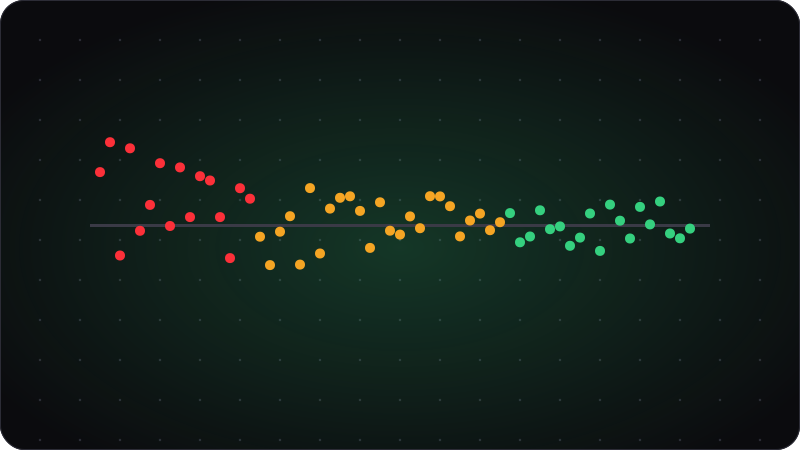
A HUD stat is never just a number. It is a measurement, and like any measurement it comes with uncertainty.
That is the key idea behind HUD sample size.
If you ask, “How many hands before I can believe this stat?”, you are already asking the right question. But the better question is usually, “How many opportunities produced this stat, and what else do I know about the player?”
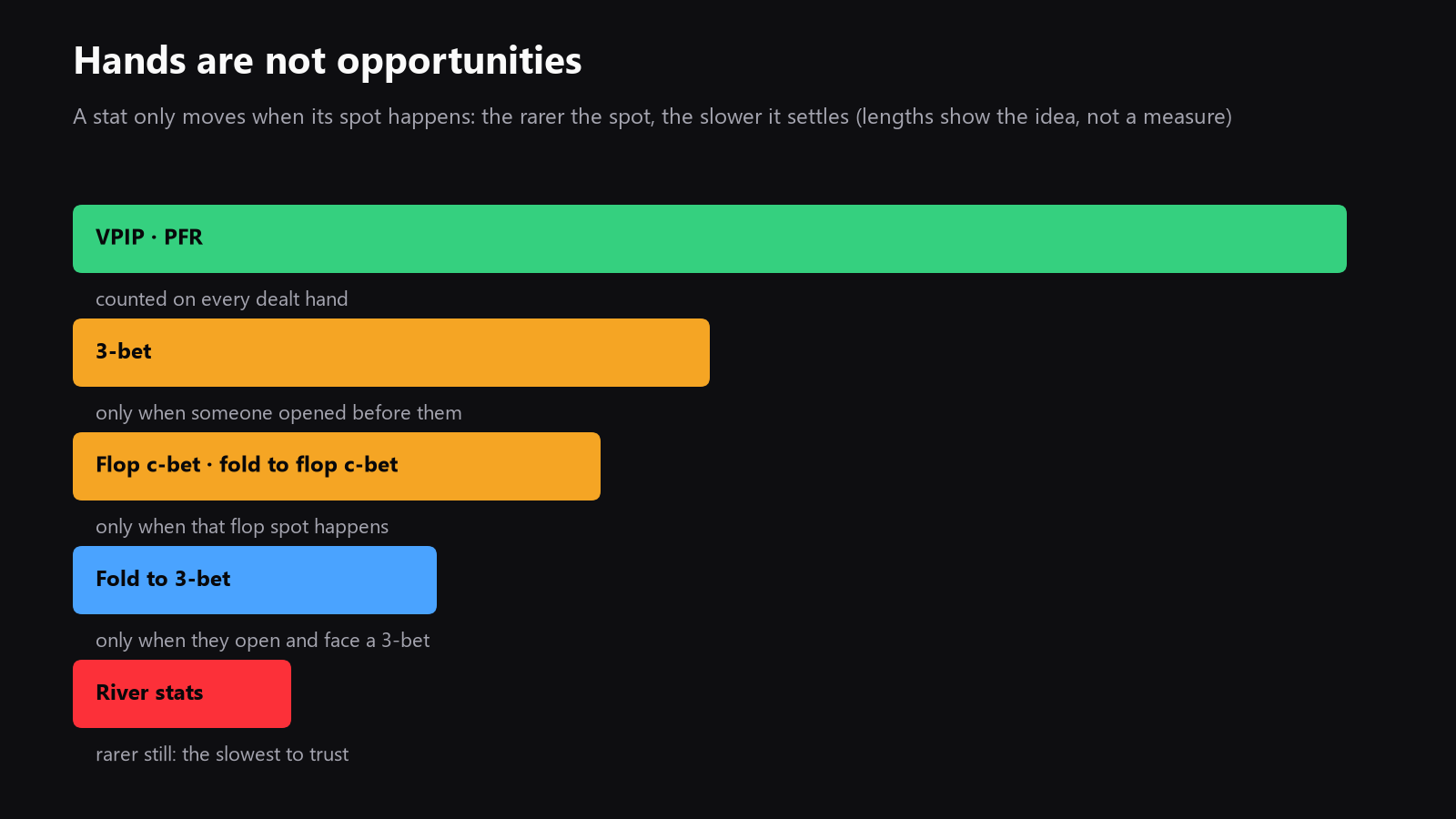
Those two questions are not the same. A player can have 1,000 hands in your database and still have very few opportunities for a rare spot, such as folding to a 3-bet or taking a line on the river. Another stat, such as VPIP or PFR, is counted on every dealt hand, so it settles on the same pace.
Hands are not the same as opportunities
This is the first mistake many players make.
They look at a stat and think, “I have 800 hands on this player, so I know him.” Sometimes that is true for broad tendencies. Sometimes it is completely false.
A HUD stat only updates when the relevant spot happens.
- VPIP changes on almost every dealt hand
- PFR is counted on every dealt hand too
- 3-bet changes only when the player faces an open and has the chance to 3-bet
- Fold to 3-bet changes only when the player actually faces a 3-bet
- Flop c-bet changes only when the player was the preflop raiser, sees a flop, and has no bet facing them before they can c-bet
- Fold to flop c-bet changes only when the player faces a flop c-bet
So when you say, “I have 500 hands,” you are not really saying how much you know about each stat. You are saying how many total hands were dealt. The useful number is the number of relevant opportunities.
That is why a player can look “known” in one part of the HUD and remain a mystery in another.
Why frequent stats settle faster
Some stats are naturally common. VPIP is the easiest example. If a player has played 100 hands, you already have 100 opportunities to see whether they voluntarily put money in the pot. The stat may still move, but it has plenty of observations.
PFR is in the same category. It is counted on every dealt hand too, so it has the same kind of raw sample as VPIP.
Now compare that with fold to 3-bet.
In 100 dealt hands, a player may have only a handful of chances to face a 3-bet. If they faced it 7 times, a stat of 71% means 5 folds and 2 times he continued. That is not useless, but it is still a very small pile of evidence.
The same principle applies even more strongly to river stats. River spots are valuable, but they are rare. That means they are slow to stabilize.
In plain language, the rarer the spot, the more hands you need.
A useful rule of thumb is this:
- common preflop stats settle first
- medium frequency postflop stats come next
- rare river spots are the slowest to trust
And even then, you should think in ranges, not absolutes.
The math idea, without the math headache
You do not need advanced statistics to use HUD sample size well, but one idea helps a lot.
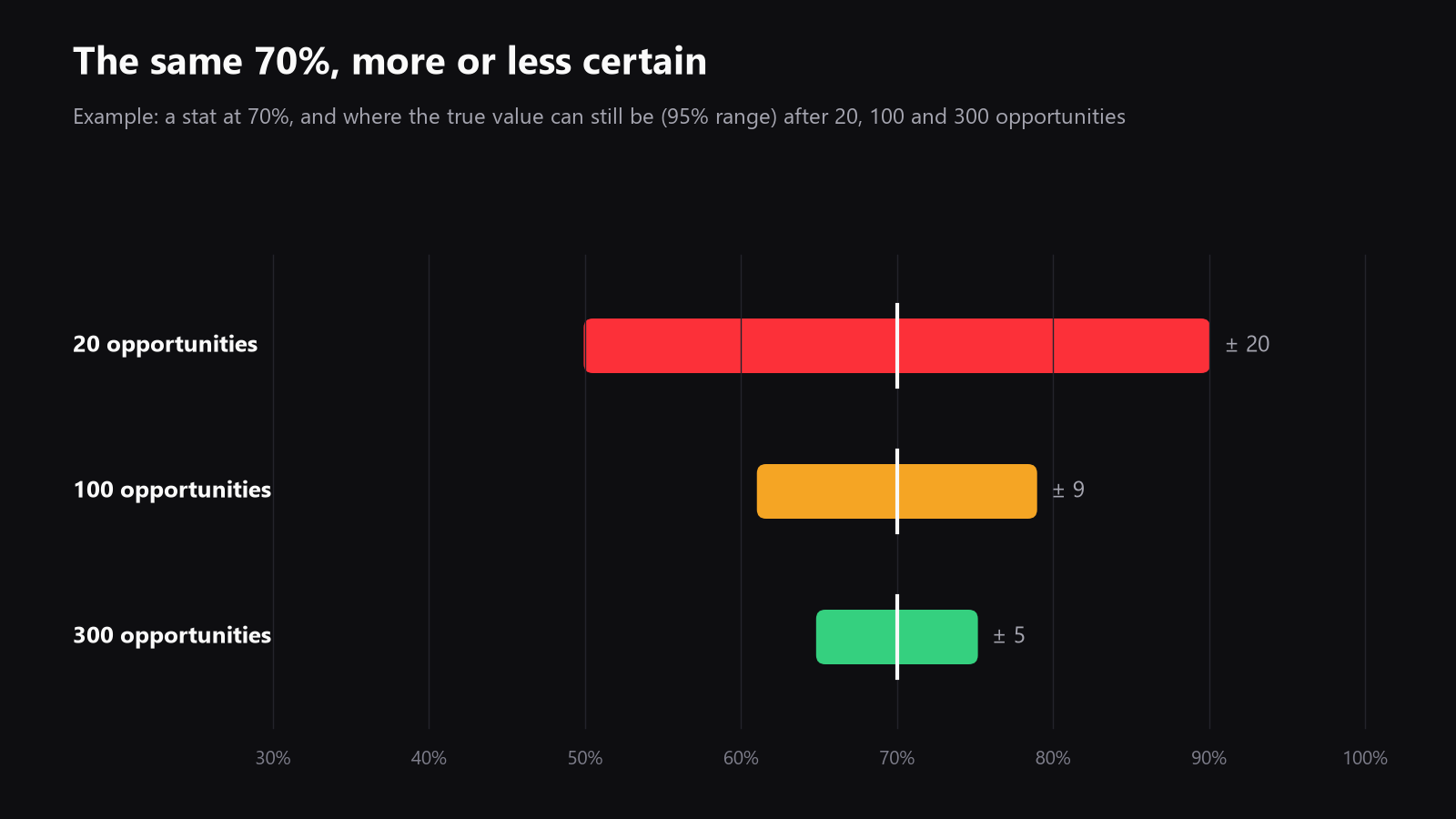
Uncertainty shrinks as sample size grows, and it shrinks slowly.
That is why doubling the sample helps, but not as much as people expect.
If a player folds to a 3-bet 70% of the time over 10 opportunities, the stat is still shaky. Move a couple of decisions either way and the number changes a lot.
If the same 70% comes from 100 opportunities, it is much more believable. A few more hands will not move it nearly as much.
This is also why small samples are dangerous in both directions:
- a stat can look extreme by chance
- a stat can look ordinary even when the player is unusual
So the real skill is not to ignore small samples, but to discount them properly.
Practical sample size guidelines
There is no magical number where a stat suddenly becomes true. Still, it helps to have rough thresholds in mind.
These are not laws. They are starting points.
VPIP and PFR
These are among the fastest stats to read.
- 20 to 30 hands can already tell you something
- 50 to 100 hands usually gives a usable first impression
- 200 hands or more is much better if you want confidence
Even then, remember that position and table dynamics can distort the picture. A player who has run card dead can look tighter than they really are.
3-bet and fold to 3-bet
These need more caution because the relevant opportunities are fewer.
- 10 opportunities is usually too thin
- 20 to 30 opportunities can give you a first read
- 50 to 100 opportunities is much more reliable
If you see a player folding to 3-bets 71% over 7 opportunities, that is a very different story from 74% over 127 opportunities.
Flop c-bet and fold to flop c-bet
These settle in the middle.
- a few dozen opportunities can already be informative
- 50 to 100 opportunities is better
- more is always better, especially if the player takes unusual lines
River stats
These are the noisiest common stats.
They can be useful, but only if you respect how rare they are.
If a river stat looks dramatic after a small number of opportunities, assume it is provisional until proven otherwise.
How to act on a small sample without being fooled
This is where a lot of players make costly mistakes. They see a percentage, forget the sample behind it, and start overreacting.
The fix is simple in principle, harder in practice.
1. Start from population tendencies
Do not treat the HUD stat as the whole truth.
Start from what the field usually does, then adjust for the player in front of you. A small sample should move your baseline a little, not erase it.
2. Trust extreme stats more when the opportunity count is large
A player who folds to flop c-bets a lot over many opportunities is different from a player who did it four times in a row.
Extreme numbers matter, but only when they come from enough chances.
3. Combine stats
One stat rarely tells the whole story.
A player with high VPIP, low PFR, and high fold to 3-bet is a very different opponent from a player with the same VPIP but a strong 3-bet game. Use the shape of the whole HUD, not one isolated number.
4. Look for consistency with showdowns and lines
Does the stat match what you have actually seen?
If the player has a loose preflop profile but keeps showing up with strong hands in big pots, you may be dealing with a tighter range in key spots than the headline numbers suggest.
5. Make smaller adjustments when the sample is small
This is the best practical habit.
If the sample is thin, exploit a little, not a lot. Increase the weight of the stat as the sample grows.
That keeps you from overbluffing a player who is not actually overfolding, or value-betting too thinly against someone whose “sticky” line is only a short-term accident.
What to prioritize in your HUD
If you have too many numbers and too little clarity, start with the stats that matter most and settle reasonably fast:
- VPIP
- PFR
- 3-bet
- Flop c-bet
- Fold to flop c-bet
Those are also the stats the HUD module in Poker Exploit shows. It shows observed statistics from your own hands, each compared with the field in amber above and blue below.
That matters because a HUD is useful only when you can separate signal from noise.
If you want to go one step further, the Replayer module lets you replay any hand street by street, which can help you review the line behind a stat and decide whether it is truly meaningful or just a temporary bump.

A simple way to think about it at the table
When you see a stat, ask yourself three questions:
- How many opportunities produced this number?
- Does this stat fit the rest of the HUD?
- If I am wrong, how expensive is the mistake?
That last question is important.
If the sample is small, the cost of overreacting is high. In that case, make a modest adjustment and keep watching.
If the sample is large and the behavior is consistent, you can act more aggressively.
That is how good HUD use works in practice. Not by worshipping percentages, but by weighting them correctly.
The short version
If you want the simplest answer to “How many hands before I trust a stat?” here it is:
- common stats like VPIP and PFR start to speak early
- stats tied to rarer opportunities need much more patience
- river stats are the slowest to stabilize
- always think in opportunities, not just hands
- with a small sample, adjust a little, not a lot
A HUD is not there to give you certainty. It is there to make your uncertainty smaller and more useful.
If you use it that way, you will stop getting fooled by tiny samples, and you will start making better exploitative decisions much faster.
Do it on your own hands.