
If you play online poker long enough, you start hearing the same advice over and over.
"Micro stakes never bluff rivers."
"The pool always calls too much."
"Nobody folds to three-bets at this limit."
Some of that is useful. Some of it is nonsense. Most of it is incomplete.
What matters is not what the average player in theory should do. What matters is what the player pool at your limit actually does. That is what population tendencies are: the stable ways a group of players deviates from balanced play.
If you know those deviations, you can make more informed decisions even when you know nothing about the person in front of you. That is the whole point of population exploits. You do not need a perfect individual read to build a solid plan against the pool. You need a good picture of the pool itself.
What a population tendency really is
In equilibrium, every action has a reason and a counterweight. People bluff enough, fold enough, call enough, and raise enough that no one can print by using a simple counter strategy.
Real pools are not balanced like that.
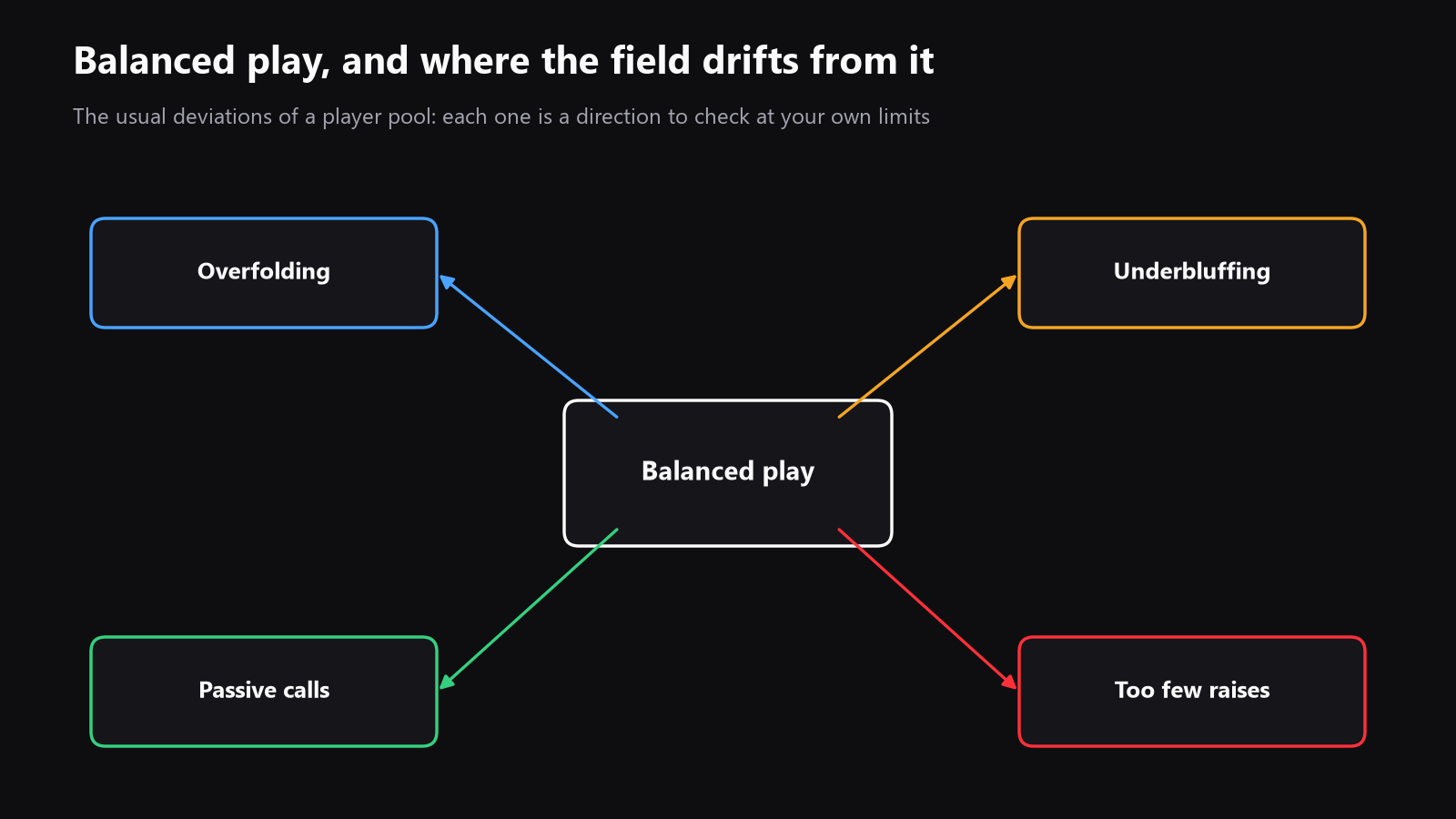
At a given stake, format, or site, players often lean the same way in the same spots. For example:
- they may fold too much against three-bets,
- they may continuation bet too often or too rarely,
- they may underbluff rivers,
- they may call too wide preflop,
- they may give up too much on the turn,
- they may overvalue one-pair hands in big pots.
Each of those leaks changes what the best exploit looks like. A balanced strategy is a starting point. A population tendency is a reason to deviate from it.
Why exploiting the field pays even when you know nothing about one opponent
This is the part many players miss.
You do not need to know whether the cutoff is a reg, a fish, or a nit to benefit from a population read. If the pool at your limit overfolds to flop pressure on certain boards, then your c-bets can be a little wider there. If the pool underbluffs the river, then your bluff-catchers can be tighter in those spots.
That is exploitative poker in its simplest form:
- Start from a sound baseline.
- Compare the baseline to the field.
- Adjust toward the field's actual leak.
- Avoid overreacting when the sample is small.
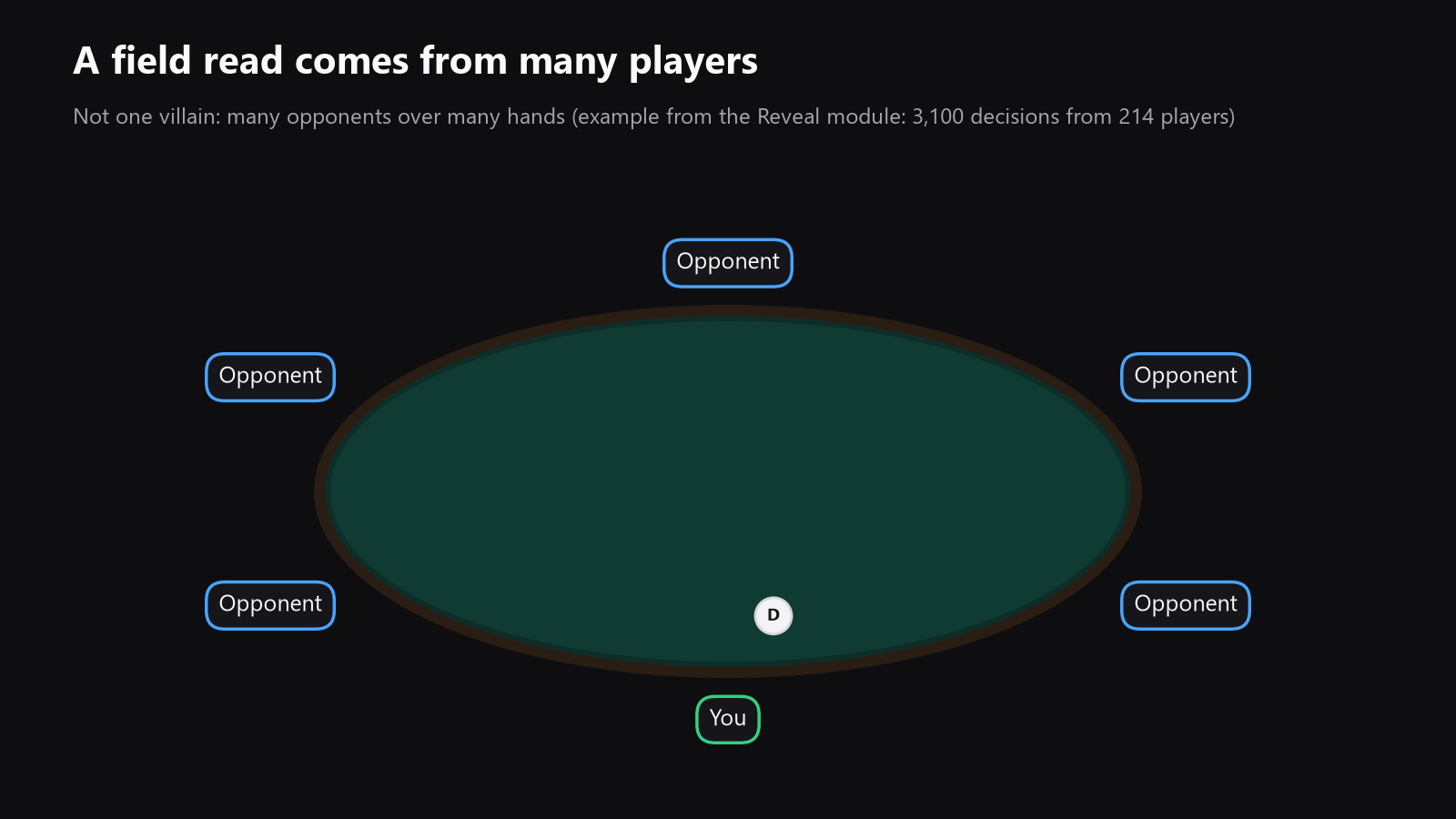
This works because population tendencies are often more stable than individual reads. One opponent may be unusual. A hundred opponents playing the same stake tend to reveal a pattern.
That said, the field is not one thing. A pool can be loose preflop and tight on the river. It can overcall in single-raised pots and overfold in three-bet pots. It can be sticky against small bets and disciplined against large bets. You need to know which spot you are in before you choose the exploit.
The mistake of trusting poker folklore
Forum lore is attractive because it is simple. It gives you shortcuts. But it also creates lazy assumptions.
If you hear "the pool never folds," you may stop bluffing in spots where the pool actually overfolds. If you hear "micro stakes never bluff," you may overfold your bluff-catchers and get bluffed off pots in the very spots where the pool does bluff. If you hear "everyone c-bets too much," you may check back too often and give up free pots.
The problem is not that population reads are useless. The problem is that vague population reads are useless.
A real field tendency is not "people are passive." A real field tendency is "players at this limit fold too much to turn barrels on scare cards after defending wide preflop." That is the kind of statement you can use.
Which population leaks matter most
Not every deviation is worth exploiting.
The best population tendencies have three qualities:
- they happen often,
- they cost a lot when you miss them,
- they are easy to adjust to without creating new mistakes.
That is why the most useful spots are usually the simple, high-volume ones.
Preflop
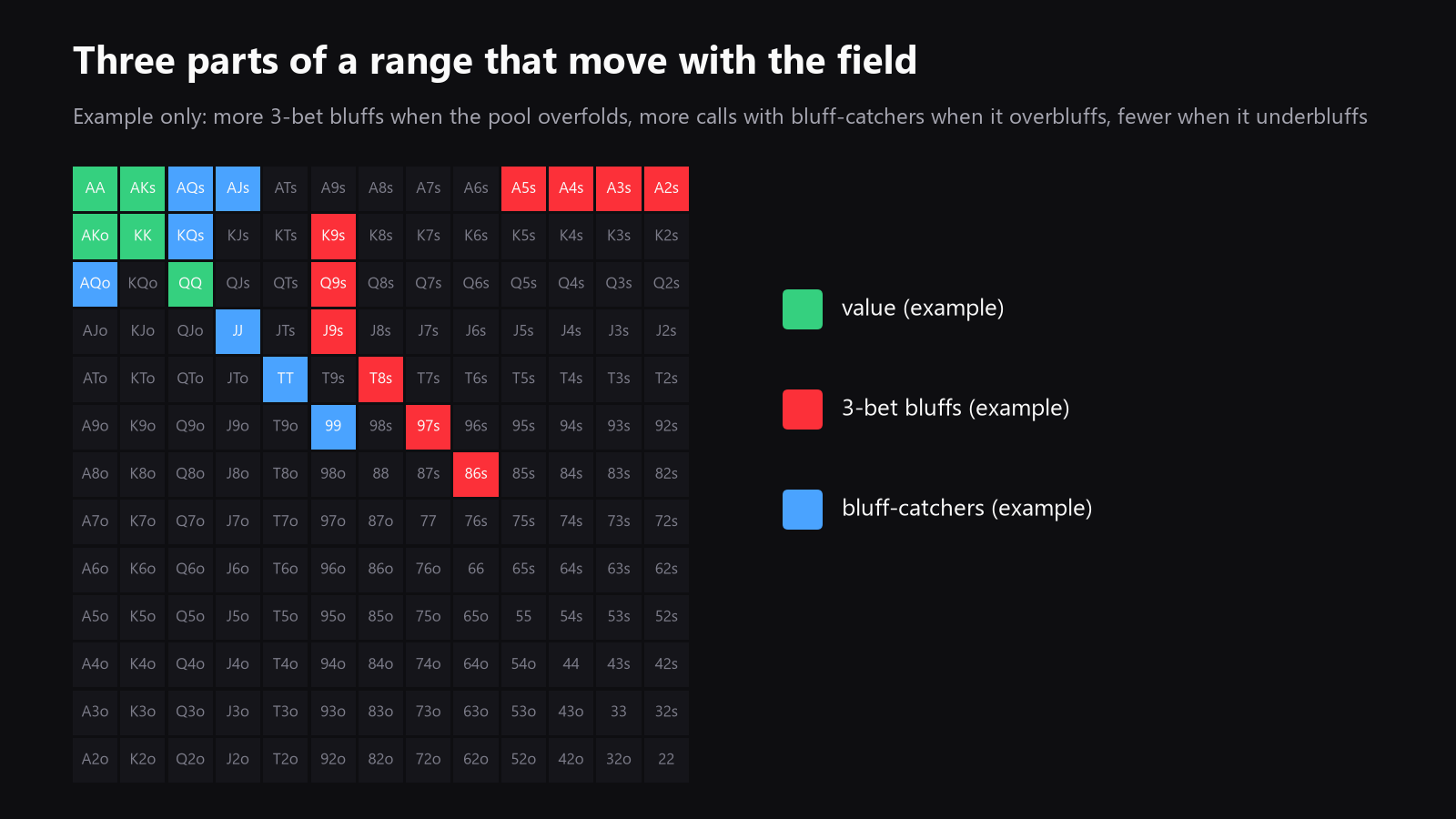
If the pool folds too much to three-bets, you can widen your three-bet range, especially in position. If it calls too much, you tighten your bluff three-bets and increase the value part of the range.
A common mistake is to look only at your own hand strength. The better question is, "How does this pool react to my action?" If they fold too much, the bluff is profitable. If they call too much, the value hand prints.
Flop
Flop tendencies often show up in c-bet spots.
Some pools overfold to small c-bets on dry boards. Others continue too wide and float too many weak hands. Some defend by raising too much, which changes your betting strategy again.
This is why board texture matters. A population exploit on A-high, dry flops is not the same as the exploit on connected, dynamic boards. The field is not equally weak everywhere.
Turn
Turn play is where many players become uncomfortable. They continue too often on the flop, then give up too much when the board changes. Or they do the opposite, folding turn and reaching river with a range that is too strong.
If the pool overfolds turns, barreling becomes attractive. If the pool calls too much, thin value grows in value and pure bluffs get worse.
River
Rivers often separate theory from practice.
Many pools do not find enough bluffs. That means your bluff-catchers can often be tighter than equilibrium in some lines, especially when the range advantage is not on the aggressor's side. On the other hand, if the player pool overcalls rivers, then thin value bets and larger sizings become more attractive.
River exploits are powerful, but they are also the easiest to get wrong if you do not know the line leading to the river. A river tendency is only useful if you know how the range arrived there.
How to turn a tendency into a good adjustment
A good exploit is not a heroic line. It is a small change that repeats well.
Ask yourself:
- What does the field do more than it should?
- How often does that happen?
- What is the immediate counter?
- Does that counter stay valid across enough hands to matter?
For example:
- If the pool folds too much to flop c-bets, you can c-bet more often on the boards where your range benefits.
- If the pool calls too much versus small flop bets, you can size up with value and cut the weakest bluffs.
- If the pool underbluffs rivers, you can fold more bluff-catchers and save money.
- If the pool overcalls turn barrels, you can value bet thinner and choose bluffs carefully.
Notice what is missing here: not one of these adjustments says "always do X."
That is important. Good population strategy is conditional. The exploit depends on the board, the line, the sizing, the position, and the texture of the ranges.
How to tell the difference between a real leak and a false one
This is where many players get fooled.
A false read sounds clean but comes from too little data, too narrow a line, or a sample that mixes different player types. A real population tendency survives repetition.
Here is a simple way to think about it:
- If the tendency appears in one session only, be cautious.
- If it appears in one line only, check whether the line itself biases the result.
- If it appears across many opponents and many sessions, it is more likely to be real.
- If your adjustment keeps working after you test it, you probably found a genuine field tendency.
The goal is not to be certain on day one. The goal is to be directionally right and progressively more precise.
How to find out what your field really does
You do not need forum arguments for this. You need hand histories.
That is why the most useful population reads come from your own pool, not from generic advice written for every stake in every room. Your games have their own habits. Your stakes have their own rhythms. Your format matters too.
If you want to see those patterns clearly, the Reveal module is built for that. It reads what the players at your limits actually did from your own hand histories and shows you when a tendency is outside its reference range. That is the difference between guessing and measuring.

The point is not to memorize every number. The point is to know where the field is drifting away from balance in the spots that matter.
For table-by-table context, the HUD panel is the other useful piece. It shows observed statistics only, not advice: VPIP, PFR, 3-bet, fold to 3-bet, flop c-bet, and fold to flop c-bet. That is enough to help you place a player inside the pool without pretending you know more than you do.

A practical way to think about population strategy
When you sit down at a new limit, do not ask, "What does theory say?"
Ask:
- What do players here actually defend?
- Where do they overfold?
- Where do they call too much?
- Where do they give up?
- Where do they reach showdown too lightly or too strongly?
Then build your strategy around those answers.
If the field overfolds, pressure them more. If the field overcalls, value bet more. If the field underbluffs, bluff-catch less. If the field plays passively, take more pots away. If the field fights back in a specific line, tighten up there and attack elsewhere.
That is how population tendencies become useful in practice.
The big idea
Exploitative poker does not begin with a perfect read on one player. It begins with a useful read on the player pool.
Once you know what the field does at your limit, you stop playing against theory in the abstract and start playing against the actual mistakes people make where you play. That is where the edge lives.
And if you want to stop relying on slogans like "the micros are all the same," measure your own pool instead. The right data shows where the field really deviates, so your adjustment rests on evidence rather than a slogan.
Do it on your own hands.