
Online poker tells are real, but they are easy to misunderstand.
Unlike live poker, you cannot watch a player breathe, talk, or stare at the board. What you do get is different: exact bet sizes, exact timing, and exact hand histories. That is enough to learn something useful, but only if you treat every clue as a hypothesis, not as a verdict.
The big mistake is to read one strange action and build a story around it. A better habit is to ask a simpler question: does this player keep doing the same thing in the same spot, or was that just one noisy hand?
What an online tell really is
An online tell is any repeatable pattern that gives you information about a player’s range.
That can be a timing pattern, like checking instantly on some boards and tanking on others. It can be a sizing pattern, like using one size for value and another for bluffs. It can also be a change from a player’s own default, which is often more useful than the raw action itself.
A tell is not the same thing as a guess.
If you see a player bet small on the flop, that does not automatically mean weak. If you see a player take time before betting the river, that does not automatically mean a bluff. The same action can come from habit, pressure, distraction, value, or a bluff. The value is in repetition and context.
The rule to keep in mind is simple:
- one strange action is a question
- repeated action in the same spot is evidence
- repeated action plus showdown is a read
Timing tells: useful, but easy to overread
Timing tells are the easiest online tells to notice, and also some of the easiest to get wrong.
A fast action often means the player had already decided. A slow action often means the player had to think. That sounds useful, but it is still too broad to rely on by itself. A player may act fast because they are multi-tabling, using a preset line, or simply not paying attention. A player may tank because they are in a real spot, or because they stepped away from the table.
So timing is not a direct translation of hand strength. It is a filter.
What timing can suggest
Timing becomes more interesting when you compare the same player across similar spots.
For example:
- a snap check on one street, then a long pause before a raise later in the hand, can mean the player had a weak branch first and a real decision later
- a quick call in one spot and a long tank in another can suggest the player is comfortable with one range and uncertain with the other
- a consistent delay before value betting and a faster pace before bluffing can be a pattern, but only if you see it often enough to trust it
The best timing tells are relative, not absolute. You are not asking, "Was that fast or slow?" You are asking, "Was that faster or slower than this player’s normal pace in this same kind of spot?"
What timing cannot tell you
Timing alone cannot tell you:
- whether the player has top pair or a draw
- whether the player is value betting thinly or bluffing
- whether the player is strong because they tanked, or weak because they clicked quickly
If you cannot connect the timing to a line, a board, and later showdowns, do not spend money on it.
Bet sizing tells: usually stronger than timing, but still not enough alone
Bet sizing is often more informative than timing because it changes the decision tree.
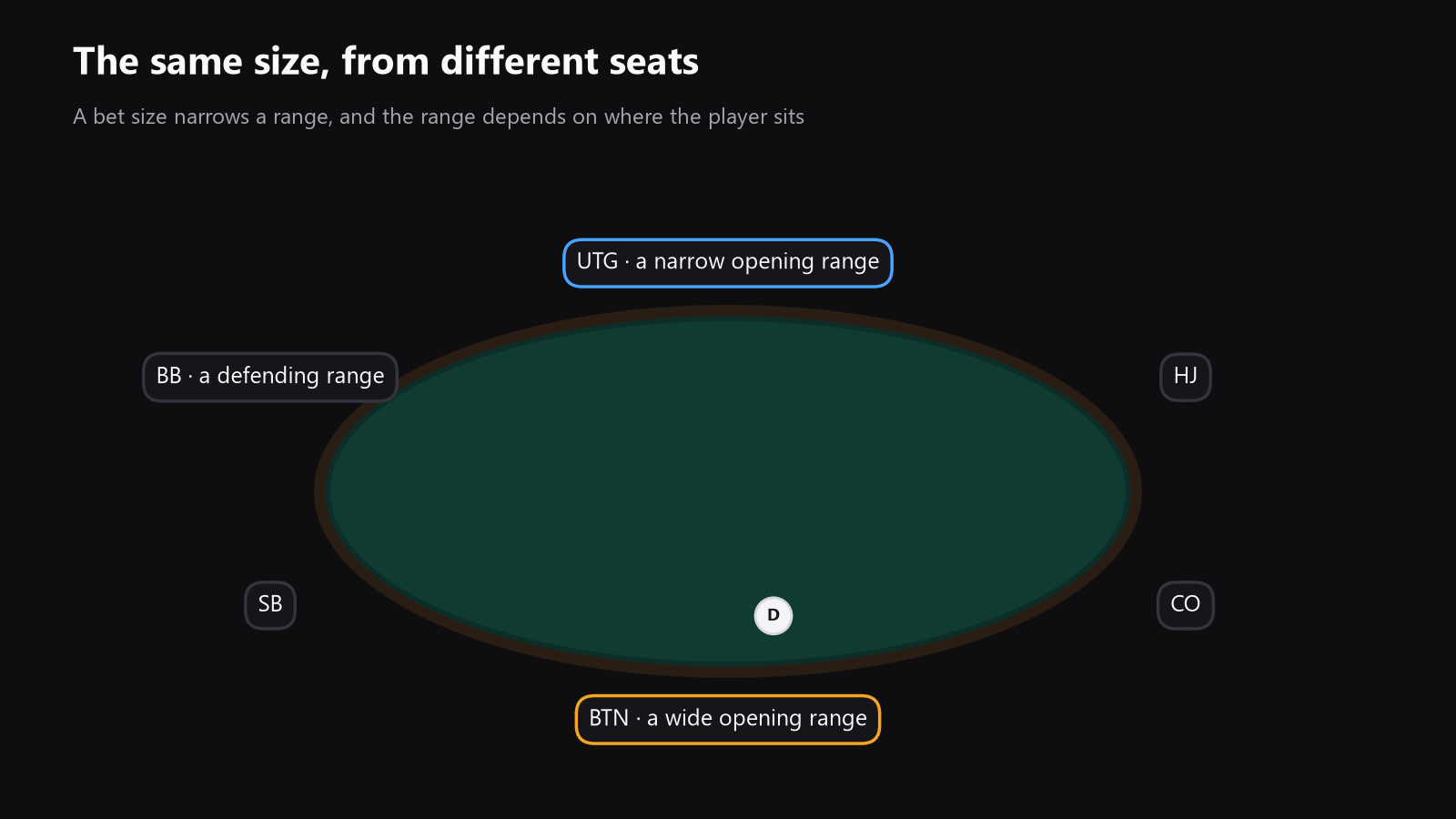
When a player chooses a size, they are saying something about their range, even if they do not mean to. That does not mean the size is literal truth. It means the size often narrows the set of hands that make sense.
Preflop sizing
Preflop, size can reveal whether a player uses a fixed habit or a hand-dependent one.
A player who always opens the same size gives away less through the size itself. A player who changes size by position, stack depth, or opponent type gives you more to work with. The key is not to assume that bigger means stronger or smaller means weaker. Some players use a large open with strong hands, some use it to isolate limpers, and some use it simply because they copied a default.
What you want to notice is deviation. If a player normally uses one open size and suddenly changes it in one spot, that is more interesting than the raw number.
Flop sizing
On the flop, small bets often mean the player wants to keep many hands in the pot. That can be a value hand, a draw, a blocking bet, or a cheap bluff. Large bets often mean pressure, protection, or polarization. Again, none of that is automatic.
A small flop bet may be the weakest part of a range, but it may also be a merged value bet from a player who likes to keep the pot controlled. A large flop bet may be a strong hand, but it may also be a draw that wants fold equity.
The board matters a lot here. A small bet on a dry board says something different from a small bet on a very connected board. A size only becomes meaningful when you add texture.
Turn and river sizing
As the hand goes deeper, sizing often becomes more revealing.
By the turn, players have usually committed to a plan. By the river, the hand is often polarized enough that the size carries real information. A big river bet can mean a strong made hand or a bluff that wants maximum fold equity. A smaller river bet can mean thin value, a blocking bet, or a player trying to reach showdown cheaply.
The important part is not the size itself. It is whether the size matches the line the player took before it.
A river overbet after passive streets often means something very different from a river overbet after aggression on earlier streets. You need the whole story.
What makes a tell reliable
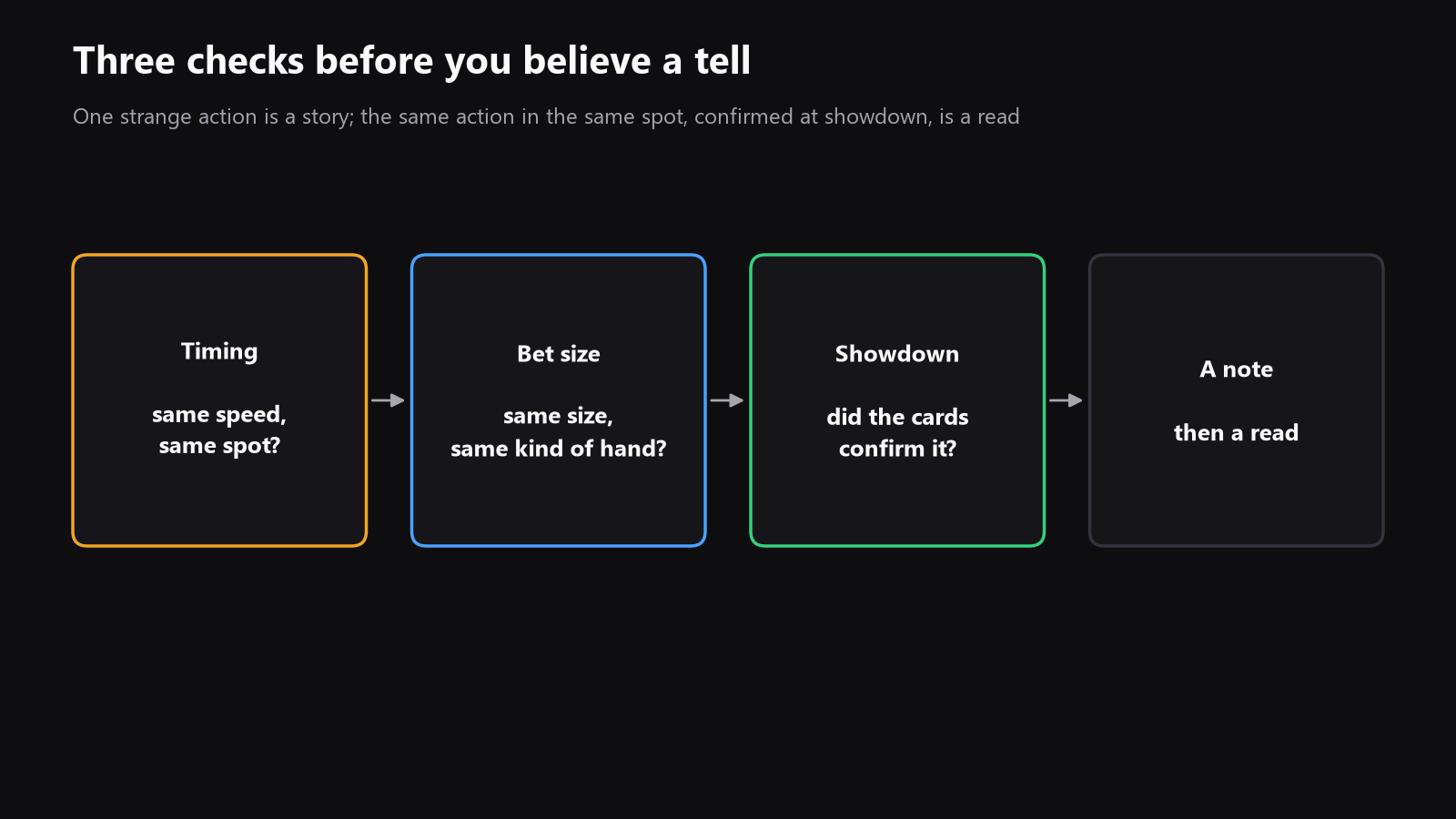
A tell becomes useful when it survives three tests.
- It happens more than once in the same spot.
- It fits the board, stack depth, and line.
- It is confirmed by showdown or by more hands later.
If only one of those is true, the tell is weak.
A good way to think about it is this: a tell should reduce uncertainty, not create a fantasy. If the read makes you feel clever but does not improve your decision tree, it is probably not ready yet.
Here is a simple way to separate useful information from noise.
| Signal | Better interpretation | Do not do |
|---|---|---|
| Instant action | Could be automatic or preplanned | Do not call it strength or weakness by itself |
| Long tank | Could be a real decision, or just distraction | Do not assume it means a tough bluff or a tough value hand |
| Small size | Could be pot control, thin value, a draw, or a blocking bet | Do not label it as weak without context |
| Big size | Could be pressure, value, or a polarized bluff | Do not fold everything just because the number is large |
How to collect tells over many hands
The only way to make online tells useful is to collect them like data.
That means you do not write "looks strong" and stop there. You write the spot.
A good note includes:
- player name
- position
- stack depth
- board texture
- street
- action before the tell
- bet size
- timing
- showdown result, if you saw one
- what you think the line meant
The goal is not to create a perfect report. The goal is to make future hands easier to read.
A simple note format
You can keep it as short as this:
- Button, 100 bb, flop K 8 3 rainbow, quick small c-bet, showed second pair
- Cutoff, 40 bb, turn tank then big bet, showed value hand
- River, out of position, instant check, later showed weak showdown hand
The exact wording matters less than the habit. You want enough context to compare one hand with the next.
Use player stats to anchor the read
This is where your notes become much more reliable if you pair them with observed statistics.
The HUD panel shows VPIP, PFR, 3-bet, fold to 3-bet, flop c-bet, and fold to flop c-bet. Those are not recommendations. They are observed stats. But they are exactly the kind of numbers that help you test whether a timing or sizing tell belongs to a real pattern.

For example, if a player keeps using a strange river size, you can ask whether that player is usually aggressive, whether they fold too much to 3-bets, or whether their flop c-bet habit matches the line you just saw. The point is not to solve the hand from one stat. The point is to make sure your tell fits the rest of the player’s profile.
That is also why reviewing real hands is better than guessing in the dark. The Reveal module shows what the players at your limits actually did, from your own hand histories. That makes it easier to separate a true pool habit from a one-off weird line.
A practical way to think about online tells
When you are unsure, run the hand through this order:
- What was the exact line?
- What size did the player choose?
- Was the timing normal for them?
- Does this fit their stats?
- Have you seen the same thing before?
- Did showdown confirm it?
If you cannot answer at least half of those questions, the read is probably still too thin.
The most common mistakes
The biggest mistakes are predictable:
- trusting one hand too much
- ignoring position
- reading speed without looking at sizing
- reading sizing without looking at board texture
- assuming your opponent thinks about the hand the same way you do
- failing to update the read when a showdown proves you wrong
A player who is fast one time and slow the next time is not random by default. They may simply be following a different branch of their range. But unless you record the spot, you will not know which branch it was.
The real lesson
Online poker tells are not about magic instincts. They are about disciplined observation.
If you track timing and bet sizes over many hands, and if you compare those clues with real showdown evidence and observed stats, you stop relying on guesses. You start building a player model.
That is the habit that matters.
And if you want that habit to become part of your review process, save the notes in Player Profiles, use the HUD panel to anchor what you are seeing, and let the Reveal module show you what the field actually does at your stakes. That is a much better base for decisions than a single dramatic tank or a strange bet size.
Do it on your own hands.