
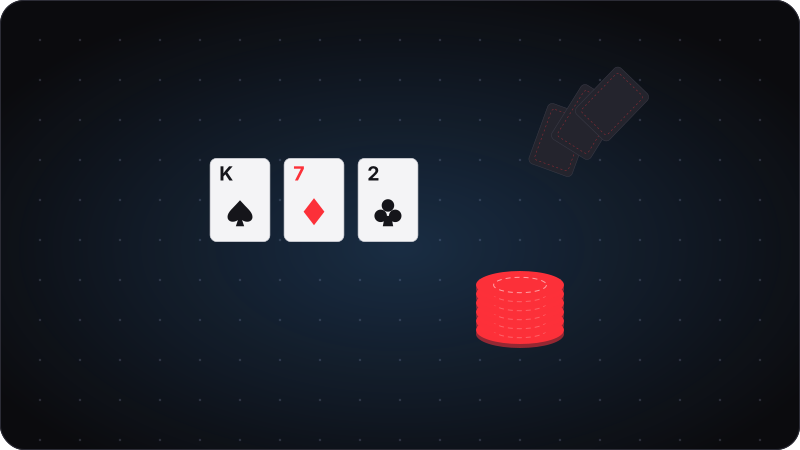
If you c-bet into a player who folds too often, you are not “running hot.” You are collecting dead money.
That is why fold to c-bet is such a useful stat. It tells you how often a player gives up on the flop after facing a continuation bet. Used well, it helps you choose when to bluff, when to value bet thinner, and when to stop firing with air.
Used badly, it becomes one more number you glance at without knowing whether it is real, random, or only true on certain boards.
This article breaks it down in plain English: what fold to c-bet measures, why low-stakes pools often fold too much, how to exploit players who overfold or underfold, and how much sample you need before the stat deserves your trust.
What fold to c-bet actually measures
Fold to c-bet is not “how often a player folds on the flop” in general.
It is narrower than that.
It measures what happens when:
- the player sees a flop,
- the preflop aggressor continuation bets,
- and the player chooses whether to fold, call, or raise.
So if a player has a high fold to c-bet, that means they often surrender when they miss the flop or do not want to continue with marginal hands. If they have a low fold to c-bet, they are continuing more often, whether by calling, raising, or floating.

The important part is not the number alone. It is the context:
- what kind of flop it is,
- whether the pot is heads-up or multiway,
- how big the c-bet is,
- and how many times you have actually seen this player face a flop bet.
A fold to c-bet stat with no sample is just a guess wearing a suit.
Why low-stakes players often fold too much
At low stakes, many players do not defend their flop range well enough.
That happens for a few common reasons:
- They call preflop with hands that are too weak to continue often.
- They dislike guessing turns and rivers.
- They overreact to pressure on dry boards.
- They give up too quickly when they miss completely.
- They continue too much on some textures and too little on others, which makes the overall number noisy.
This is why fold to c-bet is so valuable in practice. You are often not looking at a balanced opponent. You are looking at someone whose flop defense is emotionally driven, board dependent, or simply incomplete.
The field at your limits is not invisible. The Reveal module in Poker Exploit is built to show what players at your limits actually do on your own hands, rather than what theory says they should do.

On the current screens, the field at these limits checks the flop through 54% of the time and bets it 17% of the time. That already tells you a lot about how often the hand reaches the turn with no flop bet. Once you know that, fold to c-bet becomes more than a vanity stat. It becomes a clue about how much pressure the pool is willing to absorb.
How to exploit a player who folds too much
If someone folds to c-bets too often, the first adjustment is simple: bluff more often.
But “bluff more often” is not the whole answer. You still want to pick the right boards and the right sizes.
1. Bluff more on boards that miss their range
Some flops connect poorly with the caller’s range. Dry, high-card boards are the classic example. If your opponent reaches the flop with lots of middling pairs, weak suited hands, and unpaired trash, they will often have a hard time continuing on boards that favor the preflop raiser.
That is where fold to c-bet matters most. If they overfold here, you do not need to force fancy lines. A simple, well chosen c-bet can print.
2. Use small bets when the pool overfolds to them
A player who is already folding too much does not need a big reason to make a mistake. A smaller c-bet can be enough.
A pure bluff becomes profitable when the fold frequency is high enough to cover the times you lose your bet. If the pot is P and your bet is B, your bluff needs enough folds to make up for the risk. In simple terms, the break-even fold frequency for a pure bluff is:
B / (P + B)
So if you bet 2 into 6, your bluff needs to work about 25% of the time before you even count any equity. If your hand has backdoors, overcards, or other equity, the required fold frequency drops further.
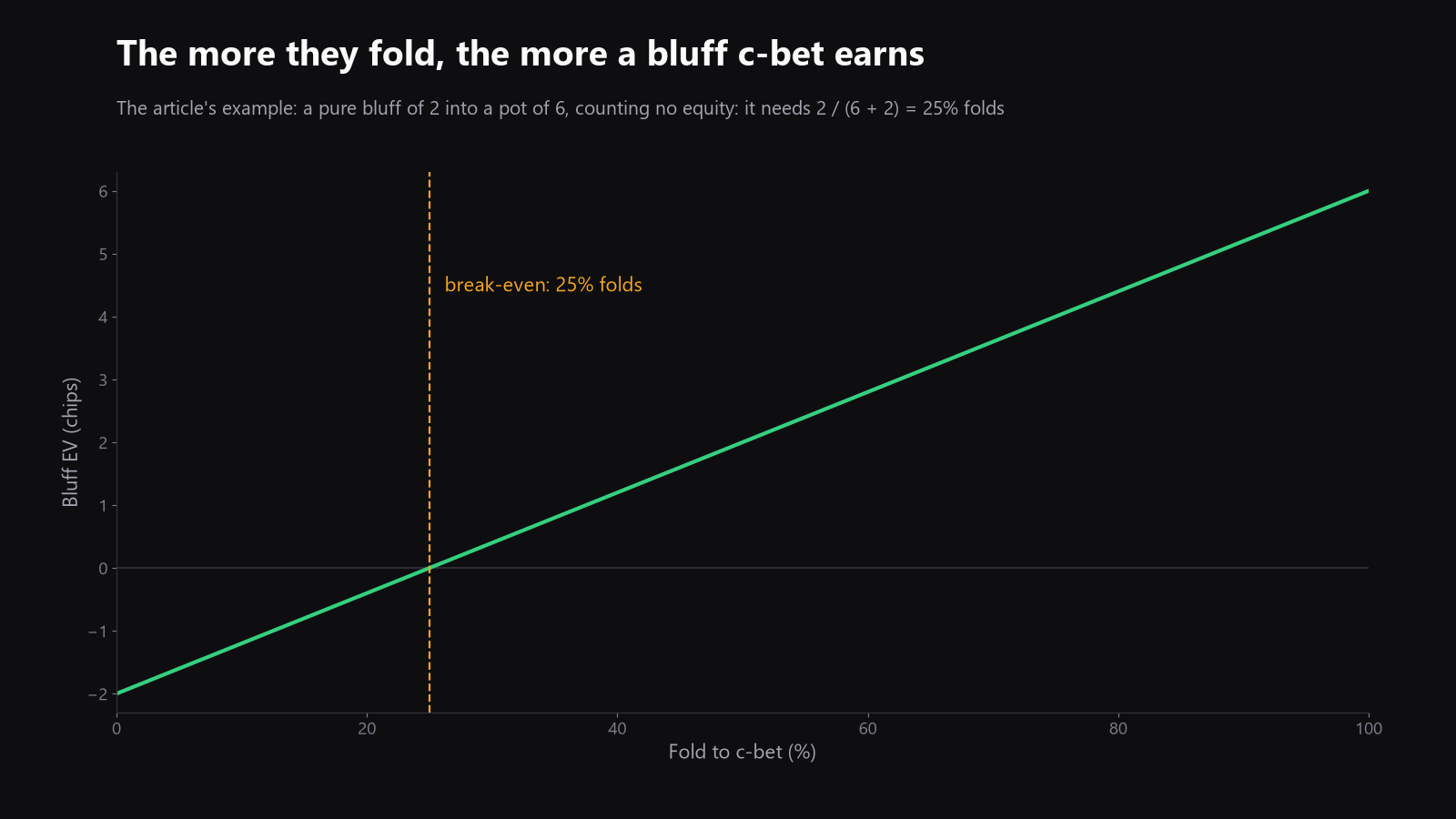
That is why small c-bets can be so effective against players who overfold. You risk less, you pick up the pot often enough, and you still keep your stronger hands in the same betting family.
3. Keep betting your value hands
When a player folds too much, your value bets still matter.
They may not call wide enough, but when they do continue, they often do it with a narrower, stronger range. Your strong hands still get paid, but your middling value hands lose value because they are mostly called by better hands, so value bet thin less often against him.
The mistake is to think fold to c-bet only matters for bluffs. It also tells you whether the player is likely to pay you off with worse hands, or whether they are going to surrender before you can extract value.
4. Do not bluff blindly
A high fold to c-bet stat does not mean every flop is a good bluffing flop.
Some boards are bad for you, even against overfolders. Some opponents overfold on certain textures and defend better on others. If you see a player fold a lot on ace-high dry flops, that does not mean they are a target on every connected or paired board.
Good exploitation is selective.
How to exploit a player who folds too little
The mirror image is just as important.
If a player continues too much, you should not auto-c-bet your entire range and hope the cards save you.
Against underfolders:
- bluff less,
- value bet more,
- and choose hands that keep equity when called.
That means your c-bets should shift toward:
- strong made hands,
- draws with real equity,
- and semi-bluffs that can still improve.
Against someone who calls flop too often, random air is not a strategy. It is a donation.
This is also where board texture matters. Some boards are simply not profitable to stab often against sticky opponents. Other boards still allow you to bet, but the reasons change: you are now betting for value and protection, not because the pool is folding too much.
Why the stat needs sample
Fold to c-bet is one of those numbers that looks cleaner than it really is.
A player can show a high or low fold to c-bet over a small number of opportunities just by chance. Two or three bad board textures can move the number a lot. A few loose calls can do the same in the other direction.
The smaller the sample, the more careful you need to be.
Ask three questions before you trust it:
- How many times has this player actually faced a flop c-bet?
- Is the stat coming from all flops, or only certain board classes?
- Are you looking at a player read, or a population read?
For one specific opponent, you want enough opportunities that the number is not just noise. For the pool, you want enough decisions that the pattern survives all the individual weirdness of one player pool.
That is one reason the HUD stat by itself is not enough. It tells you what happened. It does not tell you whether the number is stable yet.
In Poker Exploit, the HUD panel shows fold to flop c-bet alongside VPIP, PFR, 3-bet, and flop c-bet. It shows statistics, never advice. The decision still belongs to you.
How to use fold to c-bet in real study
The best way to use this stat is not to stare at it in isolation. Use it as part of a loop:
- Check the number.
- Ask which boards it comes from.
- Compare it with the field.
- Look at the hands that reached the flop.
- Decide whether the leak is real enough to exploit.
That is where a tool like Poker Exploit is useful. The Solver module gives you a baseline strategy for a spot. The Reveal module shows how the field at your limits actually behaves in your own hands. Together, they let you see the gap between theory and population.
And if you want to know whether that gap is actually costing you money, the Plan module can point you toward the leak that matters most on your own hands, instead of the one that merely looks interesting.
A simple way to think about it
If you remember only one thing, remember this:
- High fold to c-bet means your bluffs print more often.
- Low fold to c-bet means your bluffs need to be more selective.
- The number only matters when the sample is big enough to trust.
- Board texture always matters.
That is the real value of the stat. It is not a magic button. It is a way to stop guessing.
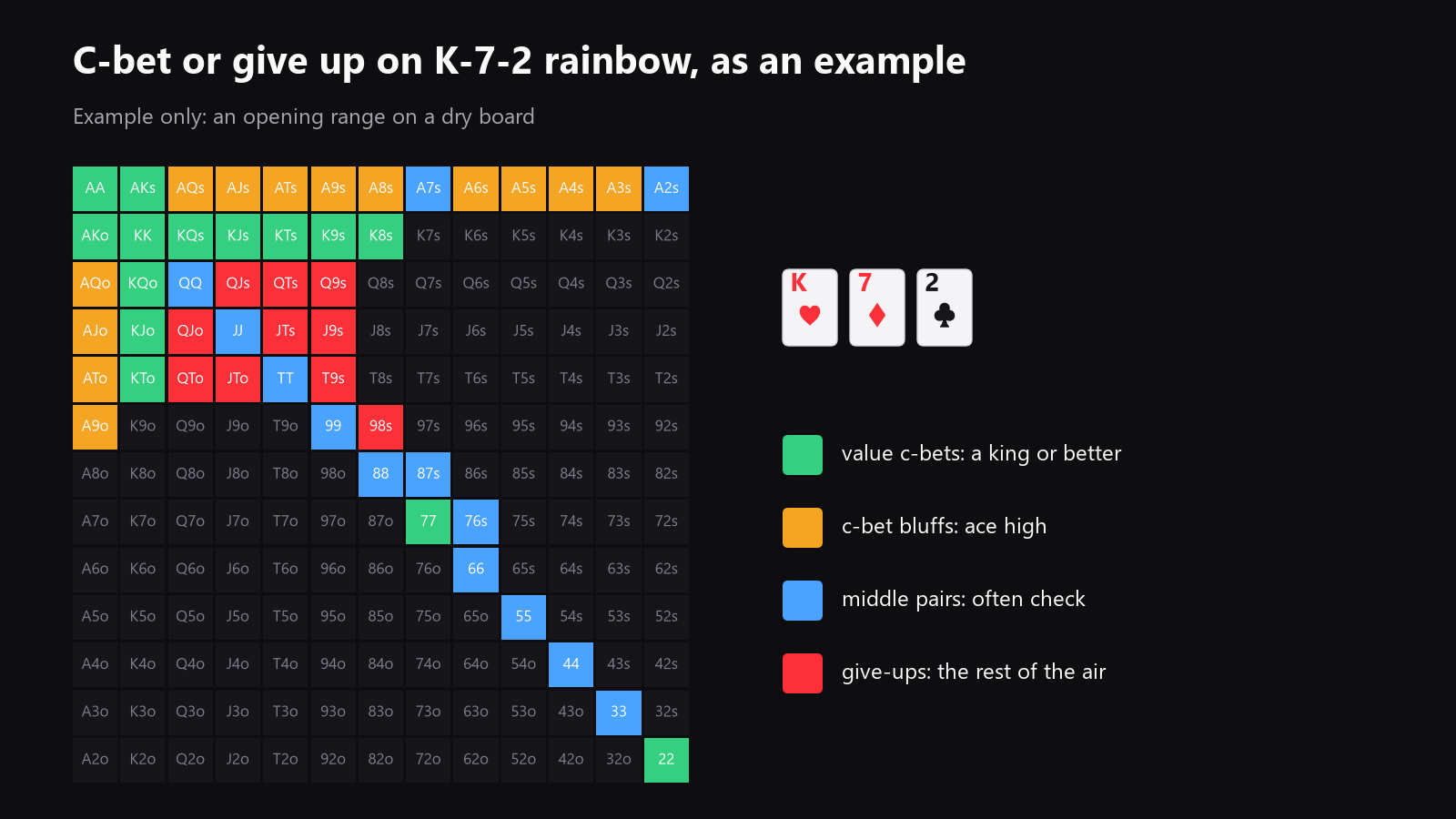
If you study flop c-bets with that in mind, you will stop seeing fold to c-bet as a raw percentage and start seeing it for what it is: a map of how often the pool lets you take the pot now.
Do it on your own hands.