

If you want to understand betting in poker, you have to understand range shape.
A lot of players can name a hand class, but still miss the real question: what does my betting range look like? Is it full of monsters and bluffs? Is it mostly strong but not nutty hands? Is it packed in the middle and missing the top end?
That shape matters because it tells you two things at once:
- what you can credibly represent
- what size of bet makes sense
A range that is too merged for a big bet feels unnatural. A range that is too polar for a tiny bet often leaves value on the table. And a capped range that tries to fire a huge barrel usually gets called by the part of villain's range that crushes it.
What a polarized range is
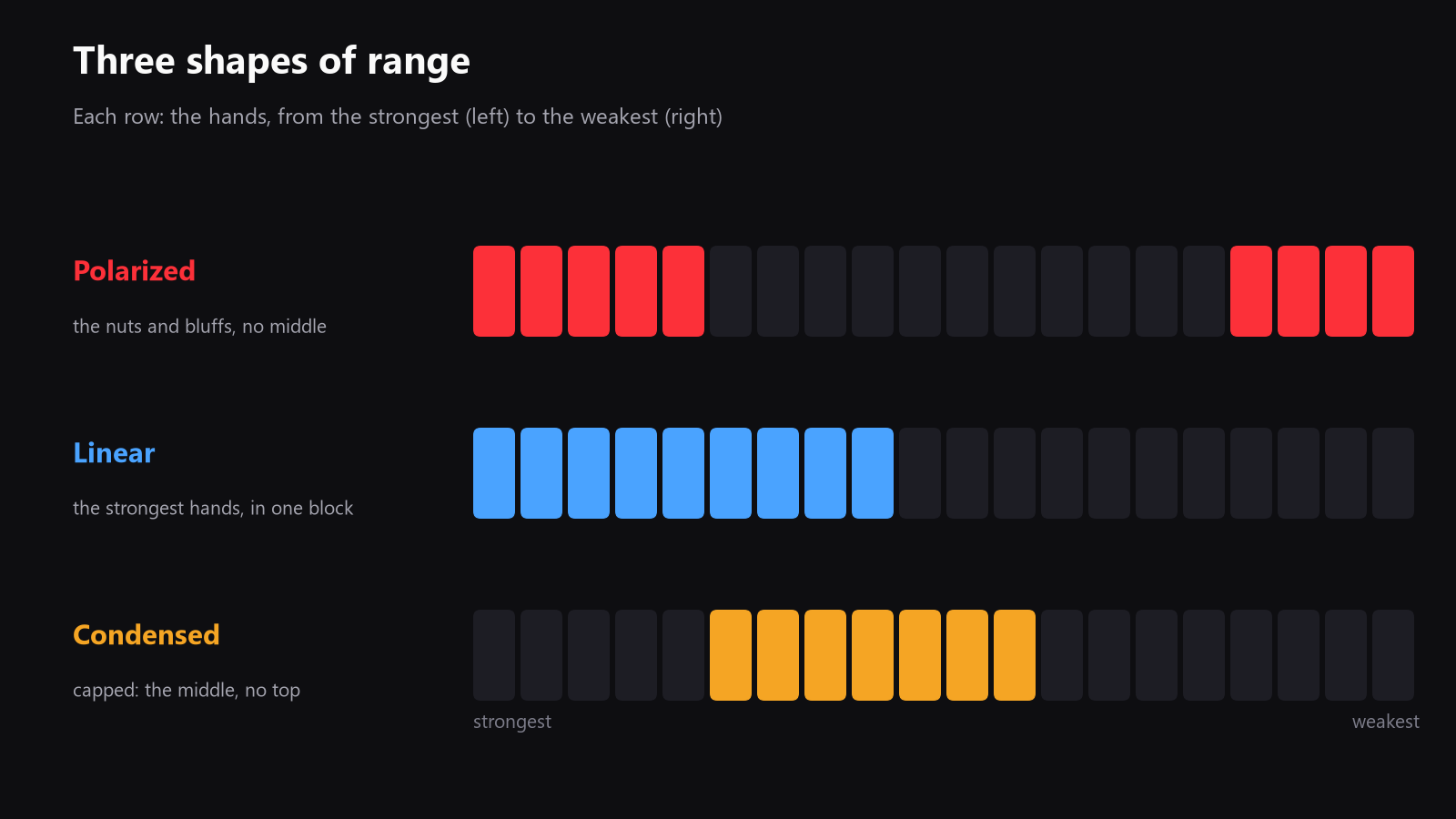
A polarized range contains two main parts:
- strong value hands
- bluffs, or hands that can credibly apply pressure
What it mostly does not contain is the middle. The medium-strength hands are usually better used as checks, calls, or check-backs.
That is why polarized ranges are so common when you bet large. If you are putting in a big bet, you usually want the hands at the top of your range to keep getting paid, and the weaker part of your range to get folds. The middle hands often do not fit neatly into either job.
A classic example is a river overbet. If you bet very big, your betting range should usually be very polar. Your value hands want to get called by worse, and your bluffs want to have a reason to exist, such as blockers or good removal effects.
A simple river example
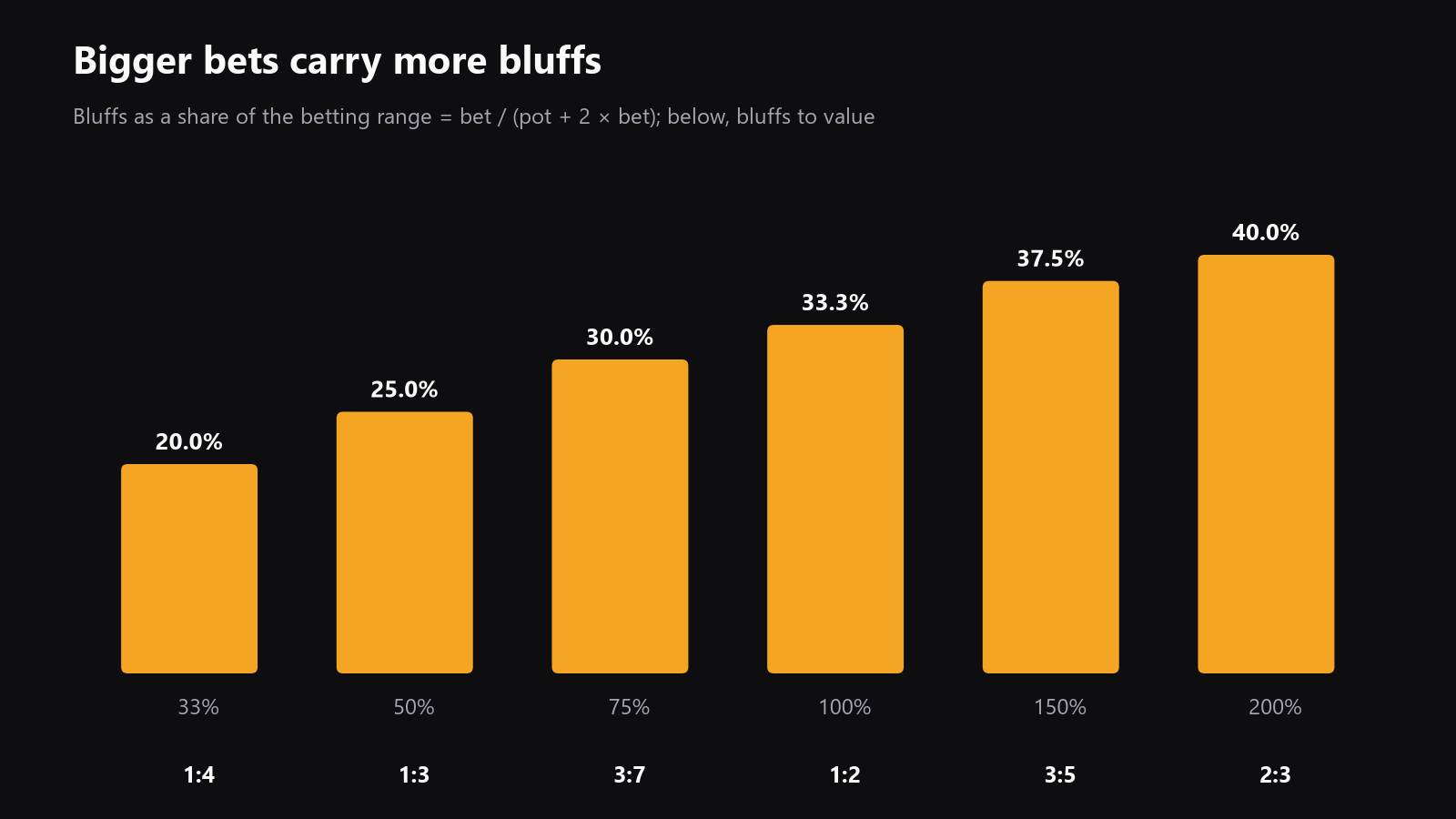
Suppose the pot is 100 and you bet 75.
If you want your bluffing range and your value range to be balanced in a way that makes bluff-catchers indifferent, your bluff-to-value ratio is:
- bluff:value = bet:(pot + bet) = 75:175 = 3:7
So for every 7 value hands, you can support about 3 bluffs.
That is a polarized shape. A lot of the middle is missing.
What a linear, or merged, range is
A linear range is often called a merged range. It includes:
- your strongest hands
- many medium-strength hands that are still good enough to bet for value
It is not trying to split the world into "nuts and air". It is saying: "I have a lot of hands that are ahead of your continuing range, even if they are not monsters."
That is why linear ranges often work best with smaller bets, or in spots where you can value-bet thinly and deny equity at the same time.
A linear range is often what you use when:
- your hand class is still ahead of a lot of worse continues
- the board is not forcing you into a pure nuts-or-bluffs structure
- a smaller bet can get called by worse hands
If you bet 1/3 pot on the river, your value range can be much more linear than with a pot-sized bet. Why? Because the price is cheaper, so many medium-strength value hands can profit from betting.
What a condensed, or capped, range is
A condensed range is packed into the middle. It contains many hands of similar strength, and few extremes.
When people say capped, they usually mean the top end is missing. In practice, that matters a lot. A capped range does not credibly represent the very strongest hands, so it has a harder time defending itself against big pressure.
A condensed or capped range often wants one of two things:
- to check a lot
- to use small bets
It usually does not want to build a huge pot with a large bet, because the larger the bet, the more it needs the threat of strong value hands behind it.
How bet size and range shape go together
This is the part that makes the whole topic click.
Small bets usually allow more linearity
A small bet asks less of your range.
You can bet many hands that are not the nuts, because:
- worse hands can call
- your value hands do not need to be ultra strong
- you do not need a huge bluffing component
That is why small flop c-bets often look merged or linear.
Large bets usually need polarization
The bigger the bet, the more your opponent is forced to continue with a stronger part of their range. That means your betting range also needs to be stronger at the top, and weaker at the bottom.
A big bet is easier to support if your range contains:
- nutted hands that want to get paid
- bluffs that have a reason to apply maximum pressure
The middle hands, again, are often the odd ones out.
A useful shortcut
Think like this:
- small bet = more linear
- big bet = more polarized
- capped range = cautious, often checking or betting small
That is not a law, but it is a very reliable starting point.
Preflop 3-bets: where each shape makes sense
Preflop is where many players first meet the idea of range shape, even if they do not name it.
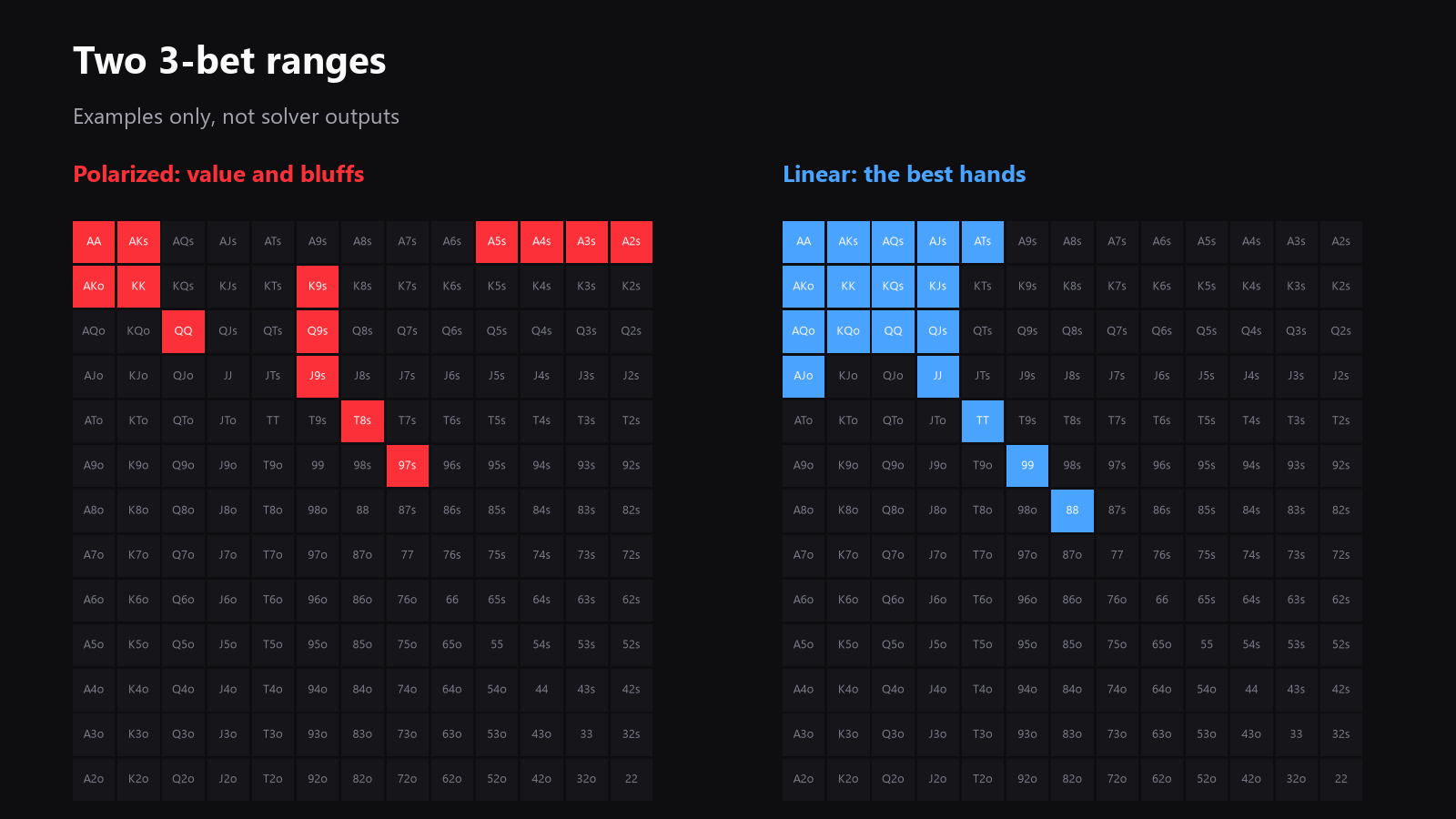
Polarized 3-bets
A polarized 3-bet range is common when you have:
- strong hands that want value
- weaker hands that are bad calls but good bluff candidates
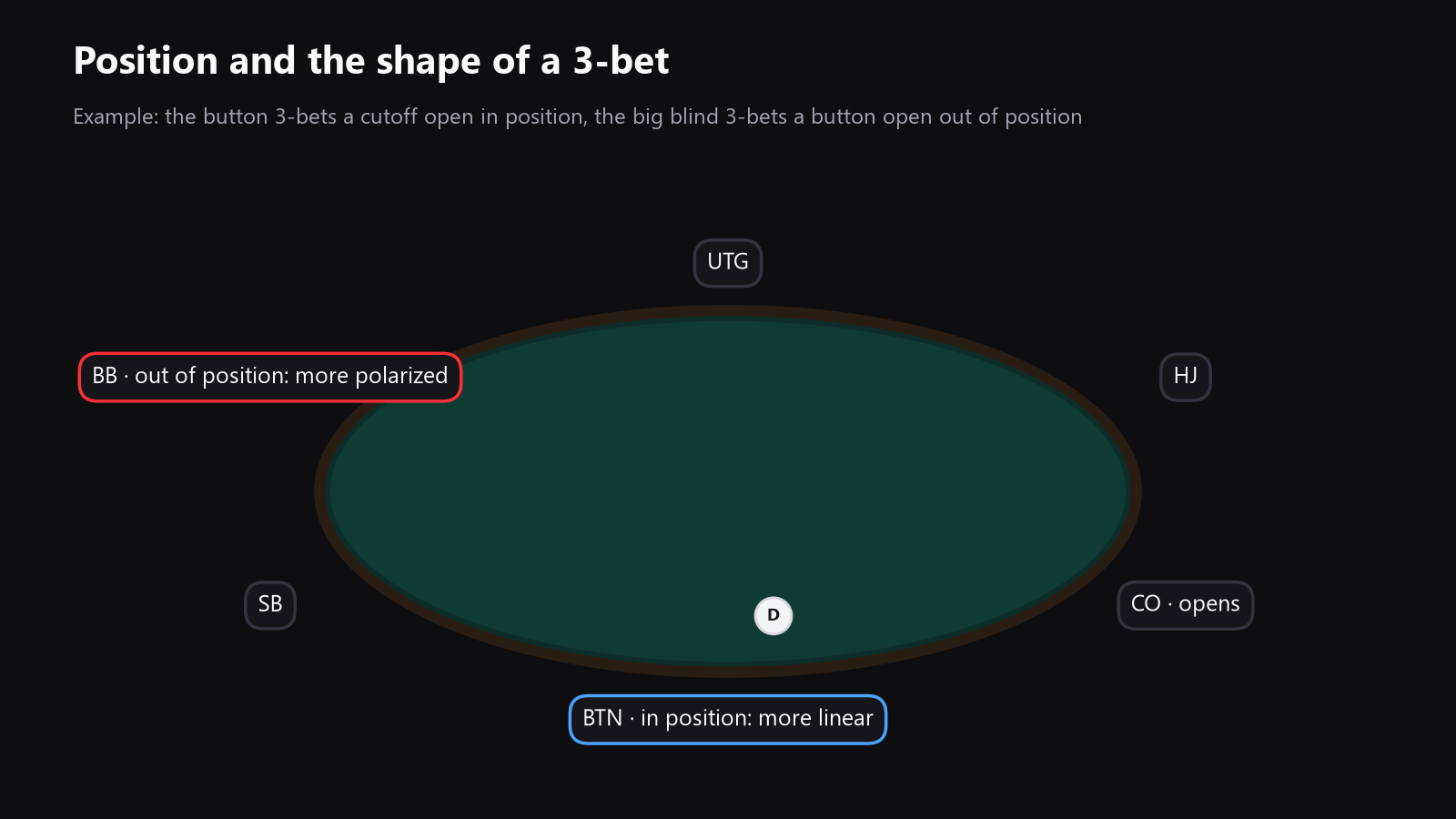
This often happens out of position, especially against late-position opens. Your value hands are obvious, and your bluffs often have blockers, like suited wheel aces or suited kings.
Why polarize there?
Because a lot of your medium hands are not ideal 3-bets. They may not want to play a bloated pot out of position, and they may not be good enough to call profitably. So you keep those hands out of the 3-bet range and reserve the 3-bet for the extremes.
Linear 3-bets
A linear 3-bet range makes more sense when the hands you choose to raise are simply better than the hands villain continues with.
This is often easier in position.
If the opener continues with a range that is still weaker than many of your betting hands, you can include more medium-strong hands in your 3-bet range. You are not just choosing between "value" and "bluff". You are choosing hands that are already good enough to build the pot.
Condensed ranges preflop
Preflop, the word capped matters more than condensed when you talk about ranges after a line has been taken.
For example, if you flat instead of 3-betting, your range often becomes more capped than the aggressor's. That does not mean you cannot continue. It means you should be careful about trying to represent the very top of the distribution when it is not really there.
Flop bets: board texture decides a lot
On the flop, range shape is heavily tied to board texture.
On dry boards, small bets can be linear
On boards where many hands are still far apart, a small c-bet can work very well with a merged range. You can bet:
- top pairs
- overpairs
- strong second pairs
- some backdoor hands
You are not always trying to polarize. Sometimes you are simply extracting value and denying equity.
A board like A-high, rainbow, and not very connected often supports that kind of structure.
On dynamic boards, polarization becomes more attractive
On connected or wet boards, the middle is less comfortable. Many medium-strength hands are vulnerable. The nuts matter more. Equity can shift fast.
That is where a polarized betting range starts to make more sense, especially if you are using a larger size.
Think of boards where straights, flush draws, two pair, and big combo draws are all in play. A big bet there usually wants strong value plus bluffs with equity or blockers, not a big pile of marginal made hands.
When your range is capped, size down
If your line leaves you capped, big bets become expensive to support.
That does not mean you must give up. It means you often prefer:
- checking more
- betting smaller
- choosing stronger bluff candidates
A capped range that tries to bomb the pot is easy to attack.
Turn bets: where range shape starts to narrow hard
The turn is where many hands lose their comfort.
A hand that was a nice flop c-bet can become a mediocre turn barrel. The pot is bigger, ranges are narrower, and the part of your range that can keep betting gets more selective.
That is why turn betting often becomes more polarized than flop betting.
Polarized turn bets
A polarized turn barrel usually has:
- strong value that wants more money in
- bluffs that picked up equity, blockers, or strong pressure potential
On the turn, your bluffs should be more deliberate than on the flop. You have fewer streets left, so every barrel matters more.
Linear turn bets
Linear turn bets still exist, especially when:
- you have hands that are ahead of villain's continuing range
- the board is favorable for thin value
- a smaller bet can get called by worse
This is common when you are extracting value from one-pair hands, weak two-pair candidates, or strong top-pair hands that do not need a huge size.
The key turn question
Ask yourself:
Am I betting because worse hands can call, or because better hands can fold?
If the answer is mostly the first one, you are leaning linear.
If the answer is mostly the second one, you are leaning polar.
River bets: the most polarized street
The river is where the difference is the clearest.
By the river, there are no more cards to come. That means:
- thin value matters
- bluff-catching matters
- big bets need strong justification
Big river bets are usually polar
A large river bet is often the purest form of polarization in poker.
Your value region is narrow, because only your best hands can bet big for value. Your bluff region is also narrow, because your bluffs need a story, usually blockers, missed draws, or hands that interact well with villain's continuing range.
Small river bets can be linear
A small block bet or thin value bet can be much more linear.
You can use hands that are not strong enough for a big bet, but still good enough to get value from worse hands and to protect your checking range.
That is why a river blocker bet often looks very different from a river overbet.
River rule of thumb
- small river bet = can be more linear
- large river bet = should be more polarized
A practical way to choose the shape
Before you bet, ask three questions.
1. What worse hands call?
If many worse hands can continue, a linear range is often fine.
2. What better hands fold?
If you are trying to force folds from a strong range, you are usually polarizing.
3. What does my range actually contain?
If your range is capped, do not pretend it is uncapped. If your value region is thin, do not force a huge size. If your medium hands are the workhorses, a smaller, more merged bet may be better.
Quick summary
Use this as a fast memory aid:
- polarized: strong value plus bluffs, little middle, usually bigger bets
- linear / merged: strong hands plus many medium-strength value hands, usually smaller bets
- condensed / capped: packed middle, weak top end, usually careful sizing, often more checking
And the most important link of all:
- the bigger the bet, the more polar your range usually needs to be
- the smaller the bet, the more linear your range can be
How to study this away from the table
If you want to get better at range shape, do not just memorize labels. Test spots.
The Solver module in Poker Exploit lets you study a spot away from the table, so you can see how a line is structured without guessing. The Reveal module is also useful when you want to compare theory with what players at your limits actually do.
That matters because many player pools at your limits are not balanced in the same way. Sometimes a line that looks theoretically polar is much closer to linear in practice, and sometimes the pool overfolds to the very sizes that a capped range should not be using.

Final takeaway
If you remember only one thing, make it this:
Range shape and bet size should fit each other.
When you bet big, think polar. When you bet small, think linear. When your range is capped, respect that reality.
That one idea will already make your preflop 3-bets cleaner, your flop c-bets more coherent, your turn barrels sharper, and your river bets much harder to read.
Do it on your own hands.