
A solver can teach you a lot, but it can also drown you in detail.
If you open a big tree, stare at mixed frequencies, and try to memorise every branch, you will usually end up with three things: you remember almost nothing, you cannot use it at the table, and you start to think solver study is only for people who already know what they are doing.
That is backwards.
A solver is not a syllabus. It is a microscope.
You do not need to study everything. You need to study the spots that matter most in your own games, ask simple questions, look for repeatable patterns, and turn those patterns into a few rules you can actually apply.
The real job of solver study
The point of solver work is not to copy exact frequencies.
The point is to answer questions like:
- When is this a betting spot and when is it a checking spot?
- Which hands want to go for value, which ones want to bluff, and which ones are too weak to continue?
- What changes on the turn?
- Which river cards favour one range over the other?
- Which hands are close to indifferent, so a small change in population or player type matters a lot?
That is what makes solver study useful.
If you learn only exact numbers, you become fragile. The number changes, the sizings change, the node changes, and suddenly the whole thing feels useless.
If you learn patterns, you become flexible.
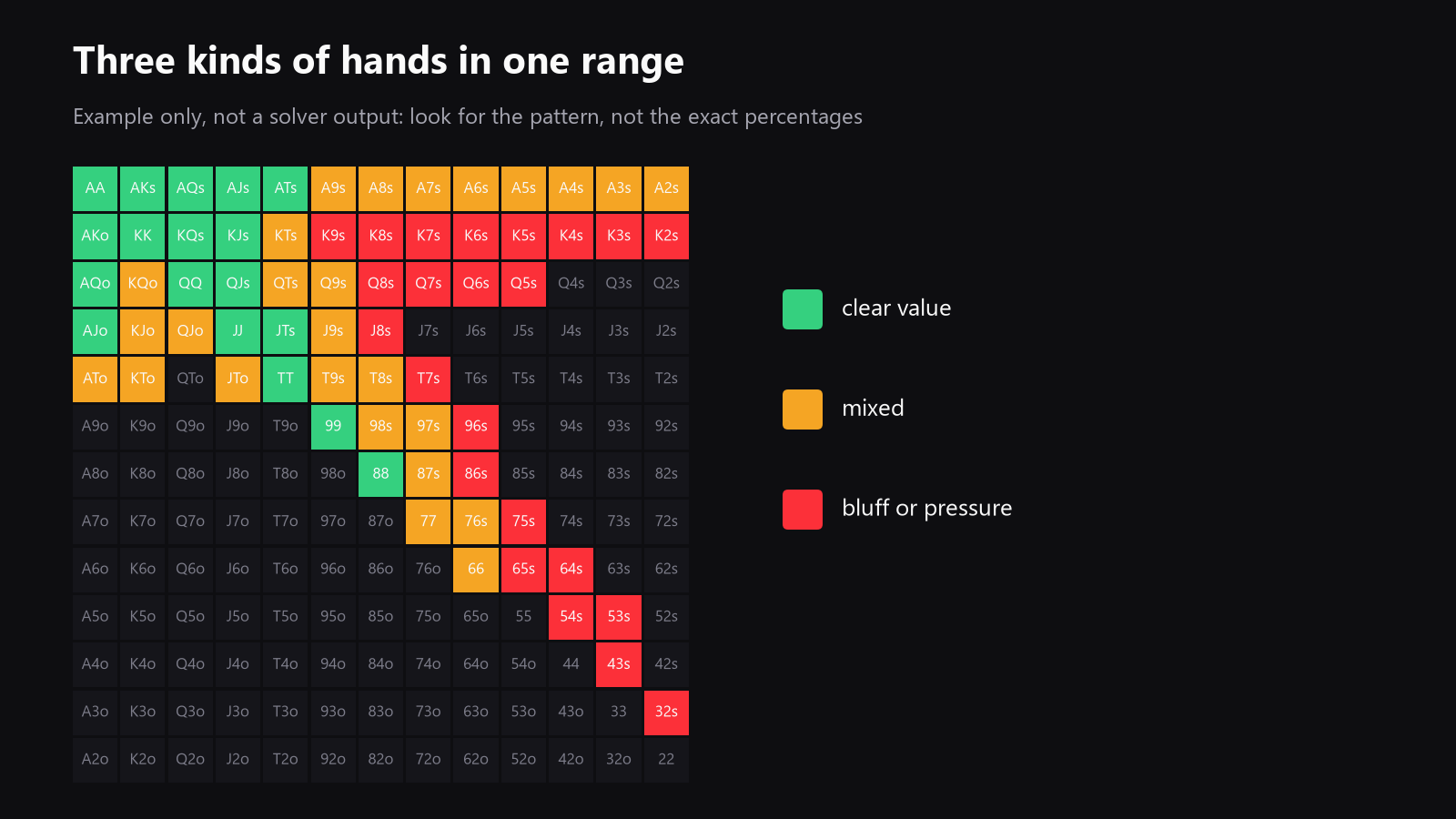
For example, if a hand is sometimes a bet and sometimes a check, do not try to store “62 percent bet” in your head. Store the reason: this hand is good enough to pressure weak continues, but not strong enough to bet confidently for pure value. That is a pattern you can recognise again.
Start from your own game, not from a random spot
The biggest mistake is picking a pretty spot instead of a useful spot.
A solver can study any board, any stack depth, any line. That does not mean you should. Start with the situations that happen often in your own play, or the ones that cost you the most.
Good starting points are usually:
- common preflop pots, like button versus big blind
- c-bet spots you see every session
- turn barrels after a flop c-bet
- river decisions where you keep guessing wrong
- short-stack spots if you play tournaments or spins
- ICM spots if payout pressure matters in your games
If you use a tracker or a study dashboard, begin with the hands that leak the most money or the most big blinds. That keeps study connected to reality.
If a spot almost never happens, leave it for later.
A solver is most valuable when it helps you improve a situation you actually see often.
Shrink the spot until it becomes understandable
A huge solver tree is hard to learn because it answers too many questions at once.
Before you open the solver, shrink the problem.
Ask:
- What is the exact preflop range?
- Who has position?
- What stack depth are we studying?
- Which street are we on?
- What is the pot size?
- What sizes do I actually want to compare?
For study, one node is better than ten.
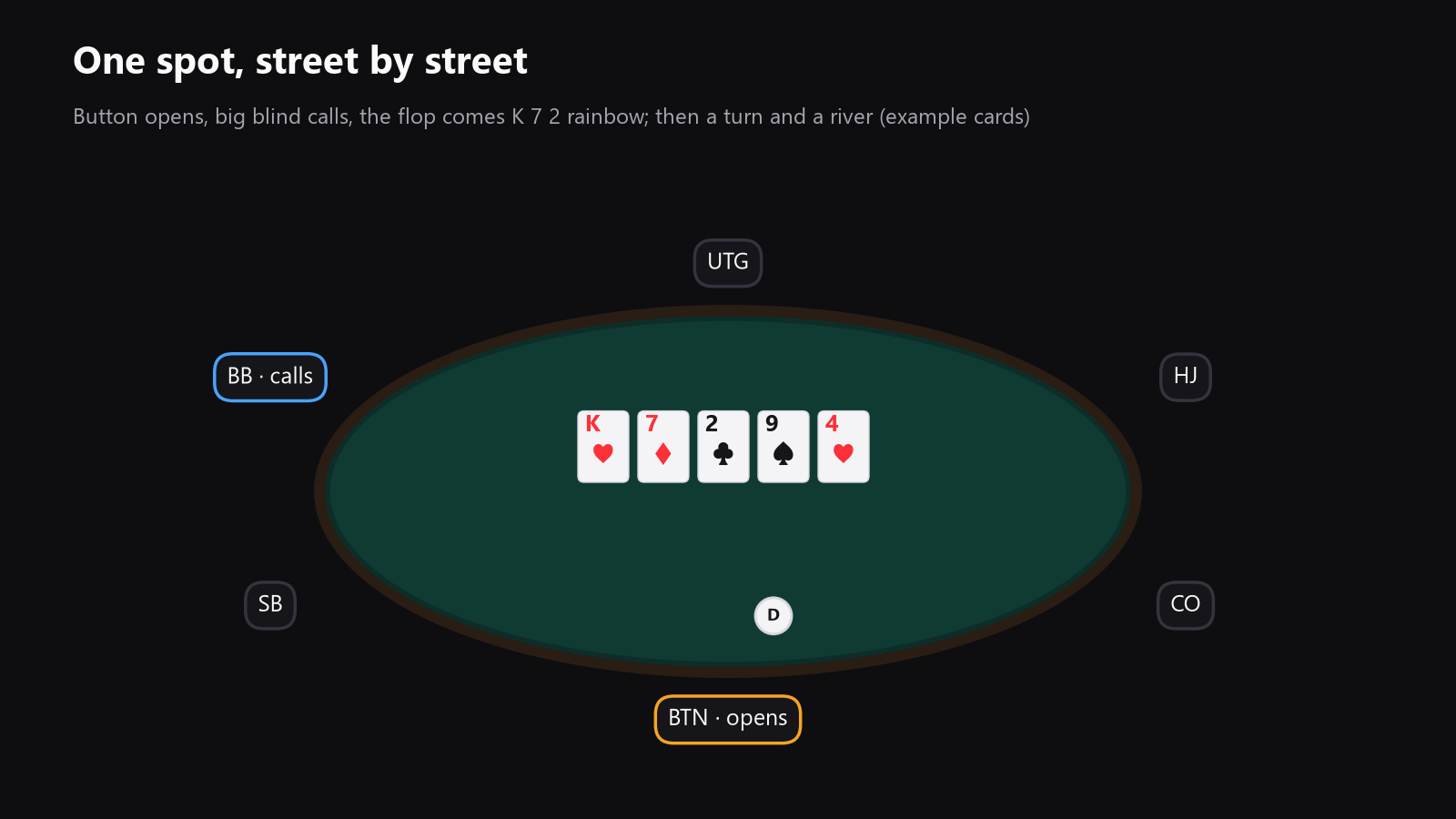
For example, instead of saying “I want to study button versus big blind,” say: “Button opens, big blind calls, flop comes K 7 2 rainbow, and I want to know what happens on the flop.”
Then shrink again: “What is the main question here, betting or checking?”
Then shrink again: “If I bet, which hands belong in value, which in bluff, and which in protection?”
The smaller the question, the clearer the answer.
This is also why many players learn faster when they study one board texture at a time: dry high-card boards, paired boards, wet connected boards, monotone boards.
Each texture asks slightly different questions.
Look for patterns, not exact frequencies
This is the point where most players get lost.
They see a solver mixing hands at 17 percent, 43 percent, 68 percent, and they feel they must reproduce those exact numbers.
You do not.
Exact frequencies matter most when you are training a very specific node, or when the spot is very sensitive, like a river bluff-catch or an ICM decision. Most of the time, what you need is the structure underneath the numbers.
Look for the pattern in four layers.
1. Range shape
Ask which side has the stronger overall range.
Does one player have more top pair, more overpairs, more nut flushes, more sets, more strong draws?
If one range is clearly stronger, that side can usually put more pressure on the other.
If the range is more capped, it usually needs to defend more carefully or check more often.
2. Nut advantage
Ask who has more of the very strongest hands on this board: sets, two pair, the nut straights and flushes.
A nut advantage does not mean “more good hands overall.” It means more of the very top.
That matters because the player with the nut edge can often bet bigger, apply more pressure, and keep the other player under tougher realisation.
3. Blockers
Ask which hands block villain’s continues and unblocks folds.
A good bluff does not just have weak showdown value. It also removes strong continues from the other range.
A good value hand does the opposite. It wants worse hands to continue.
This is why two hands with similar raw equity can belong in different actions.
4. Future playability
Ask what happens on later streets.
Some hands are fine now but terrible later. Some hands are mediocre now but become strong on many turns. Some hands need protection because the board changes a lot.
That is one of the main reasons solver work matters. It helps you see the hand not as a single decision, but as a line.
A simple arithmetic example
Suppose the pot is 10 bb and you are considering a 5 bb bet.
That bet risks 5 bb to win 10 bb.
If you want a polar betting range where bluffs and value hands are balanced in a classic break-even way, the bluff-to-value ratio is about 1 to 3.
That comes from the math, not from a solver. You can think of it as: for every 3 value hands, you need about 1 bluff.
That does not tell you which exact hands to choose. It tells you the pressure your range needs.
Then blockers, board texture and position decide the rest.
Turn solver output into a rule you can remember
A solver is only useful if you can compress the idea into a rule you will actually remember at the table.
A good rule has three parts:
- the spot
- the condition
- the action
For example:
- On dry high-card boards, in position, I can use a small bet more often.
- On boards that smash the caller, I check more and bet more selectively.
- When my range is capped and the turn favours villain, I should slow down instead of auto-barrelling.
- When I have strong blockers and my opponent overfolds, I can bluff more aggressively on the river.
Those are not exact frequencies. They are usable patterns.
A good rule also has a limit.
For example: “Bet small with my merged range on dry flops” is useful. “Bet small every time” is not.
Solver study should make you more precise, not more robotic.
Learn the difference between a clean spot and a messy spot
Some spots are easy to turn into rules.
Others are not.
Clean spots are usually:
- single-raised pots
- simple stack depths
- static boards
- clear range advantages
- straightforward sizings
Messy spots are usually:
- multiway pots
- deep stacks with many streets left
- dynamic boards
- ICM spots
- rivers with many blocker interactions
- nodes where population mistakes are huge and the best exploit is very opponent-specific
In clean spots, the solver is good for building your base strategy.
In messy spots, it is still useful, but your main goal is different. You are trying to understand what changes the decision, not to memorise a line.
That is an important skill. The best study is not always the most detailed study.
Practise the pattern until it survives pressure
Once you have a rule, practise it.
Not by reading the tree again and again. By testing yourself.
You can do this in several ways:
- cover the solver answer and guess your action first
- write down the reason before you look
- group hands into buckets, such as clear bet, clear check, close decision
- replay the spot later and ask what changed your decision
- test yourself on the same texture with different runouts
The goal is to move from “I saw this before” to “I know what to do and why.”
That is what makes the study stick.
If you only recognise the spot, you are still too dependent on memory. If you know the logic, you can handle small changes at the table.
A simple weekly solver routine
If you want a routine that does not overwhelm you, try this:
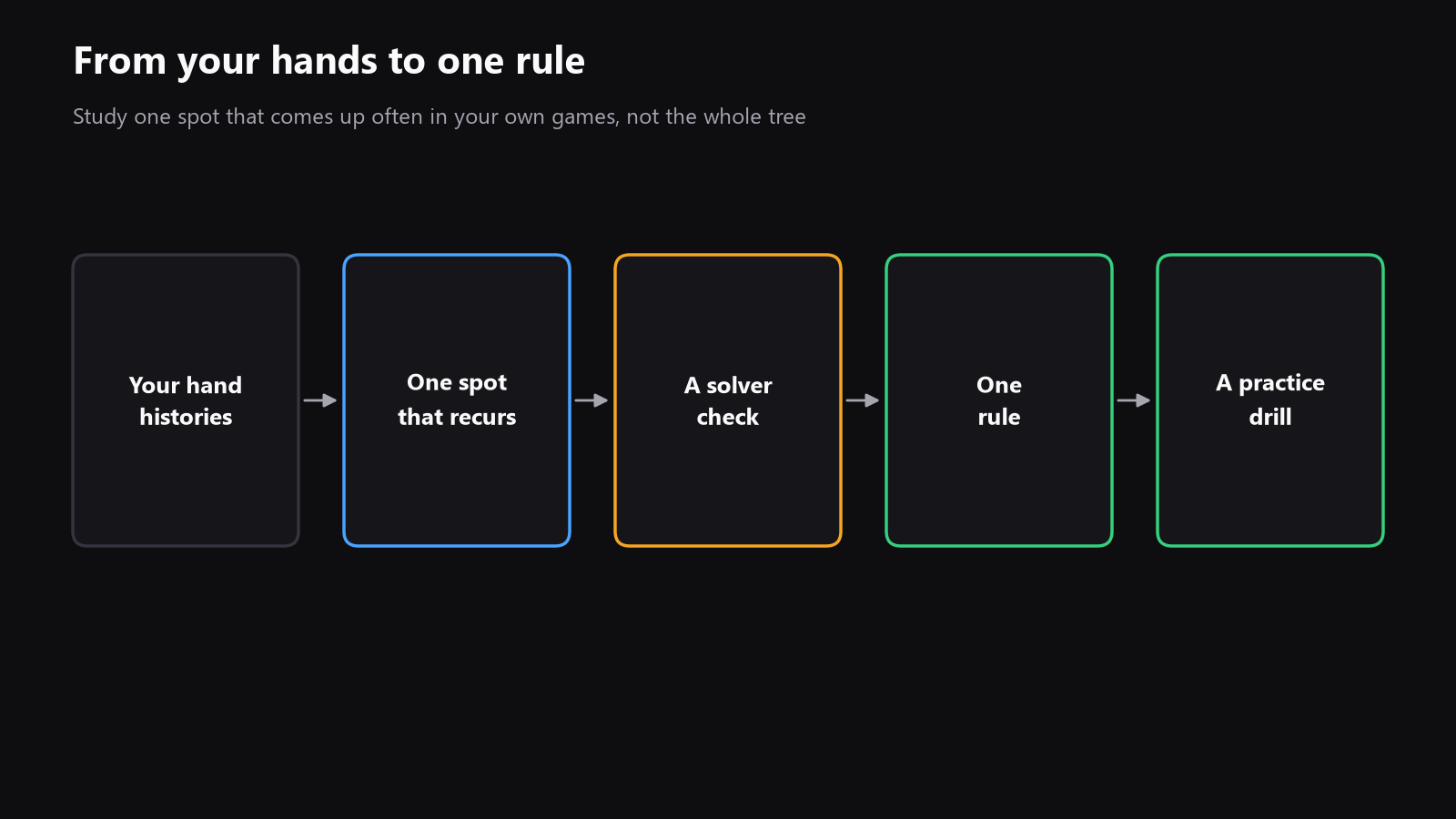
1. Pick one leak
Choose one recurring spot from your own game.
2. Pick one board or one line
Do not study the whole game tree.
3. Ask three questions
- Who has the stronger range?
- Which hands want to bet, check, or continue?
- What changes on the next street?
4. Write one rule
Make it short enough to remember.
5. Drill it
Test yourself with a few random examples until you can explain the pattern without opening the solver.
6. Revisit it later
After you play enough hands, check whether the rule still fits what you see in practice.
This is how solver study becomes useful. Not by collecting outputs, but by building habits.
Where a solver fits in Poker Exploit
If you want to do this away from the table inside Poker Exploit, the Solver module is built for exactly that kind of study.
You choose a spot, get the equilibrium strategy for two players, and study the 169-hand grid together with the result figures. It works off the table and refuses hands from the session in progress, so it is a study tool, not an in-game crutch.
That matters because the best solver work happens after the hand, when you can think slowly.
And if you want to choose better study spots in the first place, the Dashboard and Plan modules help you focus on where your own game leaks the most.

The short version
If you want to study with a solver without drowning in it, remember this:
- start from a real spot in your own game
- shrink the node until the question is simple
- look for patterns, not exact frequencies
- turn the pattern into one short rule
- practise the rule until it becomes automatic
That is enough to get value from solver study without getting lost in the output.
A solver is not there to impress you. It is there to make your decisions cleaner.
Do it on your own hands.