
Blockers are one of the most practical ideas in poker.
They are also one of the easiest to misuse.
When people say a hand is a “good blocker bluff” or a “good bluff-catcher because it blocks value,” they are talking about card removal. Your hole cards remove combinations from your opponent’s range. Sometimes that makes a bluff better. Sometimes it makes a call better. Sometimes it barely matters at all.
That is the key point: blockers are usually a tie-breaker, not the main reason to act.
What a blocker is
A blocker is simply a card you hold that makes some of Villain’s hands impossible.
If you hold an ace, Villain has fewer ace-x combinations.
If you hold a queen, Villain has fewer queen-x combinations.
If you hold a spade on a three-spade board, Villain has fewer flush combinations of that suit.
This is card removal. Your cards remove combinations from the range you are facing.
The basic combo counts are worth knowing:
- A pocket pair has 6 combinations before any cards are exposed.
- An offsuit hand has 12 combinations.
- A suited hand has 4 combinations.
Once some cards are visible, those numbers shrink.
A few useful shortcuts:
- One card of the right rank often removes 3 combinations from an offsuit holding.
- One card of one of the ranks in a suited holding removes 1 combination from that suited holding. For example, holding one ace removes 1 of the 4 combinations of AKs, from 4 down to 3; holding a seven of spades removes none.
- One exposed card reduces a pocket pair from 6 combos to 3.
- Two exposed cards of the same rank reduce that pocket pair to 1 combo.
You do not need to memorize every possible case on day one. You do need to understand the idea: your hand changes the shape of Villain’s range.
Why blockers matter more on the river
Blockers matter on all streets, but they matter most on the river.
Why?
Because by the river, ranges are narrow. Villain has already continued through several streets, so the number of possible holdings is much smaller than on the flop. A single card in your hand can remove a meaningful chunk of the value range, or the bluff range, or both.
That makes fine distinctions more important.
On earlier streets, raw equity and future playability often matter more than small card removal effects. On the river, blockers help you choose between hands that are already close.
A good mental order is this:
- First ask, “Is this hand a bluff, a bluff-catcher, or value?”
- Then ask, “Among hands in that category, which blocker profile is best?”
That order matters. Blockers should sharpen a decision, not create one from nothing.
Blockers for bluffs: block the calls, leave the folds
When you bluff, you want Villain to fold.
So your bluff should do two things:
- Block part of Villain’s calling range.
- Avoid blocking too much of Villain’s folding range.
That second part is what players mean when they say a hand “unblocks folds.”
If your hand contains a card that Villain often has in his strong made hands, that can be great for bluffing.
If your hand contains a card that Villain often has in his folds, that is usually bad for bluffing, because you are removing the very hands you want to make him fold.
So a bluff is not automatically better because it looks weak. It is better when it removes more continuing combinations than folding combinations.
Simple river example
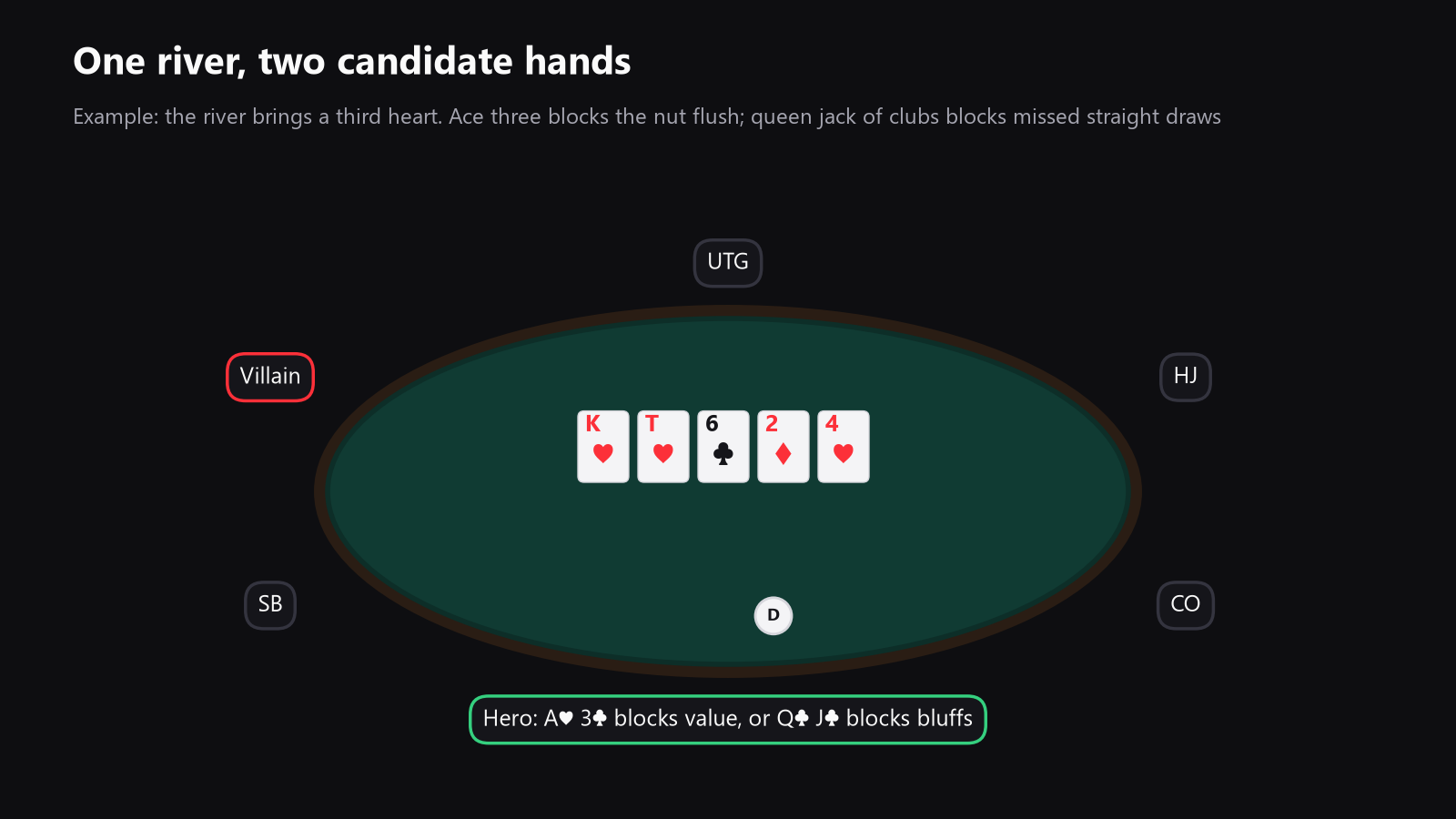
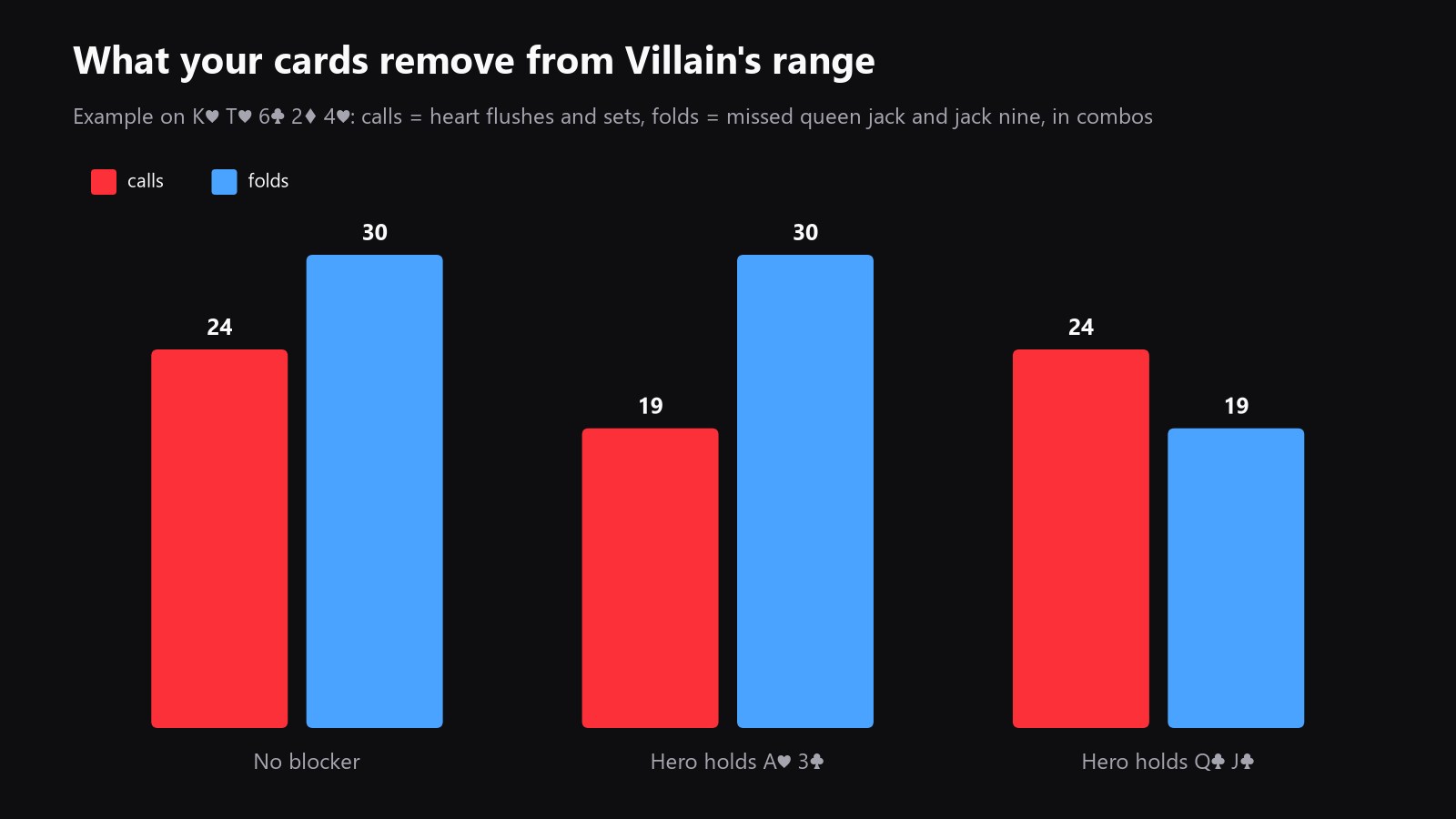
Suppose the river completes a flush, and Villain’s calling range is mostly strong made hands such as flushes, sets, and two pair.
If you hold the ace of that suit, you block some of the strongest flushes. That may be a better bluff candidate than a hand that does not block those hands.
If instead your hand contains cards that Villain tends to fold anyway, you may have a worse bluff, even if the hand itself looks ugly.
The best bluff is often not the weakest hand you can find. It is the hand that removes the most continuing combinations while leaving the folding range intact.
Blockers for bluff-catchers: block value, do not block bluffs
When you bluff-catch, you want the opposite effect.
A strong bluff-catcher should:
- Block some of Villain’s value hands.
- Avoid blocking too many of Villain’s bluffs.
That sounds simple, but players often get it backward.
If Villain bluffs with missed straight draws, then holding one of the important straight-draw cards can be bad for calling, because you are blocking the bluffing part of his range.
If Villain value-bets with top pair, two pair, and sets, then holding a card that removes some of those value hands can be good for calling.
So when choosing bluff-catchers, you want to ask two questions:
- What does Villain value-bet here?
- What does Villain bluff here?
Then compare your candidate hands.
The best bluff-catcher is often not the hand with the prettiest showdown value. It is the hand that interacts best with Villain’s actual range composition.
How to count blockers in practice
You do not need to count every combination from scratch during a session. But in study, you should learn a clean method.
Try this:
- Write down Villain’s value range.
- Write down Villain’s bluff range.
- Count the combinations in each part.
- See how many of those combinations your hand removes.
- Compare the candidate hands.
Example:
If Villain has 24 value combinations, and your hand removes 6 of them, that blocker effect is much larger than a hand that removes only 1 value combo.
If two bluff candidates are otherwise similar, the one that removes more calling combinations is usually better.
If two bluff-catchers are otherwise similar, the one that removes more value combinations and fewer bluff combinations is usually better.
That is when blockers stop being theoretical and start being useful.
A river pot odds example
Blockers become more useful when you already know the math of the spot.
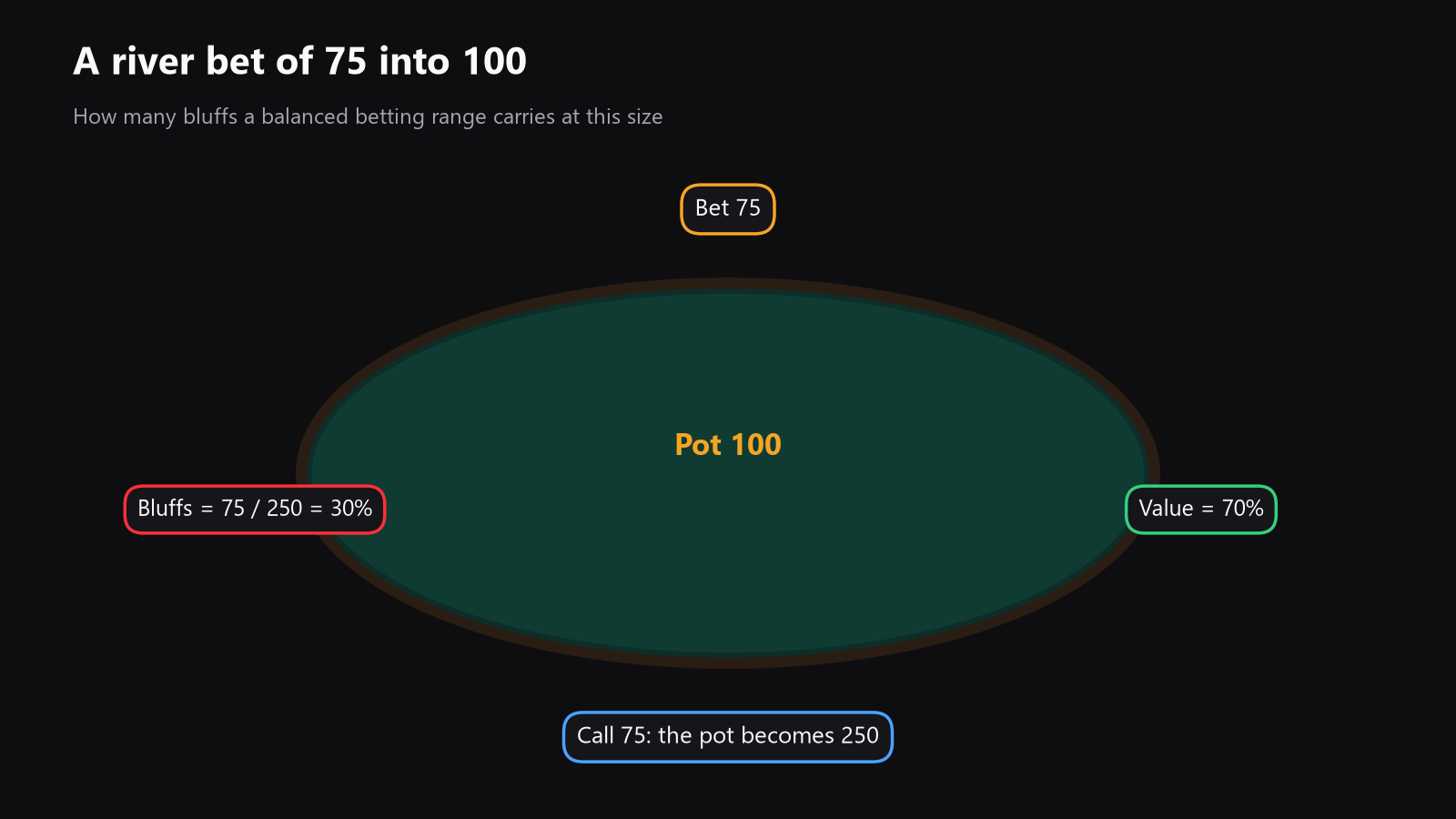
Suppose the pot is 100 and Villain bets 75.
If you are asking what bluff fraction a balanced betting range needs, the bluff share among bets is:
bluff fraction = bet / (pot + 2 x bet)
So here:
75 / (100 + 150) = 75 / 250 = 30%
That means a balanced betting range has about 30% bluffs and 70% value.
Why does that matter?
Because once you know the bluff quota, blockers help you choose which hands should fill those bluff slots. They do not change the quota. They help you assign the hands.
The same idea applies when you are facing a bet. Pot odds and minimum defense frequency tell you how often you must continue in theory. Blockers then help you choose the best continue hands among the close ones.
Why blockers are a tie-breaker, not a reason on their own
This is where many players go wrong.
They see a hand that blocks value and immediately want to bluff. Or they see a hand that blocks bluffs and immediately want to call.
Do not do that.
Start with the hand’s real job.
If your hand is far below the price to call, a nice blocker does not make it a good call.
If your hand has little or no fold equity as a bluff, a nice blocker does not suddenly make it profitable.
Blockers help you choose between hands that are already in the right neighborhood.
They do not rescue a bad idea.
A good rule is:
- First decide whether the hand belongs in the betting range or the calling range at all.
- Then use blockers to pick the best candidate.
That order keeps you honest.
The best blocker questions to ask on the river
On the river, you can simplify your study with a short checklist:
- What does Villain value-bet here?
- What does Villain bluff here?
- Which of my bluff candidates block the value range best?
- Which of my bluff-catchers block the value range best without blocking too many bluffs?
- Is the hand close enough that blockers actually matter?
If the answer to question 5 is no, stop there.
That is how blockers stay useful instead of turning into a superstition.
Common blocker mistakes
Here are the errors that cost players the most:
- Thinking every blocker matters equally.
A random overcard is not the same as a card that removes several strong combinations.
- Ignoring unblockers.
A bluff that blocks the calls but also blocks the folds can be worse than it looks.
- Forgetting raw equity.
If your hand is clearly too weak for the price, a blocker will not fix it.
- Using blockers without a range.
A blocker only matters relative to Villain’s likely value and bluff combinations.
- Treating blockers as magic.
They are a math tool, not a spell.
How to study blockers away from the table
Blockers are much easier to use when you study real spots off-table.
The Replayer module lets you review a hand street by street.
The Solver module lets you study a spot away from the table, so you can compare your own idea with an equilibrium answer when you are not in a session.
And if you want to see what real opponents at your limits actually do, the Reveal module shows the pool tendencies from your own hands.
Used together, those tools make blocker study much more concrete.

The short version
If you remember only one thing, remember this:
Blockers do not create a play from nothing. They improve a play that is already plausible.
For bluffs, you want to block Villain’s calls and leave his folds alone.
For bluff-catchers, you want to block Villain’s value and avoid blocking his bluffs.
And on the river, where ranges are narrow and every combo matters, that small edge is often enough to break the tie.
Do it on your own hands.