
Players ask this all the time: how many hands do you need before you can say whether you are a real winner, or just lucky over a small sample?
The short answer is simple: far more than most players think.
The useful answer is more nuanced: it depends on your true win rate, the variance of the format, the rake, and the size of the sample you have already played. In poker, a good result over 5,000 or 10,000 hands proves almost nothing. Even 50,000 hands can still leave a lot of doubt. If you want to read your level seriously, you need to think in tens of thousands of hands, and often in hundreds of thousands.
What “sample size” means in poker
Sample size is the number of hands you base your conclusion on.
In poker, the problem is that cards and spots do not repeat in a perfectly stable way. You can play well and still lose over 20,000 hands. You can also play badly and still show a profit over 10,000 hands because the deck happened to treat you kindly.
That is why you should not look only at raw results. You should also look at:
- your win rate, often shown in bb/100 in cash games
- variance
- margin of error
- the rake, which can turn a small gross winner into a net loser
In other words, the real question is not only “am I winning?”, but more:
“Is my sample large enough for what I am seeing to be believable?”
Why 10,000 hands almost never tell you enough
10,000 hands is very little in poker.
In another game, that might already be a serious volume. In poker, it is not. The reason is simple: variance is huge. A strong player can spend weeks going nowhere, or even losing, without that saying anything meaningful about their level.
Take a concrete example:
- you play 10,000 hands
- you are running at +8 bb/100
- you tell yourself, “I’m a winner, that is obvious”
Not necessarily.
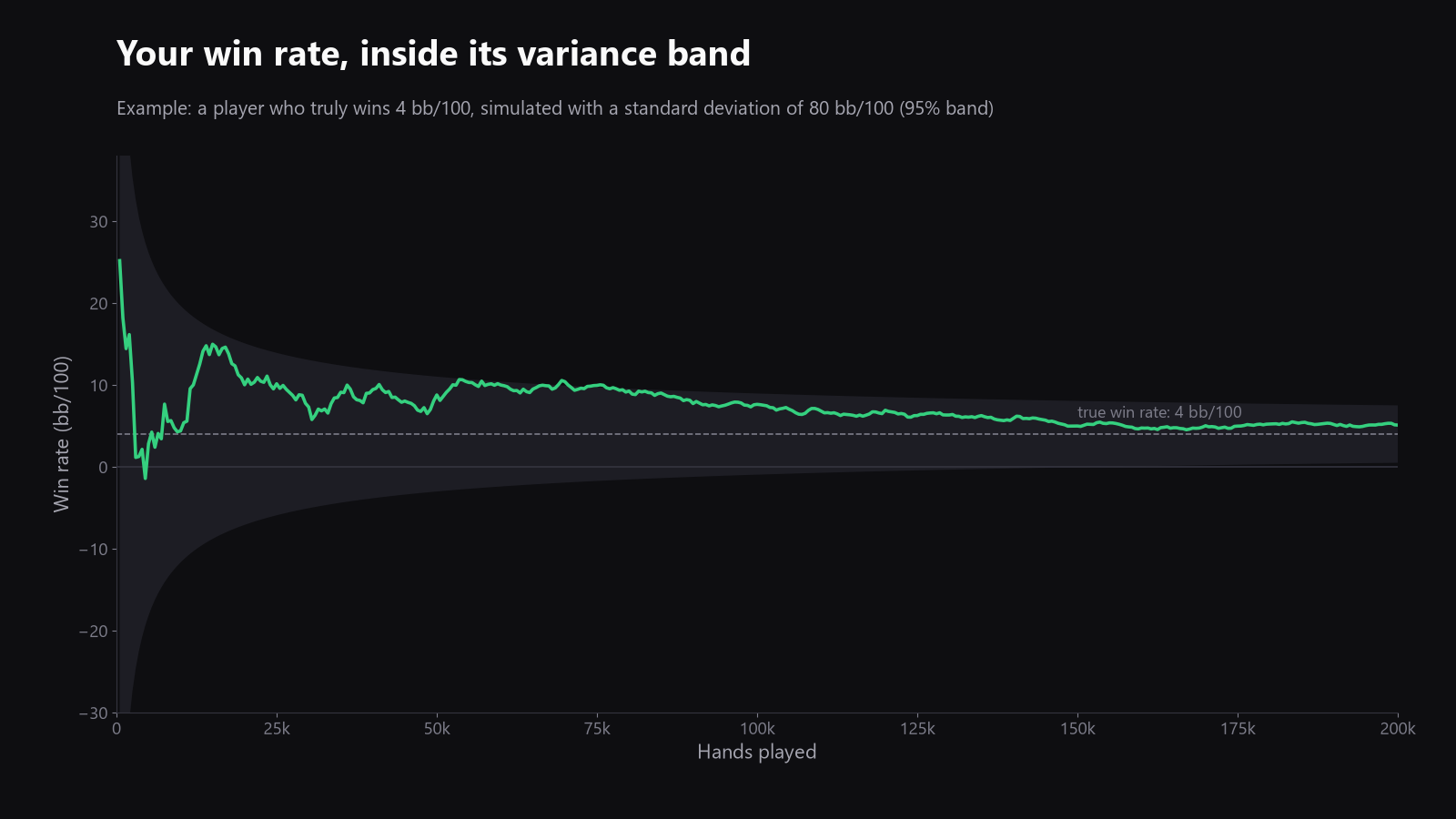
At that volume, a good run or a bad run can still move your result by several big blinds per 100 hands. The issue is not just that the sample is small. It is also that poker does not reveal your edge on every hand. It reveals it slowly.
That is why a good tracker or analysis tool should not only show your profit. It should also show your uncertainty.
The simple rule to remember
In poker, the reading error drops roughly in proportion to the inverse of the square root of the number of hands.
In plain English:
- if you multiply your hand count by 4, your uncertainty is cut in half
- if you multiply your hand count by 100, your uncertainty is cut by 10
That is why the feeling of “I am playing better” often comes long before the numbers prove it.
A practical benchmark
In no-limit hold’em cash games, a player’s standard deviation can often sit around 70 to 100 bb/100. Let’s use a simple value, 80 bb/100, to give a useful order of magnitude.
With that assumption, here is a rough 95% approximation:
| Hands played | Approximate win-rate margin |
|---|---|
| 10,000 | ± 16 bb/100 |
| 25,000 | ± 10 bb/100 |
| 50,000 | ± 7 bb/100 |
| 100,000 | ± 5 bb/100 |
| 250,000 | ± 3 bb/100 |
| 500,000 | ± 2 bb/100 |
| 1,000,000 | ± 1.6 bb/100 |
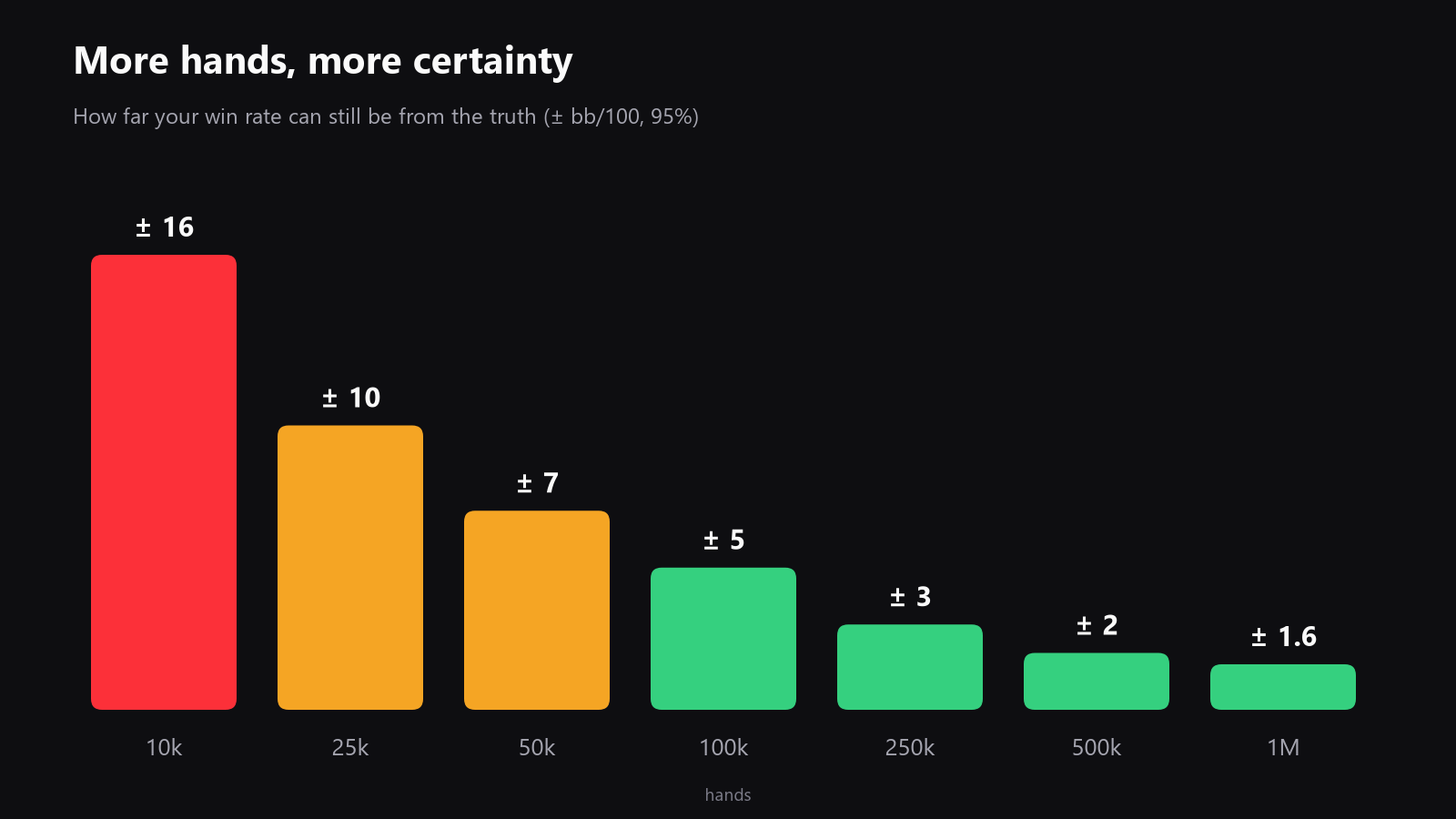
This table tells you something important: 100,000 hands is not the absolute truth, but it is much more serious than 10,000.
How to read your own sample
The right way to read sample size is not to ask “am I winning or losing?” at first glance.
You should ask three questions instead:
1. Is my result above the noise?
If your displayed win rate is +3 bb/100 over 20,000 hands, that can be encouraging. But it can still be compatible with a barely breakeven player who simply ran a bit well.
By contrast, if you are at +10 bb/100 over 200,000 hands, the result becomes much more believable.
2. Does my result take rake into account?
Rake changes everything.
A lot of players look only at gross profit and forget the rake they paid. But you can play reasonably well and still have a net win rate that is not enough to beat the stakes you are playing.
That is even more true at micro and small stakes, where rake is often a very large part of the total cost.
3. Am I breaking the data down finely enough?
A global sample can tell you “you are winning” or “you are losing”. But it does not yet tell you why.
To improve, you need to split the game into pieces:
- preflop
- flop
- turn
- river
- position
- board texture
- opponent type
- stack depth
That is where you move from result to learning.
In our program, the Dashboard module shows your win rate with its margin, the rake you paid, and whether the sample is already large enough to draw a conclusion. The Results module then lets you follow the curve over the month and across your whole career, with rake shown next to the result. That is exactly the kind of reading that keeps you from overreacting to a small sample.
How many hands do you really need to “know”?
The real answer is: it depends on what you want to know.
If you want to know whether you are a huge winner or a big loser
Then a few tens of thousands of hands can be enough to rule out the extreme cases.
For example:
- a player at -20 bb/100 over 30,000 hands is probably in trouble
- a player at +20 bb/100 over 30,000 hands probably has a huge edge, or an enormous run
- in both cases, variance still exists, but the trend is already visible
If you want to know whether you beat the stakes by a small margin
That is where you need much more volume.
This is the most common situation for serious players. They want to know whether they win 2 bb/100, 4 bb/100, or 6 bb/100. At that point, the needed sample grows very quickly.
As a practical guide:
- for a first idea, 20,000 to 50,000 hands can help
- for a serious read, 100,000 hands or more is better
- to separate a small edge from pure noise, 250,000 hands and up becomes very useful
- for very solid conclusions, people often talk about hundreds of thousands of hands
If you play tournaments
In MTTs, variance is even higher.
So the number of hands you need to judge your level should be treated with even more caution. In tournaments, you are not only reading a win rate, but also ROI, ITM, stack depths, and payout structures, all of which make swings much more violent.
In short, in tournaments you need an even bigger sample than in cash games before you can say anything stable.
The most common mistakes
Mistake 1: thinking a good month proves you are good
No. A month can be excellent and still not be conclusive.
Mistake 2: thinking a bad month proves you are bad
No again. You can play well and simply go through a rough run.
Mistake 3: ignoring rake
That is a huge mistake, especially in small stakes.
Mistake 4: mixing formats without separating them
Cash games, MTTs, Spin & Go, full ring, 6-max, heads-up, all of these have different variance and different volume requirements.
Mistake 5: looking only at profit
Gross profit without context tells half a story. Profit with win rate, rake, and margin of error tells a much more useful story.
A simple way to think about sample size
Here is the short version to remember:
- less than 10,000 hands: almost nothing
- 10,000 to 50,000: weak signal, useful for a first filter
- 50,000 to 100,000: the start of a serious read
- 100,000 to 300,000: much more credible
- 300,000 and up: you start separating small edges with much more confidence

What you should do in practice
If you really want to know whether you are winning, do this:
- Separate your formats
- Track net results, not just gross profit
- Look at win rate together with its margin
- Do not jump to conclusions too early
- Then analyze your leaks, not just your graph
That is also why reading results should go hand in hand with a clear study tool. The goal is not only to know where you stand, but to understand what is costing you money.
On poker-exploit.com, the variance page already lets you play with these ideas without installing anything: you enter your win rate and your number of hands, and you see the range where a player who wins nothing could still land after the same volume. It is a good way to visualize what “sample size” really means in practice.
Quick FAQ
Does 5,000 hands tell you anything?
Very little. It is usually too small to conclude anything.
Is 100,000 hands enough?
It is already serious, but not always enough to conclude on a small edge.
Can I know for sure whether I am winning?
Not “for sure”. In poker, you work with probability, margin of error, and statistical confidence.
Is a HUD enough to know whether I am a winner?
No. A HUD gives you information about opponents, not proof of your overall level.
What if my win rate is positive but the rake is huge?
Then you may need to change stakes, format, or table selection. Net result matters more than the feeling.
Conclusion
Poker sample size is not there to kill intuition. It is there to correct it.
If you have few hands, do not conclude too quickly. If you have many hands, read them properly. And if you really want to know whether you are a winner, do not look only at a single number over a short period. Look at your result, your rake, your margin of error, and the stability of your game over time.
In poker, the truth rarely shows up in 2,000 hands. It comes much later.
Poker reveals your level slowly.
Do it on your own hands.