

Poker bankroll management is not about being scared of moving up. It is about giving your edge enough time to show up.
If you play well but your bankroll is too small, a normal downswing can force you to quit a stake too early. If your bankroll is too large for the limits you play, you may be leaving money on the table by staying too low. The point is to find the middle ground where you can keep playing your best game without the fear of going broke.
For cash games, bankroll management is mostly about surviving variance and rake. For tournaments, it is about surviving much larger swings. For Spins and other jackpot formats, it is about surviving very long stretches where you can play well and still lose money for a while.
What poker bankroll management actually means
Your bankroll is the money you use only for poker.
That means:
- it is separate from rent, food, taxes, and bills
- it is separate from your day-to-day savings
- it is separate from money you cannot afford to lose
- it is the money that lets you keep playing after a downswing
Good bankroll management does not try to avoid losing sessions. Losing sessions are normal. It tries to avoid the one bad stretch that forces you to drop stakes too early or quit before your edge can work.
That is why the right question is not only, “How much money do I need to move up?” The better question is, “How much money do I need so that a normal downswing does not break my plan?”
Buy-ins, average buy-ins, and why the format matters
Before you decide how big your bankroll should be, you need to define the unit you are counting.
- Cash games: one buy-in is usually 100 big blinds
- MTTs: one buy-in is the full tournament entry, including rake
- SNGs: one buy-in is one entry
- Spin and Go / jackpot formats: one buy-in is one entry, but variance is much higher than most players expect
For tournaments, the important number is your average buy-in, or ABI. If you play $5, $11, and $22 tournaments in the same pool, your bankroll should be based on your ABI, not on the cheapest event in the lobby.
The format matters because variance is not the same everywhere.
- Cash games have the smallest swings
- Tournaments swing much harder because one deep run can hide many losing sessions
- Spins and jackpot formats can swing even harder because the prize structure is extremely top-heavy
How many buy-ins do you need?
There is no single perfect number, because your skill edge, table selection, rake, and volume all matter.
But if you want a practical starting point, here is a good framework.
Cash games bankroll rules
For online No-Limit Hold'em cash games:
| Approach | Bankroll |
|---|---|
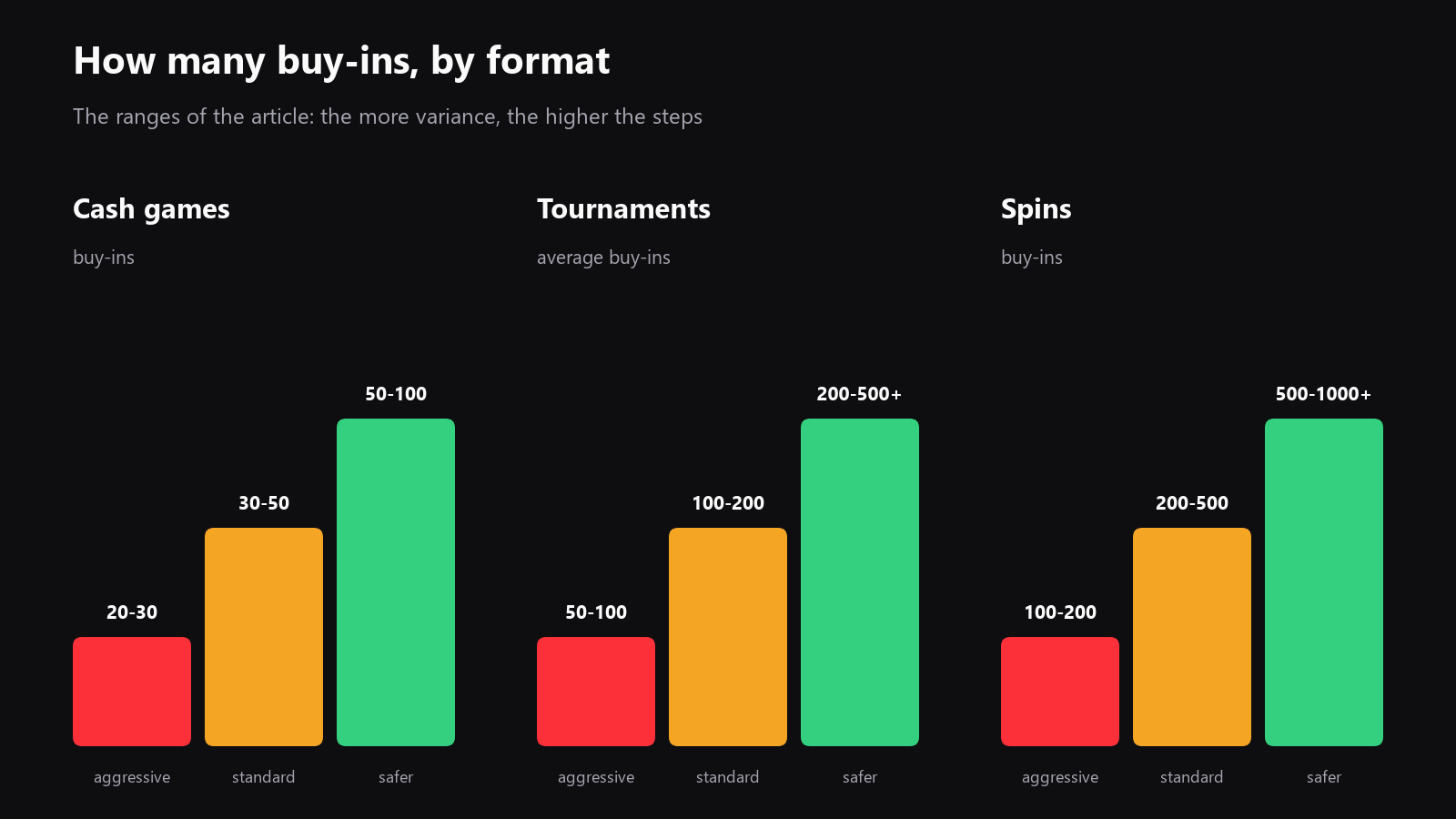
| Aggressive shot-taking | 20 to 30 buy-ins |
| Standard for a solid winning player | 30 to 50 buy-ins |
| Safer and more comfortable | 50 to 100 buy-ins |
Examples:
- playing NL10 with a 30 buy-in bankroll means about $300
- playing NL50 with a 50 buy-in bankroll means about $2,500
If you are still building your game, or if the pool is tough, aim higher. If you are clearly beating the game and you can move down quickly, you can take more aggressive shots.
Tournament bankroll rules
For MTTs, you need much more room.
| Approach | Bankroll |
|---|---|
| Very aggressive | 50 to 100 average buy-ins |
| Standard for regulars | 100 to 200 average buy-ins |
| Safer for large fields and turbos | 200 to 500+ average buy-ins |
Examples:
- if your ABI is $5, a 150 buy-in bankroll is $750
- if your ABI is $11, a 200 buy-in bankroll is $2,200
- if your ABI is $22, a 200 buy-in bankroll is $4,400
For big-field online tournaments, the lower end of these ranges can still lead to long downswings. If your schedule is full of large fields, turbos, and PKOs, move toward the safer side.
Spins and jackpot formats bankroll rules
For Spins, Jackpot SNGs, and similar formats, variance is brutal. Even strong players need a much larger cushion.
| Approach | Bankroll |
|---|---|
| Aggressive | 100 to 200 buy-ins |
| Standard | 200 to 500 buy-ins |
| Safer | 500 to 1,000+ buy-ins |
This is one of the most common bankroll mistakes in poker. Players see a few good weeks, move up too fast, and then discover that the format can keep punishing them for a long time even when they are the better player.
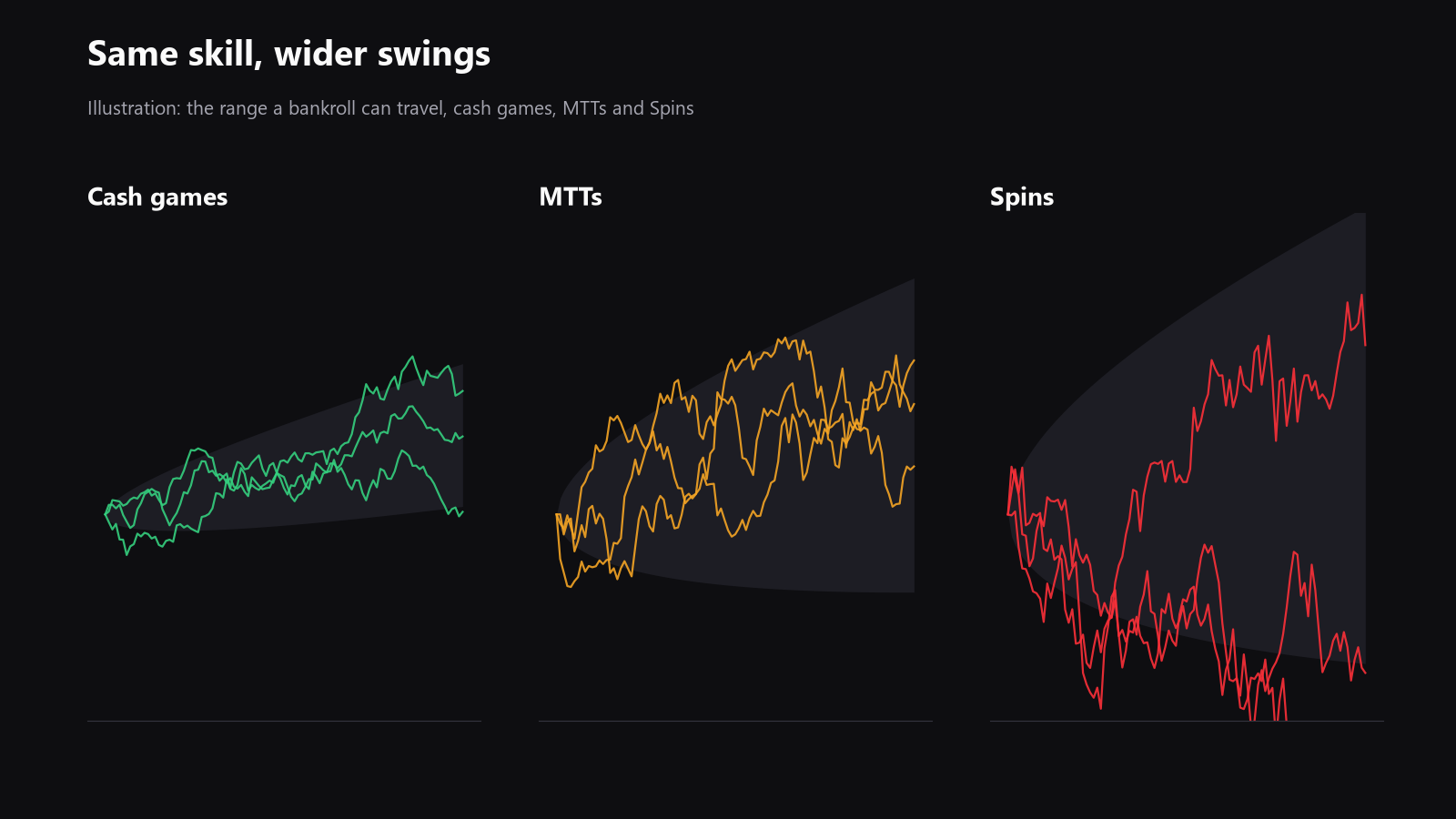
The simple rule: the bigger the variance, the bigger the bankroll
You do not need to memorize one magic number. You need to understand the forces that change it.
Your bankroll should be bigger when:
- the game has higher variance
- the field is tougher
- the rake is higher
- you play fewer hands per month
- your edge is smaller
- you have to withdraw money from the bankroll regularly
- you play formats with top-heavy payouts
- you are still learning and your win rate is not stable yet
Your bankroll can be smaller when:
- you have a proven edge
- you play a soft pool
- the format is low variance
- you volume a lot
- you can move down instantly if needed
- you do not need to withdraw from the bankroll
When should you move up?
Move up when three things are true:
- Your bankroll is large enough for the next stake
- Your results are not just a heater
- You have a real reason to believe you beat the new games
That last point matters more than many players think.
If you only move up because you ran hot for two weeks, you are not following bankroll management. You are gambling with your schedule.
A practical move-up rule for cash games
For cash games, a common approach is:
- move up when you have at least 50 buy-ins for the new stake
- take shots earlier only if the games are soft and you can move down quickly
- keep moving up in small steps, not in big jumps
Example:
If you want to play NL25, it is much healthier to have around $1,250 to $1,500 than to move up at $625 because you had a hot week at NL10.
A practical move-up rule for tournaments
For MTTs, use your ABI and your schedule.
Move up when:
- your bankroll comfortably covers 150 to 200 average buy-ins at the new level
- you have enough volume for your results to mean something
- your game is good enough to beat the pool after rake
If you play a very high-variance schedule, use the conservative end of the range.
A practical move-up rule for Spins
For Spins, only move up when the bankroll cushion is real, not theoretical.
A decent rule is:
- do not move up unless you are comfortably inside your target buy-in range
- do not let one hot streak decide it for you
- if the new stake is much tougher, delay the move even if the bankroll is technically enough
When should you move down?
Moving down is not failure. It is protection.
You move down when your bankroll no longer safely covers the stake you are playing.
That means:
- your bankroll falls below your planned threshold
- a few bad sessions push you into a danger zone
- you are no longer able to take normal variance without risking your future volume
- you need to protect your ability to keep playing well
Cash games move-down rule
For cash games, if you planned to play with 50 buy-ins for the stake and you fall far below that, move down.
A simple method:
- set a normal bankroll target
- set a lower stop line
- when you hit the stop line, move down immediately
Do not wait for “just one more session.” That is how bankrolls disappear.
Tournament move-down rule
For tournaments, move down faster than you think.
Because MTT results are so swingy, many players stay too high for too long. If your ABI no longer fits the bankroll, reduce your schedule before the pressure starts affecting your decisions.
Spins move-down rule
For Spins and jackpot formats, move down early and without hesitation.
If you keep fighting the downtrend by staying too high, you often turn variance into a real bankroll problem.
Shot-taking: the smart way to test a higher stake
Shot-taking means trying a higher limit without fully abandoning the lower one.
That is useful, but only if you do it in a controlled way.
A good shot-taking process looks like this:
- define the target stake in advance
- decide how many buy-ins you are willing to lose before dropping back
- play only a part of your volume at the higher stake
- do not change the plan because of one good or bad session
- review the shot after enough hands or tournaments, not after a single day
Example of a cash game shot
You play NL25 and want to test NL50.
Your plan might be:
- keep NL25 as your main game
- take NL50 shots only when conditions are good
- drop back if the NL50 shot costs you 3 to 5 buy-ins
- move up permanently only when your bankroll and results support it
Example of a tournament shot
You play $5 MTTs and want to try a few $11 tournaments.
Your plan might be:
- keep your ABI mostly at $5
- add a small number of $11 events
- never let the higher buy-ins become the core of your schedule until your bankroll says yes
The most common bankroll mistakes
1. Confusing confidence with bankroll
You feel good, so you move up.
That is not bankroll management. That is mood management.
2. Looking only at recent winnings
A heater can make a weak bankroll look safe. A downswing can make a solid bankroll look broken. You need enough hands or tournaments to know whether the change is real.
3. Ignoring rake
Rake is part of the bankroll question.
If the rake is high, your sustainable win rate is lower, which means your bankroll needs more care. In small stakes games, rake can be the difference between a comfortable move-up and a dangerous one.
4. Mixing bankroll money with living money
If you need the money next month, it is not the same thing as bankroll.
The moment you mix the two, you change the risk. Then your bankroll rules need to be much tighter.
5. Moving up too fast in tournaments
MTTs make many players overconfident because one score can look huge relative to the buy-in.
But one score does not erase variance. It only hides it for a while.
6. Not moving down quickly enough
Many players know how to move up. Fewer know how to move down.
The players who survive long enough to grow usually treat moving down as a normal business decision, not a personal failure.
How to judge whether your bankroll is really strong enough
The answer is not just “How much money do you have?”
It is also:
- how stable your win rate is
- how many hands or tournaments you have played
- how much rake you are paying
- whether your results are inside a normal variance band
- whether you are beating the exact games you want to play next
If you track your own hands, look at your win rate over a meaningful sample, not your last five sessions.
A tracker that shows your win rate, rake, and variance band helps here, because bankroll decisions become much easier when you can see whether you are actually ahead or just running above expectation.
If you use Poker Exploit, the Dashboard and Results modules are useful for exactly that. They show your win rate, the rake you paid, and how your result sits inside variance, so you are not guessing whether a move-up is justified. The Plan module is useful too, because it tells you what leaks are really costing you before you decide to put more money at risk in the next stake.

A simple bankroll plan you can actually follow
If you want a plan that is easy to keep, use this:
- Choose your format
- cash, MTT, Spins, or a mix
- Pick a target bankroll
- based on the ranges above
- Pick a stop-down line
- the point where you go back to the lower stake
- Track your real results
- not just your feelings after a session
- Review your game before moving up
- make sure the reason you are climbing is skill, not luck
- Take shots only with rules
- no improvised leap into a higher stake because you feel invincible
FAQ: poker bankroll management
How big should my bankroll be for online cash games?
A good starting point is 30 to 50 buy-ins, with more if you are learning, table selection is poor, or the pool is tough.
How big should my bankroll be for MTTs?
For most regular players, 100 to 200 average buy-ins is a solid starting range. If the fields are big or very volatile, you may want more.
How big should my bankroll be for Spins?
Usually much more than players expect. A range of 200 to 500 buy-ins is common, and more can be safer.
Should I move up as soon as my bankroll allows it?
Not always. You should also consider your edge, your sample size, the pool strength, and whether you can move back down without hesitation.
Should I move down after a downswing?
Yes, if the downswing puts you below your target threshold. That is what bankroll management is for.

Final takeaway
Poker bankroll management is not about playing scared. It is about making sure your skill has time to matter.
If you play cash games, a solid bankroll keeps variance from forcing bad decisions. If you play tournaments, it protects you from the huge swings that come with top-heavy prize pools. If you play Spins or other jackpot formats, it is the difference between staying in action and getting buried by a normal downswing.
So before you move up, ask yourself three things:
- Do I have enough buy-ins?
- Is my edge proven enough?
- Can I move down without drama if the run goes badly?
If the answer is yes, you are thinking like a bankroll-conscious player. If not, stay where you are, keep building, and let your results do the talking.
Do it on your own hands.