
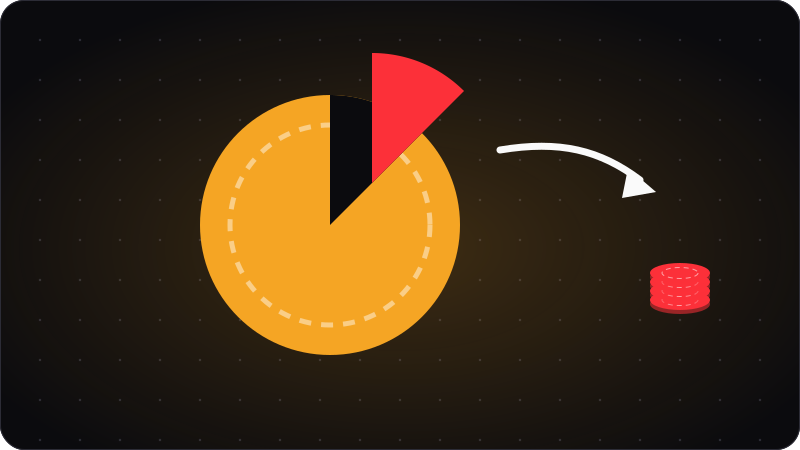
Poker rake is the fee the room takes from the games you play. It is small on one pot, but over a session, a month, or a year, it can be one of the biggest reasons your results look better or worse than your actual edge.
If you play micro stakes, small stakes, or volume-heavy formats like cash games, Spin & Go, or tournaments, rake is not a side detail. It is part of the price of every decision.
This article shows you:
- what poker rake is,
- how rake works in cash games and tournaments,
- how to estimate what you really pay,
- why rake can erase a winning strategy,
- and how to keep it from eating too much of your result.
What is poker rake?
Poker rake is the money the poker room keeps for running the game.
There are two common forms:
- Cash game rake The room takes a percentage from the pot, usually up to a cap.
- Tournament rake You pay a fee on top of the buy-in, for example $10 + $1, where the $1 is the rake.
That sounds simple, but the real cost is hidden in the structure.
A 5% rake on a pot does not mean every hand costs you 5% of the pot. The cap, the pot size, the table format, and whether the room takes rake only when a flop is seen all change what you actually pay.
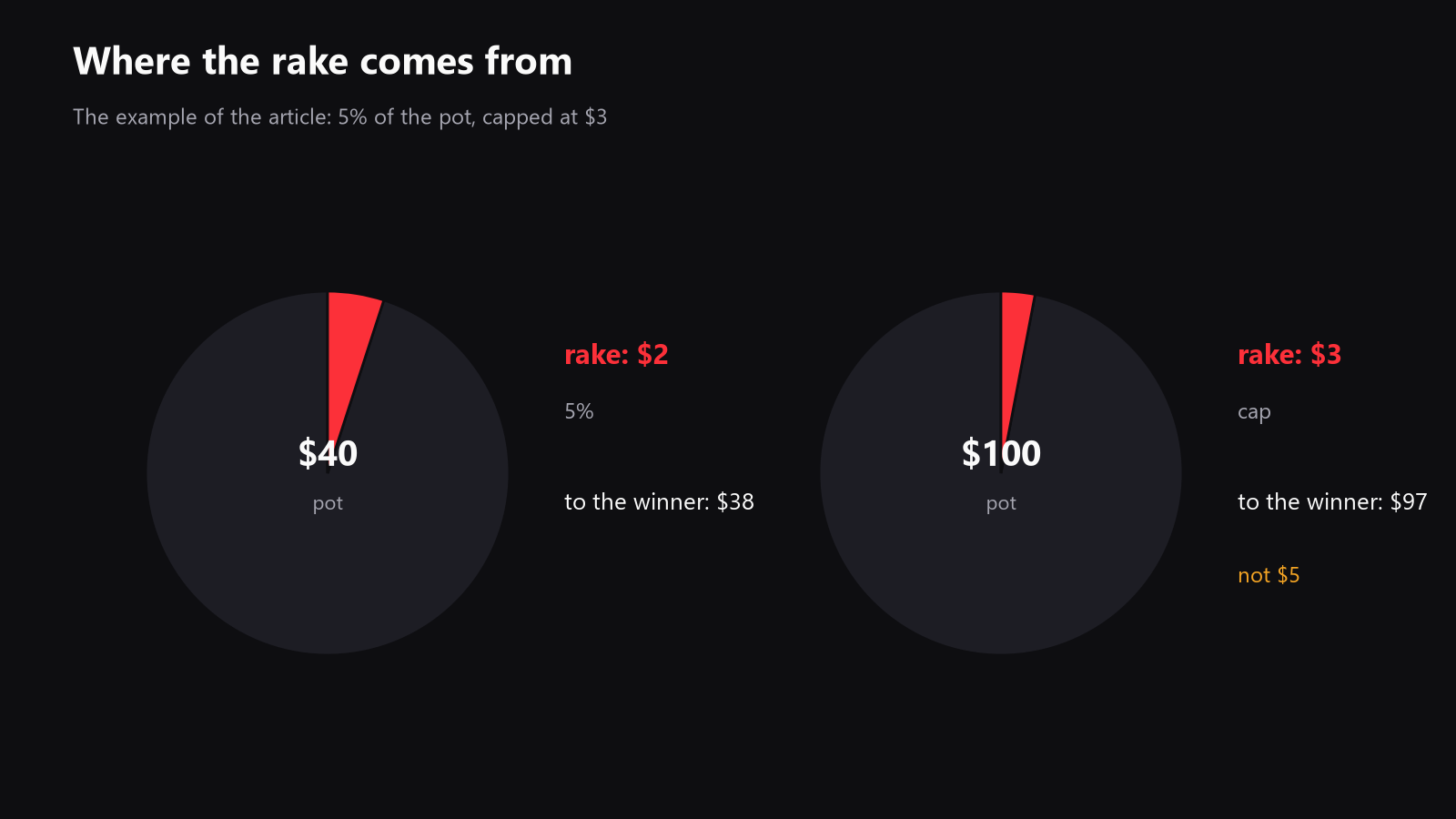
Caption: One pot can look harmless. Over thousands of hands, the same fee becomes a real cost.
How poker rake works in cash games
In cash games, the room usually takes rake from pots that go to the flop.
A typical formula looks like this:
- 5% of the pot,
- with a maximum rake cap,
- only if a flop is dealt.
Example:
- Pot: $40
- Rake: 5%
- Rake taken: $2
If the cap is $3, then a $100 pot would not create $5 of rake. It would stop at $3.
That cap matters a lot.
Why the cap matters
The rake as a percentage of the pot is much heavier in small pots than in large pots.
If you win a $10 pot and $1 goes to rake, that is 10% of the pot.
If you win a $100 pot and $3 goes to rake, that is only 3%.
This is why small-stakes cash games can feel tough even when you are playing well. Many pots are not large enough for the cap to make the rake feel gentle.
No flop, no drop
Many rooms do not take rake when the hand ends preflop.
That changes strategy too. If a pool plays a lot of small pots and folds early, the room collects less rake from each individual hand. But if you often go to the flop, you are paying the fee more often.
How rake works in tournaments
Tournament rake is easier to see, because it is usually built into the buy-in.
Example:
- $10 buy-in + $1 fee
- You pay $11 total
- $10 goes to the prize pool
- $1 is rake
In tournaments, you are not paying rake from each pot in the same direct way as cash games. But the cost is still there, and it has to be beaten by your edge before you make money.
That matters because tournament players often focus on ROI, not rake.
If the fee is high, your ROI threshold rises. You need to outperform more just to get to the same net result.
PKOs, satellites, and special formats
Some formats have a more complex cost structure.
- PKO tournaments can have a fee split inside the buy-in.
- Satellites may have a different fee structure from regular MTTs.
- Spin & Go and similar lottery formats can have a very high effective rake compared to normal cash games.
So when you ask "how much rake do I pay?" the correct answer is not just "5%" or "$1 per tournament". You need the format, stake, and cap.
How much rake do you really pay?
The real answer is usually measured in one of these ways:
- Rake per pot
- Rake per 100 hands
- Rake as a percentage of the pot
- Tournament fee as a percentage of buy-in
- Effective rake after rakeback or rewards
For cash games, the most useful number is often rake per 100 hands, because it tells you what the fee does to your winrate.
Example:
- Winrate before rake: +3 bb/100
- Rake paid: 4 bb/100
- Net result: about -1 bb/100
That is why rake is so important. A small positive edge can disappear once the room takes its cut.
Here is the key idea:
Your poker result is not just skill minus variance. It is skill minus variance, minus rake.
At small stakes, that subtraction can be brutal.
Why rake hurts micro stakes more than you think
At micro stakes, the pots are smaller and the rake cap is reached less often. That means the room takes a larger share of the pot in proportion to what is won.
This affects you in several ways:
1. Thin edges disappear
If you win by making slightly better preflop and postflop decisions, the room may still take a large part of the value you created.
2. Small pots become expensive
Hands that look harmless, like single-raised pots with one bet and one call, can carry a surprising amount of rake.
3. Loose, low-pot games can become worse
If a pool plays many small pots, the rake per hand stays high relative to the size of the pots.
4. Some styles pay more rake than others
A style that sees many flops and wins many medium-small pots can pay more rake than a style that builds larger pots or avoids marginal lines.
That does not mean you should start playing badly to dodge rake. It means rake changes which edges are worth taking.
A simple way to think about rake in your own games
The question is not only "how much rake does the room take?" The better question is:
How much rake does my own game produce?
To answer that, look at:
- your hands played,
- your winrate,
- your rake paid,
- your format,
- and your stake.
If you see a result like this:
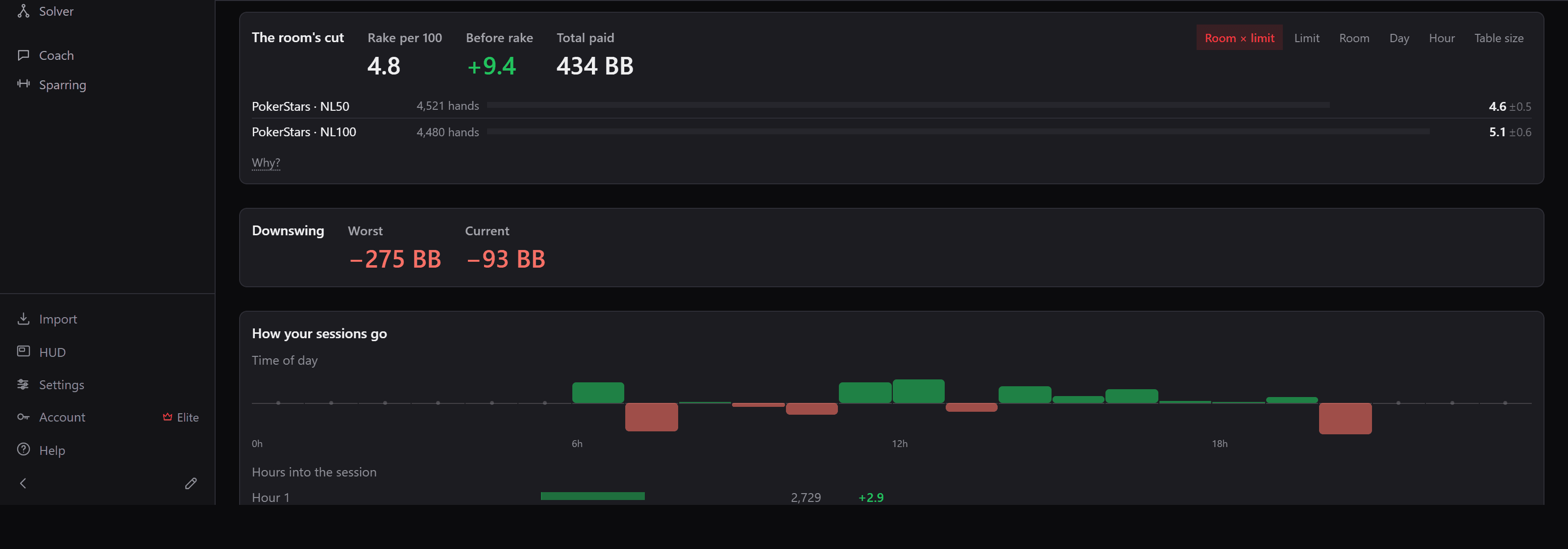
- Net winrate: +4.6 bb/100
- Rake: 4.82 bb/100
then rake is already close to the size of the edge itself. That means your real game is much tighter than the raw winnings line suggests.
This is why rake should always be shown next to the result, not hidden in a separate tab.
How to reduce the impact of rake
You cannot remove rake, but you can reduce how much it matters.
Choose the right room
Different rooms charge different rake structures and caps. Some are simply cheaper than others.
Choose the right stake
At some stakes, the rake is proportionally much harsher. Moving up or down does not just change the size of the pots, it can change the structure of the fee.
Watch the format
A fast format, a lottery format, or a format with many short pots can have a much higher effective rake.
Compare rakeback to real cost
Rakeback helps, but do not look at rewards in isolation.
A room with high rake and good rewards may still be worse than a room with lower rake and weaker rewards.
What matters is your net cost, not the headline percentage of the loyalty program.
Know when the game is not worth the price
If a pool is tough and the rake is high, your winrate needs to do more work just to stay even.
Sometimes the best move is not a better line. It is a better game selection decision.
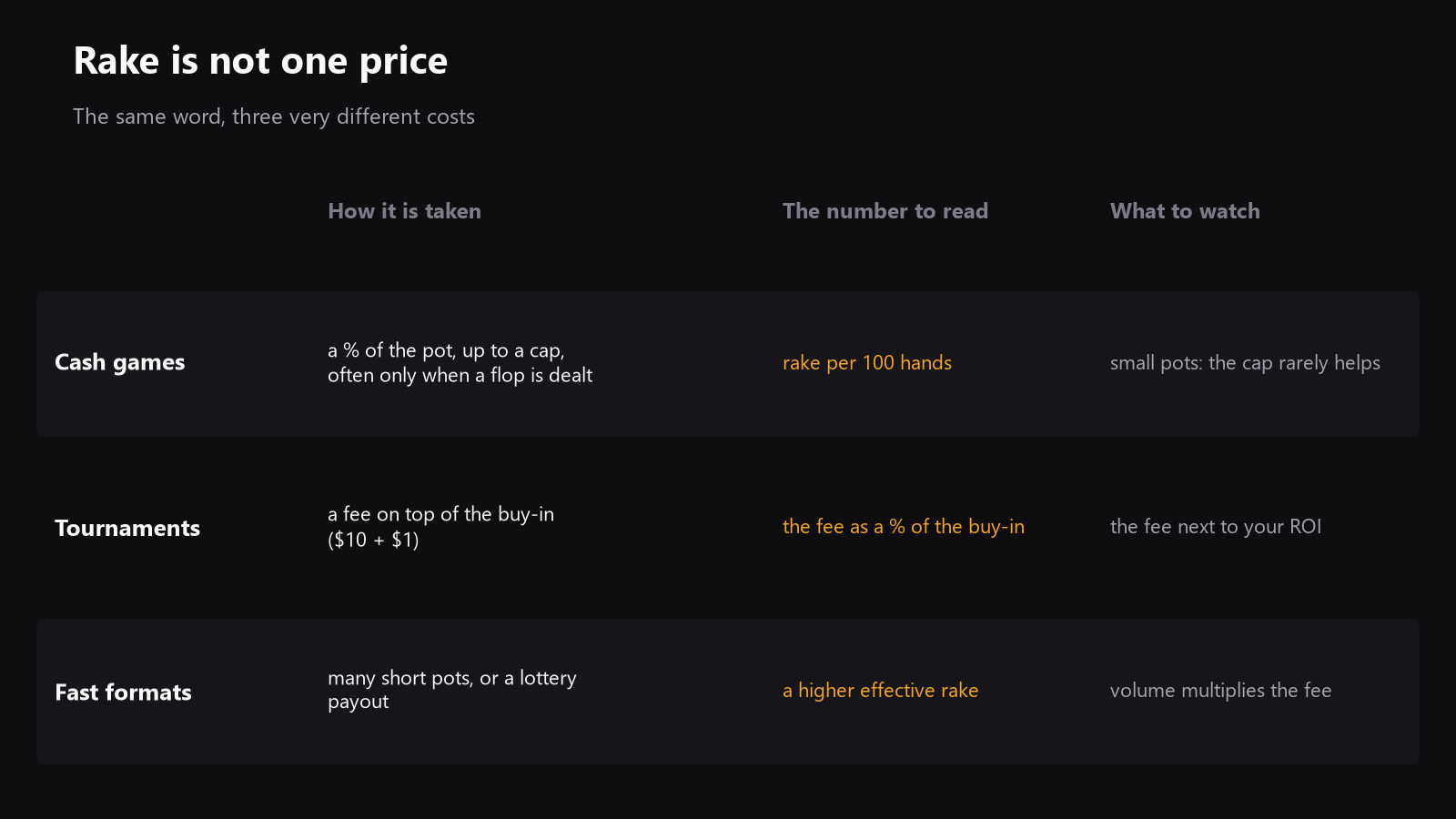
Caption: The same word, rake, can mean very different costs depending on the format.
How to calculate poker rake in practical terms
If you want a rough estimate, start with three numbers:
- Rake structure What percentage is taken, and what is the cap?
- Volume How many hands or tournaments do you play?
- Average pot size or buy-in This helps you estimate how often the cap matters.
For cash games, a tracker that reads your hand histories is the cleanest way to do it, because it can show the rake next to your result and convert it into rake per 100 hands.
For tournaments, look at:
- total fees paid,
- ROI,
- and how much of your buy-in goes to the prize pool versus the room.
If you want a quick first pass before opening your database, the site also has a free rake page where you type your numbers and see what the rake costs you.
Why rake changes strategy, not just profit
Rake does not only change your final graph. It changes which hands are worth playing.
A spot that is slightly profitable before rake can become unprofitable after rake.
That affects:
- marginal calls,
- thin value bets,
- small pots in single-raised games,
- and some speculative lines that need enough reward to justify their cost.
This is one reason serious study should separate:
- raw equity,
- strategy quality,
- and actual profitability after rake.
If you never include rake in the picture, you can overestimate your edge.
What to look at in your own results
When you review your database, do not stop at total winnings.
Look at:
- winrate in bb/100
- rake per 100 hands
- results by stake
- results by room
- results by format
- results by position
- results by month
That gives you a much clearer picture of where the money is going.
A tracker that shows rake beside results can save you from a common mistake: thinking you are running badly when the real problem is that the room is taking too much.
The Dashboard in Poker Exploit does this directly, with rake next to your winrate, and the Results screen breaks it down by month, career, room, stake, position, and hour. If you are trying to understand why a winning line looks smaller than expected, that view is often the fastest place to start.

Caption: If rake sits next to your winrate, you stop guessing and start measuring.
The short version
If you remember only one thing, remember this:
Poker rake is the cost of playing, and it can be large enough to turn a small winner into a breakeven player.
That is why rake matters so much in poker school, bankroll planning, game selection, and study.
Before you ask whether your strategy is good enough, ask whether the rake is too high for the game you are playing.
FAQ: poker rake
Is poker rake the same in every room?
No. Rake structure, cap, and rewards vary from room to room.
Do cash games and tournaments pay rake the same way?
No. Cash games usually pay rake from pots. Tournaments usually pay a fee on top of the buy-in.
Can rake make a winning player lose?
Yes. If your edge is smaller than the rake you pay, your net result can be negative.
Is rakeback worth it?
Sometimes, but only if you compare the reward to the actual rake and to the quality of the games. A good rebate does not fix a bad game.
How do I see my own rake?
Use your hand histories and look at rake per 100 hands, or use a tracker that shows rake next to your results.
Final thought
If you are serious about improving, do not treat rake like background noise. It is part of the game, and it can be one of the biggest leaks in your result even when your strategy is solid.
The best players do not just ask, "Did I play well?" They also ask, "What did this game cost me?"
Do it on your own hands.