
If you play online poker, rakeback and promotions can look simple from the outside. A site advertises 20%, 30%, or 40%, and it is tempting to compare those numbers as if they were the whole story.
They are not.
Rakeback is only a share of the rake you paid, given back in some form. Sometimes it is a direct percentage. Sometimes it comes through a loyalty scheme, a cash bonus, a race, or a leaderboard. To know whether a deal is good, you need to convert it into one unit you can trust, then compare it with the rake you actually pay.
For cash games, that unit is usually big blinds per 100 hands, or bb/100.

What rakeback really is
Rake is the fee the room takes from the pots or from your buy-in structure, depending on the game. Rakeback is some of that fee coming back to you later.
It can come in several forms:
- A simple percentage of rake paid
- A loyalty system with levels
- Cash rewards or bonus funds
- Races and leaderboards
- Seasonal promotions with prizes
The headline is easy to understand, but the real value is usually hidden in the conditions. A 40% offer sounds bigger than a 25% offer, but the smaller headline can still be worth more if it is easier to clear, has fewer caps, or pays on a rake structure that is better for your volume.
That is why you should never compare promotions by the advertised percentage alone.
The number you actually need: value in bb/100
To compare rakeback deals properly, turn everything into the same unit.
For cash games, use this idea:
Rakeback value per 100 hands = total value you receive, in big blinds, divided by hands played, then multiplied by 100
If the deal is a simple percentage of rake paid, the math is even easier:
Rakeback value per 100 hands = rake paid per 100 hands × rakeback percentage
Example
Suppose you play NL10, where 1 bb is $0.10.
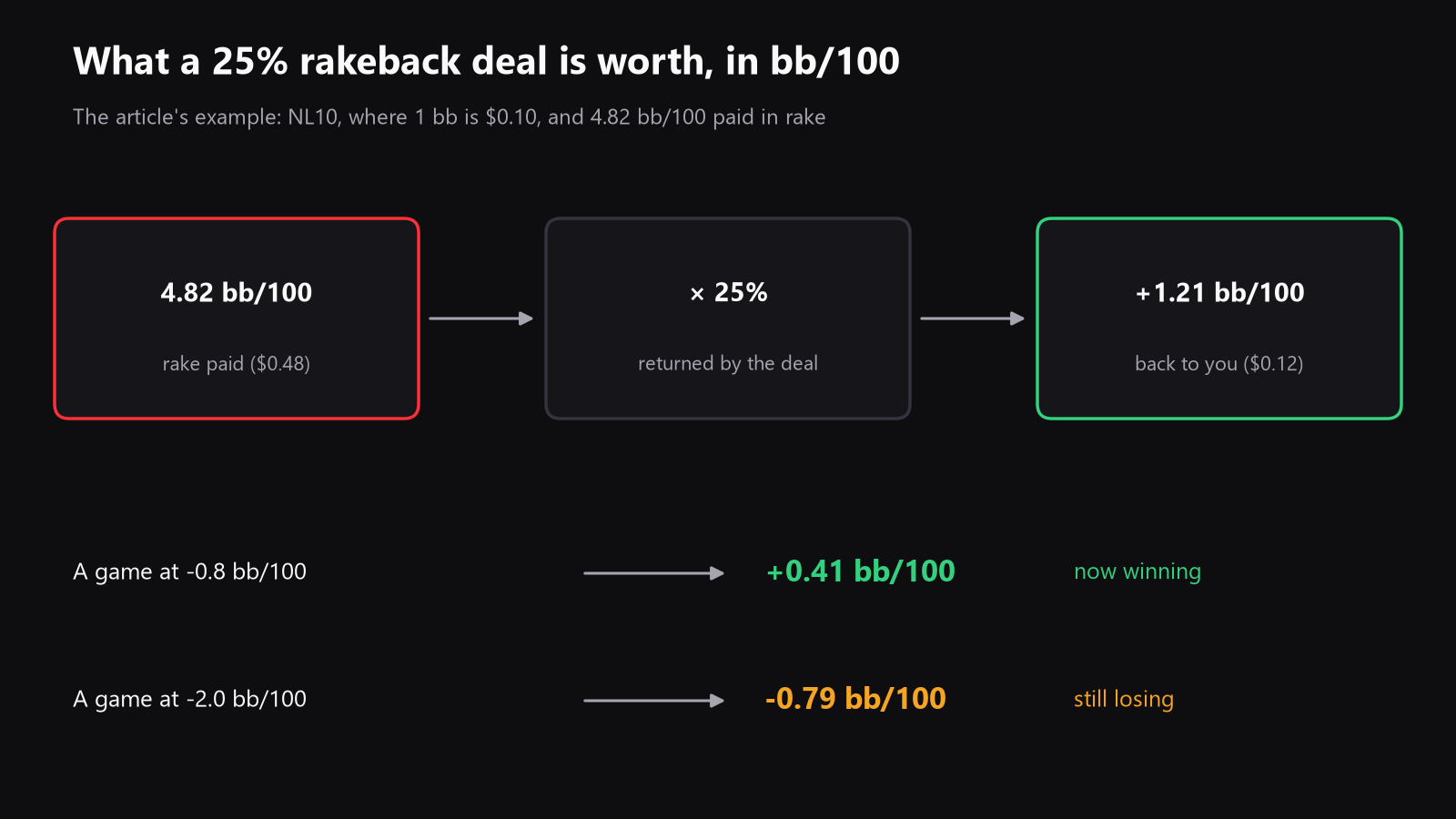
If you pay 4.82 bb/100 in rake and your deal returns 25% of that rake, then your rakeback is:
- 4.82 × 0.25 = 1.205 bb/100
So the deal is worth about 1.21 bb/100.
If your game is losing -0.8 bb/100 after rake, that promotion can push you to:
- -0.8 + 1.21 = +0.41 bb/100
That is a real difference.
But if your game is losing -2 bb/100, the same promotion only brings you to:
- -2 + 1.21 = -0.79 bb/100
The deal helps, but it does not turn a losing game into a winning one.
That is the key point: rakeback only becomes profit if it covers the gap.
The main types of promotions, and how to judge them
| Promotion type | What to convert | What to check |
|---|---|---|
| Percentage cashback | Rake paid × percentage | Is it based on rake paid, or on a points system? |
| Loyalty tiers | Average value across the tiers you actually clear | Can you really reach the next level with your volume? |
| Bonus funds | Cash value of the bonus | How hard is it to clear, and does it expire? |
| Races | Expected prize value | How likely are you to place in a paying spot? |
| Leaderboards | Expected prize value | How big is the field, and what is your realistic share? |
1. Percentage cashback
This is the easiest deal to understand. If the room gives back a fixed share of the rake you paid, you can usually estimate its value quickly.
But check the details:
- Is it on all games or only some formats?
- Is there a cap?
- Does it apply to rake paid, or only to points earned?
- Does the percentage change after you pass a threshold?
2. Loyalty schemes
A loyalty scheme can be strong, but only if you actually clear the level that pays the best rate.
This is where many players fool themselves. They look at the top tier and assume they will reach it. In practice, if your volume is too low, your average rakeback rate may be much lower than the headline rate.
So the real question is not, “What does the top tier pay?” It is, “What do I actually clear over my normal volume?”
3. Bonuses
A bonus is just another way to return some of your rake, but it often pays in stages.
That means you should ask:
- How many points or how much rake must you generate?
- What is the cash value of the bonus?
- Does it expire?
- Is there a minimum volume to unlock it?
A bonus that looks large can have a low practical value if it is hard to clear before it expires.
4. Races and leaderboards
These are the most misleading if you only look at the top prize.
The value of a race or leaderboard is the sum, over each paid place, of the chance you finish there times that place's prize; it is not the prize pool times your chance of getting paid.
So a leaderboard should be treated like expected value, not like guaranteed income.
That means you need to be honest about:
- Your volume
- The player pool
- Your likely finish position
- The payout structure
If you only ever finish outside the money, the leaderboard is worth nothing to you, no matter how big the first prize looks.
Why rake matters before rakeback
This is the part many players get backward.
Rakeback is a rebate on a cost. It does not replace the cost.
If the room takes too much rake from your games, a good promotion can reduce the damage, but it cannot magically erase it. First you measure the rake. Then you measure the reward.
That order matters because:
- A bad game with great rakeback can still be bad
- A good game with no rakeback can still be profitable
- The best situation is a game you beat, plus a promotion that adds to that edge
In other words, rakeback is not a substitute for a solid win rate. It is a layer on top of it.
A simple way to compare two offers
When you compare two rooms or two promotions, do not compare the marketing copy. Compare the net value.
A good checklist is:
- How much rake do you actually pay?
- How much value do you actually get back?
- How many hands do you need to get that value?
- Does the deal still work at your stakes and your volume?
- Does the reward cover the gap between your result and break-even?
If Room A gives you 30% back on a high rake structure, and Room B gives you 20% back on a lower rake structure, Room B can still be the better deal.
Headline percentage is not enough.
For tournament players
The same logic applies in MTTs, Sit & Gos, and Spins, but the conversion is a little different.
In tournaments, bb/100 is less stable because stacks and blinds change constantly. So it is often better to think in terms of:
- buy-ins paid back
- ROI impact
- expected value over a volume of entries
The principle stays the same, though:
promotion value + your game edge = your real result
If the rake is heavy and the promotion is weak, you need a bigger edge to stay profitable.
A practical way to think about it
If you want a short rule, use this one:
- If the promotion does not cover the gap between your post-rake result and zero, you are still losing.
- If it does cover the gap, it can turn a marginal loser into a winner.
- If your sample is too small, do not pretend the estimate is precise.
That last point matters. Your own win rate can still be noise if you do not have enough hands.
Where to check your own numbers
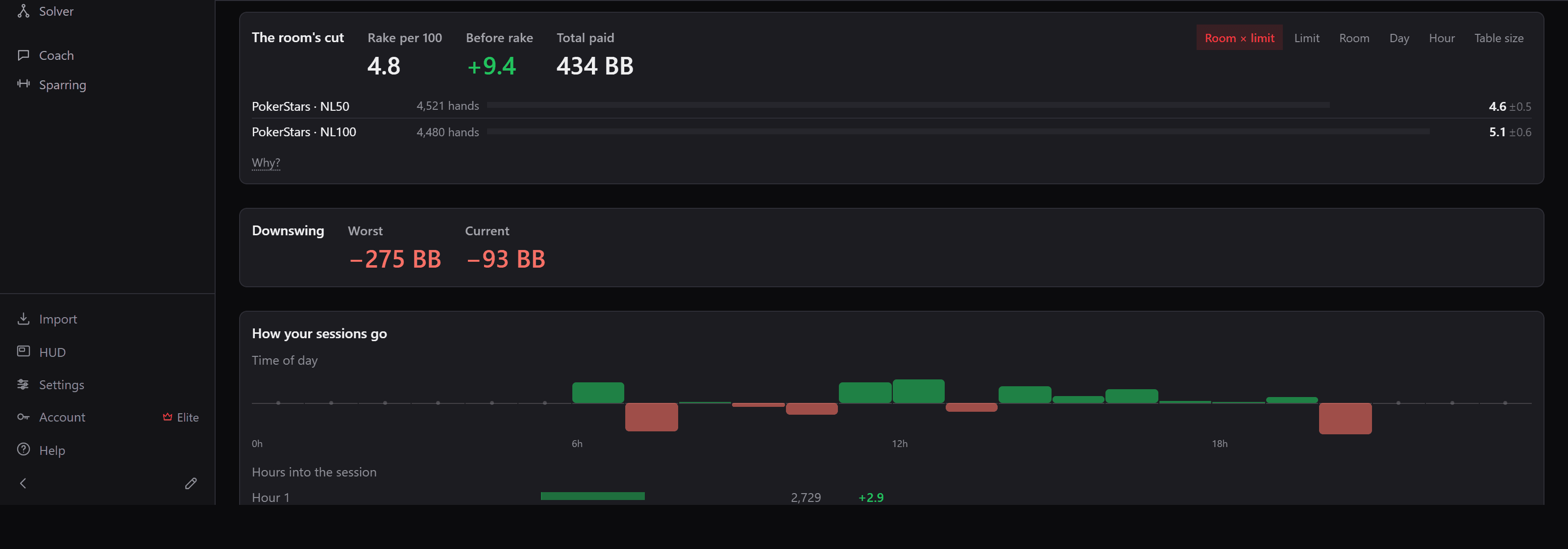
The room will not put rakeback into your hand histories. That means your tracker can measure the rake you paid, but you still have to count what comes back separately.
If you want a clean way to look at the rake side, Poker Exploit’s free Results screen shows the rake next to your result, and the free Dashboard shows your rake per 100 hands, your win rate with its margin, and whether the sample is large enough to call it yet. The free rake page on poker-exploit.com also works out how much rake you pay from the figures you type.
The bottom line
Rakeback and promotions matter, but only after you know three things:
- what rake you pay
- what the promotion really returns
- whether that return is enough to cover your gap to profit
A good deal can help a solid player become more profitable. A bad deal can hide the real cost of playing. And a great-looking headline can still be weak if it is hard to clear, capped, or based on a prize you are unlikely to reach.
So do the math in bb/100, not in slogans.
Do it on your own hands.