
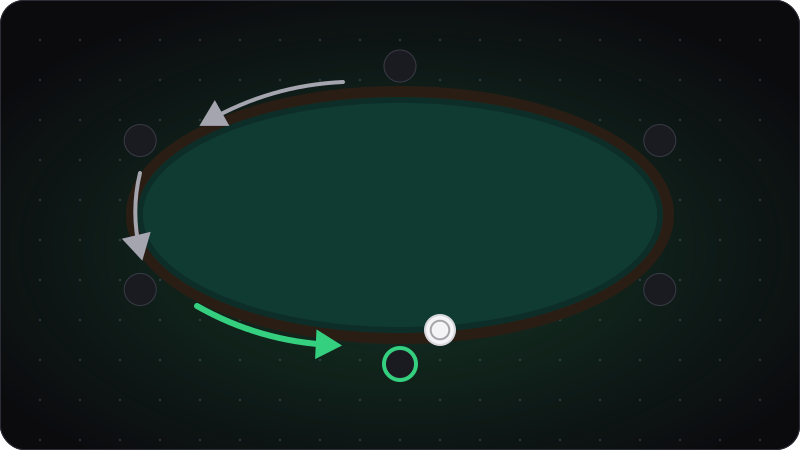
If you want to understand poker, start with position.
At a poker table, position is not just where you sit. It is the order in which you act. And in poker, acting later is usually better than acting earlier, because you get more information before you have to make a decision.
That is why the button is so valuable. It is the seat that acts last on most postflop streets, and that extra information is worth a lot.
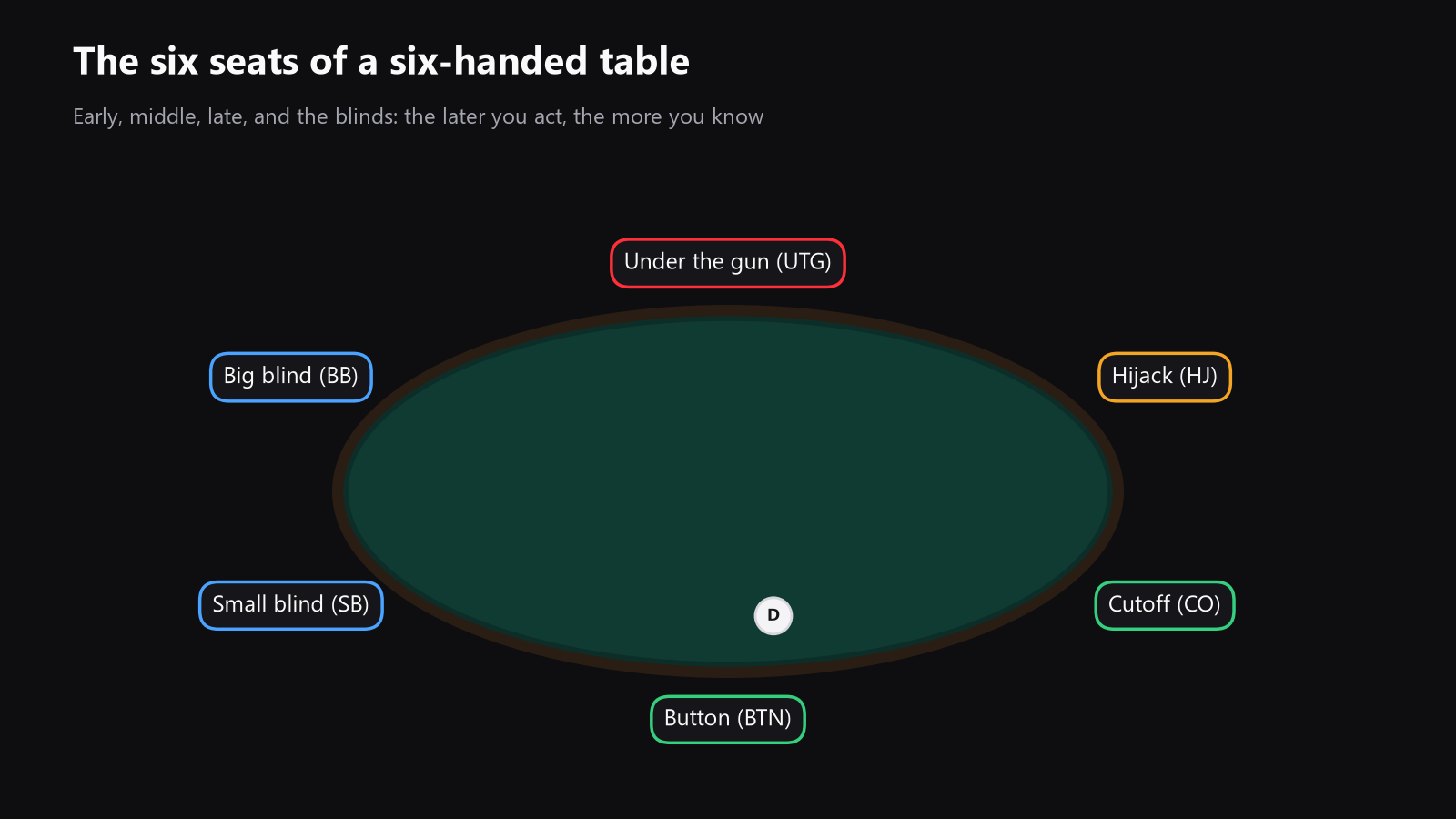
What poker position means
Position changes the game in two ways:
- It changes how many players act before you.
- It changes how often you get to act with more information than your opponent.
That second point is the real reason position matters so much.
When you are in position, you see what other players do before you have to decide. You can check back more often, bluff more efficiently, value bet thinner, and control the size of the pot more precisely. When you are out of position, you have to act with less information, and that makes every street harder.
This is why two identical hands can have very different value depending on the seat.
For example, a hand like AJo may be a clear open from the cutoff, but far less attractive under the gun. The cards did not change. The seat did.
The order of action
Before the flop, action starts to the left of the big blind and continues around the table.
In a full ring game, the usual order is:
- Under the gun
- Middle positions
- Hijack
- Cutoff
- Button
- Small blind
- Big blind
After the flop, the order changes in most pots: the first active player to the left of the button acts first, and the button acts last. That is the key point for normal multiway pots. In any pot at a full table, heads-up or multiway, the button acts last after the flop. In a heads-up game, with only two players at the table, the button posts the small blind, acts first before the flop and last after the flop.
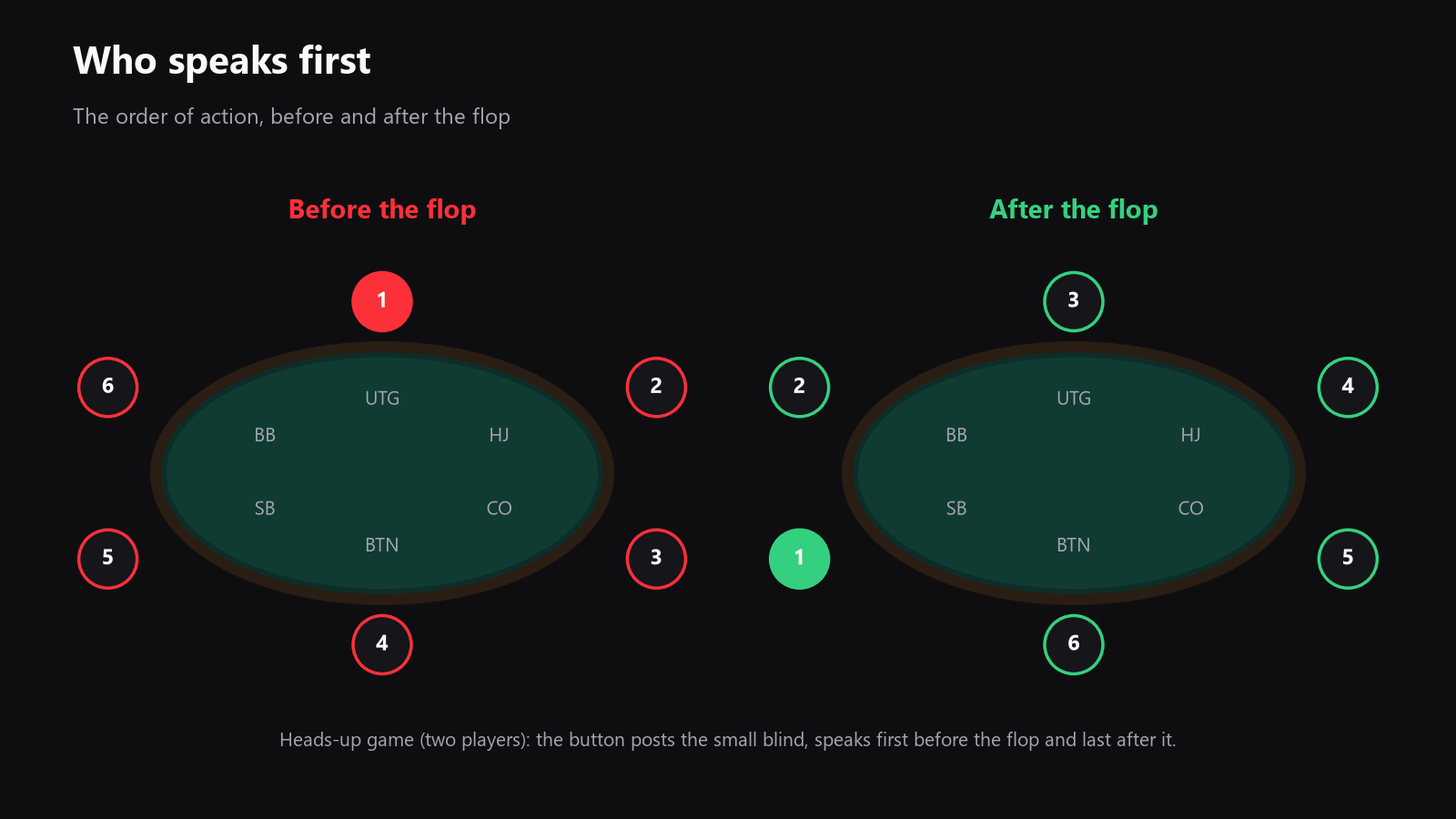
A useful way to think about it is this:
- Early position means you speak first and know the least.
- Middle position means you know a bit more, but still not much.
- Late position means you know the most and can apply the most pressure.
- The blinds are special because you post forced money and often play out of position.
Why later position is stronger
Position is powerful for several reasons.
1. You get more information
Every action before yours is a clue. A check, a bet, a call, a raise, all of it narrows down ranges.
When you act last, you do not have to guess as much. You can make a cleaner decision because you are responding to real information, not just a theory of what might happen.
2. You realize your equity better
Poker hands do not just have raw equity. They have realized equity, which means how much of that equity you actually get to turn into chips.
Position helps you realize more of your equity because you can:
- check back when the pot is already enough
- take free cards more often
- bluff when opponents show weakness
- value bet when they show capped ranges
- control the size of the pot
That is why some hands that look ordinary preflop become much stronger in position.
3. You can bluff more profitably
A bluff works best when your story makes sense and your opponent has shown weakness.
If the action checks to you on the button, you can stab often because many ranges are capped and many players miss the flop. If someone bets into you, you can still raise or call with a much clearer picture of where they stand.
Out of position, your bluffs are harder to sell because you often have to act without knowing what comes next.
4. You can value bet thinner
Position is not only about bluffing. It also helps you extract value.
When you act last, you can bet for value in spots where an out of position player might check. You can pressure second pair, weak top pair, and capped ranges more effectively. You also get paid less often when you are behind, because you can keep the pot smaller.
5. You can steal the blinds
The button is the best seat to attack the blinds because only two players remain behind you and they are forced to defend from awkward positions.
That makes blind stealing one of the main sources of profit in poker, especially in tournaments and in softer cash games. Even when nobody folds perfectly, the button still gets the best mix of fold equity, position, and postflop control.
Seats at the table, from best to worst
The exact ranking depends on stack depth, rake, player pool, and format, but the general idea is simple.
Early position
This is the toughest area of the table.
You act first, so you are exposed to raises behind you. Because of that, your opening range has to be tighter and stronger. You want hands that play well against resistance and do not mind facing pressure.
Typical mistakes in early position:
- opening too many weak suited hands
- overvaluing marginal offsuit broadways
- calling too much instead of raising or folding
- trying to "make something happen" without position
Middle position
Middle position is a little better, but still not easy.
You are not under the same pressure as under the gun, but there are still many players left to act. Your range can widen a bit, but discipline still matters.
Hijack
The hijack is often the first really comfortable seat.
You have fewer players behind you, so stealing and isolating become much more attractive. Many players start feeling more aggressive here, and that is justified.
Cutoff
The cutoff is one of the strongest seats in poker.
Why? Because only the button and blinds remain. You are close to the best seat, you have good steal opportunities, and you often play heads-up or against a short field.
A lot of the money in modern poker comes from the cutoff and the button.
Button
The button is the king seat.
You act last on most postflop streets. You get the most information. You can play more pots, steal more blinds, and control the action better than anyone else.
If you learn only one lesson from position, learn this one: the button is not just "a good seat". It is the seat that gives you the biggest strategic advantage over time.
Small blind
The small blind is usually one of the worst seats.
You already posted money, and you are still out of position against everyone except the big blind in some situations. That means you pay to play and then have to make hard decisions without information.
Big blind
The big blind is different.
You have already posted the full blind, so you often get a slightly better price to continue preflop. But postflop, you are still out of position against most of the table.
That makes the big blind a defensive seat, not a comfortable one.
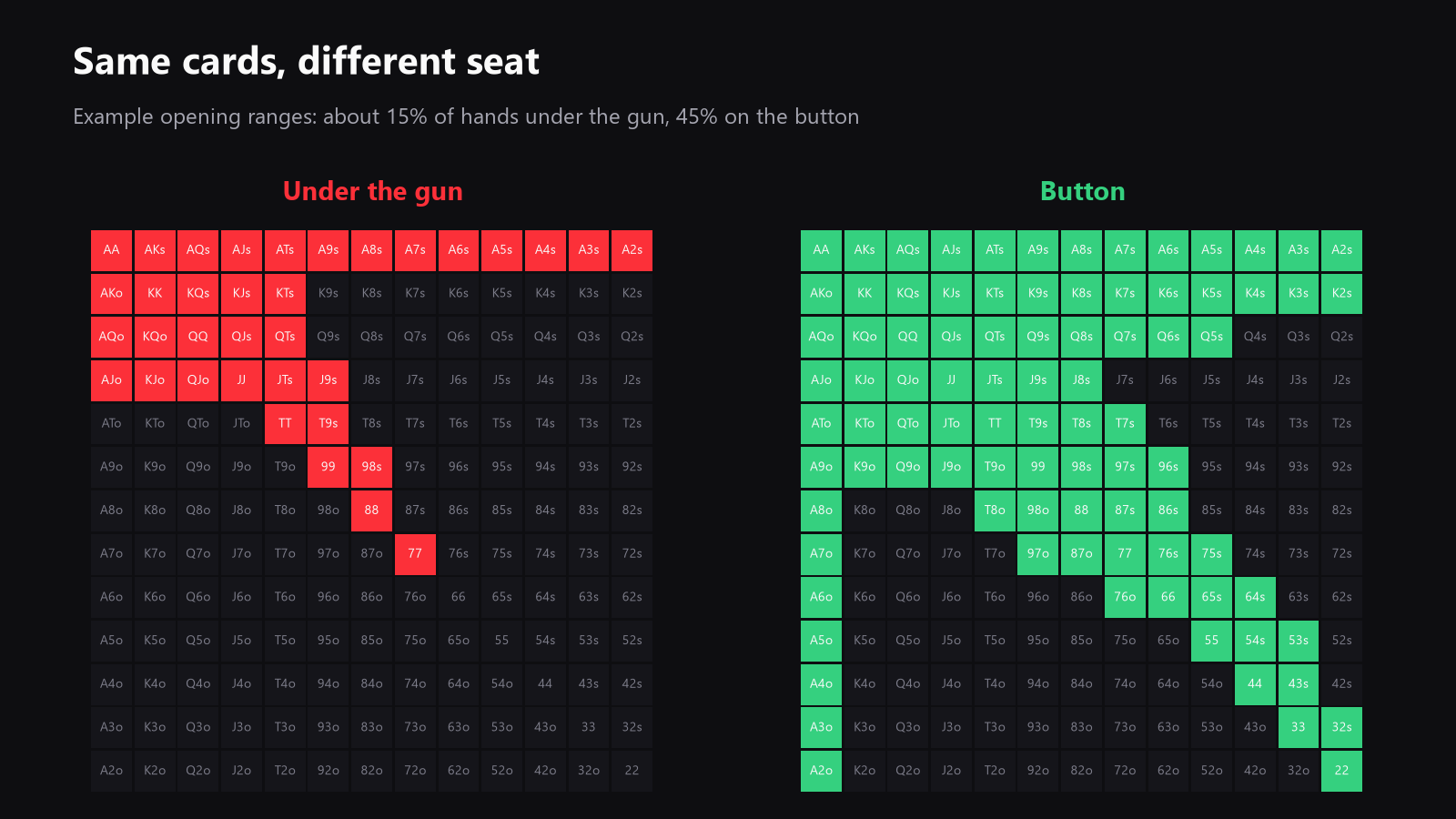
Why the button is the most profitable seat
The button is the most profitable seat because it combines three advantages at once:
- you act last on most postflop streets
- you can open a wide range preflop
- you get the best chances to steal the blinds
That combination matters more than any single card in your hand.
Imagine two identical holdings, such as K9 suited.
On the button, you may be able to open it, pressure the blinds, and play a lot of pots in position.
Under the gun, that same hand may be too loose, because there are too many players left to act and too many stronger ranges behind you.
The hand did not get better. The seat did.
This is also why the button is where good players build a lot of their win rate. They do not just play more hands there. They play better hands in better conditions.
Position changes your ranges
One of the biggest leaks among newer players is using the same range everywhere.
That is not how poker works.
A good range in early position is tighter because it has to survive more resistance. A good range on the button is wider because it has more ways to win:
- it can win preflop
- it can win on the flop with a c-bet
- it can win by checking back and realizing equity
- it can win by value betting later streets
In other words, the value of a hand is not fixed. It depends on where you are sitting.
That is why a solid preflop chart always changes by position.
Position in cash games and tournaments
Position matters in both formats, but the details change a little.
Cash games
In cash games, deeper stacks make postflop skill and position especially important. You have more streets to play, more chances to make or avoid mistakes, and more room to realize edges.
Tournaments
In tournaments, stack depth changes over time. When stacks are deep, position is very valuable because there is room for maneuvering. When stacks get shorter, position still matters, but raw hand strength becomes more important and postflop edges shrink.
Antes also make late position more valuable because there is more dead money to pick up.
Common mistakes players make with position
Here are the most common leaks:
Playing too many hands early
If you open too wide from early position, you invite too much pressure and put yourself in awkward spots.
Not opening wide enough late
If you are too tight on the cutoff and button, you leave money on the table. Late position is where many profitable steals begin.
Defending the blinds without a plan
Defending the blinds just because you "already posted" is a mistake. You still need hands that play well out of position.
Ignoring postflop position
Some players think position matters only preflop. It does not. Postflop is where position often matters most.
Confusing aggression with quality
Being aggressive from the button is good. Being reckless from the button is not the same thing.
A simple rule you can use immediately
If you remember only one practical rule, use this:
The later you act, the wider you can usually play.
That does not mean "play any two cards on the button". It means your range should expand as your position improves, because your ability to realize equity and pressure opponents improves too.
A hand that is too weak to open from early position can be perfectly fine from the cutoff or button.
How to study position in your own game
The fastest way to learn position is not to memorize abstract theory. It is to check how your own results change by seat.
Look at:
- where you lose the most money
- whether the blinds are bleeding too much
- whether the button is carrying your results
- whether your early position opens are too loose or too tight
- how much rake you pay in the seats you play most often

If you review your own hands by position, patterns appear quickly. You may find that the button is strong, as it should be, but the blinds are costing you more than you realized. Or you may find that your early position opens are leaking because you are entering pots that are too hard to win.
That is the kind of review that turns "I know position matters" into actual improvement.
Final takeaway
Poker position is one of the most important ideas in the game.
Early position is difficult because you act first. Late position is powerful because you act with more information. And the button is the best seat because it combines the best information with the best opportunities to steal, control, and extract value.
If you understand position, your preflop ranges improve, your postflop decisions improve, and your win rate usually follows.
The best players do not just play good cards. They play good cards in good seats.
Do it on your own hands.