
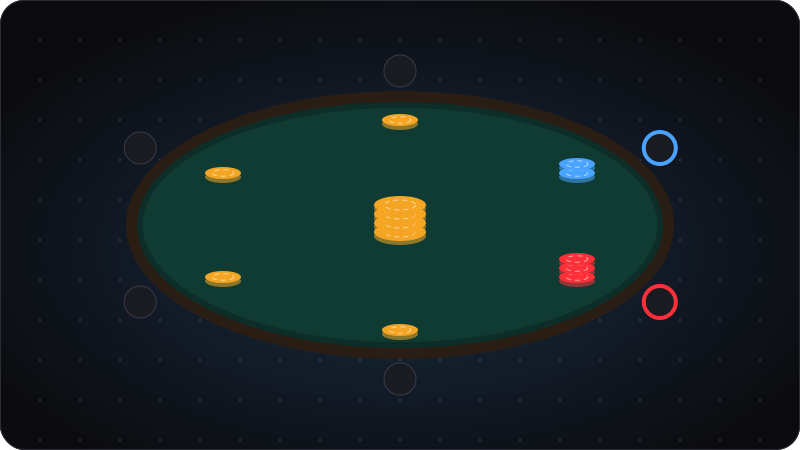
In poker, the pot does not begin at zero.
That is the first thing to understand about blinds and antes, and it is the reason so many hands are worth fighting for even before the flop is dealt. In a normal hold'em game, the table puts money in the middle before any player has chosen to enter the pot voluntarily. Those forced bets create action, shape strategy, and give you something to win every orbit.
What blinds are
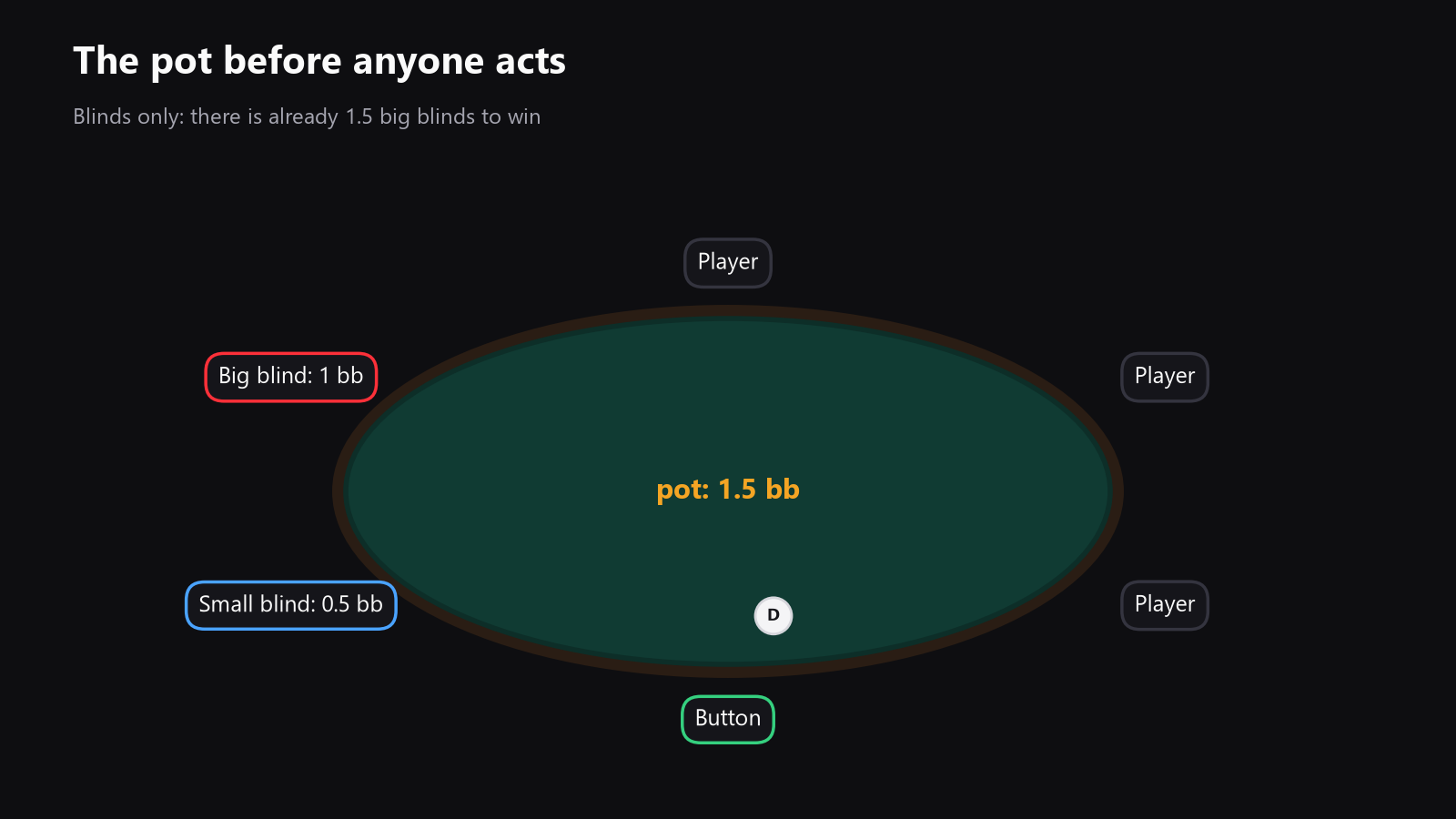
The blinds are the two forced bets posted by the players immediately left of the button.
- The small blind posts less.
- The big blind posts more.
- The button rotates, so every player pays these positions in turn.
In no-limit hold'em cash games, the blinds are usually the only money in the pot before cards are dealt. If you are playing 1/2, the small blind posts 1 and the big blind posts 2. That means the pot starts at 3 before anyone calls, raises, or folds.
That matters because poker is not played from a blank slate. The player in the cutoff, button, or blinds is not deciding whether to play for an empty pot. They are deciding whether to compete for money that is already there.
What antes are
Antes are extra forced contributions, usually smaller than the blinds, that all players post before the hand.
They are common in tournaments and sometimes appear in cash games or special formats. The important idea is simple: antes add more dead money to the pot before the first voluntary action.
There are two common ways antes are collected:
- Full antes: every player posts the same amount.
- Big blind ante: one player, usually the big blind, posts the ante for the whole table.
A big blind ante is just a cleaner way to collect the same money. The table still puts extra chips into the pot before the flop, and that extra money changes the math of every steal, call, and defense.
Why the pot is never empty
This is the core idea.
Because blinds and antes are forced, there is always something in the pot to win.
Even if every player folds, the last active player wins the money already posted. That is why preflop aggression exists. You are not trying to win an empty pot. You are trying to take down dead money.
Dead money is money that is already committed to the pot and can no longer be protected by the player who posted it. A blind is dead money as soon as the hand begins. An ante is dead money too. Once that money is in the middle, every player at the table has an interest in it.
This is also why position matters so much. The closer you are to the button, the more often you can try to win the pot with a raise and not have to show a hand down.
How blinds and antes change strategy
Blinds and antes do more than create a pot. They shape the correct strategy.
1. They make stealing profitable
If the pot starts larger, a raise needs fewer folds to break even.
A simple example:
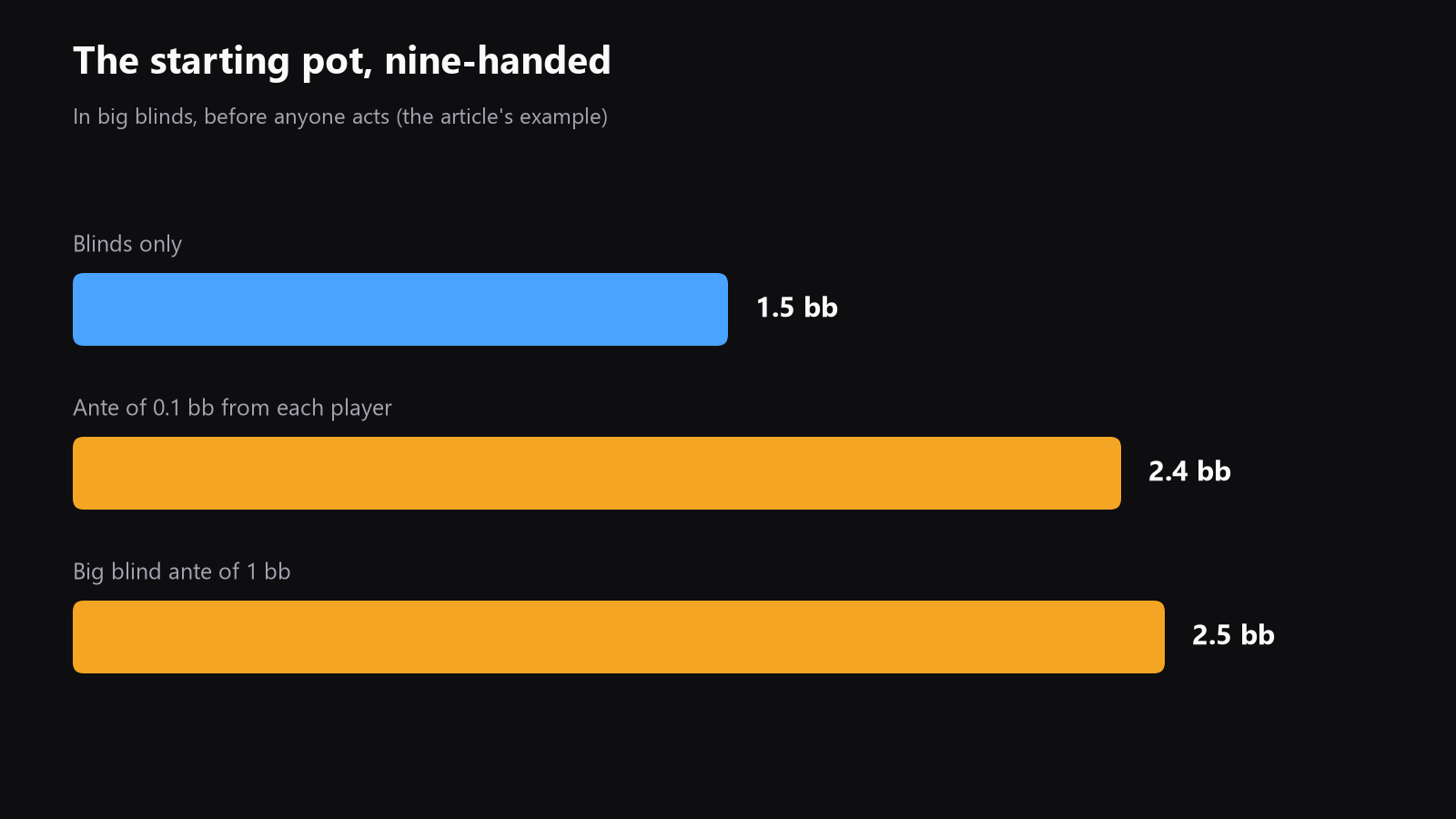
- No ante, blinds only: pot starts at 1.5 big blinds in a 9-handed game.
- Full ante of 0.1 big blind from each player: pot starts at 2.4 big blinds.
- Big blind ante equal to 1 big blind: pot starts at 2.5 big blinds.
Suppose you open to 2.5 big blinds.
- If the pot is 1.5 big blinds, you are risking 2.5 to win 1.5.
- If the pot is 2.4 big blinds, you are risking 2.5 to win 2.4.
That extra money in the middle makes opening wider from late position more attractive. It also makes it more important not to give away too much by folding too often.
2. They increase the value of position
When there is already money in the pot, the player who acts later has more ways to profit from it.
In practical terms, the button and cutoff gain value because they can:
- open more hands,
- attack tighter players in front of them,
- realize their equity better after the flop.
The blinds, by contrast, face a difficult job. They are forced to put money in first, then play out of position after the flop more often. That is why the money in the pot is not just a detail. It changes which hands are worth playing and where they are worth playing from.
3. They change tournament pressure
In tournaments, antes become more and more important as the event goes on.
As stacks get shallower relative to the blinds and ante, the forced money becomes a larger part of every pot. That means:
- stealing becomes more valuable,
- re-stealing becomes more valuable,
- fold equity matters more,
- small mistakes cost more relative to stack size.
This is one reason tournament play often feels faster and more aggressive than cash games. The structure itself pushes action.
Cash games versus tournaments
In cash games, blinds are the main forced bets. The pot starts small, but it still starts with money in it.
In tournaments, blinds and antes are both part of the structure. The pot is bigger before the flop, so players fight harder for it. Big blind ante structures make this even cleaner, because the table gets the same economic pressure without everyone handling antes separately.
The strategic consequence is simple: if the pot already contains forced money, you do not need a monster hand to profit. You need a hand, a position, and a plan that takes that dead money into account.
A common mistake: thinking you need a strong hand to enter
Many players treat the blinds and antes as if they were irrelevant background noise.
They are not.
They are the reason a suited connector on the button, a small pair in position, or a light 3-bet from late position can be profitable. You are not paying to see every flop. You are choosing spots where the money already in the pot makes your move worth it.
That does not mean you should play recklessly. It means the value of a hand is not just the cards in your hand. It is also the pot size, the position, and the money already forced into the middle.
A quick way to think about it
Whenever you look at a preflop spot, ask three questions:
- How much money is already in the pot?
- Who is forced to invest next?
- Who has the best position to win that money back?
If you answer those three questions well, blinds and antes stop being a technical detail and become a clear source of strategy.
Why this matters in your own results
If you play online, your own database can help you see your results more clearly.
In Poker Exploit, the free Dashboard module shows your win rate, the rake you paid, the number of hands, and whether the sample is large enough to settle anything. The free Results module breaks your results down by month, by room, by stake, by position, and by hour. That makes it easier to see where your money goes and whether a run is still just variance.
The free Self Analyser module can then point you to the situations you play worst, including preflop spots by position. That is a simple way to turn a broad topic like blinds and antes into something you can actually work on.

Final takeaway
Blinds and antes are the reason poker pots start with money already inside them.
That one fact explains a lot of the game:
- why late position is so valuable,
- why stealing is part of good strategy,
- why tournaments play differently from cash games,
- why preflop decisions matter even when nobody has shown strength yet.
Every hand begins with forced money in the middle. The whole game grows out of that fact.
Do it on your own hands.