
At the table, you are never really facing "a player". You are facing a pattern.
Some opponents play too few hands. Some enter too many. Some raise too often. Some call too much. Some attack in the right places. Some attack everywhere. If you can identify the pattern early, you get a clearer basis for your decisions immediately, and that is one of the fastest ways to understand who you are facing.
The useful part of player types is not the label itself. The useful part is the adjustment that comes with it.
The stats you should read first
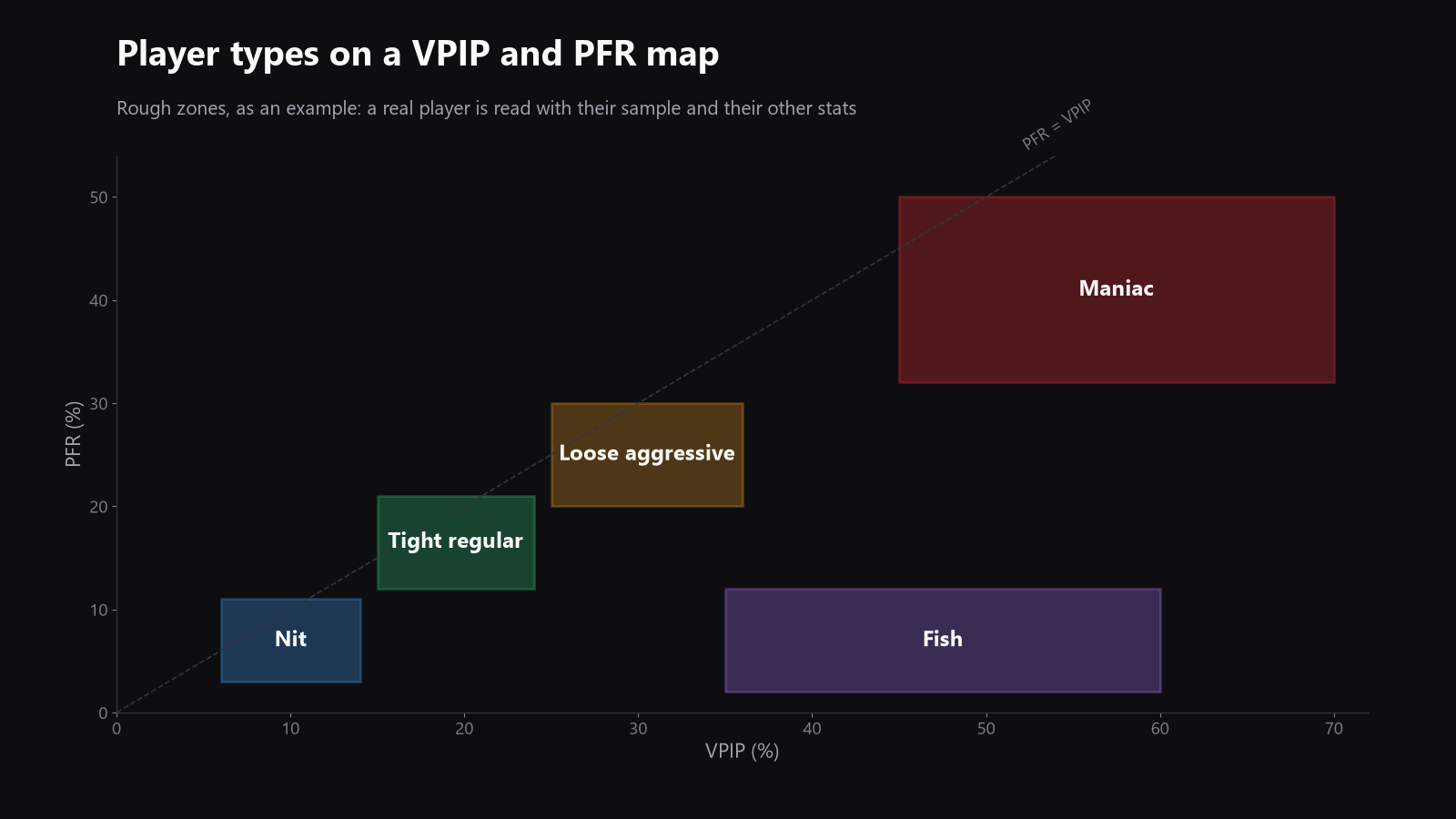
If you want to recognise poker player types quickly, start with a few basic stats:
- VPIP: how often a player voluntarily puts money in the pot.
- PFR: how often they raise preflop.
- 3-bet: how often they re-raise.
- Fold to 3-bet: how often they give up when someone re-raises them.
- Flop c-bet: how often they continue with aggression after raising preflop.
- Fold to flop c-bet: how often they give up when facing a flop continuation bet.
That is enough to identify a lot of opponents.
If you use Poker Exploit, the HUD module shows those observed stats at the table, and it also shows the opponent type, the colour you gave them, your notes, and comparisons with the field. It shows information, never advice.
A quick cheat sheet for the main player types
| Type | Usual profile | Main adjustment |
|---|---|---|
| Tight regular | Fewer hands, fairly solid aggression, controlled ranges | Steal more, respect strength more |
| Loose aggressive player | Plays more hands, raises more, uses pressure | Use position, trap more, value bet wider |
| Recreational player or fish | Calls too much, enters too many pots | Value bet more, bluff less |
| Nit | Very tight, folds too much | Attack relentlessly, do not pay off lightly |
| Maniac | Very aggressive, lots of raises and barrels | Tighten up, let them overbluff |
1. The tight regular
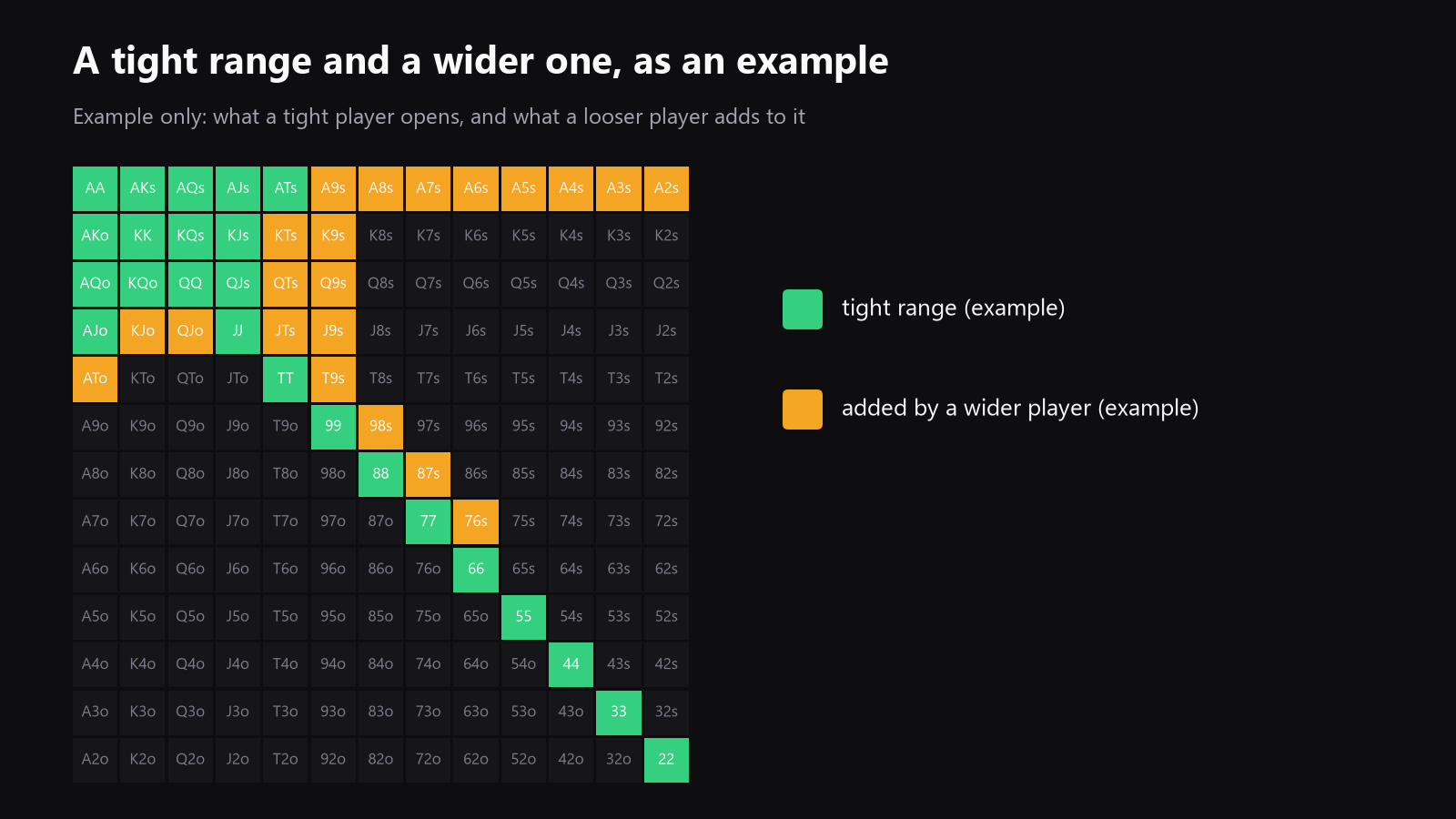
The tight regular, often called TAG for tight aggressive, is usually a solid player who chooses spots carefully. They do not play many hands, but when they enter a pot, they usually enter with a plan.
What to look for
- VPIP is low or moderate.
- PFR is close to VPIP.
- 3-bet is present, but not wild.
- They do not call too much preflop.
- Postflop aggression is selective, not random.
What this means
A tight regular is usually not giving away chips in obvious ways. Their main leaks, when they exist, are often structural rather than explosive. They may fold too much in some bluff spots, or they may become uncomfortable when you put them under repeated pressure.
How to adjust
- Steal their blinds and late-position opens more often.
- 3-bet them in good spots, especially in position.
- Do not overbluff into clear strength.
- Value bet your strong hands.
- Pay attention to whether they defend enough or overfold in certain lines.
Against a tight regular, you usually win by taking many small edges, not by forcing giant bluffs.
2. The loose aggressive player
Loose aggressive players, or LAGs, are active. They play more pots, raise more often, and apply pressure more often than a standard tight regular.
A good LAG is not the same thing as a maniac. A good LAG can still be disciplined. The difference is that the loose aggressive player often uses aggression as a weapon, while the maniac often uses it as a habit.
What to look for
- VPIP is higher than average.
- PFR is also high, so they are not just calling.
- 3-bet is active.
- They attack late position well.
- They keep pressure on the flop and sometimes on later streets.
What this means
A loose aggressive player wants you to feel uncomfortable. They can create awkward decisions because they are often wide enough to have many possible holdings. If you respond by folding too much, they can run you over. If you respond by calling too wide without a plan, they can also punish you.
How to adjust
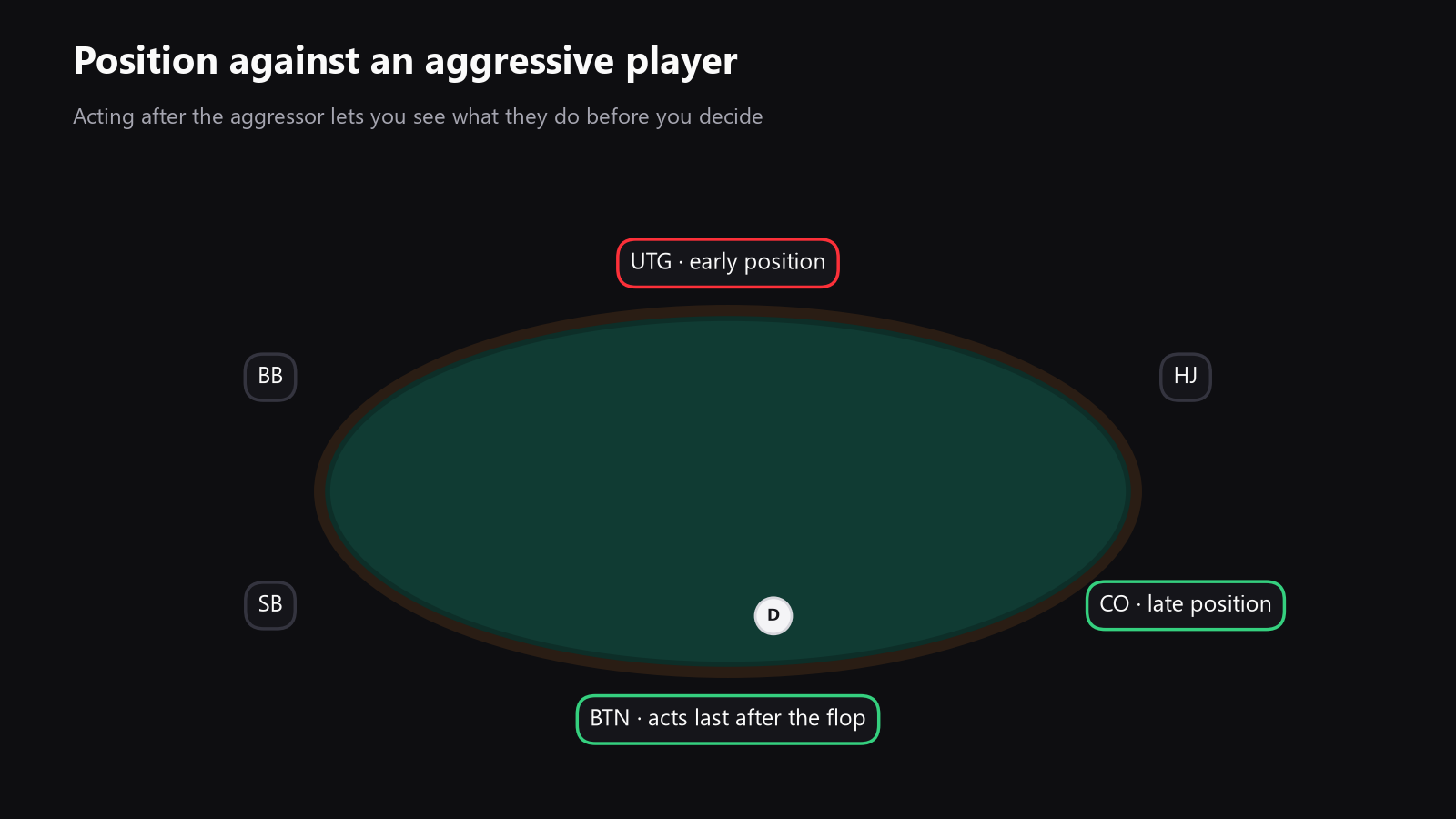
- Use position against them whenever possible.
- Widen your value range.
- Trap more when they over-bluff.
- Do not overfold just because they keep firing.
- Do not force bluffs into ranges that continue well.
The best adjustment against a LAG is often patience plus good position.
3. The recreational player, or fish
The recreational player is usually easy to spot once you look at the stats and the action pattern. This player often enters too many pots, calls too much, and does not protect their stack with much structure.
"Fish" is poker slang. It does not mean stupid. It means a player who makes enough costly errors for you to exploit them.
What to look for
- VPIP is much higher than PFR.
- They call preflop far more than they raise.
- They limp often.
- They continue with too many weak hands postflop.
- Their lines can look loose, passive, or inconsistent.
What this means
The main leak in this profile is often calling too much. That means they allow you to realise value when you have the best hand, and they often do not make your bluffs work enough to compensate.
How to adjust
- Isolate them more often when you have position.
- Value bet more often.
- Value bet larger when they keep calling.
- Bluff less in marginal spots.
- Punish loose limps and loose calls with hands that can make strong top-pair or better type value.
Against a recreational player, your job is simple: get paid when you are ahead and do not get fancy when you do not need to.
4. The nit
The nit is the tightest end of the spectrum. This player hates uncertainty, dislikes marginal decisions, and usually avoids trouble.
A nit can still be a winning player, but the shape of their game is often very clear.
What to look for
- Very low VPIP.
- Very low PFR.
- Few cold calls.
- High fold to 3-bet.
- High fold to flop c-bet on many boards.
- Strong action usually means real strength.
What this means
Nits often give up too much. They protect their stack too carefully and defend too little.
How to adjust
- Open wider against them.
- Steal their blinds aggressively.
- 3-bet their opens if they overfold.
- C-bet good boards where their range misses often.
- Be careful when they suddenly show strength.
A nit is often one of the easiest player types to exploit because the leak is stable. They do not make enough tough counterattacks.
5. The maniac
The maniac is the player who makes every pot feel bigger than it should. They raise a lot, re-raise a lot, and keep the pressure on.
Sometimes the maniac is simply punting. Sometimes they are applying extreme aggression with some logic behind it. Either way, they make poker noisy.
What to look for
- High VPIP.
- High PFR.
- High 3-bet.
- Aggressive postflop lines.
- Low willingness to slow down.
What this means
A maniac can be overbluffing, overvaluing weak hands, or both. But do not confuse "wild" with "always bluffing". Some maniacs still have enough value in their range to punish weak calling.
How to adjust
- Tighten your ranges when they are behind you.
- Let them keep betting when you have real strength.
- Call down more with strong bluffcatchers, not with random hope.
- Value bet hard when you are far ahead.
- Avoid flashy bluffs unless the spot is very clear.
Against a maniac, the best weapon is usually discipline. If you do not panic, their aggression often works against them.
How to recognise a player from a few stats
The fastest way to classify someone is not by one number. It is by the relationship between the numbers.
VPIP and PFR together
This is the first filter.
- Low VPIP, low PFR: likely a nit or a tight regular.
- High VPIP, high PFR: likely a loose aggressive player or a maniac.
- High VPIP, low PFR: often a recreational player who calls too much.
The gap between VPIP and PFR
If the gap is large, the player is probably calling too much preflop.
That is one of the clearest signs of a weaker recreational player.
3-bet and fold to 3-bet
These help you see how much a player resists pressure.
- High 3-bet and low fold to 3-bet means they can fight back.
- Low 3-bet and high fold to 3-bet often means they are easier to pressure.
- Aggression with high folding can mean they are too honest in some spots.
Flop c-bet and fold to flop c-bet
These show what happens after the flop.
- A high flop c-bet frequency often means the player likes to keep initiative.
- A high fold to flop c-bet often means they give up too often when they miss.
- A player who c-bets often but folds too much to resistance may be overusing weak lines.
The point is not to memorise numbers in isolation. The point is to turn numbers into a plan.
If you want those numbers at the table, the HUD module in Poker Exploit keeps the observed stats, player type, colour, notes, and field comparison next to each seat, so the pattern is easier to read while the hand is still fresh.
The best adjustment is not the same on every street
Player types are not only preflop categories.
A tight regular may open correctly but overfold later. A fish may limp too much and then call too much postflop. A nit may defend too little everywhere. A maniac may be wild early but slower on scary runouts. A loose aggressive player may be strongest in position and weaker out of it.
That is why the label is only a starting point.
The real question is always: what does this player do badly in this exact spot?

The biggest mistake: treating player types as fixed
Do not lock someone into a label too early.
A player can be a nit in early position and splashy on the button. They can be tight for an hour and then tilt. They can overcall in one format and overfold in another. They can look like a maniac in one session and play much more carefully in the next.
So use labels as a first pass, then update them when new hands arrive.
That is also why a hand history tool matters. The Reveal module in Poker Exploit shows how the field at your limits plays by street and by spot, from your own hands; it does not sort players into types or give reads on individual opponents. For per-opponent stats, colours and notes, use Player Profiles and the HUD module.

A simple way to remember the five main types
If you want one shortcut, use this:
- Tight regular: disciplined, small edges.
- Loose aggressive: pressure matters, position matters.
- Fish: value is king.
- Nit: steal and pressure.
- Maniac: stay calm and let them overdo it.
That does not describe everything. But it is enough to give you a clearer basis for your decisions quickly.
Final takeaway
The purpose of player types is not to sort people for fun. The purpose is to choose better actions.
When you recognise a nit, you steal more. When you recognise a fish, you value bet more. When you recognise a loose aggressive player, you defend with better hands and better position. When you recognise a maniac, you stop fighting every battle. When you recognise a tight regular, you keep collecting the small edges they leave behind.
If you want to make those reads faster, a tracker with a clean HUD and the Reveal module gives you a clearer basis for your decisions, because the pattern stays visible while the hands are still recent.
Do it on your own hands.