

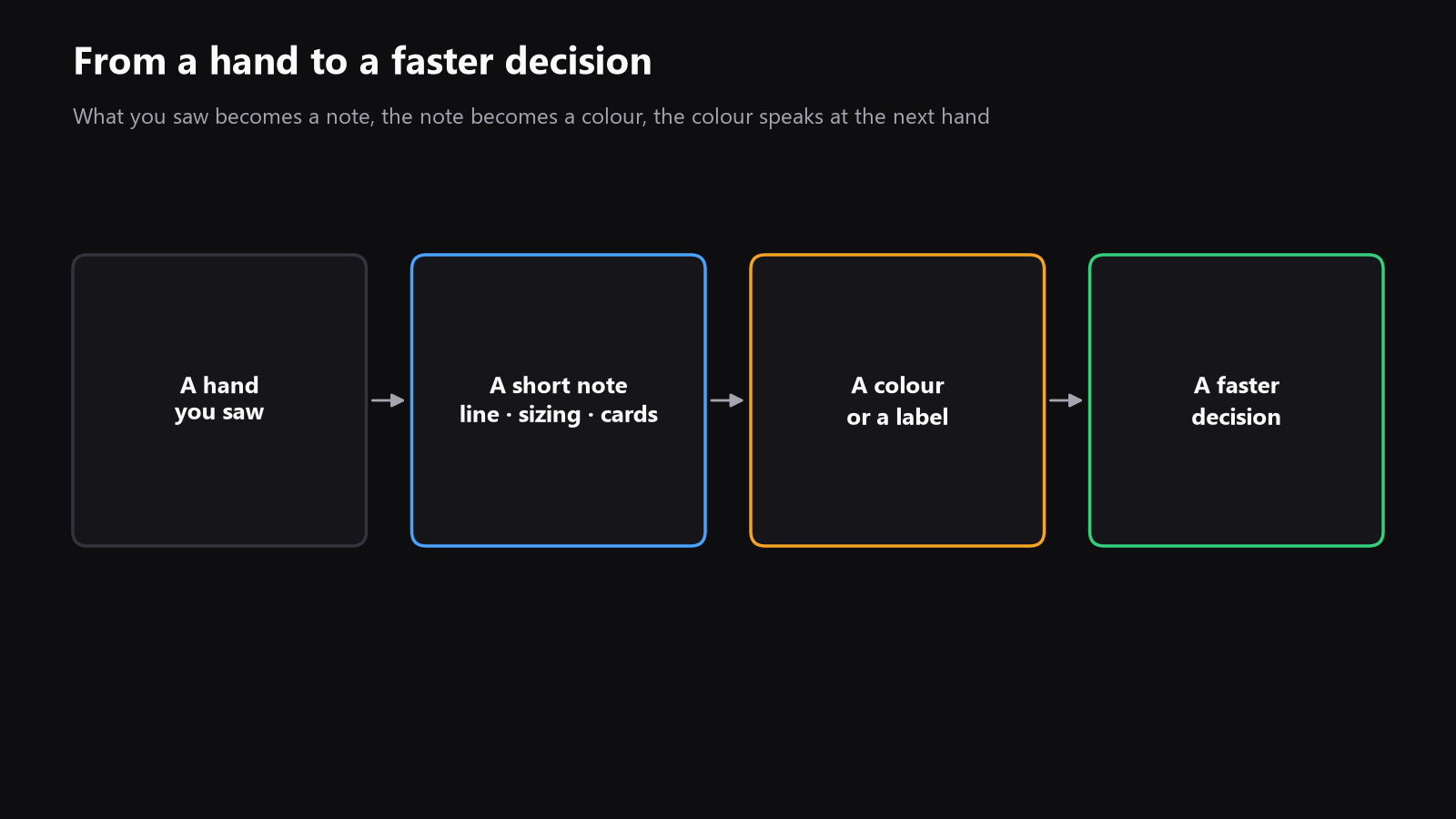
If you play online poker regularly, you already know that the same player can show up again and again. The question is not whether you will see them again. The question is whether you will remember anything useful when they do.
That is what good poker notes are for.
A good note is not a diary entry. It is not a complaint. It is not “this guy is bad.” It is a compact piece of information that still means something when you come back to it two months later, half asleep, with six tables open.
In this article, you will learn:
- what makes a poker note useful
- what is worth writing down, and what is not
- how to classify opponents with colors or labels
- how to make your notes readable months later
- how tools like the HUD module and the Player Profiles module can make this faster
Why poker notes matter
Online poker gives you partial information. You see a hand, a line, a sizing, a showdown. Then the hand ends and the table moves on.
Without notes, all that information evaporates.
With notes, you can build a memory of the player pool:
- who bluffs too much
- who underbluffs rivers
- who overcalls preflop
- who c-bets automatically
- who gives up when checked to
- who only raises when strong
- who is capable of odd sizings with a specific hand class
That matters because poker is not just about your own cards. It is also about recognizing patterns in other people.
And the best part is that you do not need a huge sample to begin. One shown hand can already be valuable, if you write it correctly.
What makes a note useful
A useful note has three qualities:
- It describes something specific
- It can still be understood later
- It changes how you will react next time
Let’s look at each one.
1. Specific
“Fish” is not specific enough.
“Calls three streets with second pair” is better.
Even better:
- “Called flop and turn with top pair weak kicker, then called river on a scary card”
- “Raised flop as a semi-bluff after calling preflop from the button”
- “Checked back top pair on the turn in position”
The more precise the note, the more likely it is to help you in a future hand.
2. Understandable later
A note should survive time.
If you write:
- “X was weird here”
- “Always has it”
- “Donk monkey”
you may understand it today. You probably will not understand it in three months.
Instead, write the action and the context:
- board texture
- street
- position
- sizing
- showdown result if relevant
Example:
- “UTG opened 2.5x, called 3-bet OOP, check-called flop and turn, called river and showed second pair on A-high board”
That note still makes sense later, even if you do not remember the exact hand.
3. Actionable
The note should help you decide.
A good note should answer a future question like:
- Can I value bet thinner here?
- Can I bluff this player here?
- Should I expect a raise only with strong hands?
- Is this a player who overfolds to 3-bets?
- Does this player stab when checked to, or check back too much?
If the note does not change your line, it is probably too vague.
What is worth noting
Not every hand deserves a note. If you write down everything, your database becomes noise.
The best note-worthy events are usually:
Showdowns
Showdowns are gold because they reveal real hands behind real lines.
Note hands where the player:
- calls down light
- slowplays strong hands
- bluffs in a spot you did not expect
- takes an unusual line and shows the actual holding
- uses a sizing that tells you something
A showdown tells you not just what they did, but what their action can mean.
Unusual sizings
A sizing can be a message.
For example:
- a very small flop raise on a wet board
- a huge river bet after passive play
- a tiny 3-bet from a player who usually 3-bets bigger
- a weird turn overbet in position
You do not need to guess too much. Just record what happened and what it showed.
Example:
- “Turn overbet after flop c-bet and turn barrel, showed value hand”
- “Small river bet with second pair, likely blocker size”
Lines that repeat
If a player does the same thing several times, that pattern matters.
Examples:
- always checks back top pair in position
- check-raises flop only with strong draws and sets
- folds the river after passive lines
- calls preflop too wide from the blinds
A repeated line is often more useful than one flashy hand.
Sizing patterns
Some players use sizing in a way that reveals a lot.
For example:
- same bet size with value and bluffs
- smaller continuation bets on dry boards
- bigger bets when protected value is wanted
- larger 3-bets out of position
When you notice a pattern, note it.
What not to note
Not every detail is worth saving.
Avoid notes that are:
- too emotional
- too general
- too long
- too hard to parse quickly
Bad examples:
- “This guy is a maniac and I hate him”
- “Bad reg, always annoying”
- “Seems fishy”
- “Played badly”
These do not help you make decisions.
Also avoid writing a full story. You are not writing a hand review for yourself six months from now. You are writing a field note for future table decisions.
A simple structure for good notes
A practical note can often be written in this order:
Position or spot + line + sizing + showdown / inference
Examples:
- “BTN vs BB, flop c-bet 33%, double barrel turn, gave up river on scare card”
- “Cold-called 3-bet IP, called two streets with top pair weak kicker”
- “Check-raised flop small on monotone board, showed nut flush draw”
- “River shove after passive line, value heavy”
You do not need full sentences if your shorthand is consistent.
The point is to make future you understand the meaning instantly.
How to classify opponents with colors or labels
Notes are excellent, but color and labels make table decisions faster.
When a player appears, you do not want to read five notes before acting. You want a quick category that tells you what kind of player you are facing.
A simple system is best.
Keep the labels broad
You do not need 15 categories.
A few broad labels are enough:
- Reg
- Fish
- Nit
- Aggro
- Unknown
You can also use custom labels if your software lets you, but the idea is the same: make the classification fast.
Use colors consistently
Colors should mean the same thing every time.
For example:
- green for a recreational player
- blue for a regular
- red for an aggressive or dangerous player
- yellow for uncertain / mixed profile
The exact colors matter less than the consistency.
If your system is messy, it stops being useful.
Let the label and the note work together
The label is the shortcut. The note is the proof.
Example:
- Label: Fish
- Note: “Calls three streets with pair, rarely folds river”
That is useful because the label tells you the type and the note tells you why.
Another example:
- Label: Reg
- Note: “3-bets light from blinds, folds river after missed c-bets”
Now you know the broad category and the exploitable pattern.
How to update your classification over time
People change, and samples grow.
A player who looked like a calling station after 40 hands might turn out to be a decent reg after 800. A reg who looked balanced might have one obvious leak you can attack.
So do not freeze your opinion too early.
Update your classification when:
- the sample gets larger
- you see a new showdown
- the player changes stakes or table type
- your old note is contradicted by later hands
A good habit is to revise old notes instead of adding contradictory ones forever.
For example:
- “Mostly passive preflop, but more aggressive in late position”
- “Looks tight overall, but overfolds river on scary cards”
- “Fish, but capable of light flop raises in position”
That is more accurate than pretending every player fits a perfect box.
How to write notes that age well
A note written for today often fails because it depends too much on memory.
To make it age well, include the things that do not disappear:
- the action
- the position
- the street
- the sizing
- the board texture
- the showdown hand, if you saw it
Examples:
Instead of:
- “He slowplayed”
Write:
- “Checked top set on flop, called turn, raised river”
Instead of:
- “Calls too much”
Write:
- “Called flop and turn with second pair on K-high board”
Instead of:
- “Weak on rivers”
Write:
- “Folded river to third barrel in a spot where range looked capped”
A future you can use those notes. A vague memory cannot.
The role of the HUD
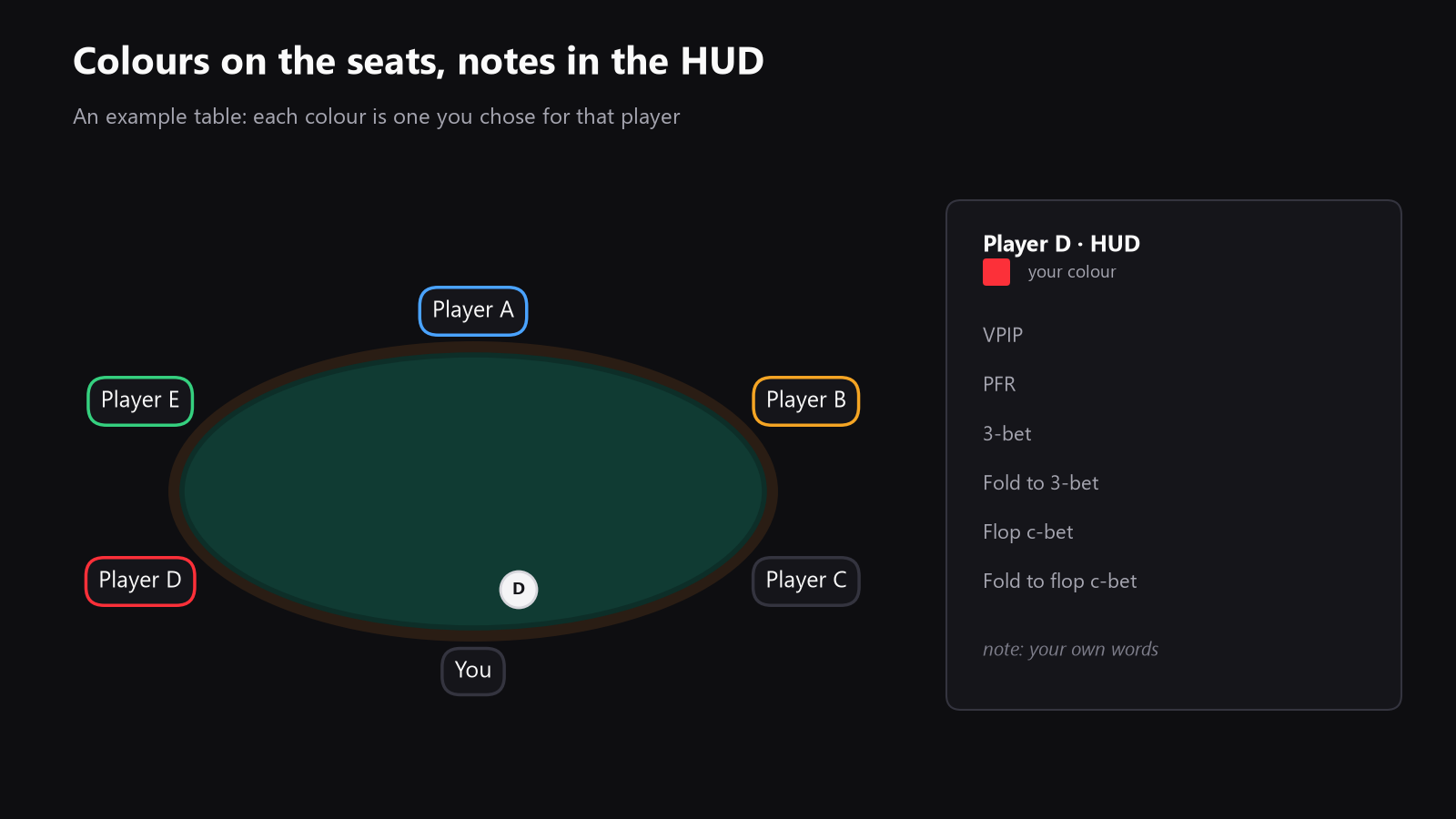
The HUD module shows observed statistics from your own hands: VPIP, PFR, 3-bet, fold to 3-bet, flop c-bet, and fold to flop c-bet.
That matters because those numbers help you classify players faster.
For example:
- high VPIP and low PFR usually points toward a looser caller
- high 3-bet can point toward a more aggressive profile
- high fold to 3-bet can point toward a player you can attack preflop
- high fold to flop c-bet can suggest a player who gives up too often after the flop
These stats do not replace notes. They support them.
A stat tells you the shape of a player’s tendencies. A note tells you the exact situation behind a tendency.
That combination is powerful.
Why colors and notes are better together than alone
A color label gives you speed. A note gives you accuracy.
Together, they reduce the time you spend reconstructing a player from scratch.
Imagine you sit with a marked opponent:
- color says “fish”
- note says “calls down light, especially in position”
- HUD stats show high VPIP and low fold to flop c-bet
You already know a lot before the next hand is dealt.
You do not need to be perfect. You need to be fast enough to avoid missing value and to avoid bluffing into the wrong player type.
A practical workflow you can use
Here is a simple system that works well:
- Mark the player with a color as soon as you have a read
- Add one short note after a meaningful hand
- Rewrite or refine the note when you see a showdown
- Keep only the information that will matter next time
- Use the label first, the note second, the stats third
If you want to stay disciplined, ask yourself after each note:
- Will I still understand this in three months?
- Does this note describe a real pattern?
- Will this change my decision next time?
If the answer is no, rewrite it.
How Poker Exploit helps keep notes usable
The Player Profiles module keeps your notes and colors attached to each opponent, so you do not have to rely on memory or scattered text files.
And because the HUD module shows key observed stats from your own hands, you can combine numbers with your written reads instead of guessing.
That does not make decisions for you. It just makes your memory sharper and your table time faster.
The best note is the one you can use immediately
A poker note is successful when it changes a decision later.
Maybe it saves you from bluffing a calling station. Maybe it helps you thin value bet. Maybe it tells you not to hero-call a river shove. Maybe it reminds you that a player only raises when strong.
That is the entire point.
You are not trying to become a historian of every hand. You are trying to build a practical memory of the player pool.
Write less, but write better. Classify simply, but consistently. And make sure every note can still help you long after the hand is over.
Do it on your own hands.