
A poker leak is not just a bad hand or a lost pot.
It is a habit. A repeatable mistake. A pattern in your decisions that costs money often enough to matter. The key word is not "mistake". The key word is "repeatable". One ugly bluff is a one-off mistake. A line you keep taking in the same spot, over and over, is a leak.
That is why the right way to talk about leaks is not "I feel like I play badly on rivers" or "I keep losing with ace king". The right way is: where, exactly, does your game cost the most, in big blinds per 100 hands, and is that gap real or just noise?
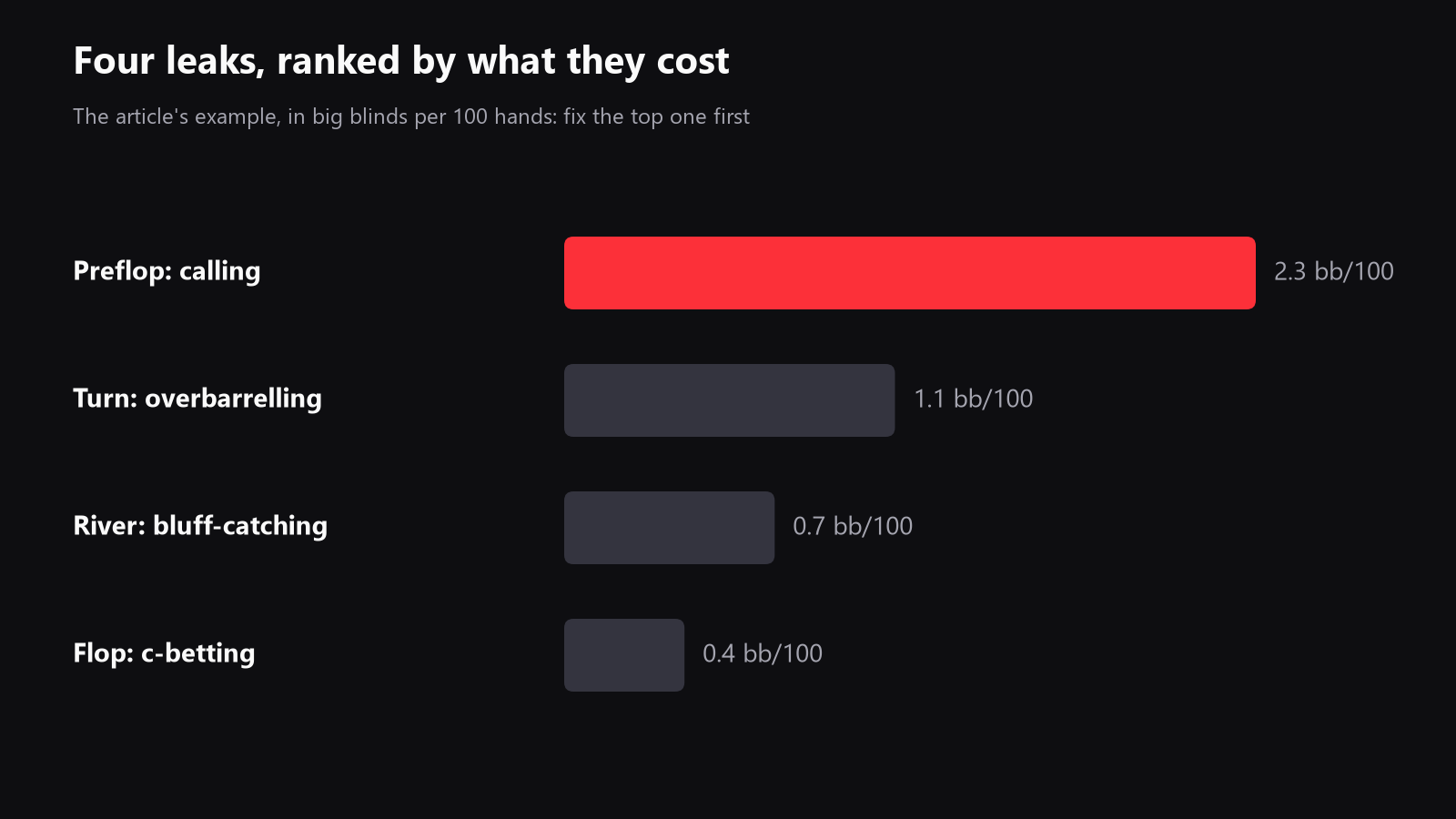
For example: a preflop calling leak might cost 2.3 bb/100, a flop c-bet leak 0.4 bb/100, a turn overbarrel leak 1.1 bb/100, and a river bluffcatch leak 0.7 bb/100.
What a leak really is
A leak has three parts:
- It happens in a real situation, not in one random hand.
- It happens often enough to affect your results.
- It loses more than the alternative would, once you measure it.
That last point matters. A leak is not "playing differently from a solver" in the abstract. A leak is a difference that costs you money against the players you actually face.
That is why the best leak finder is not your memory. It is your own hand histories, compared with the right reference.
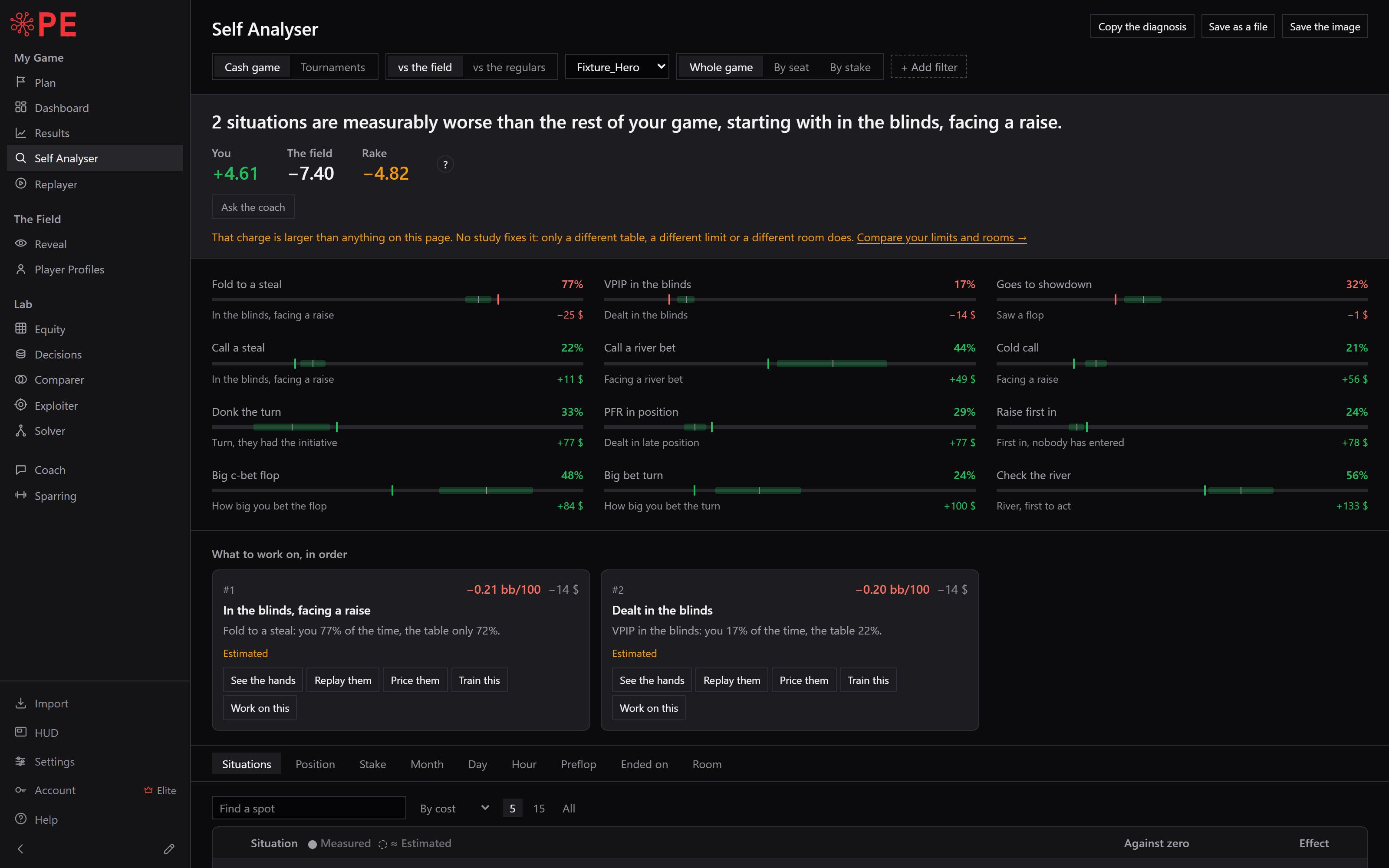
At Poker Exploit, the free Self Analyser module is built for that. It does not tell you what to do in a hand. It shows what your habits cost, by situation, in big blinds per 100 hands. It marks each situation as measured, estimated, or not measurable, and tells you whether the gap is already separated from noise or about how many hands it would take.
The most common poker leaks at micro and small stakes
The exact leaks depend on format, pool, and stake, but some patterns show up again and again.
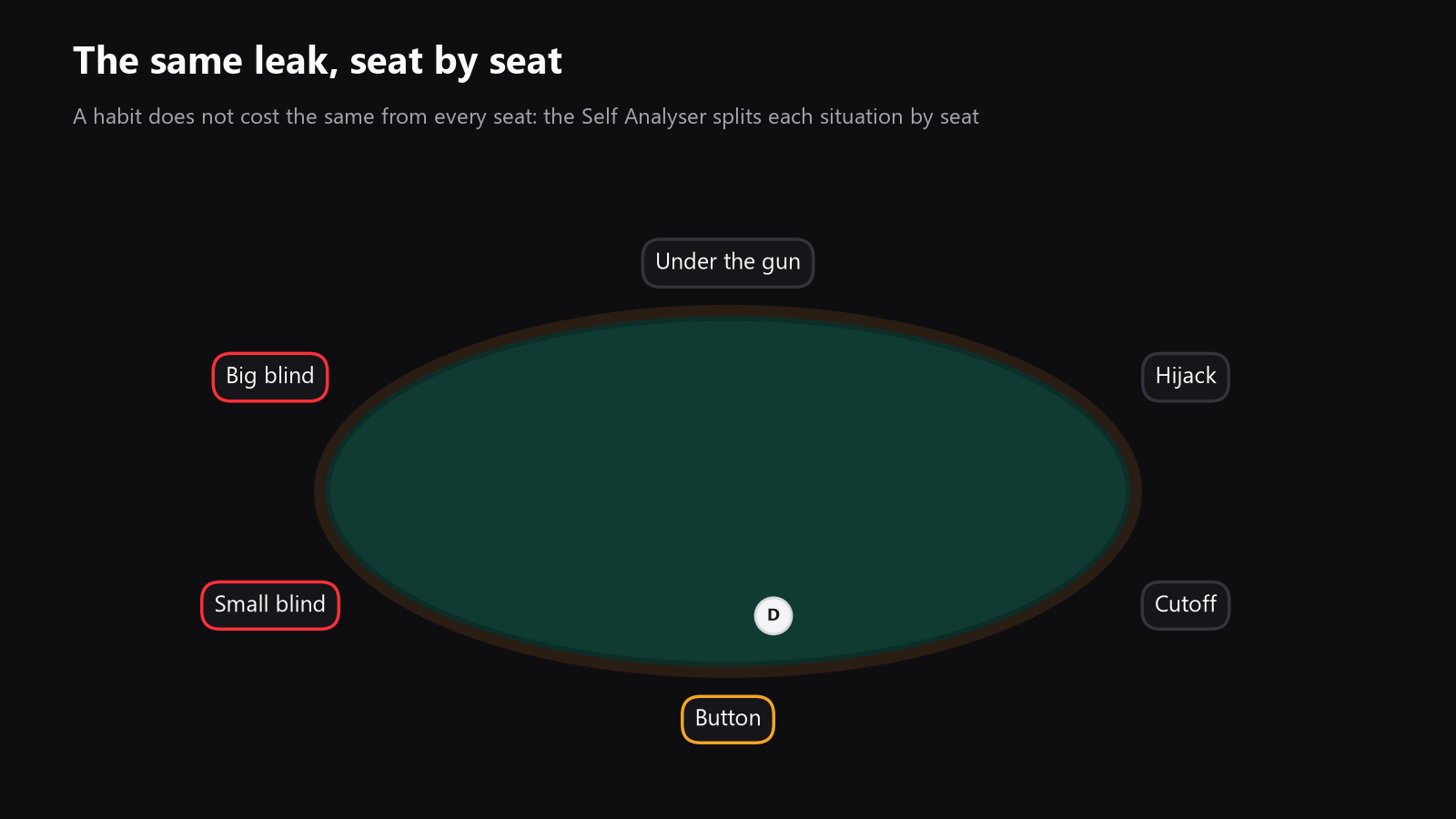
1) Playing too many hands out of position
This is one of the cleanest leaks in poker.
You enter pots too wide from early position, defend too much from the blinds, or call too many opens when you will play the rest of the hand without position. That usually means you realize less equity, face more awkward turns, and make more expensive postflop mistakes.
At micro and small stakes, this leak often hides behind the feeling that "the hands look playable". They do. But "playable" is not the same as profitable after rake, position, and postflop pressure.
2) Calling too much
Many players lose money by being too curious.
They call preflop when a fold is better. They call flop c-bets with weak bluffcatchers. They call turn barrels because "the price is good". They call rivers because they "beat bluffs".
Sometimes that is correct. Often it is not.
The leak is not calling once. The leak is building a habit of arriving at the river with too many hands that cannot improve and cannot profitably bluffcatch.
3) Not c-betting enough, or c-betting in the wrong spots
At low stakes, many players go too passive after they raise preflop. They check too much on boards where their range should attack. They give up the initiative too easily.
Others have the opposite leak. They auto c-bet without thinking about board texture, range advantage, or how often the pool folds. That burns money too, just more slowly.
The fix is not "c-bet more". The fix is "c-bet better". Some boards are good for pressure, some are not. Some pools overfold, some defend too much. Your frequencies should reflect that.
4) Missing value bets
This one is especially costly in loose, passive games.
You reach turn or river with a hand that is ahead often enough to bet, but you check because you are afraid of being raised, or because you assume worse hands will not call. In many pools, that fear is too conservative.
Small stakes players miss value in two ways:
- they do not value bet thin enough
- they size too small when the hand clearly wants more money in the pot
5) Ignoring rake
Rake is not a side note. It is part of the game.
At small stakes, rake can be the biggest cost in your results. Poker Exploit's Dashboard can say that directly: "Rake costs you 4.82 bb/100, more than any leak. Change table, limit or room."
That is not a theoretical warning. If your result is being eaten by rake, the first fix may not be technical. It may be structural.
6) Failing to adjust by pool
A leak can also be a failure to adapt.
If your pool overfolds to flop bets, you should not play as if they defend like solver bots. If they call too much, your bluffs lose value and your thin value bets become more important. If they under 3-bet, your opening strategy should change.
The point is not to "exploit everyone". The point is to stop leaving money on the table because you are using one strategy for every room, every stake, and every table type.
How to find your leaks in your own statistics
This is where most players go wrong. They look at overall win rate first.
That is useful, but not enough.
Your win rate can be dragged around by variance, table quality, rake, and runouts. A leak is more specific than that. You need to break your game into situations.
A good process looks like this:
Step 1: Start with the biggest cost
Do not begin with the spot you dislike most. Begin with the spot that costs the most.
If one situation costs 2.3 bb/100 and another costs 0.4 bb/100, the first one deserves attention first, even if the second one feels more embarrassing.
That is the logic of the free Self Analyser module. It sorts situations by cost, so you work where the money is leaking most.
Step 2: Compare your frequency to the field
A leak is often visible as a frequency that sits far outside the pool.
For example, suppose the field at your limits checks the flop through 54% of the time and bets it 17%. If your own frequencies are far from those figures, it is worth asking why.
That does not mean the field is always right. It means the field gives you a baseline, and your deviation from it should be deliberate, not accidental.
Poker Exploit's Reveal module is what gives that reference. It reads what the players at your limits actually do, from hand histories, so you are not comparing yourself with a vague idea of "what good players do". You are comparing yourself with a real pool.
Step 3: Separate measured from noisy
A gap is not automatically real just because it looks large.
If a situation has only appeared a handful of times, the estimate is fragile. A river spot you have seen 12 times can look extreme and still be mostly noise. A preflop spot you have seen 500 times is much more informative.
A rough rule of thumb:
- very rare spots need a lot of hands before they mean anything
- common preflop spots become useful much sooner
- postflop spots in thin branches often need more data than you think
If a spot appears once every 100 hands, then 1,000 hands gives you only about 10 samples. That is not enough to conclude anything unless the gap is extreme: on 10 decisions, a 50% frequency has a margin of about ±31 points. At 10,000 hands, you have about 100 samples, and the margin narrows to about ±10 points. Now you are starting to talk about a pattern.
This is why the right answer is not "I have played 8,000 hands, so I know my leaks". The right answer is "I have enough hands in this specific situation to trust the signal."
Step 4: Read the cost, not the feeling
A leak can feel small and cost a lot.
If a mistake costs only 1 bb/100, it sounds harmless. Over 20,000 hands, that is 200 big blinds. At 100 bb per buy-in, that is 2 buy-ins. Over 100,000 hands, it is 1,000 big blinds, or 10 buy-ins.
That is why the right ranking is in bb/100, then multiplied by the number of hands you actually play.
Feeling is not a measuring tool. Cost is.
Which leak should you fix first?
Not the one you hate most. Not the one that happened in your last session. The one that costs the most.
Use this order:
- Biggest measured cost
- Biggest cost with enough hands to trust it
- Biggest cost that is also easiest to change
- Biggest cost linked to pool adjustment
If the rake costs more than any leak, it comes first.
That order matters. A smaller leak that is measured can deserve priority over a larger one still inside the noise, because the larger one may not be real. And a leak that is losing money in rake-heavy pools may deserve priority over a technical leak that appears larger but is less urgent.
If your Dashboard says rake is the biggest cost, start there. If your Self Analyser says one postflop spot is costing you the most, start there. If both are true, the answer is even clearer.
How to know a leak is fixed
A leak is not fixed because you had one good week.
A leak is fixed when the statistic moves, and stays moved, after enough new hands.
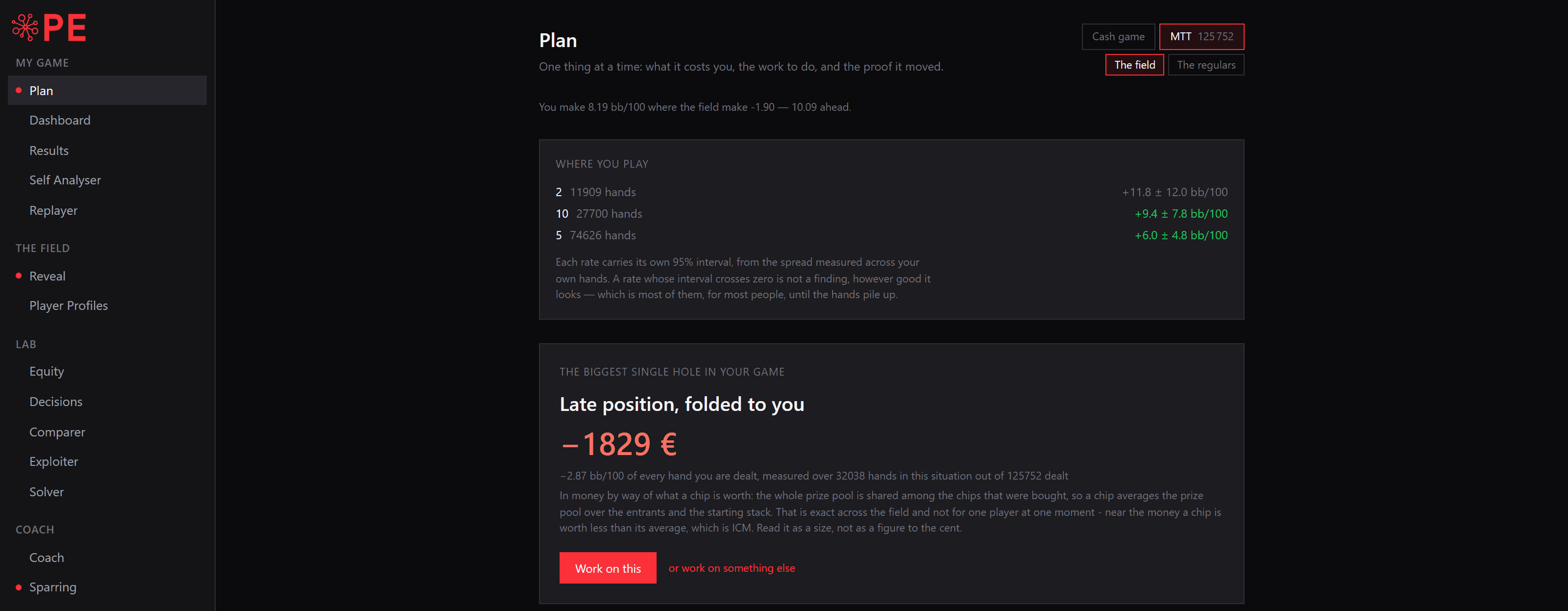
That is why the Plan module is useful. It does not just tell you what to work on. It measures the change.
The process is simple:
- measure the spot before
- train it over several sessions
- collect more decisions in the same situation
- measure it again
- compare before and after
That is a much better test than memory. If the frequency changed, the cost fell, and the new sample still holds, then you have evidence.
In Poker Exploit, the free Plan module is built around this idea. It turns a leak from a vague worry into a tracked project.
A practical way to think about leaks
If you want a simple mental model, use this:
- A leak is a habit
- A habit becomes a leak when it costs enough
- A cost becomes important when it survives variance
- A fix is real when the new sample confirms it
That is the whole game.
You do not need to find every flaw in your poker at once. You need to find the few habits that cost the most, in the situations that matter most, and repair them with evidence.
That is also why studying leaks in isolation is not enough. You want the hand list, the price of the spot, the reference for your pool, and a way to test improvement.
The short version
If you remember only five things, remember these:
- A poker leak is a repeatable mistake that costs money
- The best leaks to fix are the most expensive ones, not the most annoying ones
- Compare your stats to the players at your limits, not to a vague ideal
- Do not trust a gap until it has enough hands behind it
- A leak is fixed only when the new sample says so
If you want to work this way on your own game, start with the free Self Analyser module. It shows what your habits cost, situation by situation, and it gives you a clear next step instead of a vague feeling.
Do it on your own hands.