
Your poker database is not a pile of old hands. It is the best map you have of where your money comes from, where it disappears, and which parts of your game are still guesswork.
If you look at it the right way, it can answer simple but important questions:
- Where do I win and lose?
- Do I play better in some positions than others?
- Does one room treat me better than another?
- Do I leak more at certain stakes?
- Am I worse late at night?
- Do my results change with session length?
- Is this downswing real, or just variance?
- How much of my result is rake?
The problem is not a lack of data. The problem is that it is very easy to ask the database a bad question, or to read the answer badly.
That is why database analysis should start with one rule: do not search for conclusions first. Search for the right breakdown first.
Start with the question, not the feeling
Most players open their tracker after a bad run and ask something vague like, “Why am I losing?”
That question is too broad to be useful.
A better way is to split it into smaller questions.
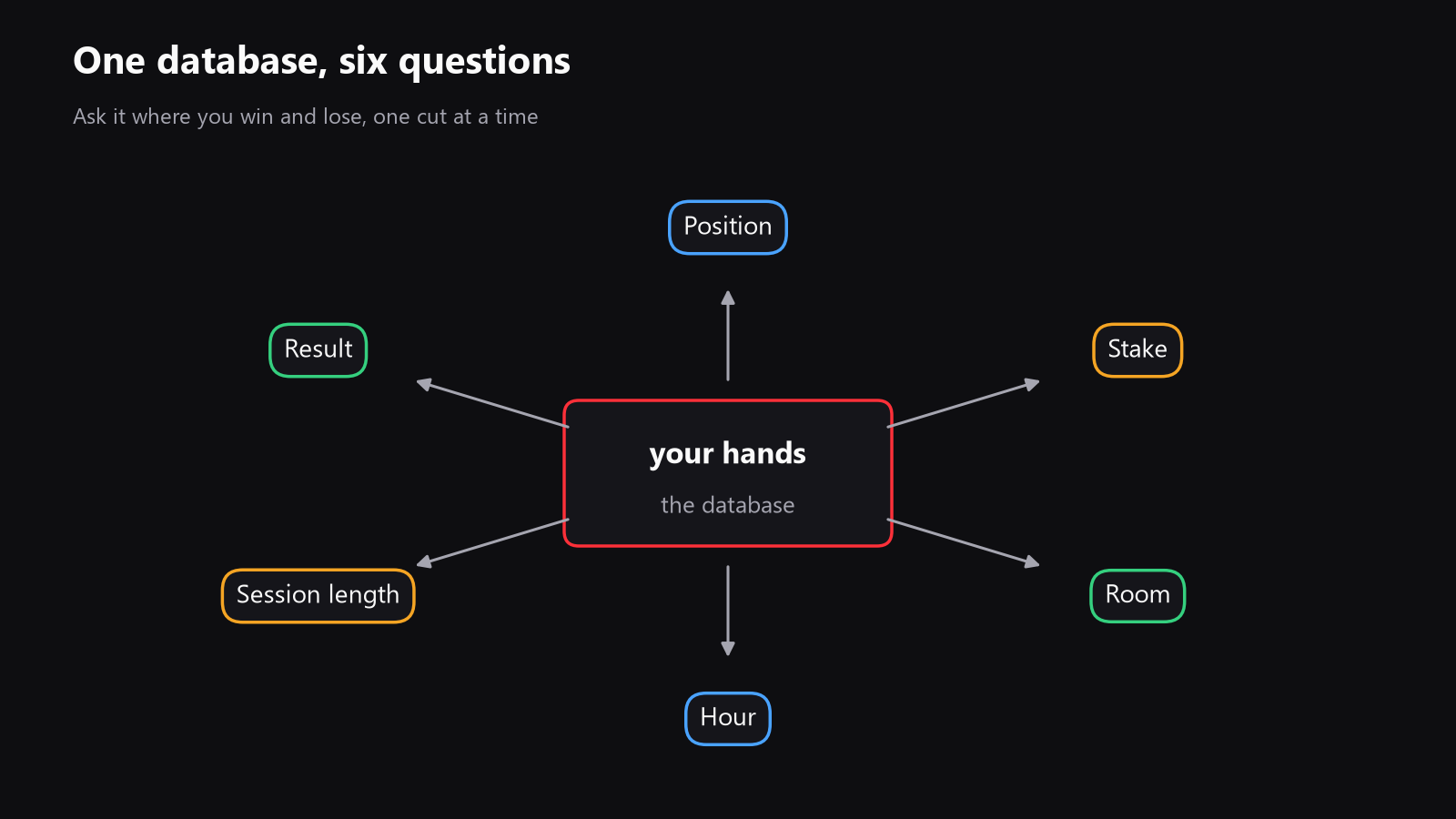
The questions worth asking
Here are the most useful ones:
- By position: Do I lose more in the blinds than the field does? Am I making enough from late position?
- By stake: Do I beat one limit and lose another?
- By room: Do I perform differently on different sites?
- By hour: Do I play worse late at night or during long sessions?
- By session length: Do my last 30 minutes or last hour go badly?
- By preflop action: Am I losing in 3-bet pots, single-raised pots, limped pots?
- By street reached: Do the losses come preflop, on the flop, on the turn, on the river, or at showdown?
- By board texture: Do certain boards hurt me more?
- By stack depth: Am I comfortable deep, but not at 20 to 40 big blinds?
- By table size: Do I do better at 6-max, 8-max, or full ring?
These questions matter because they point to different fixes.
If you lose much more than the field in the blinds, you need preflop and defense work. If you lose mostly in one room, it may be pool composition, rake, or table selection. If you lose late in long sessions, the answer may be mental and physical, not strategic.
Use filters like a scalpel, not a fishing net
A good database analysis is usually built one filter at a time.
The mistake many players make is to stack too many filters at once:
- Saturday nights
- only 25NL
- only after midnight
- only 6-max
- only 100bb deep
- only when playing on one monitor
- only after losing a pot
At some point, the sample becomes too small to say anything reliable.
The right order is usually this:
- Start broad.
- Find the biggest leak or biggest strength.
- Narrow down.
- Confirm whether the pattern stays there.
For example:
- First, look at your result by position.
- Then, if one position is clearly bad, split that spot by preflop action.
- Then, if the leak is still there, split by stack depth or board texture.
- Then, if needed, open specific hands and see what goes wrong.
That is how you move from “I think I lose in the blinds” to “I defend too tightly in the big blind against small open sizes at 40 to 60bb.”
The Results module in Poker Exploit is built around this kind of question. It reads your whole history, lets you filter by room, stake, table size, position, stack depth, preflop action, street reached, board texture, date, and more, and then breaks the result down by the things that actually matter.
Do not trust a number until you know the sample size
A number without a sample size is just decoration.
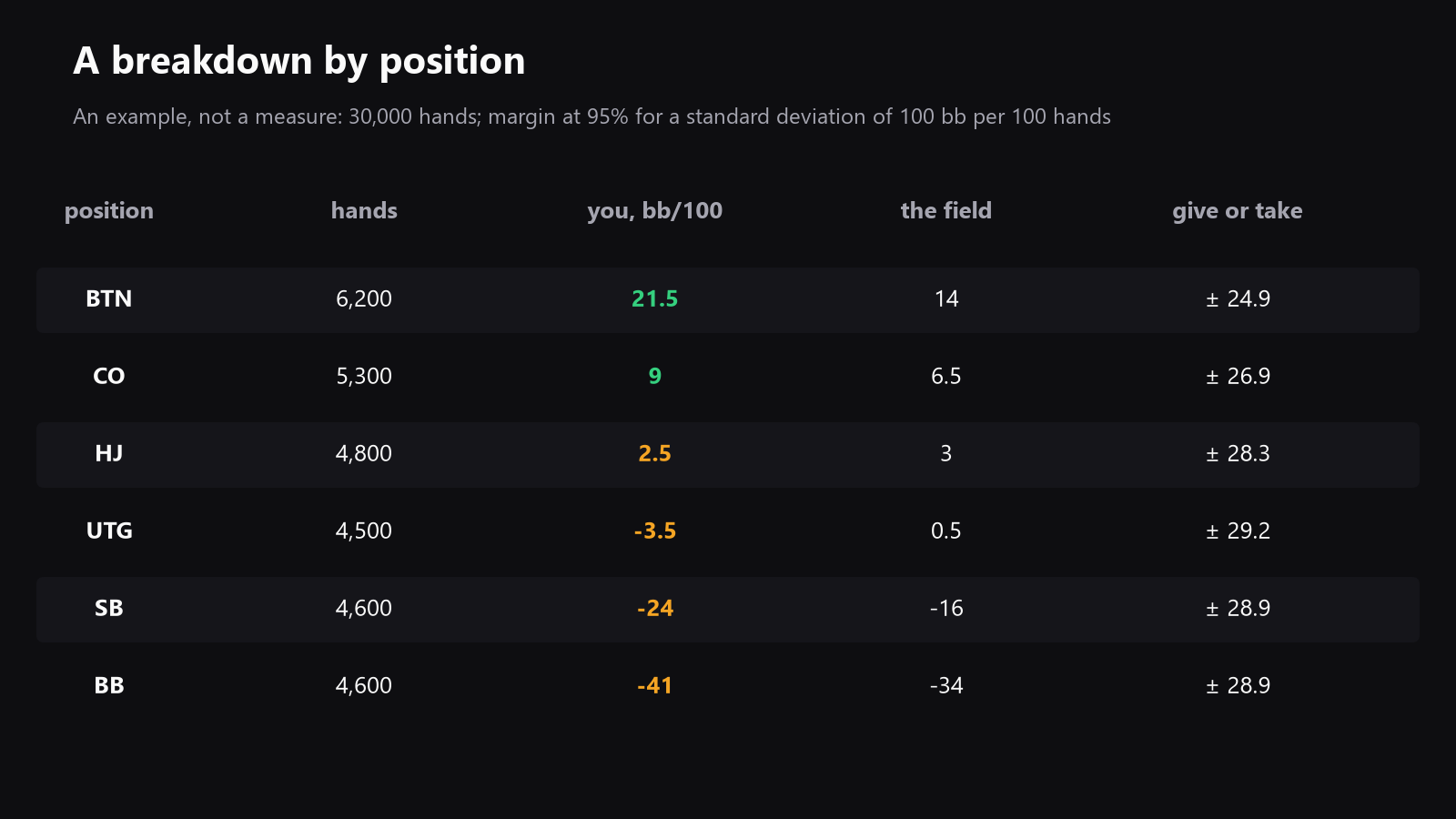
If you see that you are winning at 8 bb/100 in one spot, that sounds great. But if it comes from 200 hands, it means almost nothing.
If you see that you are losing at 4 bb/100 in another spot, that sounds bad. But if it comes from 300 hands, it is noise: the margin at that sample is several times bigger than 4 bb/100.
What matters is not just the result, but how much confidence you should have in it.
The three things you want to know
When you read a breakdown, ask:
- How many hands is this based on?
- What is the margin of error?
- Is the headline big enough to matter?
If the margin is large, the answer is still uncertain.
For example, if a result is shown as +4.6 ± 8.2 bb/100, the margin is wider than the win rate itself. That does not mean you are not a winner. It means the sample is not strong enough to settle the question yet.
This is where many players fool themselves. They treat a noisy result as if it were a fact.
A good tracker should tell you when it can and cannot conclude anything. In Poker Exploit, the Dashboard headline says whether the sample settles anything. That sounds small, but it saves a lot of bad decisions.
Read the all-in EV line the right way
Your real curve is not always the same as your all-in EV line.
That is normal.
The all-in EV line shows what your run would look like if all heads-up all-ins where both hands were shown were priced at equity instead of actual outcome. It helps you separate run good and run bad from the rest of your results.
How to use it
If your real curve is below your all-in EV line, you may be running below expectation in all-in situations.
If your real curve is above it, you may be running above expectation.
If the two lines are close, then all-in variance is probably not the main story.
But do not make the classic mistake of using the EV line as a full truth machine. It only adjusts a specific part of the game. It does not explain every swing, and it does not solve leaks.
A useful reading looks like this:
- Real curve down, EV line down about as much: all-in luck is not the story; the loss comes from the rest of your play, the rake, or ordinary variance away from all-ins, so check the margin.
- Real curve down, EV line flat or up: the drop comes mostly from all-ins where you got less than your equity; away from them you are not losing.
- Real curve up, EV line down: your profit comes from all-ins won above your equity; in expectation you are losing.
- Both lines flat: you are around break-even, and the margin tells you whether that is settled.
The point is not to worship one line or the other. The point is to read them together.
Put rake next to result
A lot of players know their win rate.
Very few know what rake does to it.
That is a mistake, especially at micro and small stakes, where rake can take a very large bite out of the result.
If your tracker shows a profit curve without the rake beside it, you are only seeing half the picture.
You should ask:
- How much rake do I pay per 100 hands?
- Is rake larger than one of my leaks?
- How much bigger would my win rate be without the rake?
- Would a different room or stake change the picture?
Sometimes the biggest leak is not a technical leak. It is the rake.
If the rake costs you more than any strategic mistake, the correct answer may be table selection, limit selection, or room selection, not a new study plan.
That is exactly why the Results module shows the rake next to the result.
Look at the street where the hand ends
One of the most useful breakdowns is to see where your hands finish:
- preflop
- flop
- turn
- river
- showdown
- no showdown
This can tell you a lot about your style.
For example:
- If you lose a lot in pots that end preflop, maybe you fold your blinds too often, open and then fold too often to 3-bets, or miss profitable steals.
- If you lose a lot in no showdown pots, maybe you are c-betting too much or giving up too often.
- If you lose a lot at showdown, maybe you are value betting too thin, bluff-catching too wide, or not getting away from second-best hands.
The split between showdown and no showdown is especially useful because it separates two very different types of pressure.
A player who loses mostly without showdown may be too passive. A player who loses mostly at showdown may be too sticky.
Those are different problems, and they need different fixes.
Study by position before you study by hero story
Players often explain their results with stories:
- “I always lose in tournaments.”
- “I always run bad on weekends.”
- “I always get coolered after midnight.”
- “I always lose in tough pools.”
Those stories may be partly true, but they are not analysis.
A better approach is to start with position, because position is one of the clearest and most stable ways to understand your game.
Ask:
- What is my win rate in early position?
- What is my win rate in the cutoff and button?
- What happens in the blinds?
- Am I better when I act last?
- Am I losing too much when I have to play out of position?
Position often reveals structural leaks that do not show up in vague discussion.
If you are losing mostly from early position, your opening ranges may be too loose or your postflop plan may be weak. If you are winning mostly on the button but bleeding everywhere else, that may mean you depend too much on position and not enough on solid all-round fundamentals.
Use hour and session length to catch fatigue leaks
Not all leaks are technical.
Some are time leaks.
That is why hour and session length are worth studying.
Ask:
- Do I play better in the first hour?
- Do I drift after long sessions?
- Do I win or lose more in the late evening?
- Does my result change after a big pot lost?
- Do I make worse decisions when I stay too long?
The Results module can show “How your sessions go”, including time of day, hours into the session, and what happens after a big pot lost. That is valuable because many players do not have a strategy problem. They have an energy management problem.
If your results fall off after two hours, the fix may be simple:
- shorter sessions
- more breaks
- fewer tables
- less late-night play
- a stop-loss rule
- a better warm-up and cool-down routine
That is not glamorous. It is also often profitable.
Read room and stake together
Two sites can feel similar and still play very differently.
One room may have softer opponents but higher rake. Another may have tougher regulars but better table selection. A lower stake may be softer, but the rake can eat more of your edge. A higher stake may reduce rake pressure, but the games may be tougher.
That is why you should compare room and stake together, not in isolation.
If one room consistently gives you better results, ask why:
- softer pool
- better seating
- lower rake
- better table availability
- more familiar game flow
If one stake looks bad, ask whether it is really a strategic leak or just a tougher environment.
What to do after the database gives you an answer
A database analysis is useful only if it changes what you do next.
Here is a simple decision tree.
If the result is big enough and the sample is solid
Then act.
Examples:
- A clear leak in the blinds
- A persistent loss in 3-bet pots
- A clear problem in long sessions
- A room where rake destroys your edge
Then the next step is targeted study.
If the result looks real but the sample is weak
Then keep watching.
Do not overreact.
You can still use the trend to decide what to watch next, but do not rebuild your game around noise.
If the result is explained by variance
Then do not “fix” it.
A bad all-in run is not a leak by itself.
The right response is emotional control, not a strategic overhaul.
If the result points to a specific spot
Then drill that spot.
For example:
- 3-bet pots in position
- defending the big blind versus small opens
- turn barrels after check-call
- river bluff-catching
- short stack push/fold decisions
That is where a coach question becomes useful.
The Coach module in Poker Exploit answers questions like “Where am I losing?” and “When do I play best?” with a query on your own hands, so you can move from a broad result to a focused study target.
A simple weekly routine for database review
If you want this to become a habit, keep it simple.
Once a week, do this:
- Open your overall results.
- Check whether the sample is large enough.
- Look at the curve and the all-in EV line.
- Check rake beside result.
- Break down by position.
- Check one extra filter that you suspect matters.
- Write down one thing to study next.
That is enough.
You do not need a giant spreadsheet system. You do not need to inspect every line every day. You need a repeatable process that tells you where your money goes.

The real goal of database analysis
The goal is not to prove you are good.
The goal is not to defend your ego.
The goal is to answer, as precisely as possible:
- Where am I winning?
- Where am I losing?
- Is this real?
- What should I work on next?
If your database can answer those questions, you stop guessing. If it cannot, you are probably reading it the wrong way.
That is why the best poker database analysis is not just a graph. It is a decision process.
And if you want that process in one place, on your own hands, with filters, breakdowns, sample size, margin, rake, and EV line already built in, that is exactly the kind of work the free Results module is meant to do.
Do it on your own hands.