
If you want your study time to pay off, hand review cannot be random.
Most players open the biggest pot they lost, feel bad for a few minutes, and close the software. That is not a review. That is a reaction. A real review has a goal: you want to understand whether a decision was good, bad, or just uncertain, and then turn that into one thing you can actually work on.
The good news is that you do not need to review every hand from every session. You need to review the right hands, in the right order, with the right questions.
Start with the right hands
Do not limit yourself to the biggest pots you lost.
A bad call in a 12 big blind pot can matter more than a lost 80 big blind pot if the smaller mistake happens often. A review is about expected value, not only emotion. So you should look for hands that are:
- unclear at the time
- close decisions
- big pots, yes, but not only big pots
- spots that happen often
- hands where you felt unsure, rushed, or “followed the line”
- hands where villain’s action surprised you
- hands where you won but suspect you played them badly
That last point matters a lot. Winning a pot does not mean you made the right decision. You can get paid after a mistake. You can also make the correct fold and lose the pot anyway. If you only study losing hands, you will miss many leaks.
A simple rule works well:
- Review obvious mistakes first.
- Then review uncertain hands.
- Then review repeat spots, especially ones that happen a lot.
- Only after that, look at the biggest pots.
What makes a hand worth reviewing
When you choose a hand, ask yourself why it deserves attention.
Here are the best reasons:
1. The decision was close
If you were not sure whether to call, bet, or check, that is a good review hand. Close spots are where your judgment gets trained.
2. The hand changed shape street by street
A flop c-bet, a turn that changes the board texture, or a river that brings a scary card are all good reasons to replay the hand street by street.
3. The hand involved a common situation
For example, single-raised pots in position, 3-bet pots, defending the big blind, facing a flop check-raise, or deciding whether to barrel the turn. One mistake in a common spot is worth more than a rare mistake in a strange line.
4. You got different information than you expected
Maybe villain’s line looked strong, but the showdown showed weakness. Or maybe you thought they were loose, but they were actually much tighter than you assumed. These hands are valuable because they update your assumptions.
5. The pot was not huge, but the decision was structurally important
A 20 big blind pot can teach you more than a 200 big blind pot if the 20 big blind spot happens every session.
Replay the hand one decision at a time
A useful review is not “I won” or “I lost.” It is a sequence of decisions.
Replay the hand from the start and stop at every important node. For each one, ask a small set of questions:
- What is my range here?
- What is villain’s range here?
- What is the price I am being offered?
- What equity do I need to continue?
- What am I trying to make worse hands do?
- What better hands continue against me?
- What worse hands fold?
- What does villain’s line say about their range?
- What changes on the next street if I continue?
This is where the hand becomes teachable.
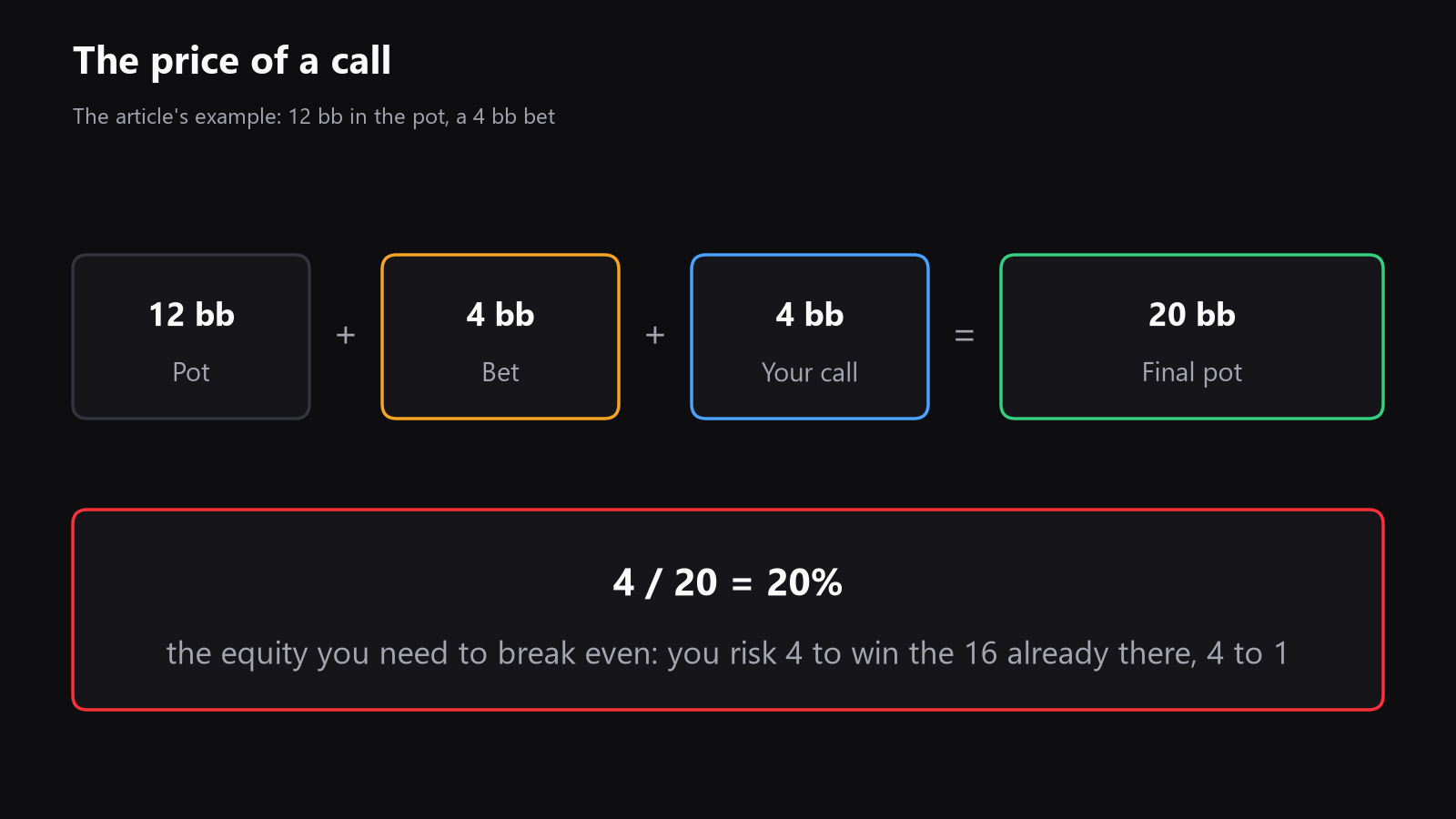
Suppose the pot is 12 bb, villain bets 4 bb, and you must call 4 bb. You call 4 to win the 16 already in the pot, odds of 4 to 1; the final pot is 20, so you need 4 / 20 = 20% equity to break even on a pure call. But that is only the start. You also need to know how your equity realizes, how often future streets force you to fold, and what your range looks like when you continue.
That is why “I had enough equity” is not enough. You also need to know whether your hand is easy to play, whether it suffers on later streets, and whether your opponent’s range is capped or uncapped.
The questions to ask on each street
You do not need a giant checklist. You need the same questions every time.
Preflop
- Is my open standard here?
- If I called, was it because of position, stack depth, or opponent type?
- Is my 3-bet for value, as a bluff, or too thin?
- What hands should I defend here, in theory and against this pool?
Flop
- Does this board favor my range or villain’s range?
- Is my c-bet for value, protection, or pressure?
- If I checked, was it because of range advantage, hand class, or pot control?
- If villain bet, what does their sizing represent?
Turn
- What changed?
- Did I gain equity, lose equity, or keep about the same share of the pot?
- Is this a good barrel card?
- Has villain’s range narrowed enough to attack or enough to slow down?
River
- What is the value part of my range now?
- What bluffs make sense?
- What worse hands can call?
- What better hands fold?
- Is this a blocker bet, a bluff catch, or a check?
If you ask these questions every time, you stop reviewing “a hand” and start reviewing the decisions inside the hand.
Separate the decision from the result
This is the biggest mistake in hand review.
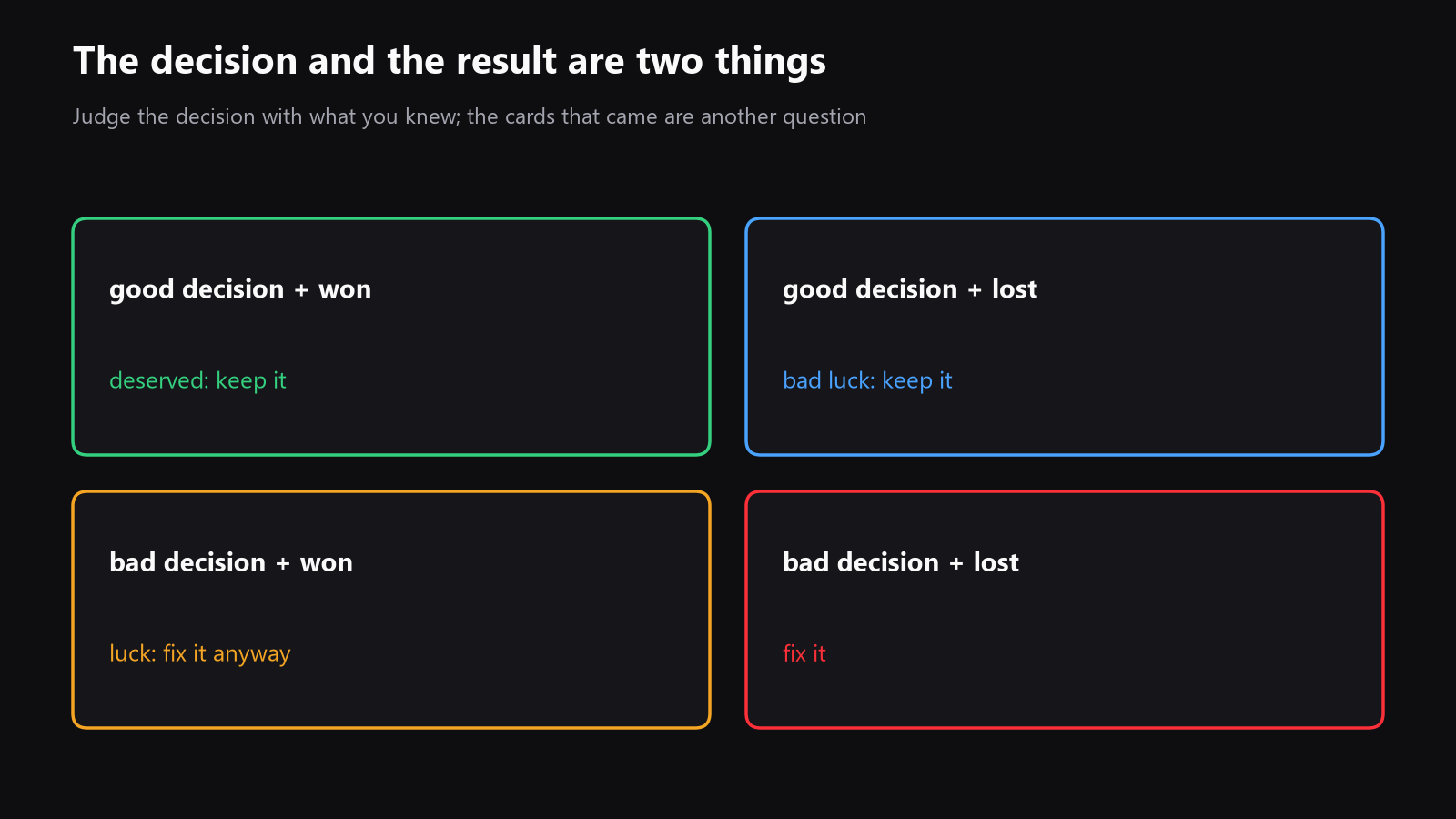
Players confuse “I lost” with “I played badly,” and “I won” with “I played well.” That is dangerous.
A correct decision can lose because the opponent had it, because the runout was bad, or because variance did its job. An incorrect decision can win because the board saved you or because the opponent made a bigger mistake.
So during review, separate two things:
- the quality of the decision
- the final result
A simple way to do it is to label each key action:
- clearly good
- probably good
- unclear
- probably bad
- clearly bad
Then do the same for the result:
- won on a good decision
- lost on a bad decision
- won because of luck
- lost because of luck
- mixed
If the hand went all in, the all-in result can be especially misleading. You can play perfectly and lose. You can also play poorly and get lucky. That is why a review should never stop at the chips pushed across the line.
In Poker Exploit, the Results module draws an all-in EV line, which is useful for exactly this reason. It shows the same run with the all-ins valued at their expectation, so you can see how much of the gap between your result and your expectation comes from all-in luck (heads-up all-ins where both hands were shown).
Do not review alone in a vacuum
A hand is easier to understand when you compare it with something.
You can compare it to:
- the field’s average line
- your own usual line
- a solver baseline
- a similar hand from another session
- a note you already have on the opponent
For example, if your field overfolds to flop bets and you also know this opponent folds too much, your c-bet becomes more attractive. If, on the other hand, the pool defends more than you assumed, your bluffs may be too optimistic.
That comparison matters because poker is not only about abstract theory. It is about the population you actually play against.
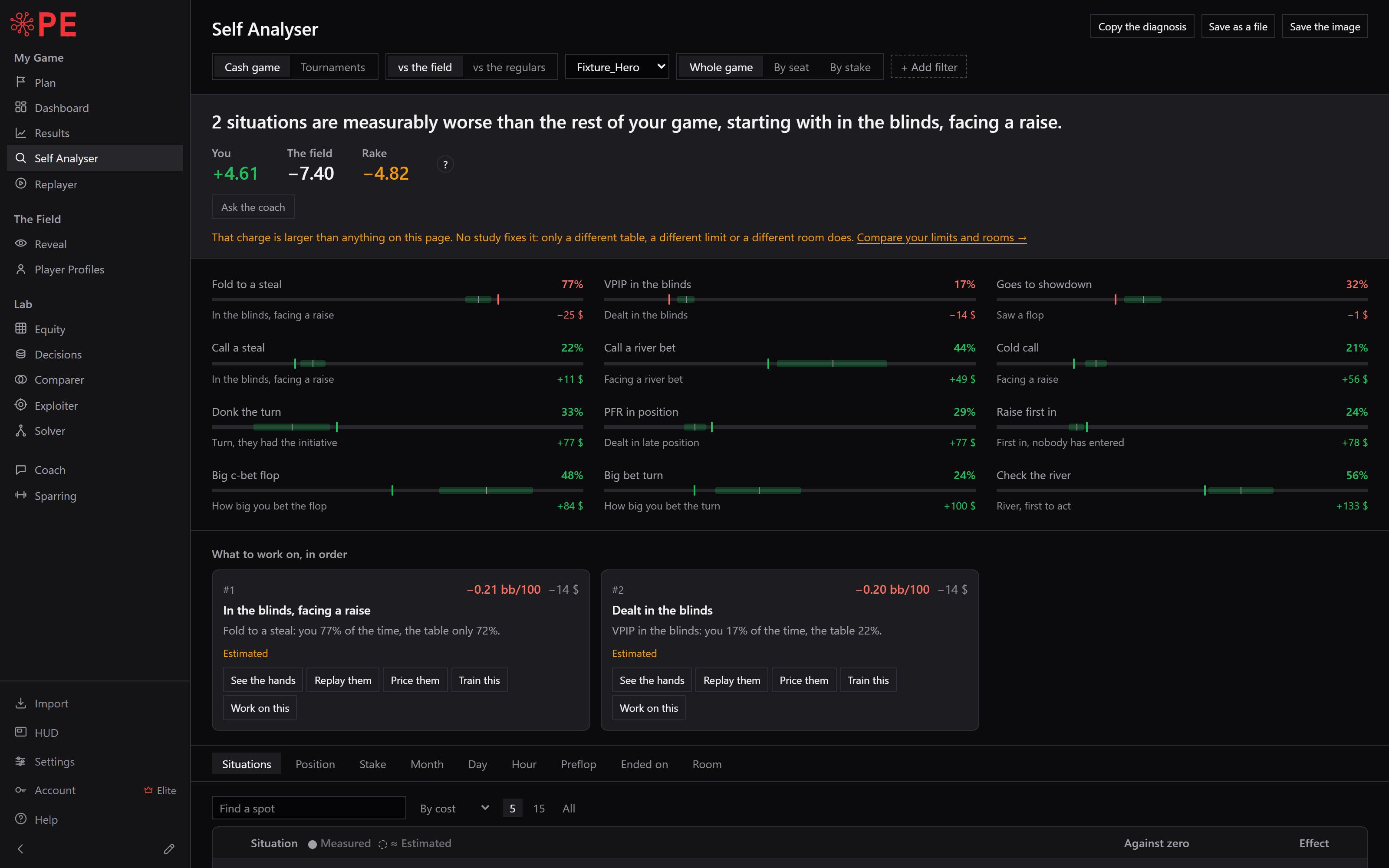
If you use Poker Exploit, the free Self Analyser module is built for this. It starts from the situation instead of the hand: it ranks the costliest spots first, compares them with the field, and lets you replay the hands from that situation, biggest first. That is a fast way to find what is really worth fixing.
Turn one review into one study project
A review becomes useful when it produces one concrete task.
Not “study c-bets.” Not “work on turn play.” Not “be less spewy.”
You want something like this:
- “I defend too wide in blind versus blind when stacks are 30 to 40 bb.”
- “I overfold river after turning second pair into a bluff catch.”
- “I miss value with top pair on wet boards.”
- “I barrel too often when my range is not strong enough.”
- “I do not know how to react to small flop bets in single-raised pots.”
That is the level of precision you want.
The reason is simple: a vague leak cannot be trained. A precise leak can.
Once you have identified the leak, save the hands that show it. Mark them, group them, and review them together. That is how a session review becomes study material instead of one isolated insight.
A practical review routine
If you want a simple routine, use this:
After the session
- Cool down for a few minutes
- Mark hands that felt uncertain
- Mark big pots, but do not stop there
- Mark hands with weird sizes, weird lines, or unexpected showdowns
During review
- Replay the hand street by street
- Stop at every decision point
- Ask what ranges look like
- Check the price and the equity you need
- Separate decision from result
- Write one sentence about what the hand teaches you
At the end
- Pick one leak only
- Collect 3 to 10 hands that show it
- Study that leak next session
- Return to the hands and see whether your thinking changed
That final step matters. Study should change future decisions, not just produce notes.
If you want to review faster, use tools that do the math for you
Manual review is important, but it is slower if you have to calculate every pot odds spot by hand.
A good workflow is one where the review screen already gives you the basic numbers: pot, price to call, equity needed, stack sizes, and SPR. Then you can spend your energy on the real question, which is not “can I count?” but “is this decision good against this range in this spot?”
That is why a hand review tool is so useful. In Poker Exploit, the free Replayer module replays any hand action by action and shows the relevant numbers directly. From a hand in your review, you can also jump one click into Decisions, the Solver, Equity or Sparring for deeper work, as long as it is not from the session in progress.

The bottom line
Good hand review is not a pile of saved hands.
It is a process:
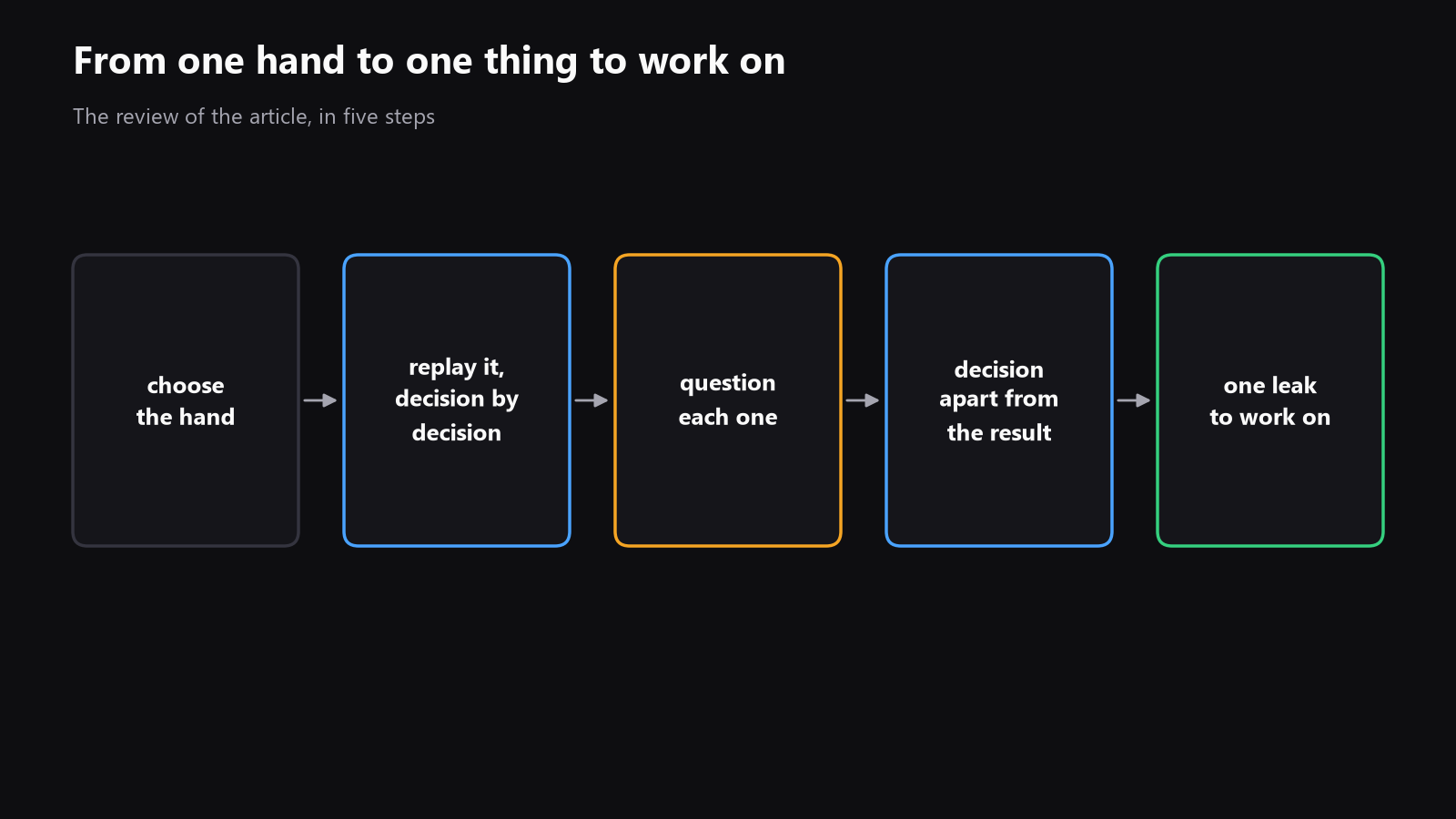
- pick the right hand
- replay it street by street
- question each decision
- separate decision from result
- compare it with ranges, prices, and equity
- turn it into one clear leak to work on
If you do that consistently, your review time stops being a post-session habit and becomes real improvement.
Do it on your own hands.