
A poker HUD is one of the simplest tools in online poker, and one of the easiest to misunderstand.
Used well, it gives you a fast picture of how opponents actually play. Used badly, it turns a handful of numbers into false certainty. The difference is not the software, it is the reading.
In this guide, you will learn what a HUD is, how to set up a free one, how to read the main stats, how many hands a stat needs before it starts meaning something, and what a HUD must never do.
What a poker HUD is
HUD means heads-up display.
In poker, it is the panel that shows live statistics beside each player at the table, taken from hand histories the room has already written on your computer. It does not guess. It does not read minds. It only counts what happened.
That is why a HUD is useful, but only if you understand two things:
- what each stat measures
- how much sample you need before the number is worth trusting
A HUD is not a coach. It is a label maker. It helps you see patterns faster, then you still have to think.
How to set up a free poker HUD
If you want a free poker HUD, the first step is not software, it is the room setting that saves hand histories. That setting must be on. If the room does not write the hands, no HUD can read them.
A practical setup looks like this:
- Turn on hand history saving in the poker room.
- Open the HUD module in your tracker.
- Let it read the folders where the room writes hands.
- Use the table management option, such as “Open all”, to show every panel at once.
- Or let it open automatically whenever a new table appears.
- If one panel cannot be matched to a window, place it by hand once.
- Keep the stats list simple at first.
A good default is the standard six-stat layout:
- VPIP
- PFR
- 3-bet
- Fold to 3-bet
- Flop c-bet
- Fold to flop c-bet
That is enough for most players to start reading a table correctly.
The HUD can also be customized from a catalogue of stats, with up to eight rows, and the list can be different for each format. If you are new, resist the urge to overload it. More stats do not mean better reads if you cannot interpret them fast enough.

A strong HUD does one more thing well: it gives you a baseline. When you do not yet have a read on someone, the panel can show the field at that stake and table size, taken from your own history. That gives you a reference point instead of a blank screen.
How to read the main HUD stats
Here is what the default stats mean.
VPIP
VPIP means voluntarily put money in pot.
It tells you how often a player enters a hand by choice, not because they were forced in by the blinds.
- Low VPIP usually means tight
- High VPIP usually means loose
- Very high VPIP usually means the player wants to see a lot of flops
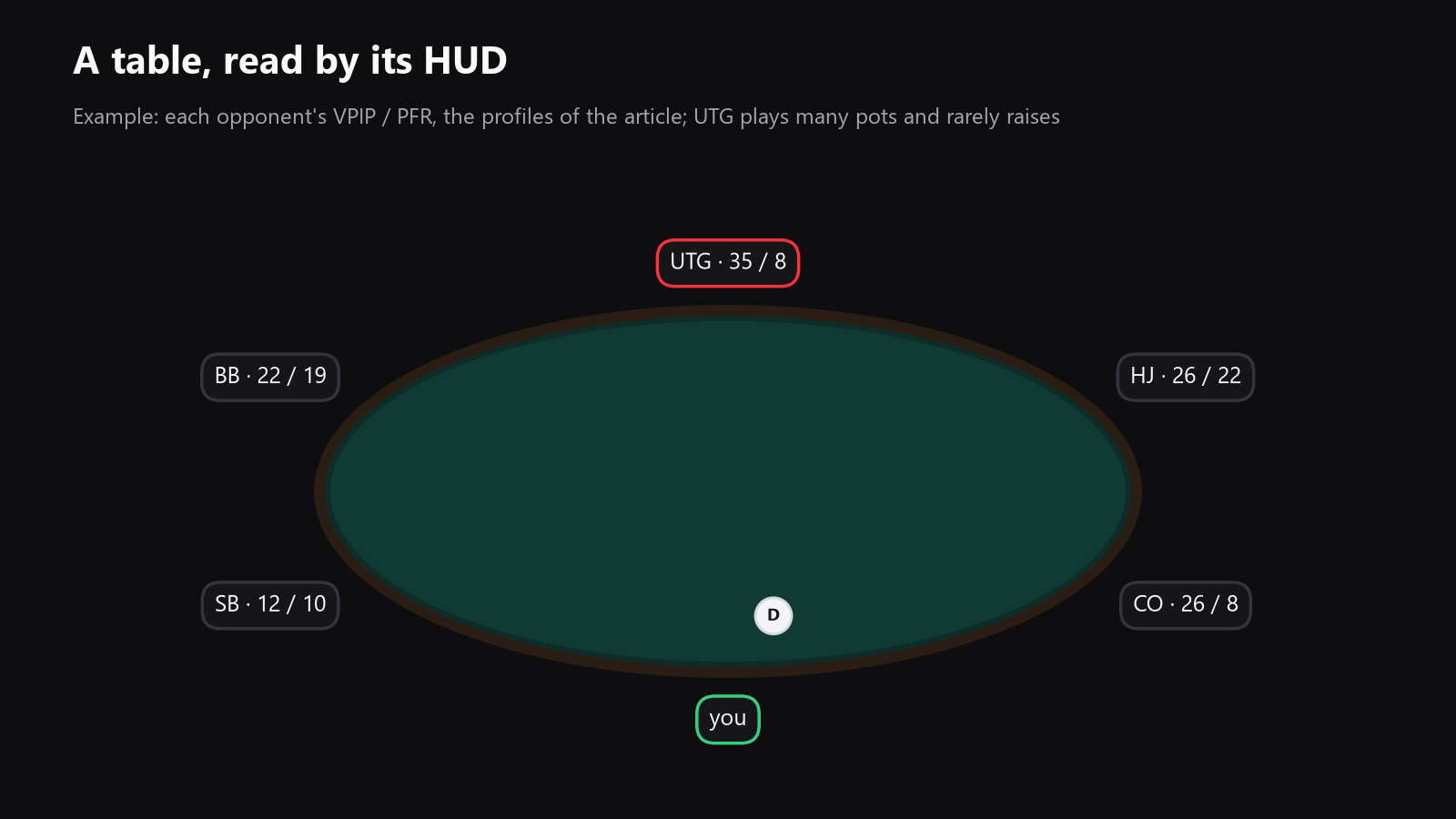
A player with 12 VPIP is entering very few pots. A player with 35 VPIP is playing many.
PFR
PFR means preflop raise.
It tells you how often a player raises before the flop.
The key comparison is VPIP versus PFR:
- If VPIP and PFR are close, the player is usually aggressive preflop
- If VPIP is much higher than PFR, the player is entering pots passively, often by calling
- If both are low, the player is tight
- If both are high, the player is loose and aggressive
A 26 VPIP with a 22 PFR is very different from a 26 VPIP with an 8 PFR.
3-bet
A 3-bet is a preflop re-raise.
This stat shows how often a player fights back before the flop instead of just calling or folding.
- High 3-bet means more preflop aggression
- Low 3-bet means a more straightforward or value-heavy range
- Very high 3-bet can mean pressure, light reraises, or both
Do not read 3-bet in isolation. A player can have a healthy 3-bet number and still be tight overall if they only 3-bet strong hands.
Fold to 3-bet
This is one of the most useful preflop stats.
It tells you how often a player gives up after opening and facing a 3-bet (a re-raise).
- High fold to 3-bet means they are opening hands they do not want to defend often
- Low fold to 3-bet means they continue more, either with calls or 4-bets
- A very high number can be a gold mine if the sample is real
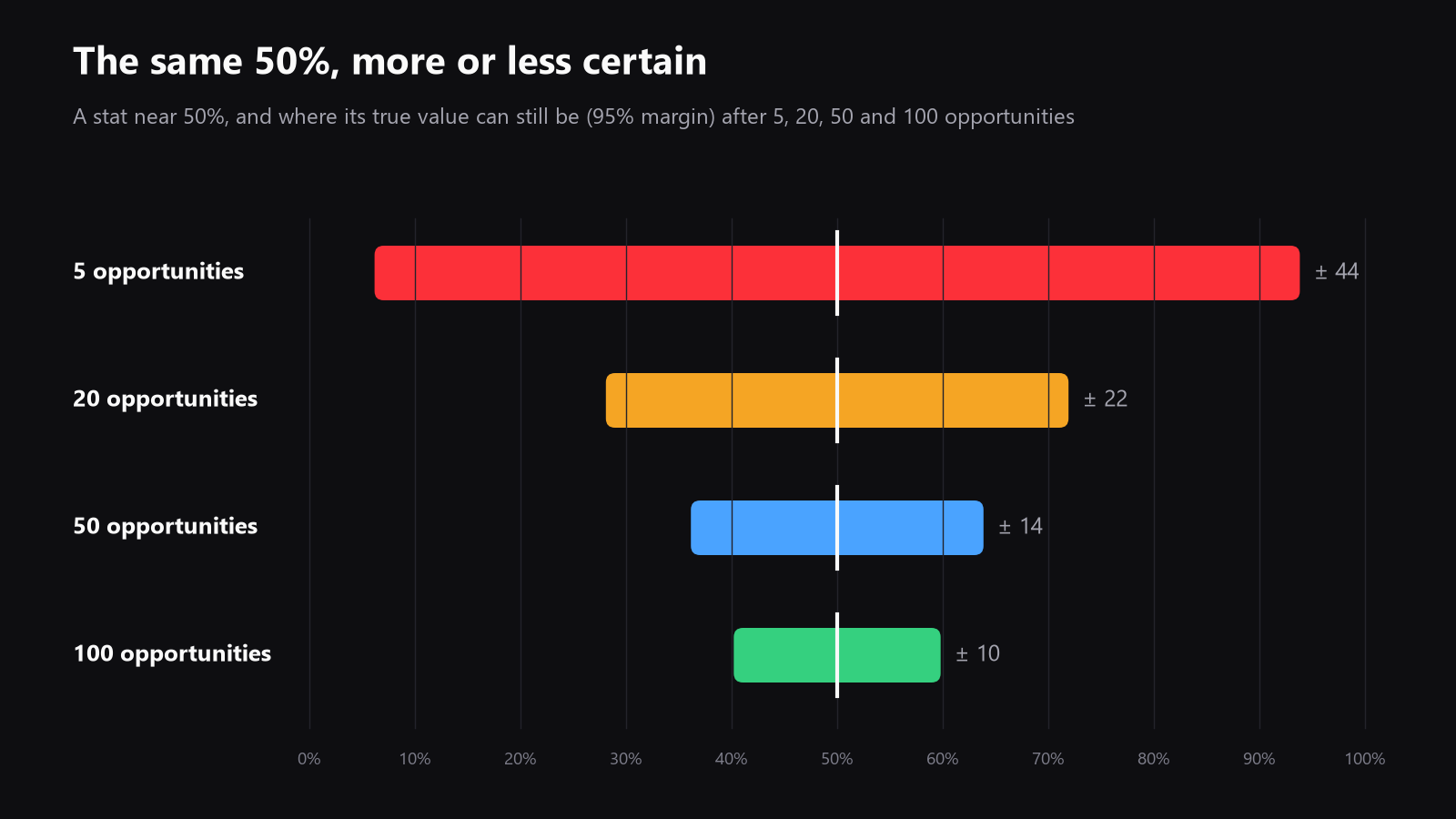
This is the kind of number that can tempt you into overreading. Be careful. Five folds out of 7 (71%) is not the same thing as 71 folds out of 100.
Flop c-bet
C-bet means continuation bet.
It measures how often the preflop aggressor bets the flop after raising before the flop.
- High c-bet means the player often keeps the story going
- Low c-bet means they check more often and may give up more
- A very high flop c-bet can mean an automatic stab on many boards
This stat matters more when you know whether the pot was heads-up or multiway, whether the player was in position, and what kind of board they saw.
Fold to flop c-bet
This tells you how often a player folds after facing a flop continuation bet.
- High fold to flop c-bet means they overfold or do not continue enough
- Low fold to flop c-bet means they defend flops more often
- It is one of the first stats that can show a player is too fit or fold on the flop
Again, the number alone is not enough. The board texture, position, and stack depth still matter.
How many hands a stat needs before it means something
This is the part most players get wrong.
A HUD stat is not about total hands only. It is about opportunities.
A player may have 300 total hands, but only 14 chances to 3-bet, or only 18 chances to face a flop c-bet. Those are very different samples.
A useful rule of thumb:
- VPIP and PFR start to give a clue after 20 to 30 hands
- They become more reliable around 50 hands and beyond
- 3-bet and fold to 3-bet need more opportunities, often 50 or more, and even then, for a stat near 50%, the 95% margin is about ±44 points at 5 opportunities, ±22 at 20, ±14 at 50 and ±10 at 100
- Flop c-bet and fold to flop c-bet usually need a bigger sample too, because those spots do not happen every hand
- River stats need even more patience
The right question is not “What is his fold to 3-bet?” The right question is “How many times has that situation actually come up?”
If you want one simple mental model, use this:
- Few opportunities, treat the stat as a clue
- Medium sample, treat it as a tendency
- Large sample, treat it as a real read
Common reads from a HUD
A HUD becomes useful when you can turn numbers into a profile.
Here are a few common ones.
The tight player
Example: 12 VPIP, 10 PFR, 3-bet low
This player enters few pots and rarely gets out of line. When they show strength, you should respect it more often than not.
The loose-passive caller
Example: 35 VPIP, 8 PFR
This player plays many hands but does not raise much. They like to see flops and call too often.
Against this type, value hands go up in value. Bluffs that rely on fold equity go down in value.
The solid regular
Example: 22 VPIP, 19 PFR, 3-bet around average
This player is not extreme. They play a reasonable number of hands and keep pressure on when they should.
Against them, you need better reasons to deviate from standard lines.
The pressure player
Example: high 3-bet, high c-bet, high fold to 3-bet
This player likes to attack, especially preflop and on the flop. Sometimes that means real aggression. Sometimes it means too much auto-pressure.
The HUD helps you separate those two only when the sample is large enough.
The fit or fold player
Example: low c-bet, high fold to flop c-bet, low continued aggression
This player often gives up when the board does not favor them. Against that type, postflop stabs can become much more profitable.
Why table size matters
A 22 VPIP player in full ring is not the same as a 22 VPIP player in six-max.
That is why a good HUD should be read with the table type in mind. The same number can mean very different things depending on how many seats are in play.
How to read the color coding
A useful HUD should not force you to stare at every stat equally.
When a figure is far from the field, the software can mark it in a different color. In Poker Exploit, the number appears amber above the field and blue below it.
That is useful because your eye can catch the difference instantly.
But color is a signal, not a verdict.
A stat can be far from the field and still be based on a tiny sample. So use the color to notice, then use the sample size to decide whether it matters.
What a HUD must never do
A poker HUD has clear limits.
It must never:
- recommend an action during a hand
- act like a live coach
- hide the sample size
- turn one number into a full strategy
- ignore the room’s rules
- pretend a stat is more certain than it is
That last point matters a lot.
A HUD describes past behavior. It does not know the cards in the player’s hand right now, and it does not know whether a particular line was a bluff, a value bet, or a one-off mistake.
That is why the best HUD is honest. It shows the numbers and stops there.
Which rooms read, and which do not
The rooms currently read are PokerStars, Winamax, partypoker, 888poker, the Winning Poker Network, and iPoker in beta.
GGPoker and its network are not read.
Each room has its own rules about HUDs, and you should always follow those rules. We never speak for a room.
A couple of practical examples matter here:
- partypoker has banned HUDs since 2019, so there is no panel there, and you should review the hands after the session
- 888poker forbids a HUD at SNAP, its fast-fold tables
If the room bans HUDs, respect that and use post-session study instead.
The simplest way to think about a HUD
A HUD is a memory aid.
It tells you who enters too many pots, who raises too little, who defends too much, who folds too often, and who keeps firing when they should not. That is already a lot.
But the real skill is not collecting numbers. It is knowing when the number is strong enough to trust.
If you want that workflow in one place, the HUD module in Poker Exploit is free, for good. It reads the hand histories your room writes on your computer, shows the standard six stats by default, follows each table window, and never shows a recommended action.
That is what a HUD should do, and nothing more.
Do it on your own hands.