
If you play micro stakes or small stakes, you do not need a heroic study plan. You need a routine you can repeat.
Most players already know the problem. They study a bit, play a bit, get distracted by one interesting video, then jump to a completely different topic the next day. A month later, nothing has really changed. You have watched a lot, but you have not built anything.
The fix is simple in principle, but hard to follow: study one thing, in a small loop, until you can tell whether it moved.
The goal of study is not to learn everything
When your time is limited, poker study has one job: make one part of your game measurably better.
That means three things:
- You choose one leak.
- You work on it with a clear plan.
- You check whether it changed after enough hands.
This is where most players go wrong. They try to improve preflop, postflop, river play, mental game, table selection, bankroll management, and solver study all at once. That feels productive, but it spreads attention too thin. You end up with a little knowledge everywhere and no real change anywhere.
A better question is: where am I losing the most, and what should I fix first?
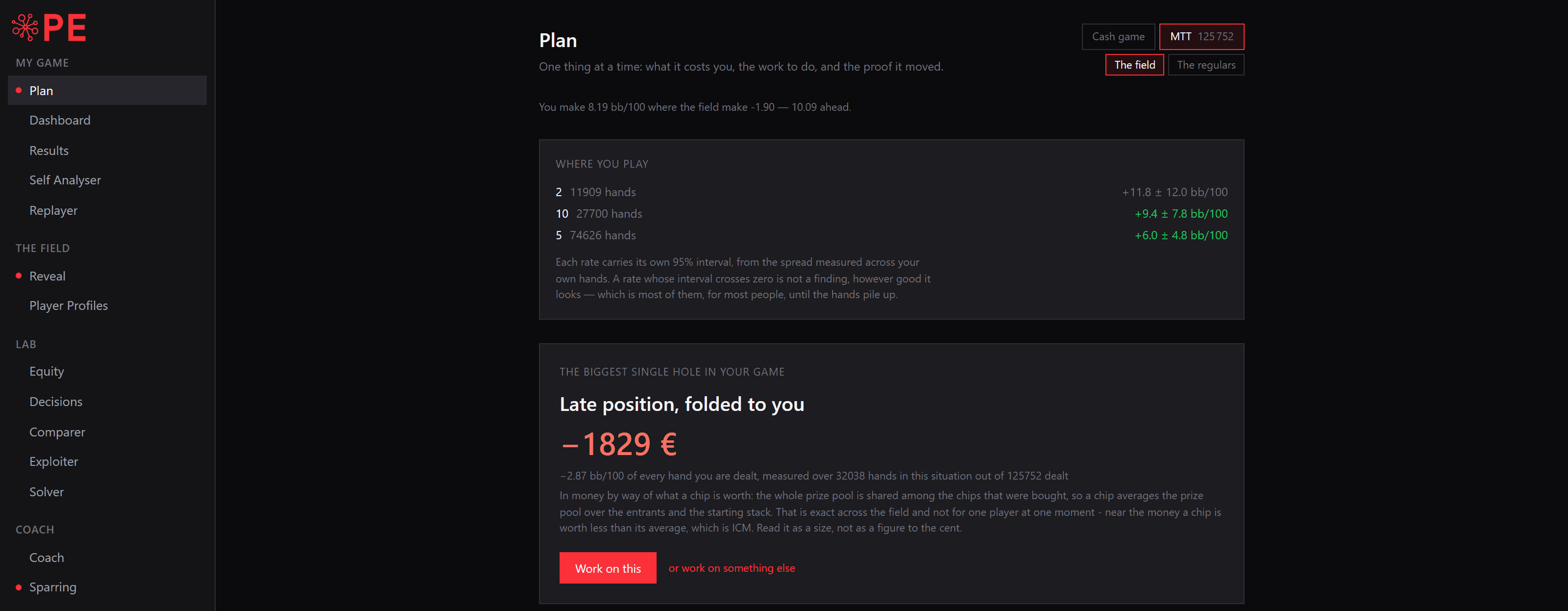
That is the kind of question the free Plan module is built to answer. It names the biggest single hole in your game, tells you what it costs, and tells you which statistic the verdict will be read on. Then you work that one spot until the next check actually means something.
How to split your hours between playing and studying
If you have little time, do not make study bigger than your volume of hands. You need both.
A good starting split for a recreational micro stakes player is:
- 70% playing
- 30% studying
If you have 6 hours a week, that is roughly:
- 4 hours playing
- 2 hours studying
If you have 10 hours, that might become:
- 7 hours playing
- 3 hours studying
If you are very lost technically, or if you have never reviewed your own hands before, a temporary 50/50 split can make sense for a few weeks. But do not stay there forever. Poker improvement needs fresh hands from your own pool. Without them, you are studying in a vacuum.
A good weekly routine is not about huge blocks. It is about repetition.
For example:
- One session to choose the leak
- One session to review a few hands from that spot
- One or two play sessions where you try the new idea
- One session to review again and write down what happened
That is enough to start building feedback instead of guessing.
Pick one thing to work on
The best leak to study first has four properties:
- It happens often
- It costs real money
- You can describe it clearly
- You can measure it again later
Bad study targets are vague. Good study targets are specific.
Bad: "I need to get better postflop." Good: "I fold too much to flop c-bets in single-raised pots."
Bad: "I should study ranges." Good: "I am overcalling river bets in one pool of spots."
Bad: "I want to improve everything preflop." Good: "My big blind defense versus small opens is too tight."
The free Self Analyser module is useful here because it compares each situation to the field and tells you when the gap is real, or how many hands it would need before it is no longer just noise. That matters. You do not want to spend a week fixing something that was never actually a leak.
Study your own hands first
Theory is useful, but your own hands tell you where the theory matters.
At micro stakes, many leaks come from repeated practical mistakes, not from missing an advanced solver idea. You are often losing because you:
- call too wide in one pool of spots
- fold too much in another
- miss value on rivers
- check back hands that should bet
- bluff in places where your pool never folds enough
That is why your database is your best teacher.
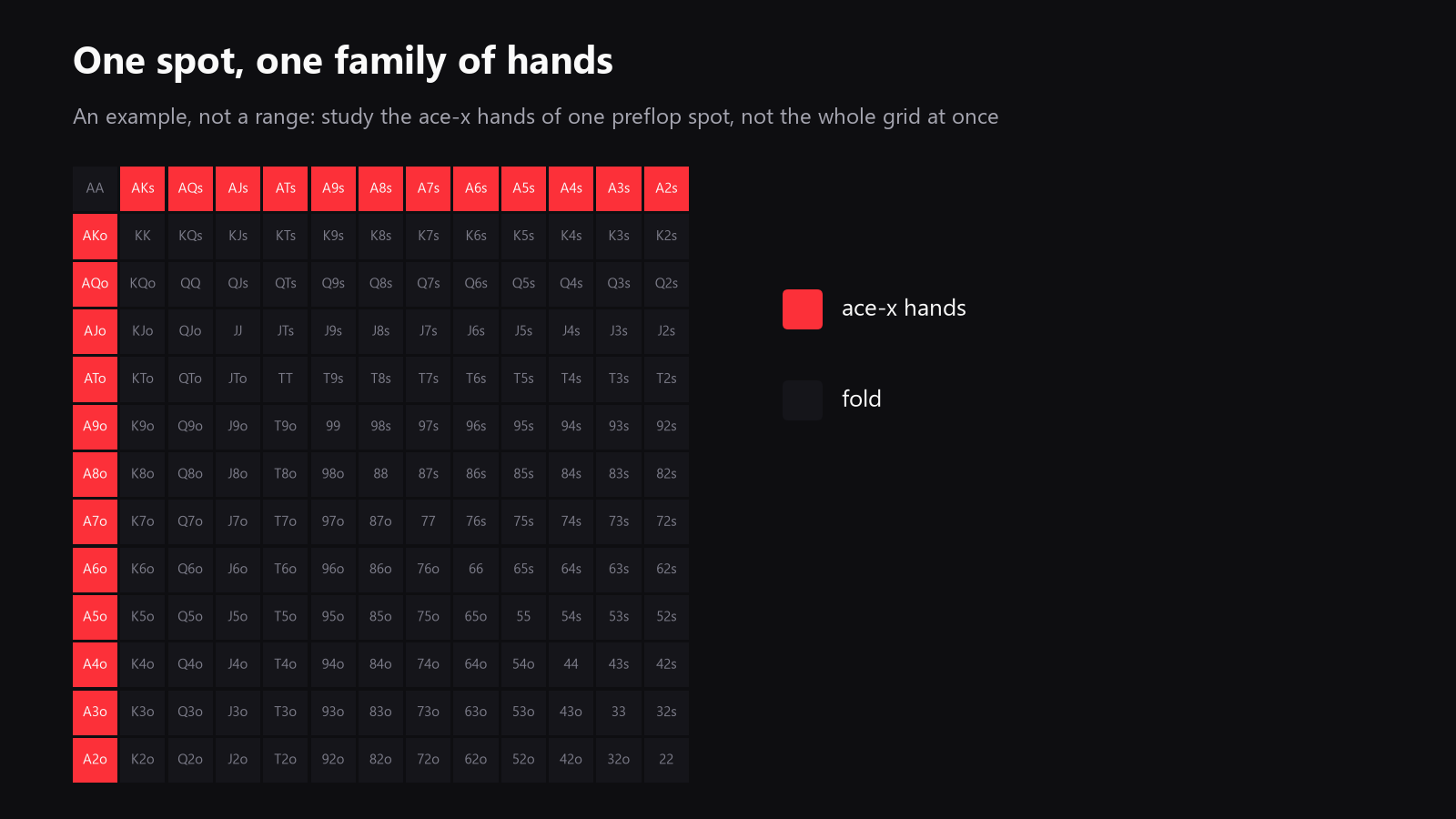
A good study block should start with your own hands, not with random content. Look for spots that repeat. Group them by family:
- preflop decisions
- postflop decisions
- facing a bet
- push or fold spots
- one leak you already suspect
Then ask two questions:
- What did I do?
- What should I have done differently next time?
If you want a structure for this, the Pro Sparring module does exactly that with real spots from your own hands. You pick an action, and it shows the equilibrium play, what each option gives up in big blinds, and what the field does in that spot. That is far more useful than memorising a chart in isolation, because it ties the idea to the hands you actually play.
A simple weekly routine you can actually keep
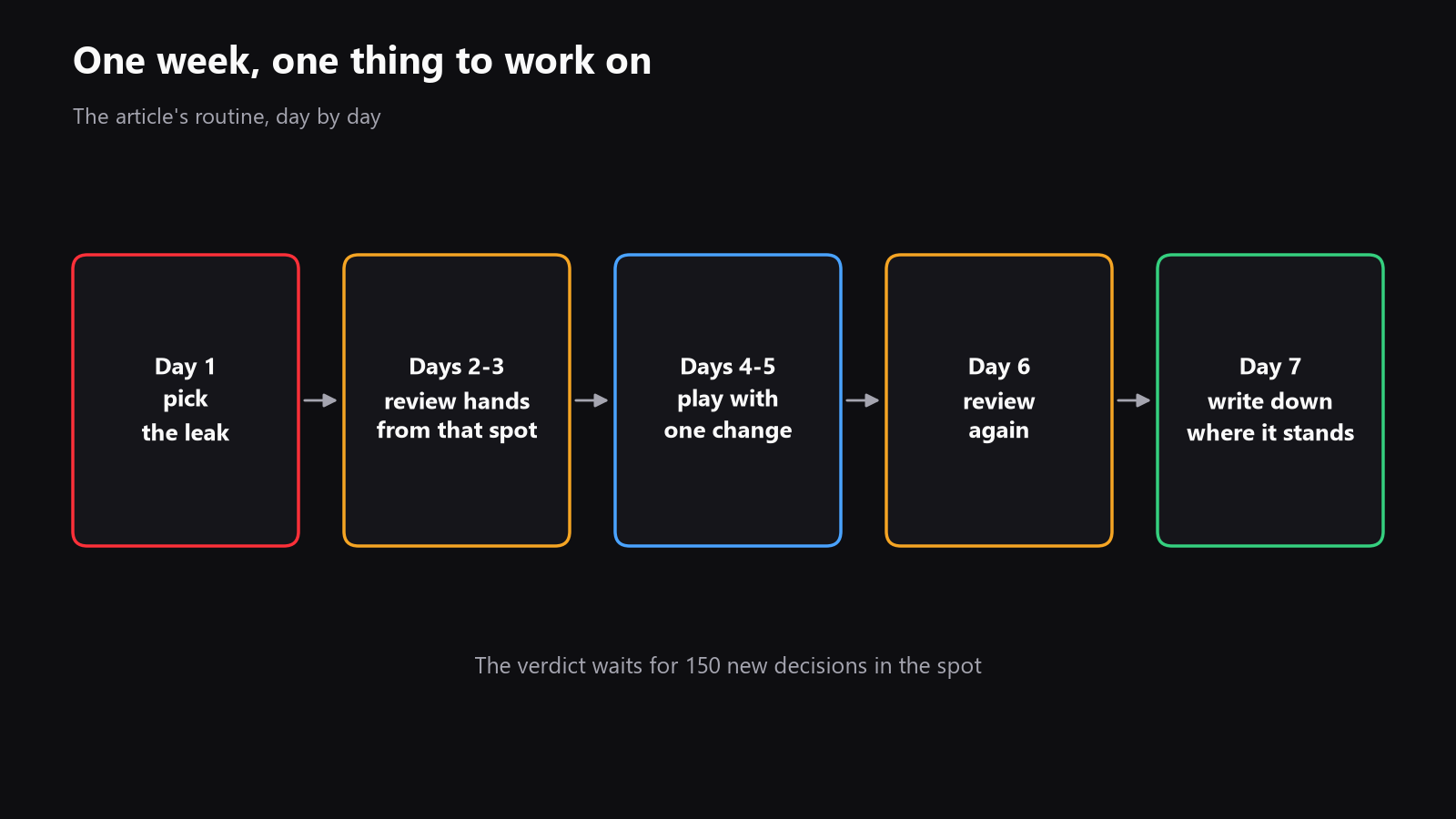
Here is a routine that works if you have limited time.
Day 1: pick the leak
Spend 15 to 20 minutes deciding what to work on.
Write down:
- the spot
- why it matters
- what you think the problem is
- what you are going to try differently
Example:
"I fold too much against flop c-bets in one-raised pots. For the next week, I will defend a little wider on the boards where my pool bluffs more than I thought."
That note matters. If you do not write the change down, you will forget what you were trying to test.
Day 2 or 3: review hands from that spot
Take 20 to 30 minutes and inspect a small sample of your own hands.
Do not try to solve every hand. You are looking for patterns.
Ask:
- Was I too tight, too loose, too passive, too aggressive?
- Did I make the same error in more than one hand?
- Was the mistake preflop, on the flop, or later?
- What did the population do in this spot?
This is where studying your own hands becomes real study, not entertainment.
Day 4 or 5: play with one adjustment in mind
Now go play, but only with one adjustment active.
Do not try to fix three things during the same session. That usually leads to confusion. You will not know which change helped and which one hurt.
Day 6: review again
Look at the same spot again after more hands.
If you have enough volume, the free Plan module makes this easier because it runs in cycles: five training sessions, then a wait until 150 new decisions in that situation are in; the verdict waits until they are, then a new measurement. That is a much better rhythm than checking every ten hands and pretending the result means something.
Day 7: write the verdict
At the end of the week, write down:
- what you changed
- what seemed to work
- what did not
- how many of the 150 new decisions are in; the verdict waits until they are
That final note is important. If you never close the loop, every week feels like the beginning of a new project.
Do not judge by results too early
This is one of the biggest mistakes in poker study.
You try a better line for three sessions, lose money, and conclude that the idea was bad. That is not analysis. That is impatience.
Short term results are noisy. A better decision can lose. A bad decision can win. If you are only checking your profit, you are not really studying your game, you are looking at variance.
Use the result, but use it correctly.
Ask:
- Did the frequency change?
- Did the spot become more stable?
- Did I make the same mistake less often?
- Did the sample get large enough to matter?
The Dashboard screen is useful here because it shows win rate with its margin, not just the raw result. That is the right mindset. You need to know whether the sample says anything yet.

What a good study session looks like
If you only have 45 to 60 minutes, use this format:
- 10 minutes: review your note from last time
- 20 minutes: inspect hands from the chosen spot
- 10 minutes: compare with field frequencies or solver logic
- 10 minutes: write the change you will test next
That is enough.
You do not need a marathon. You need a loop.
If you want a coach-like habit without making things complicated, the Pro Coach module can help because it answers fixed questions on your own hands, such as:
- Am I running badly, or playing badly?
- Which one should I fix first?
- Did I fix what you told me about?
- Am I getting better?
Those are excellent study questions because they force you to stay on the right topic.
The classic mistakes to avoid
Here are the mistakes that waste the most time.
1. Studying everything at once
This feels ambitious, but it creates no visible progress.
2. Copying theory without a use case
If you do not know where the pool differs, theory becomes decoration.
3. Judging by short term results
Good decisions can lose in the short run. Bad decisions can win.
4. Never checking again
A leak is only useful if you know whether you fixed it.
5. Changing too many things at once
If you change five habits, you will not know which one mattered.
6. Ignoring your own hands
General theory helps, but your own pool of hands is where the real money is won or lost.
A weekly template you can copy
If you want a very simple template, use this:
- Monday: choose one leak, write the plan
- Wednesday: review 20 to 30 hands from that spot
- Friday: play and try the new adjustment
- Sunday: review again and write the verdict
If you have more time, add another short study block. If you have less time, keep the same order and shorten each block. The order matters more than the length.
The point of studying poker
Poker study is not about collecting information.
It is about moving one part of your game from unclear to clear, then from clear to better, then from better to measured.
That is why a weekly routine works. It keeps you honest. It gives you a leak, a change, and a check. It also keeps you from doing the most common thing in poker study, which is to feel busy while learning nothing concrete.
Start with one spot. Write what you think is wrong. Work on it for a week. Then, once enough new decisions are in, check whether it moved.
That is how you find out whether you improved.
And if you want a tool that keeps the process disciplined, the free Self Analyser module helps you find the leak, the free Plan module turns it into a cycle, and the Pro Coach and Sparring modules help you work on your own hands instead of guessing in the dark.
Do it on your own hands.