
If you play online poker regularly, even at small stakes, a tracker is one of the first tools worth understanding.
A free poker tracker does not play the hand for you. It does something more useful over time: it reads your hand histories, stores them in a database, and helps you study your own game. Done well, it shows you where your money goes, whether a result is real or just variance, and which leaks are worth fixing first.
If you remember one thing, make it this:
A poker tracker is not only a graph. It is a map of your game.

What is a poker tracker?
A poker tracker is software that imports your hand histories and lets you review them in a structured way. Once your hands are in the database, you can study them by:
- position
- stake
- poker room
- format, such as cash games, MTTs, Sit & Go, or Spins
- month or over your career
- opponent, if the software also has player profiles and a HUD
- hands won or lost, and how much rake you paid
In plain language, a tracker answers questions like:
- Am I actually winning, or am I just running well?
- Where am I losing the most?
- Which parts of my game repeat often enough to matter?
- How much rake am I paying?
- Which opponents play very differently from the pool?
A good tracker also saves time. Instead of opening hands one by one, you can filter your database and focus only on the situations that matter.
What a tracker tells you about your own game
A tracker becomes valuable when it helps you ask better questions.
1. Your win rate is not enough by itself
Many players look at the graph and ask, “Am I winning?” That is too vague.
A proper tracker should show you:
- your win rate in big blinds per 100 hands
- the size of the sample
- whether the result is still inside normal variance
- the shape of the run, not only the final number
This matters because poker samples are noisy. A short stretch can look great or terrible without proving much. A tracker should help you tell the difference between a real trend and a temporary run.
2. Rake can be the biggest leak
At micro and small stakes, rake often takes a large chunk out of your win rate.
A tracker makes that visible. That matters because some players spend hours worrying about complex strategic spots while the biggest issue is simpler: they are playing in a game where the rake is crushing their result. If your tracker shows that rake is a major cost, the fix may be table selection, stake selection, or room selection, not a new line in a solver.
3. Position tells you a lot
One of the most useful reports in any tracker is by position.
You may already know that position matters in theory. The tracker makes it personal:
- Are you losing too much from the blinds?
- Are you too tight on the button?
- Are you opening too wide from the cutoff?
- Are you defending the big blind badly?
Position reports often reveal leaks that are hard to feel in the moment because they are spread over many sessions.
4. Street reports show where the mistakes happen
A tracker can help you break results down by street:
- preflop
- flop
- turn
- river
That is useful because leaks are rarely spread evenly. You may be fine preflop and lose money on later streets, or the reverse.
This kind of breakdown helps you answer practical questions:
- Do you call too much preflop and miss too often?
- Are you c-betting too much or too little?
- Are you missing value on the river?
- Are you overfolding in spots where the pool underbluffs?
If you play tournaments, the same logic still applies. The important spots just change with stack depth and stage of the event.
5. A HUD gives live context, if your room allows it
Some trackers include a HUD, or heads-up display, that shows live statistics on the table.
Typical stats include:
- VPIP
- PFR
- 3-bet
- fold to 3-bet
- flop c-bet
- fold to flop c-bet
The goal of a HUD is not to make decisions for you. It is to help you recognize the type of player in front of you: tight, loose, passive, aggressive, or extreme in one direction. A HUD is most useful when it is readable and simple.

What a good free poker tracker should do
Not every free poker tracker is worth your time. Some are too limited. Others are hard to set up. Some look useful at first but become frustrating when you try to study seriously.
When you compare options, check these points.
| Feature | Why it matters |
|---|---|
| Auto-import of hand histories | If import is painful, you will not use the tracker consistently |
| Clear reports and filters | You need to find leaks quickly, not dig through menus |
| Win rate plus sample size | Without sample size, a graph can mislead you |
| Rake visibility | You want to know how much the game costs you |
| Replayer | Studying hands street by street is often the fastest way to learn |
| HUD support, if allowed | Useful for live table context, but only if your room permits it |
| Player notes and colours | Helps you remember tendencies instead of starting from zero every session |
| Works for your format | Cash, MTT, Sit & Go, Spins, depending on what you play |
| Easy upgrade path | If the software is good, you may want more later |
A free tracker should make your study easier, not more complicated.
How to choose a free poker tracker
The best tracker for you depends on how you play and what you need right now.
If you play cash games
Look for:
- strong filters by position and stack depth
- rake reports
- a clear graph with sample size
- a replayer
- a HUD that stays readable when you multi-table
Cash-game players usually benefit most from reports that isolate recurring leaks, because the same decisions happen again and again.
If you play tournaments
Look for:
- support for MTTs, Sit & Go, and Spins if needed
- stack-depth filters
- reports that help you review tournament performance over time
- all-in EV, ROI, and ITM if the tracker shows them
- study tools that fit short-stack and late-stage spots
Tournament players need a tracker that respects changing stack sizes. A spot at 40 big blinds and a spot at 12 big blinds are not the same problem.
If you are a beginner
Choose the tool that is easiest to understand.
You do not need the most complex tracker on day one. You need one that helps you answer basic questions:
- Am I losing money in the blinds?
- Am I calling too much preflop?
- Am I paying too much rake?
- Is my graph down because of a bad run, or because my game is leaking?
For a beginner, clarity is more valuable than a huge list of advanced features.
If you already have old hand histories
Some trackers can import archives from older software. That is useful because your old hands are still your hands.
If you have played for months or years already, do not ignore that data. A good tracker can turn an old archive into a baseline, which is often much better than starting from zero.
How to use a tracker well, without drowning in data
A free poker tracker only helps if you use it with a plan.
Start with one question
Do not open ten reports at once.
Pick one question, for example:
- Where am I losing the most?
- Is my red line too low?
- How much rake do I pay?
- Which position is my worst?
- Do I overfold to 3-bets?
Then use the tracker to answer only that question.
Focus on enough hands, not every hand
Poker creates a lot of noise. That is normal.
If you have only a small sample, do not force conclusions. A tracker should make you more disciplined, not more emotional. When the sample is too small, the honest answer may simply be: “Not enough hands yet.”
Review your biggest losing spots first
You do not need to study your best spots first. Study the expensive ones.
A practical order is often:
- preflop mistakes
- blind defense
- c-bet and fold-to-c-bet spots
- turn and river value decisions
- specific opponent tendencies
That order is not sacred, but it is efficient. Fixing the largest leaks usually gives the best return on study time.
Use the replayer for hands that matter
Graphs tell you there is a problem. The replayer helps you understand why.
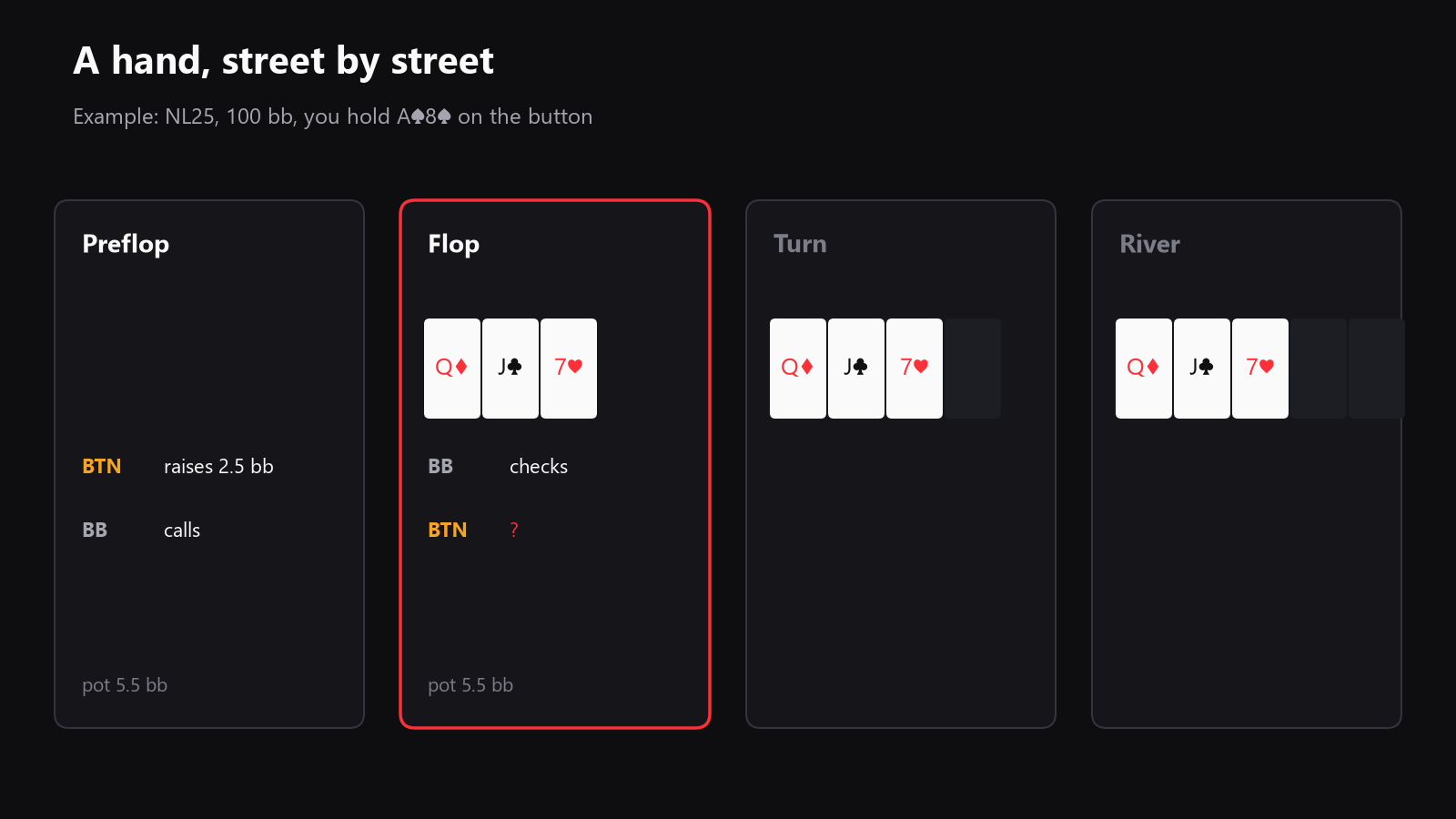
When a spot looks suspicious, open the hand and go street by street:
- what was the stack depth?
- what ranges were in play?
- what did position change?
- was the pot already large relative to stacks?
- what did the line say about the opponent?
This is where learning becomes real.
What to look for in a free tracker, beyond price
“Free” can mean different things.
Sometimes it means truly free for good, with some limitations. Sometimes it means a basic version that stays free while deeper study tools are reserved for later.
So when people search for the best free poker tracker, the real question is not only price. It is value.
Ask these questions:
- Can I import my hands without pain?
- Can I understand the reports quickly?
- Does it show me whether a result is likely variance?
- Does it show rake?
- Can it follow me as I move from one limit to the next?
- Is the interface easy enough that I will actually use it after the first week?
A tracker that is free but confusing is usually more expensive than a paid tool you use every day.
A discreet note if you want one tool for everything
If you want a poker tracker that starts with the basics and stays focused on your own hands, Poker Exploit includes a free tracker with import, dashboard, results, replayer, HUD, player profiles, plan, and self analyser.
That matters because the useful part of a tracker is not how many menus it has. It is whether it helps you see, quickly, where your money goes and what to work on next.
Common mistakes players make with poker trackers
1. They stare at one graph too long
A graph is useful, but it is not the whole story. You need filters.
2. They ignore rake
At micro and small stakes, rake can explain more than people think.
3. They study tiny samples as if they were facts
A few unlucky sessions do not define your game.
4. They collect stats but never act on them
A tracker should lead to adjustments, not just notes.
5. They choose a tool that is too hard to use
If the software feels heavy, you will avoid it. The best tracker is the one you can open every week without friction.
FAQ: free poker tracker
Is a free poker tracker enough?
Yes, for many players it is enough, especially if you mainly want to import hands, review results, see variance, and find leaks. If you later need deeper study tools, you can look at paid upgrades.
What does a poker tracker tell you that a graph alone does not?
A lot. It can break your results down by position, stake, opponent, and format. It can also show whether your result is likely the product of variance or a real pattern in your play.
Do you need a HUD?
Not always, but it helps if your room allows one. A HUD gives you live context on the table, while the real study happens in reports, filters, and hand reviews.
What is the most important stat to look at first?
For most players, start with win rate, sample size, rake, and position. Those four already tell you a lot.
Can a tracker make you a winning player by itself?
No. It cannot replace study or good decisions. What it can do is show you where to improve, so your study time is spent on the right problems.
Final thought
A free poker tracker is worth using when it does three things well:
- it imports your hands cleanly
- it shows you the truth about your results
- it helps you find the leaks that matter most
If it can do that, it is not just software. It is part of your poker education.
And if you want to see what that looks like on your own hands, start with a tracker that makes the basics clear first.
Do it on your own hands.