
If you play poker, you need one thing absolutely clear: which hand beats which.
That sounds basic, but a lot of pots are still lost because a player misreads the board, forgets that the best five cards count, or does not know when a kicker decides the winner. This guide gives you the full poker hand rankings in order, from high card to royal flush, then shows you exactly how ties work.
In standard high poker, including Texas Hold’em, the rule is simple: your best five cards matter. Not your seven cards, not your pocket pair by itself, not the two cards you were dealt. The best five-card hand wins.
The poker hand rankings, from weakest to strongest
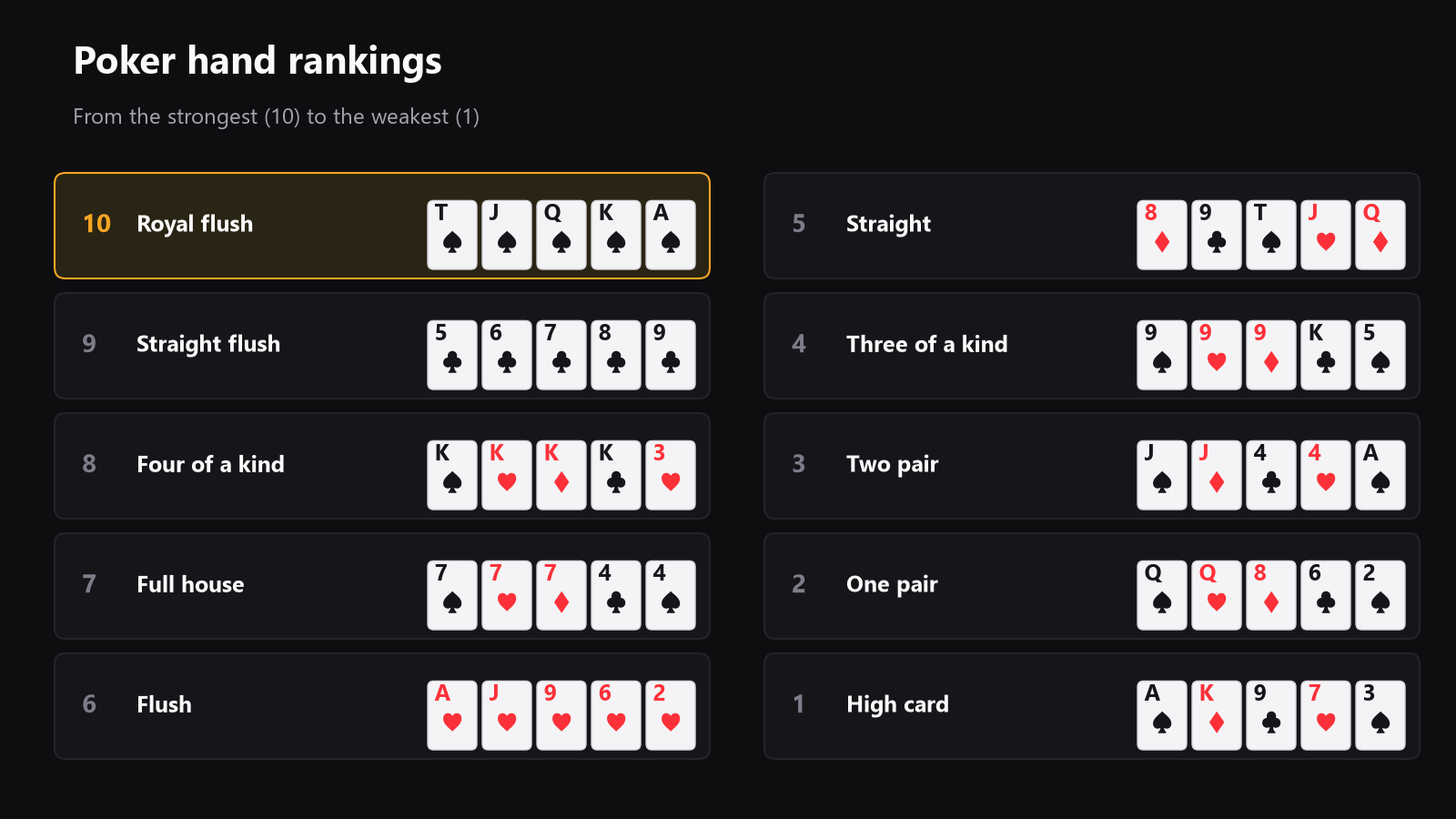
Here is the standard ranking order in high poker.
| Rank | Hand | Simple example |
|---|---|---|
| 1 | High card | A K 9 7 3 |
| 2 | One pair | Q Q 8 6 2 |
| 3 | Two pair | J J 4 4 A |
| 4 | Three of a kind | 9 9 9 K 5 |
| 5 | Straight | 8 9 T J Q |
| 6 | Flush | A J 9 6 2, all the same suit |
| 7 | Full house | 7 7 7 4 4 |
| 8 | Four of a kind | K K K K 3 |
| 9 | Straight flush | 5 6 7 8 9, all the same suit |
| 10 | Royal flush | T J Q K A, all the same suit |
A royal flush is the highest straight flush. It is the nuts in standard poker.
1. High card
If you do not make any pair or better, your hand is a high card hand.
Example: A K Q 9 4
If both players have a high card hand, the highest card decides it. If the highest card is the same, you compare the next one, then the next one, until one hand is higher or the five cards are identical.
Example:
- Player 1: A K Q 9 4
- Player 2: A K J T 8
Player 1 wins because the third card, Q, beats J.
High card hands are rare as winners in all-in pots, but they still happen when the board runs dry and nobody connects.
2. One pair
A pair is two cards of the same rank.
Example: Q Q 8 6 2
If two players both have one pair, you first compare the pair itself.
Example:
- Pair of kings beats pair of queens.
- Pair of aces beats everything below it.
If the pair is the same, kickers decide.
Example:
- Player 1: A A K 9 3
- Player 2: A A Q J 8
Player 1 wins because the best kicker, K, beats Q.
In Hold’em, this often happens when the board pairs one rank and both players use that pair. Then the hole cards decide the kickers.
3. Two pair
Two pair means exactly what it says: two different pairs.
Example: J J 4 4 A
When two players both have two pair, the highest pair is compared first.
Example:
- A A K K 7 beats Q Q J J A
If the highest pair is the same, compare the second pair.
If both pairs are the same, compare the kicker.
Example:
- Player 1: Q Q 8 8 A
- Player 2: Q Q 8 8 K
Player 1 wins with the ace kicker.
This is one of the most common showdown mistakes for beginners. They see the same two pair on the board and forget that the fifth card can still matter.
4. Three of a kind
Three of a kind, or trips, is three cards of the same rank.
Example: 9 9 9 K 5
If both players have trips, the rank of the trips decides first.
Example:
- Three kings beats three jacks.
If the trips are the same, compare kickers.
Example:
- Player 1: 7 7 7 A Q
- Player 2: 7 7 7 A J
Player 1 wins because Q beats J.
Again, the fifth and fourth cards matter when the main part of the hand is tied.
5. Straight
A straight is five cards in sequence, with mixed suits.
Example: 8 9 T J Q
The highest card in the straight decides the winner.
Example:
- 9-high straight beats 8-high straight.
- Q-high straight beats J-high straight.
Important detail: ace can be high or low.
So these are both valid straights:
- A K Q J T
- 5 4 3 2 A
But A K Q J T is the highest straight, while 5 4 3 2 A is the lowest straight, also called the wheel.
A straight does not use kickers. If the top card is the same, the straight is tied.
6. Flush
A flush is five cards of the same suit, not in sequence.
Example: A J 9 6 2, all hearts
If two players both have a flush, compare the highest card first.
Example:
- A K Q 9 4 flush beats A K Q 8 7 flush
If the highest card is the same, compare the next card, then the next one.
A flush can be surprisingly close. Two flushes of the same suit are not always tied just because they are both flushes.
If the five cards are identical in rank, the pot is split.
7. Full house
A full house is a three of a kind plus a pair.
Example: 7 7 7 4 4
To compare full houses, first compare the trips.
Example:
- Queens full of fives beats tens full of aces
If the trips are the same, compare the pair.
Example:
- Q Q Q 8 8 beats Q Q Q 7 7
A full house has no kicker. Once the trips and the pair are equal, the hand is tied.
8. Four of a kind
Four of a kind, or quads, is four cards of the same rank.
Example: K K K K 3
If two players both have quads, compare the rank of the quads first.
Example:
- A A A A beats K K K K
If the quads are the same, compare the kicker.
Example:
- Player 1: 9 9 9 9 A
- Player 2: 9 9 9 9 K
Player 1 wins because the ace kicker beats the king kicker.
That is a rare but very clean showdown.
9. Straight flush
A straight flush is five cards in sequence, all of the same suit.
Example: 5 6 7 8 9, all spades
Compare straight flushes by the highest card in the straight.
Example:
- 9-high straight flush beats 8-high straight flush
A straight flush uses the same comparison rule as a straight, just with the extra strength of the flush.
10. Royal flush
A royal flush is the highest possible straight flush:
T J Q K A, all of the same suit
It cannot be beaten by any other standard poker hand.
If two players somehow make the exact same royal flush from the board in Hold’em, they split the pot.
How ties are decided
This is where many players get confused.
There are three broad cases:
1. The hand rank is different
Then the higher-ranked hand wins.
Example:
- Flush beats straight
- Full house beats flush
- Pair beats high card
2. The hand rank is the same, but the main cards differ
Then compare the relevant ranks.
Examples:
- Higher pair wins
- Higher trips wins
- Higher full house trips wins
- Higher straight wins
3. The hand rank and the main cards are the same
Then kickers decide, if the hand type uses kickers.
That is true for:
- High card
- One pair
- Two pair
- Three of a kind
- Four of a kind
- Flush, by comparing cards from top to bottom
That is not true for:
- Straight
- Full house
- Straight flush
- Royal flush
Those hands are decided by their main rank only, or split if fully identical.
What is a kicker?
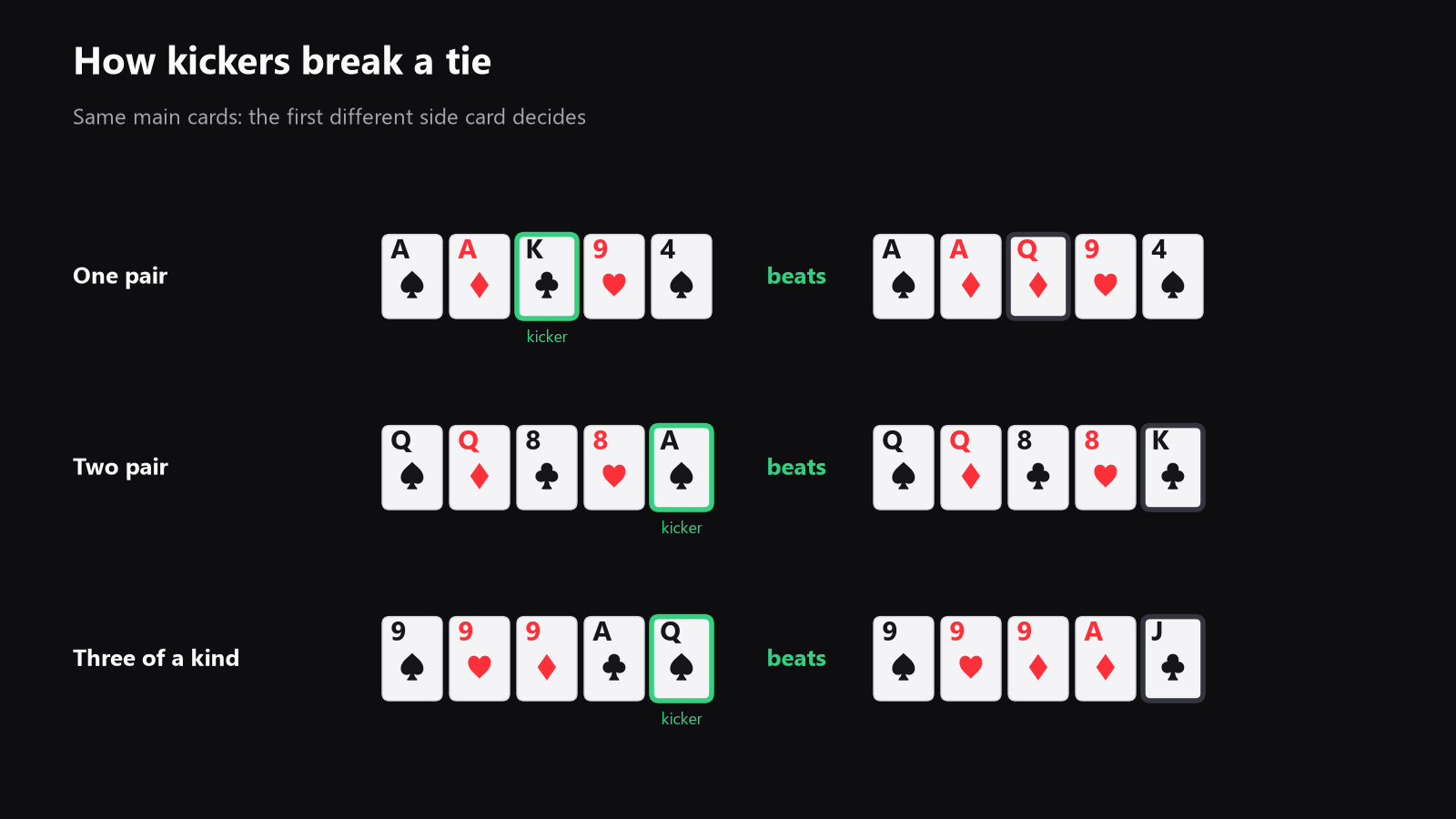
A kicker is the side card that breaks a tie when the main part of the hand is the same.
Simple examples:
- Pair of aces with a king kicker beats pair of aces with a queen kicker
- Two pair, queens and eights, with an ace kicker beats the same two pair with a king kicker
- Three nines with A Q beats three nines with A J
Kickers matter a lot in Hold’em because you often share part of the hand with the board.
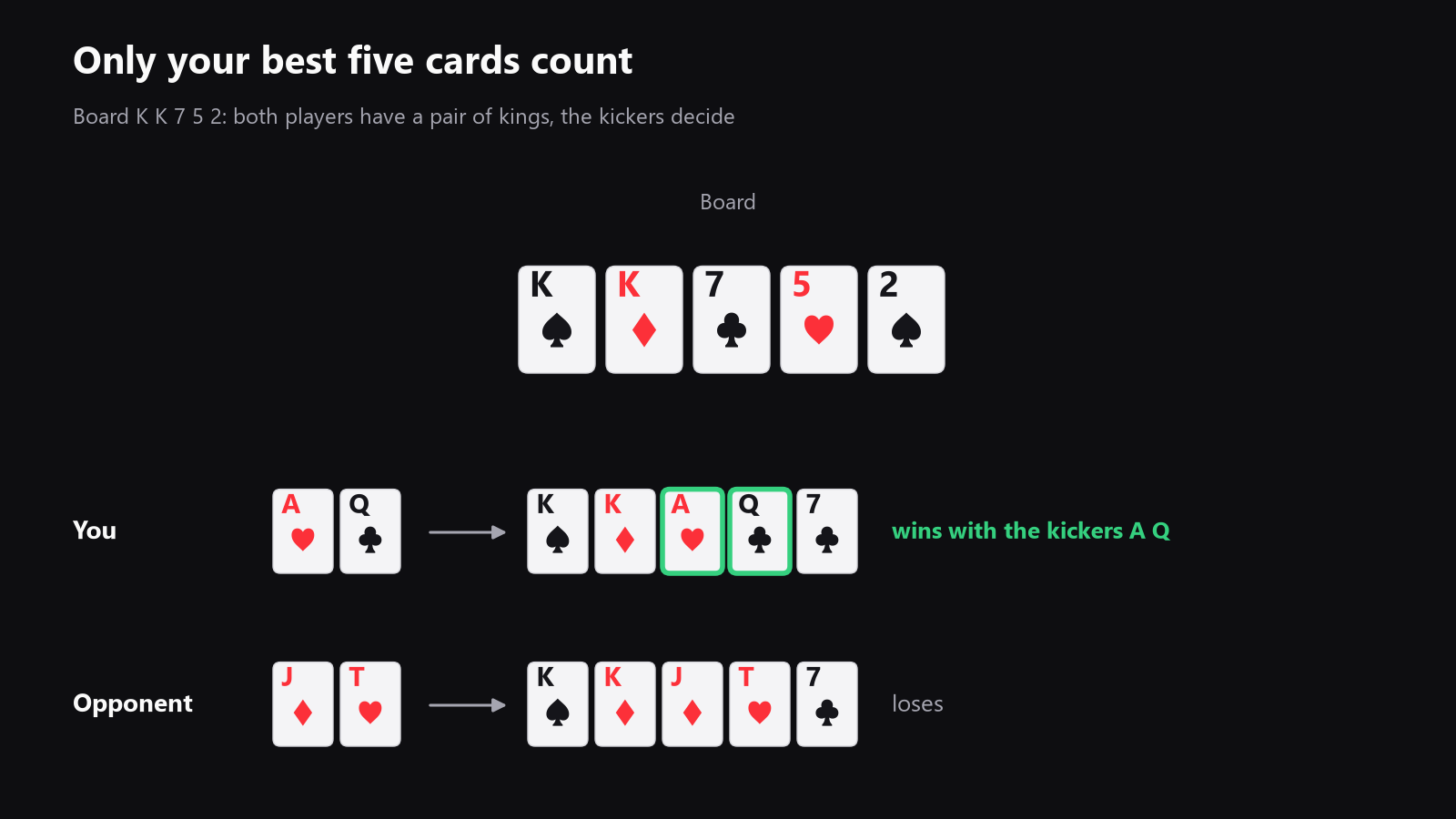
Example in Hold’em
Board: K K 7 5 2
- You: A Q
- Opponent: J T
Both players have a pair of kings, but your best five cards are K K A Q 7, while your opponent’s are K K J T 7.
You win because of the kickers.
The board can play for everyone
In community card poker, sometimes the board itself is the best hand for all players.
Example: Board: A K Q J T
Everyone has a straight. Nobody can make something better, so the pot is split.
Another common case: Board: Q Q Q 8 8
Everyone has queens full of eights unless a player can make quads or a better full house with the hole cards.
This is why you should always ask one question at showdown:
What are my best five cards, and what are your best five cards?
Not what is in my hand, and not what is on the board alone.
Suits do not rank hands in standard poker
This is a simple rule, but it saves a lot of mistakes.
In standard poker hand rankings:
- Hearts do not beat spades
- Spades do not beat clubs
- Diamonds do not beat hearts
Suits only matter when they help make a flush or straight flush.
If two hands are otherwise identical, the pot is split. Suit order does not decide the winner.
Common mistakes to avoid
Thinking a bigger card in your hand always matters
It does not if it does not help your best five.
Thinking a flush beats a full house
It does not. A full house is stronger.
Forgetting that ace can be low in a straight
A 5-high straight is A 2 3 4 5.
Forgetting that kickers can decide a tie
They often do in pairs, two pair, trips, and quads.
Thinking the best hand is the best seven cards
In Hold’em, you only use five.
A simple way to check any showdown
When you are unsure who won, go through these steps:
- Identify the best five cards for each player.
- Compare the hand rank first.
- If the hand rank is the same, compare the main card ranks.
- If still tied, compare kickers where they apply.
- If everything matches, split the pot.
If you do that slowly, almost every showdown becomes obvious.
Why this matters when you review your own hands
Knowing the rankings is not just about spotting the winner at the table. It also helps you review hands correctly.
If a pot felt unlucky, the best way to check it is to replay the spot street by street. The Replayer module lets you do that on your own hands, so you can see exactly which five cards were live and whether the result was a real mistake or just a runout.
And when you want to know whether those showdowns are changing your results in a meaningful way, the Dashboard module shows your win rate and its variance, while the Self Analyser module helps you see which kinds of spots you play well and which ones cost you most.

Quick recap
Here is the full order again, from weakest to strongest:
- High card
- One pair
- Two pair
- Three of a kind
- Straight
- Flush
- Full house
- Four of a kind
- Straight flush
- Royal flush
If you remember only three things, remember these:
- The best five cards count
- The higher hand ranking wins
- Kickers break many ties
Once you have that locked in, poker showdowns become much easier to read.
Do it on your own hands.