
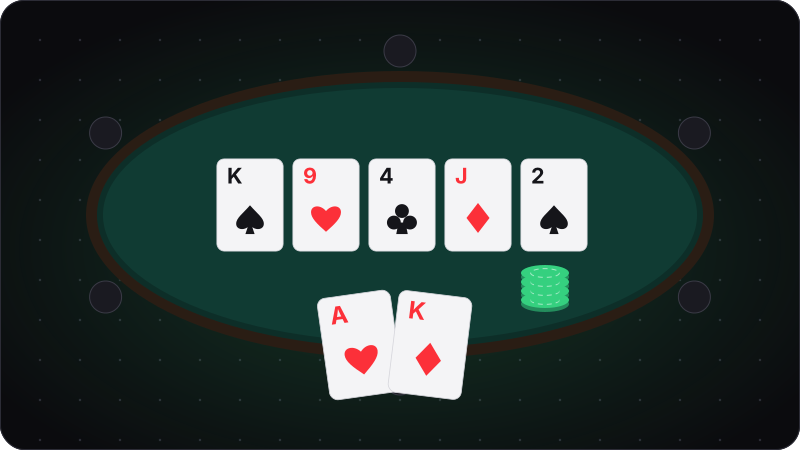
Texas hold'em is the most popular form of poker online and in many live rooms. If you want to learn how to play Texas hold'em, you only need to understand a few core ideas: the setup of the table, the card rankings, the betting rounds, and how a hand reaches showdown.
This guide covers the common no-limit version of hold'em, which is what most players mean when they search for Texas hold'em rules. The rules are simple to state, but the game has a lot of detail. You will learn both.
The goal of Texas hold'em
Your goal is to win chips or money by taking the pot.
You can do that in two ways:
- Everyone else folds before showdown.
- You reach showdown with the best five-card poker hand.
In hold'em, each player gets two private cards, called hole cards. Five community cards are dealt face up in the middle of the table. You make your final hand from the best five cards you can form using any combination of your two hole cards and the five community cards.
That detail matters a lot:
- You may use both hole cards.
- You may use one hole card.
- You may use none, if the board itself is the best hand for everyone.
The setup: deck, seats, blinds, and button
Texas hold'em uses a standard 52-card deck. There are no jokers.
Suits are equal. Spades, hearts, diamonds, and clubs have no built-in order over one another.
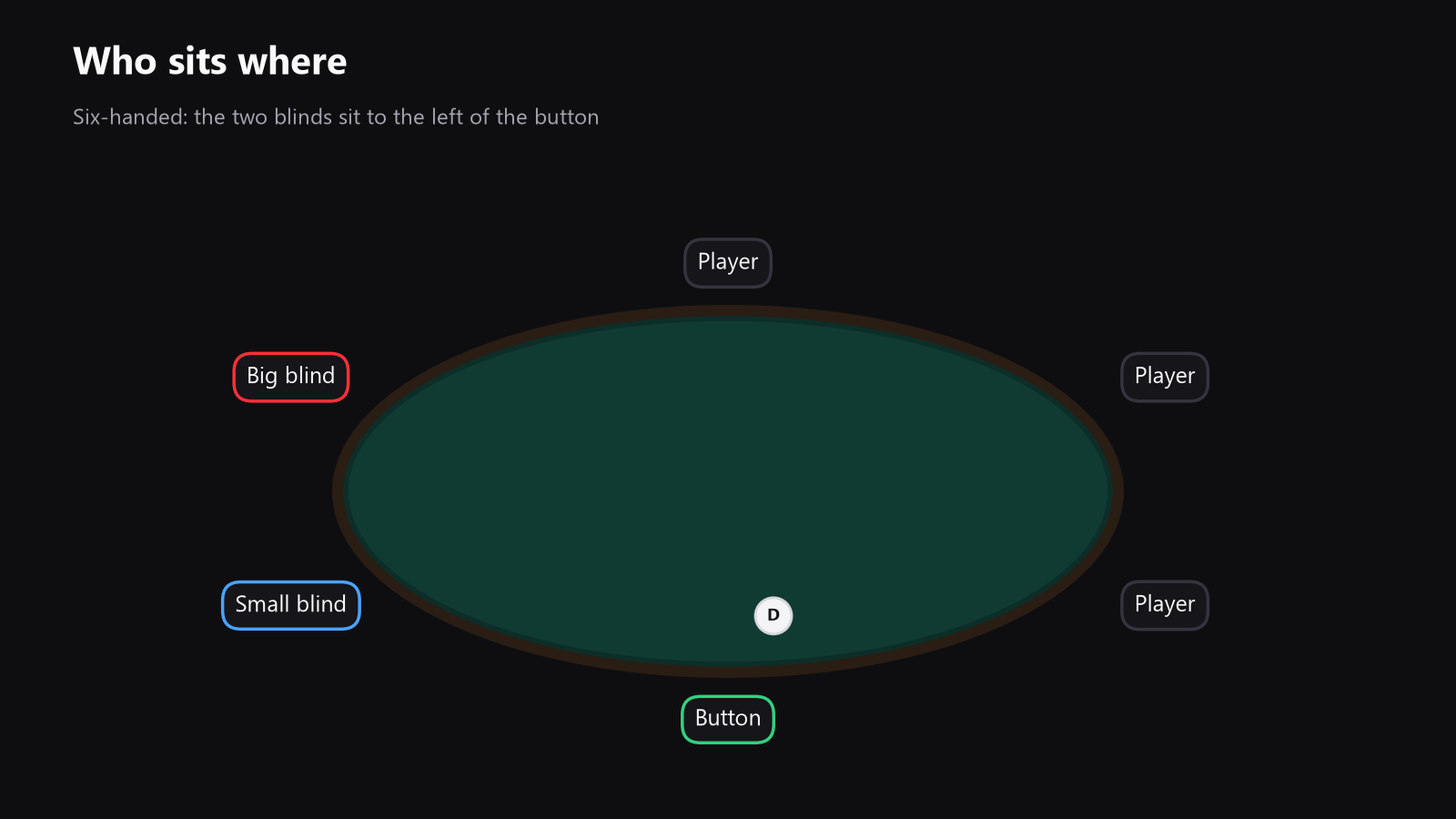
A table has a dealer button, which marks where the deal starts and, in most games, who acts last after the flop. In a casino or online game, the dealer button moves one seat clockwise after each hand.
The two players left of the button post forced bets:
- Small blind
- Big blind
These bets start the pot before any cards are dealt. They also create action, because there is already money to win.
A typical no-limit cash game might be 1/2, which means:
- Small blind = 1
- Big blind = 2
A tournament uses the same basic rules, but the blinds rise over time.
The order of play
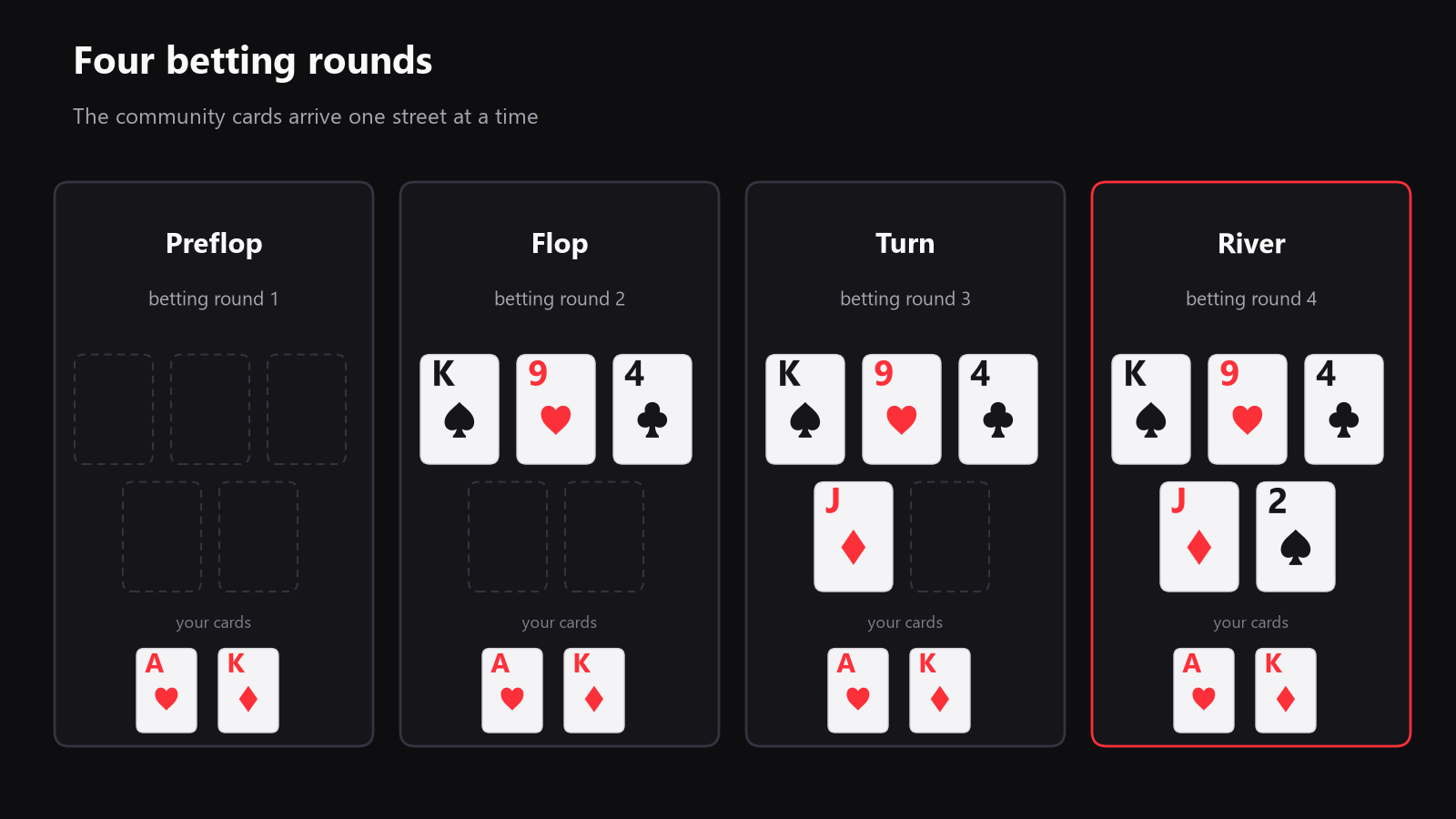
A hand has four betting rounds:
- Preflop
- Flop
- Turn
- River
1. Preflop
Each player gets two hole cards.
Action starts with the player left of the big blind. That player can fold, call, or raise. Action continues clockwise around the table until all active players have matched the largest bet or have folded.
2. Flop
If at least two players remain, three community cards are dealt face up. These are the flop.
A new betting round starts. The first active player left of the dealer button acts first.
3. Turn
A fourth community card is dealt face up. This is the turn.
Another betting round starts.
4. River
A fifth and final community card is dealt face up. This is the river.
The final betting round happens here.
If more than one player remains after the river betting, the hand goes to showdown.
The actions you can take
The basic actions in hold'em are:
- Fold: give up your hand and any chance to win the pot
- Check: pass the action without betting, only possible if no bet has been made on that street
- Bet: put chips in first
- Call: match the current bet
- Raise: increase the current bet
- All-in: put all your remaining chips in the pot
A round ends when every remaining player has either folded or put in the same amount of chips as the current highest bet.
Important rule: you cannot check facing a bet
If someone bets before you, you must fold, call, or raise. You cannot check.
Important rule: in no-limit hold'em, the size of a raise can be large
In no-limit games, you can bet or raise many times the size of the big blind, up to your stack. That is one reason the game has so much pressure and so many decisions.
The hand rankings
When players reach showdown, the best five-card hand wins.
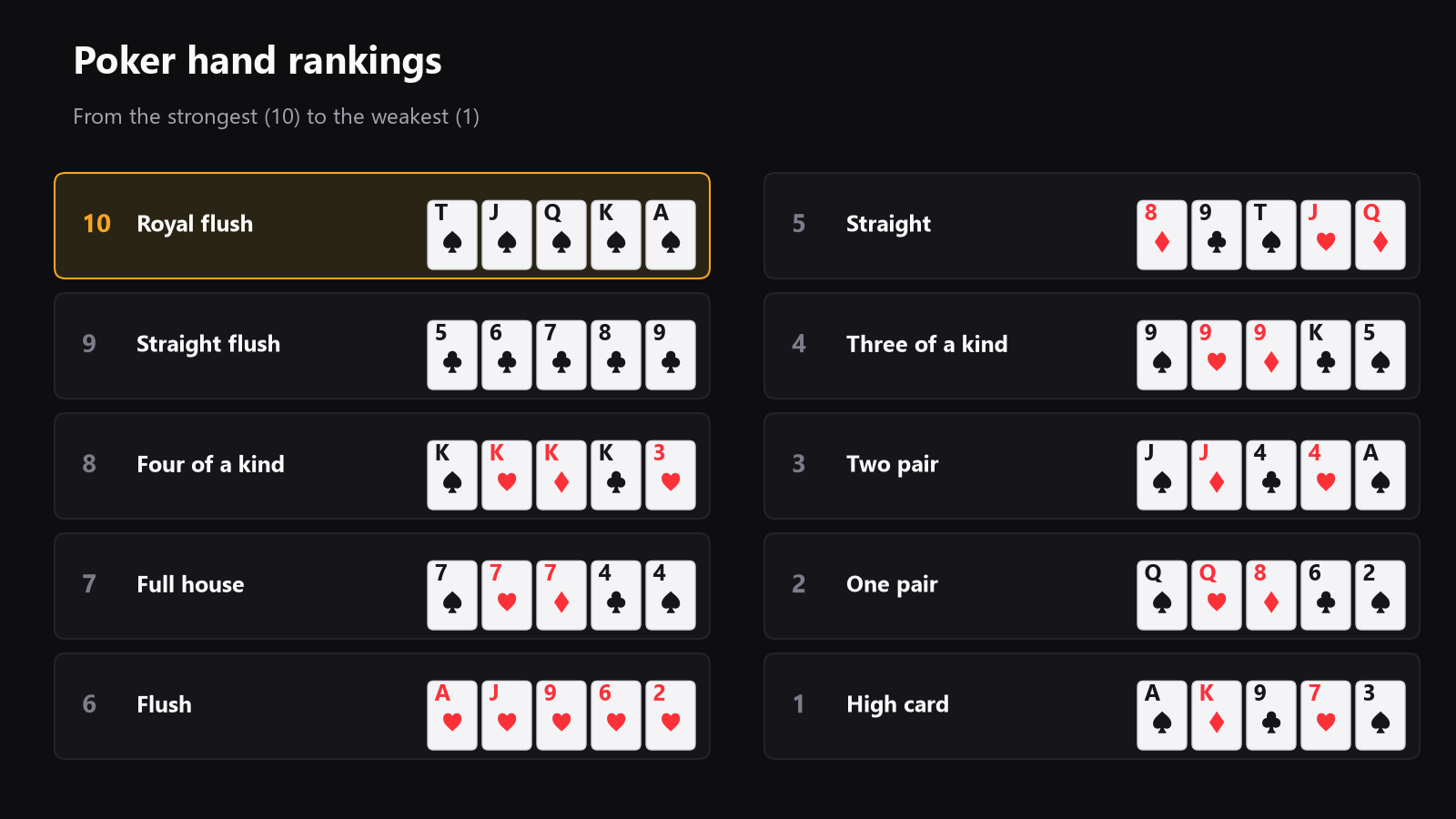
Here is the ranking, from strongest to weakest:
- Royal flush
- Straight flush
- Four of a kind
- Full house
- Flush
- Straight
- Three of a kind
- Two pair
- One pair
- High card
A few details that beginners often miss
- A straight is five cards in rank order, such as 5-6-7-8-9.
- An ace can be high or low in a straight, so A-2-3-4-5 is valid, but Q-K-A-2-3 is not.
- A flush is five cards of the same suit, but they do not need to be in order.
- A full house is three of a kind plus a pair.
- If two players have the same hand category, kickers can decide the winner.
For example, pair of aces with a king kicker beats pair of aces with a queen kicker.
Who acts first
Knowing who acts first is part of knowing the rules.
- Preflop: the player left of the big blind acts first
- Flop, turn, and river: the first active player left of the button acts first
That player can check if no bet has been made, or bet if they want to start the action.
A complete example hand from the deal to showdown
Let’s follow one simple hand.
Table setup
You are in a 6-handed cash game with blinds 1/2.
Seats, clockwise, are:
- Button
- Small blind
- Big blind
- Under the gun
- Hijack
- Cutoff
You are on the button.
Your hole cards are A♠ K♠.
Preflop
- Under the gun folds
- Hijack raises to 6
- Cutoff folds
- You call on the button
- Small blind folds
- Big blind folds
The pot is now 15.
Flop
The flop comes Q♠ J♣ 2♦.
The hijack bets 5 into 15.
You call.
The pot is now 25.
Why call? Because in hold'em, you are not trying to win every pot immediately. You are trying to continue only when your hand, your draw, and the price make sense.
Turn
The turn is T♥.
Now the board reads Q♠ J♣ 2♦ T♥.
The hijack bets 12.
You call again.
The pot is now 49.
At this point, your hand is very strong. With A♠ K♠, you have made a straight, A-K-Q-J-T, often called Broadway.
River
The river is 3♣.
The hijack checks.
You bet 20 for value, and the hijack calls.
Showdown
You turn over A♠ K♠.
Your opponent shows A♦ Q♦.
Your best five-card hand is A-K-Q-J-T, the Broadway straight.
Your opponent’s best five-card hand is also A-K-Q-J-T, because the board already contains Q, J, T, and the ace and king from your hole cards are enough to complete the straight.
This means the pot is split.
That is a very important hold'em lesson: sometimes your hand looks different, but the board makes the final five-card hand for everyone.
Showdown rules
When the betting ends and more than one player remains, the players show their cards.
The best hand wins the pot.
A few key points:
- If everyone but one player folds, the last player wins immediately and does not need to show cards in many rooms.
- If two or more players remain, cards are shown.
- In many games, the last aggressor shows first if there was a bet on the river. If everyone checked the river, the first player left of the button may show first. Rooms can vary a little in procedure, but the hand ranking rules do not change.
If two players have the same best five-card hand, they split the pot.
Side pots and all-in hands
All-in pots are common in hold'em, especially in tournaments.
If a player does not have enough chips to call a bet, they can still go all-in for their remaining stack. The main pot is built with the chips that all involved players could match. Any extra chips go into a side pot.
Example:
- Player A is all-in for 20
- Player B calls 20
- Player C raises further and B calls the extra amount
Now there can be:
- a main pot, contested by all players who put in 20
- a side pot, contested only by the players who contributed more than 20
If you are new to hold'em rules, side pots are one of the first things worth learning carefully, because they decide who can win which chips.
Common beginner mistakes
Here are the mistakes that cause confusion most often:
- Forgetting that you must use the best five cards
- Thinking your two hole cards always matter
- Forgetting that the board can play for everyone
- Confusing a flush with a straight
- Ignoring kicker strength when pairs are equal
- Not understanding side pots when someone is all-in
If you fix those six things, you already understand the core rules of Texas hold'em.
A simple way to remember the game
Think of hold'em in this order:
- Two private cards
- Four betting rounds
- Five shared cards
- Best five-card hand wins
That is the whole game at its core.
What to learn next
Once you know the rules, the next step is not memorizing more definitions. It is learning how often hands actually win, where mistakes happen, and how much rake changes your result.
That is where reviewing your own hands becomes useful. A tracker with a Dashboard module can show your win rate, rake, and sample size, while the Replayer lets you go back through a hand street by street. If you want to study hold'em seriously, that kind of review turns the rules into something you can use.
Do it on your own hands.