
If you are learning poker, one of the first things you need is a clean picture of the actions and the order of a betting round.
Fold, check, call, bet, raise, all-in. These are the words that shape every hand. If you know when each action is legal, who acts first, and when a round ends, poker becomes much easier to read.
This guide focuses on no-limit hold'em, because that is where most players meet these rules first. The same logic also helps in other poker variants, but hold'em is the best place to start.
The six actions in poker
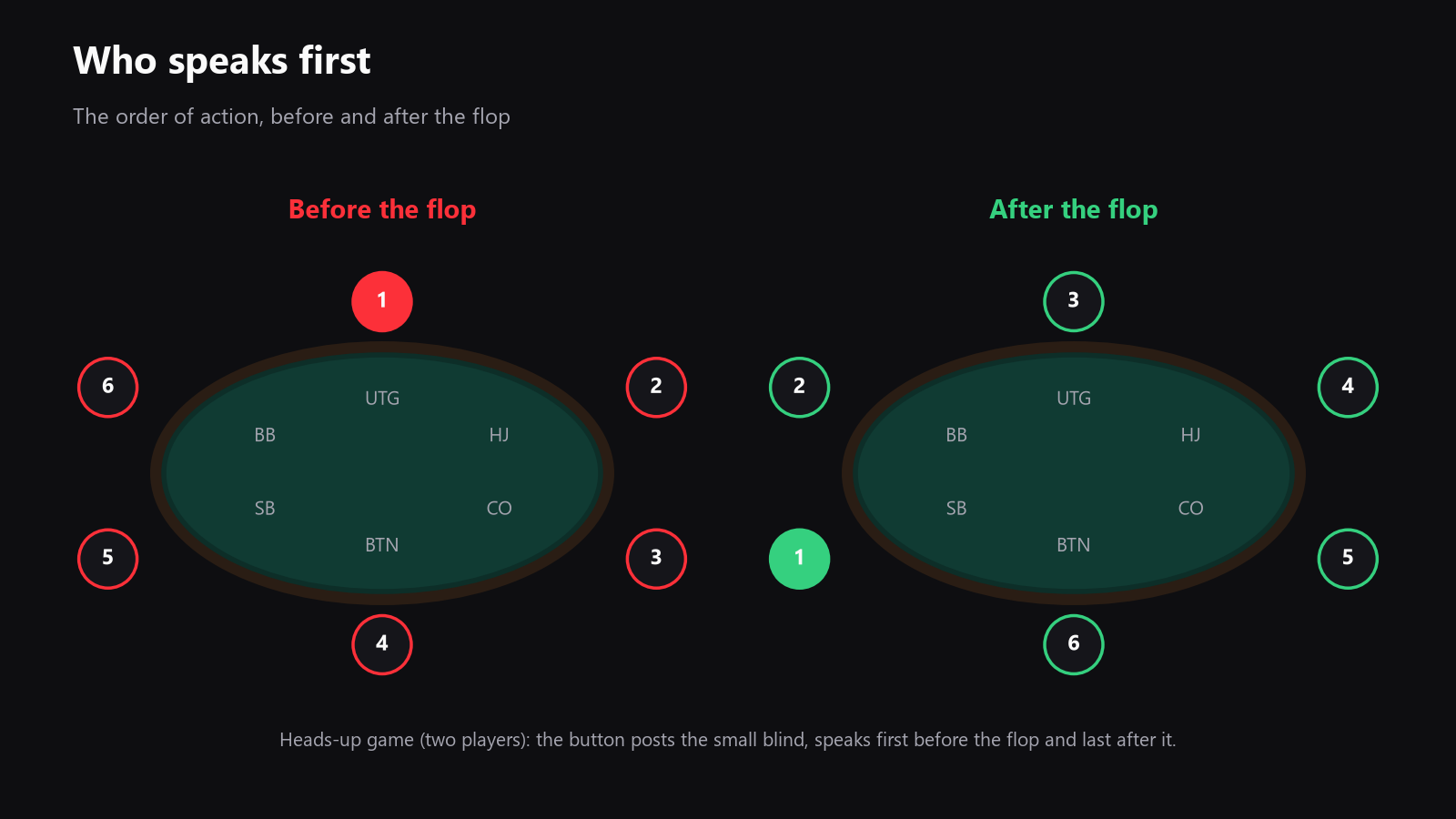
Here is the short version first:
| Action | When you can use it | What it means |
|---|---|---|
| Fold | Any time it is your turn | You give up the hand and any chance to win the current pot |
| Check | When nobody has bet yet in that round | You stay in the hand without putting in more chips |
| Call | When there is a bet or raise in front of you | You match the current price to stay in the hand |
| Bet | When nobody has bet yet in that round | You put chips in and create a price for others |
| Raise | When there is already a bet in front of you | You increase the size of the bet |
| All-in | When you put in all your remaining chips | Your stack is committed, and the action may continue for others |
Fold
When you fold, you are done with that hand.
You lose any chips you already put into the pot, but you do not have to put in more. Your cards are no longer live. You cannot win the pot anymore.
Check
A check is a pass.
You keep your hand, but you do not add chips to the pot. You can only check if nobody has bet yet in that betting round. If there is already a bet, checking is not allowed. You must then fold, call, or raise if you can.
A check is not strength or weakness by itself. It is simply a legal action when the price is zero.
Call
To call means to match the current bet.
If one player bets 5 big blinds, and you want to continue, you call 5 big blinds. If the bet is 3 big blinds and someone else has already called 3, you still call 3, because the current price is the same for everyone who acts after the bet.
A call can also be partial when you do not have enough chips. In that case, you put in what you have left, and you are all-in.
Bet
A bet is the first time chips are put in during a betting round, after the cards are dealt for that street.
For example:
- preflop, the blinds are already in the pot, but the first voluntary action is usually a raise, not a bet
- on the flop, if nobody has bet yet, the first player to act can bet
Once someone bets, the round is no longer a check-through round. Everyone after that player must respond to the bet somehow.
Raise
A raise is an increase over an existing bet.
If one player bets 5 big blinds, and you make it 15, you raise. The key idea is simple: there is already a price, and you make that price higher.
A raise changes the action for everyone still in the hand. Players who have not yet acted must now face the new price. Players who already acted may get another turn if the betting remains open.
All-in
All-in means you put all your remaining chips into the pot.
This is not a separate legal category from the other actions. An all-in can be:
- a bet, if nobody has bet yet
- a raise, if there is already a bet
- a call, if you are matching a bet and your stack is smaller than the amount you need
That is why all-in is both simple and tricky. The chips are easy to count, but the effect on the betting round depends on the situation.
How a betting round works
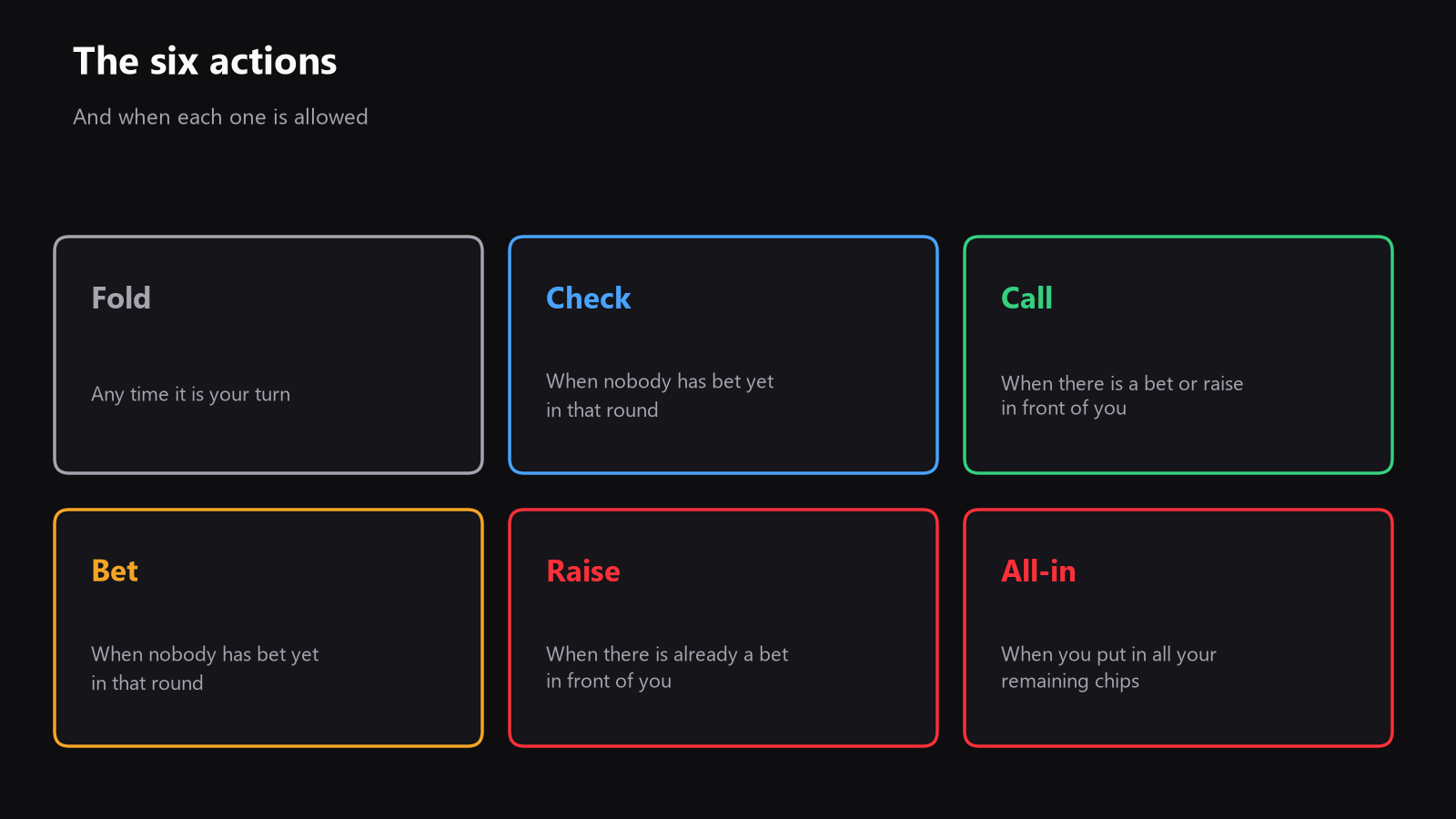
A betting round is the sequence of turns on one street.
In hold'em, the streets are:
- preflop
- flop
- turn
- river
A round starts when the cards for that street are dealt, or, preflop, when the blinds have been posted and action begins.
The round ends when one of these things happens:
- everyone folds except one player
- everyone still in the hand has matched the last bet or raise, or is all-in
- everyone checks, with no bet made on that street
When the round ends, the next street begins, unless the hand is already over.
Who acts first
This is one of the most important rules in poker.
Preflop
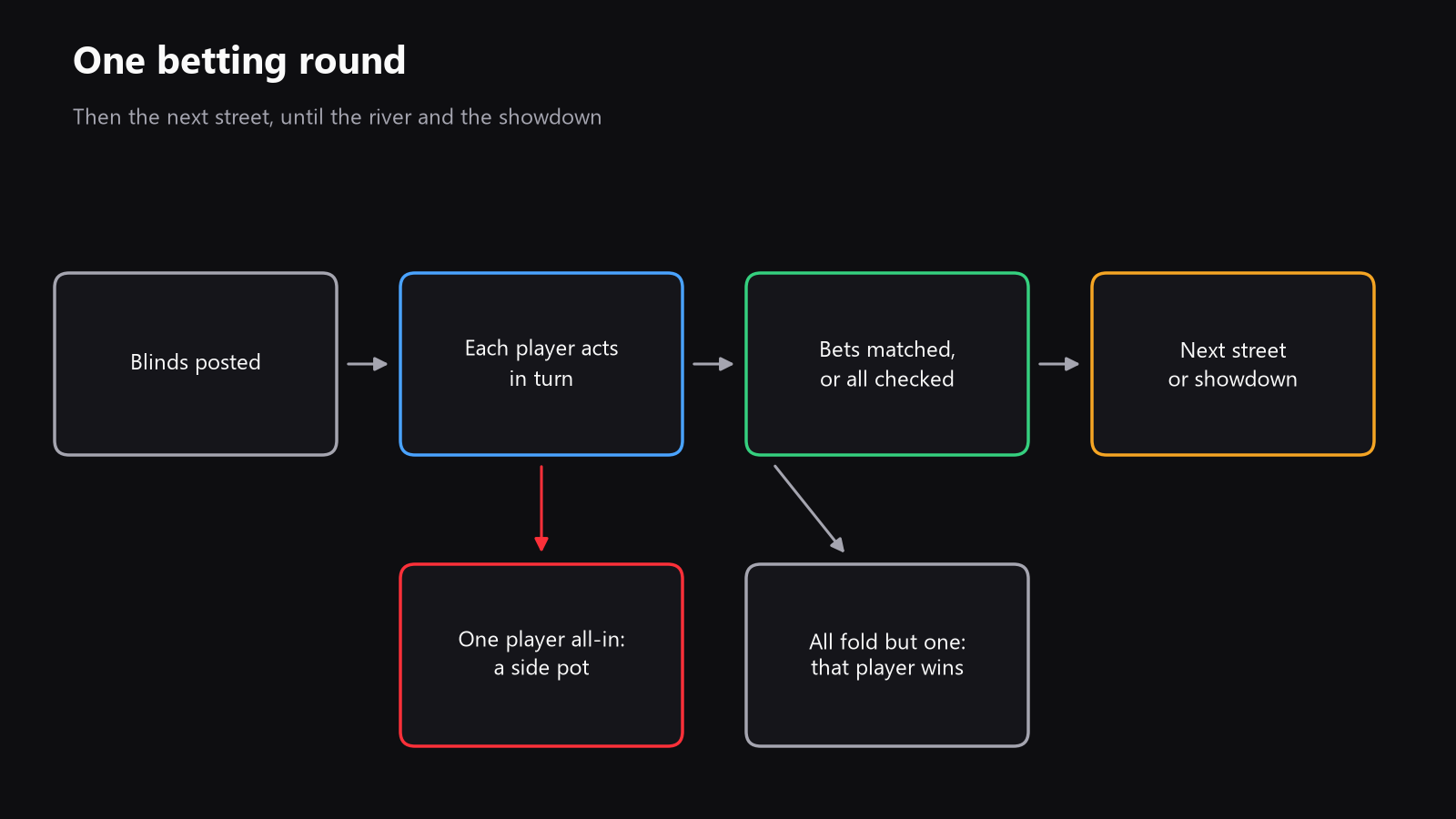
Preflop action starts with the first active player to the left of the big blind.
That means:
- if there are many players, the action begins left of the big blind
- if players fold, the action keeps moving around the table until it reaches the last player still in the hand
In normal six-max or full-ring hold'em, the blinds are forced bets, and preflop action starts with the first player to the left of the big blind. The blinds simply act later because they are last to respond.
In heads-up hold'em, though, it is different: the button is also the small blind, and the button acts first preflop.
Postflop
On the flop, turn, and river, the first active player to the left of the button acts first.
Usually, that is the small blind if the small blind is still in the hand. If the small blind folded preflop, then the first active player to the left of the button acts first instead.
Heads-up
Heads-up play works differently.
In heads-up no-limit hold'em:
- the button is also the small blind
- the button acts first preflop
- the button acts last on the flop, turn, and river
That is why heads-up feels very different from full-ring or six-max poker.
What happens after a bet or a raise
Once a bet is made, checking is no longer possible for the players who still face that bet.
Their choices are now:
- fold
- call
- raise, if the rules and stack sizes allow it
- all-in, if they want to put in all their chips
A raise reopens the action for the players who have not yet acted, and sometimes for players who already acted earlier in the round.
That is what makes the betting round a chain, not just a set of isolated turns. Every new bet changes the price for everyone behind.
A note on minimum raises
In no-limit hold'em, a raise must normally be at least as large as the previous bet or raise.
For example, if the bet is 4 big blinds, a normal raise must usually increase it by at least 4 more big blinds. That is why you often hear players talk about a minimum raise.
An all-in can be smaller than a normal raise if the player does not have enough chips for a full raise. In that case, the action may not fully reopen in the same way a full raise would.
Side pots when someone is all-in
If a player goes all-in and another player has more chips, the hand can create a side pot.
The idea is simple:
- the all-in player can only win chips they were able to match
- extra chips from deeper stacks go into a separate side pot
- players who did not cover the all-in player cannot win that extra pot
Example:
- Player A goes all-in for 10 big blinds
- Player B calls 10 big blinds
- Player C has 40 big blinds and calls 10 big blinds
Now there is:
- a main pot, which everyone can win
- a side pot, which only Player B and Player C can win, if more chips go in later
You do not need to master side pots on day one, but you do need to know they exist. They are a basic part of real poker rules.
A simple hand example
Let’s walk through one hand.
Preflop
- The blinds are posted.
- Action starts left of the big blind.
- One player folds.
- Another player raises.
- The next player calls.
- The blinds now face the raise, so they must fold, call, or raise.
At the end of preflop, everyone remaining has matched the current price, or they are all-in, so the flop can be dealt.
Flop
- The first active player left of the button acts first.
- That player checks.
- The next player bets.
- The third player folds.
- The first player now must respond to the bet, so they can fold, call, or raise.
If the bet is called, the flop round ends, and the turn is dealt.
Turn and river
The same logic repeats.
Each street starts fresh, but with the same action order:
- first active player left of the button acts first
- a check is only legal if nobody has bet yet
- once a bet exists, the other players must respond to it
That is the whole structure of a betting round.
Common mistakes players make
1. Trying to check facing a bet
You cannot check when there is already a bet in front of you.
If somebody has bet and you do not want to continue, you fold. If you want to stay in, you call or raise.
2. Confusing call and raise
A call matches the current price.
A raise increases it.
This sounds basic, but many beginners mix the words because both actions put chips into the pot. The difference is whether you are matching or increasing.
3. Forgetting that action order changes by street
Preflop and postflop do not use the same first player.
If you learn only one thing from this article, make it this: preflop starts from the big blind side in normal games, and postflop starts from the button side.
4. Thinking all-in always ends the action
Not always.
Sometimes an all-in ends the betting for that player, but other players may still have decisions, especially if side pots are involved.
5. Ignoring the button
The button matters because it defines who acts first after the flop, turn, and river.
If you understand the button, you understand a big part of poker order.
Why this matters when you study hands
The rules themselves are not the whole game, but they are the frame of the game.
If you misread the action order, you can misunderstand a hand. If you confuse a call with a raise, you can misunderstand a line. If you do not know when a betting round ends, you can misread the whole spot.
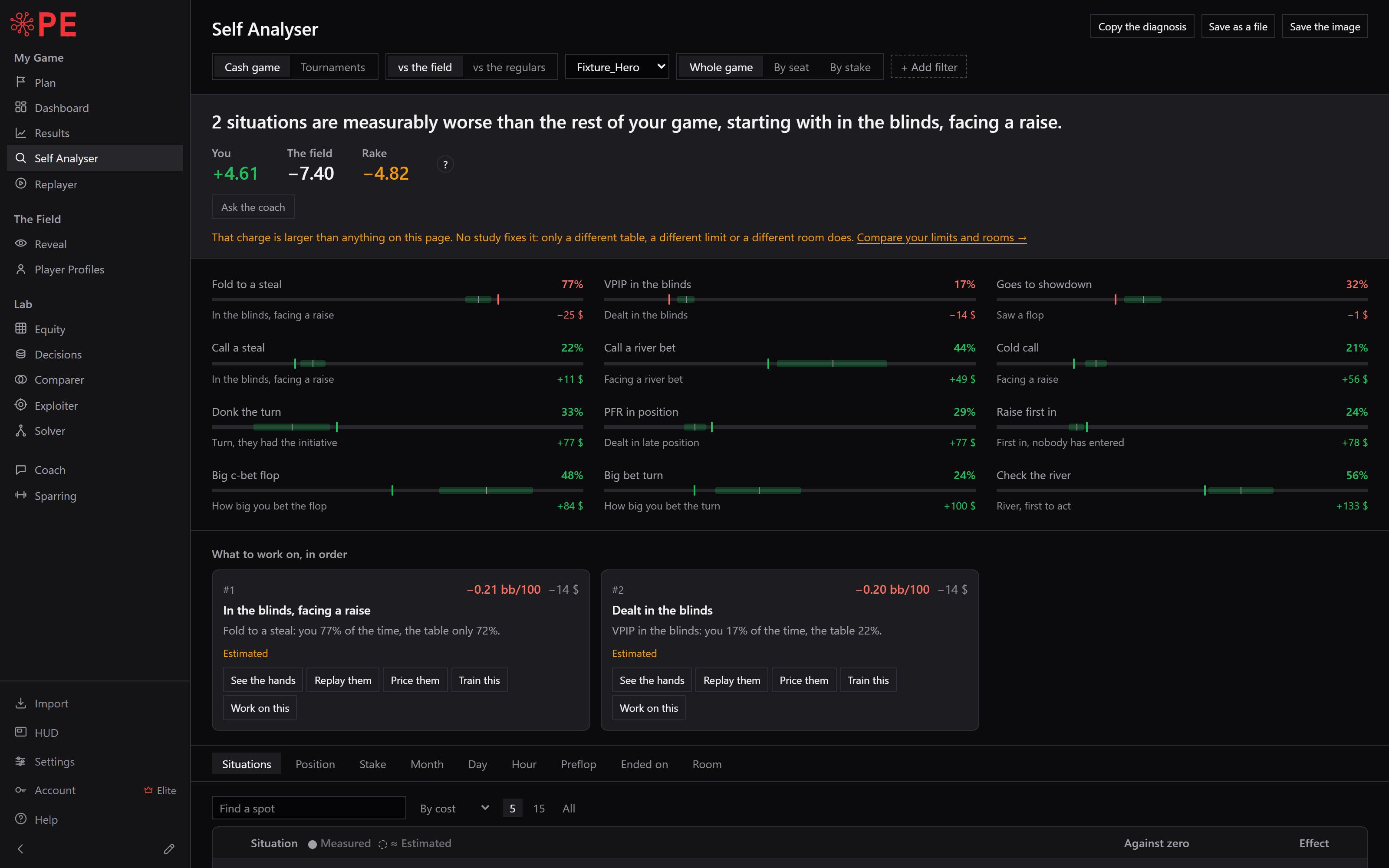
That is why it helps to review your hands street by street. The Replayer module shows the sequence clearly, and the Self Analyser module measures which situations you play badly, both against the field and against the rest of your game.
The short version
If you want the rules in one minute, remember this:
- fold means you leave the hand
- check means you pass without adding chips, only when no bet exists
- call means you match the current bet
- bet means you put chips in first on that street
- raise means you increase an existing bet
- all-in means you commit your remaining chips
And for the betting round:
- preflop starts left of the big blind in normal games
- in heads-up, the button is also the small blind and acts first preflop
- postflop starts left of the button
- a round ends when the action is matched or everyone checks, and also when every player still in the hand is all-in
- if someone is all-in, side pots may appear
Once this structure is clear, the rest of poker becomes much easier to read.
Do it on your own hands.