
Most poker goals fail for a simple reason: they ask variance to do the work.
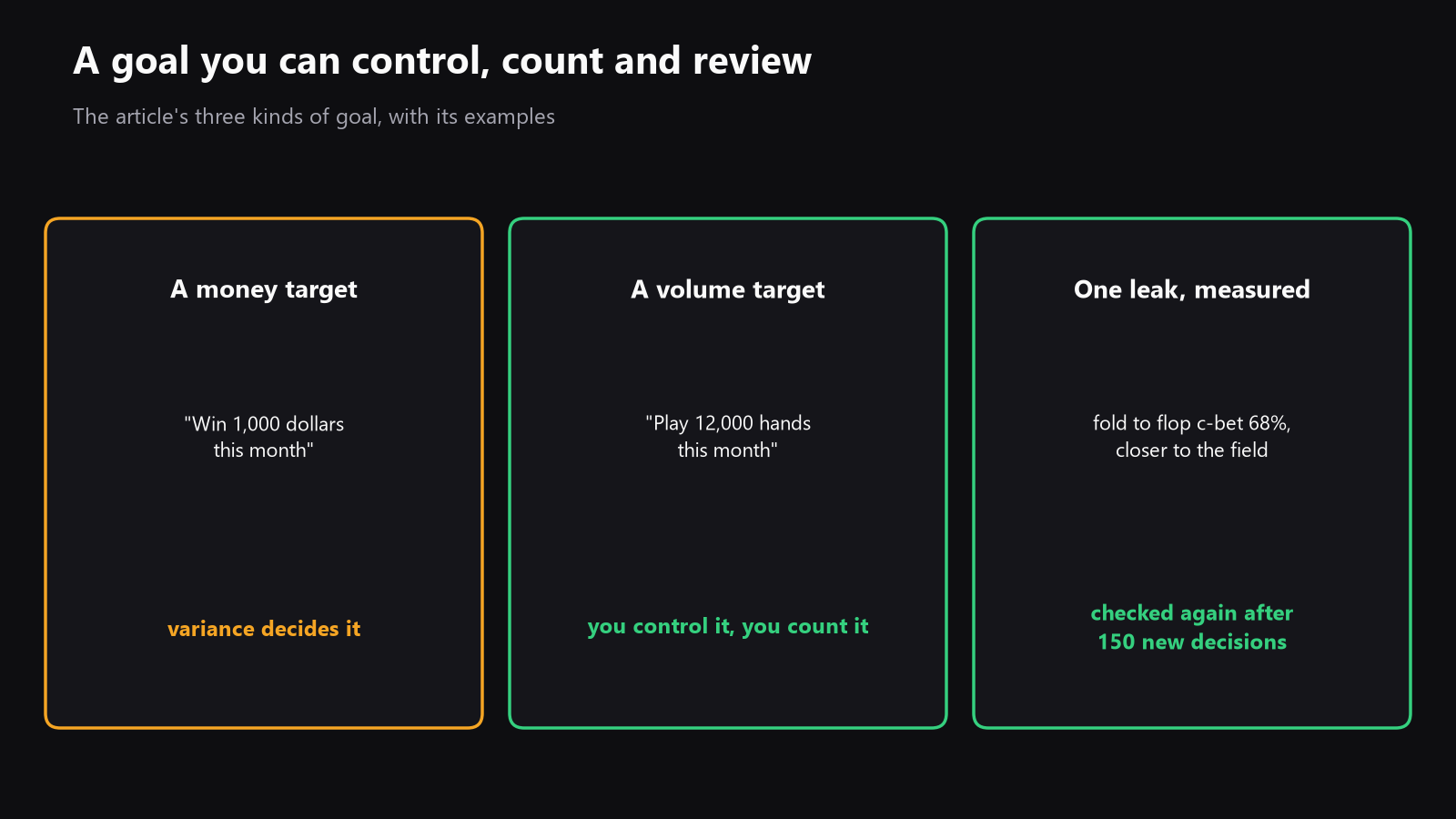
"I want to win 1,000 dollars this month" sounds concrete, but poker does not pay you on command. You can play well and lose. You can play badly and win. If you use money as the main goal, you are judging a month by a number you do not fully control.
That does not mean money is irrelevant. It means money is the wrong main target if you want to improve as a player.
A better poker goal is something you can control, count, and review. That can be volume, a study routine, or one specific leak with a statistic before and after. If you set goals that way, you are no longer hoping for a good result. You are building a process that can be checked honestly.
Why a money target is a bad poker goal
A money target is attractive because it is easy to understand. It also creates the biggest trap.
If your goal is "make 500 dollars," then a good month can look bad and a bad month can look good.
A player might:
- run below expectation for 20,000 hands and miss the target while making better decisions
- run above expectation for a short stretch and hit the target while leaking value
- change stakes or table quality and get a result that says more about the games than about the player
That is variance. It is not a small detail. It is the core reason why poker is hard to judge over short samples.
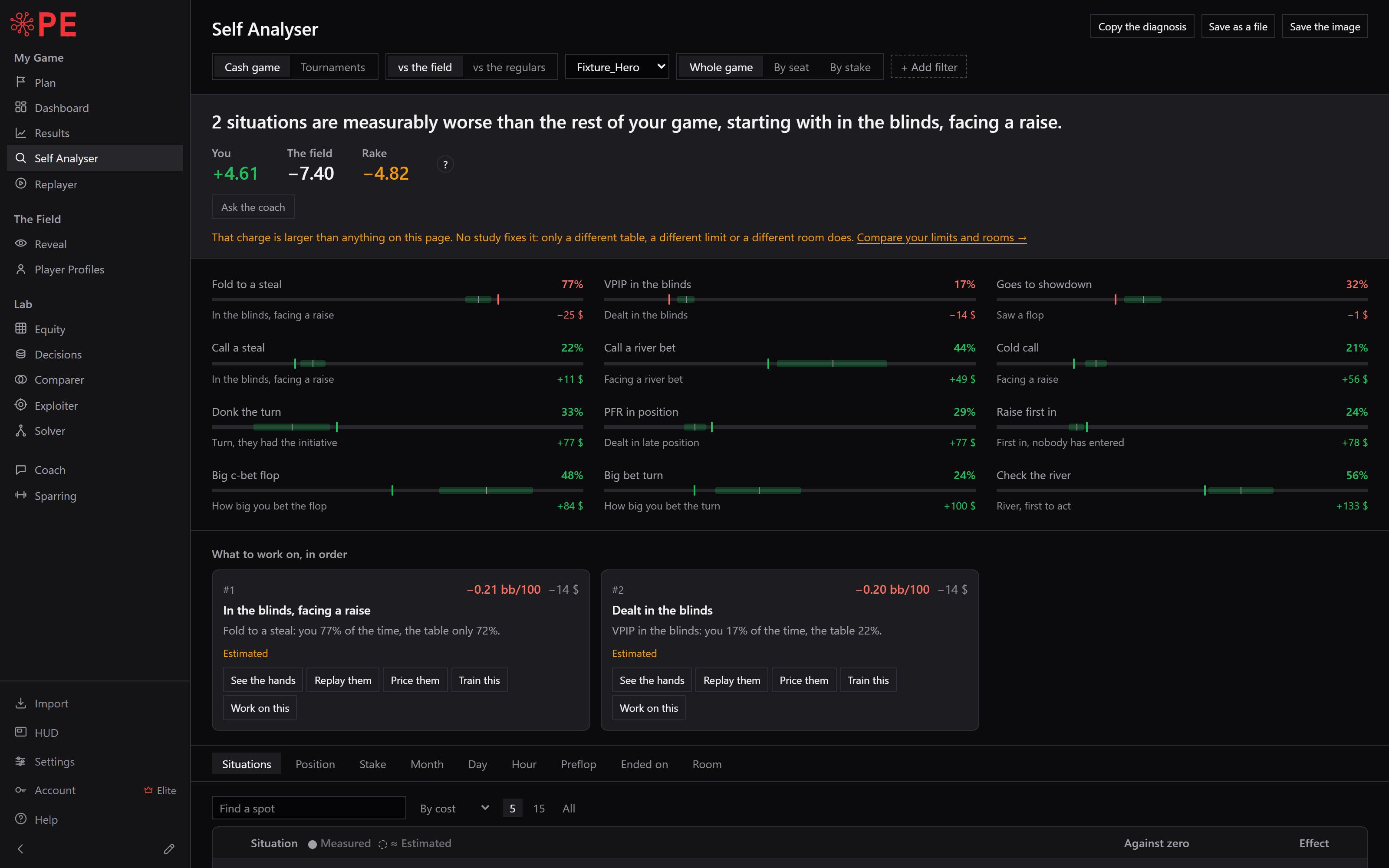
A dashboard that shows your win rate with a margin makes this obvious. For example, a result like 4.61 ± 8.2 bb/100 over 9,028 hands does not tell you, "You are definitely a winner." It tells you the sample is still wide. The margin is larger than the win rate itself. That is a warning that the month does not settle much yet.
That is exactly why a goal built around money can fool you.
If the sample is small, money is a noisy scoreboard. If the rake is large, money is a lower scoreboard, not a noisier one. And if the biggest cost is rake, the right action is not "try harder and hope." It is to change table, limit, or room if that is what the numbers suggest.

There is one case where a money target is still useful: your personal finances. If you need a monthly income plan, fine. But do not use that number to decide whether you improved at poker.
For improvement, use poker numbers.
What makes a poker goal measurable
A measurable goal has three parts:
- A thing you control
- A number you can measure
- A date when you will judge it
That is the whole idea.
1) A thing you control
You do not control how the deck falls. You do control:
- how many hands you play
- how often you study
- which spot you work on
- whether you review your marked hands
- whether you compare your decisions before and after training
2) A number you can measure
The number has to be specific.
Bad:
- "I want to play better"
- "I want to improve my endgame"
- "I want to stop making mistakes"
Good:
- "I will play 12,000 hands this month"
- "I will do eight study sessions of 45 minutes"
- "I will reduce my fold to flop c-bet in one chosen spot from 68% to something closer to the field, then check it again after 150 new decisions"
3) A date when you will judge it
A goal without a review date is just a wish with a spreadsheet.
If you want a monthly goal, give it a monthly verdict. If you want a weekly goal, review it weekly. If you never set the review date, you will always feel busy and never know whether the work did anything.
A good poker goal is not only measurable. It is measurable before you start.
That is why the free Self Analyser module is useful. It gives each situation a cost in big blinds per 100 hands and tells you whether that number separates from noise. That matters because a real goal should be built on a real leak, not on a feeling.
A simple test
Before you call something a goal, ask:
- Can I count it?
- Can I measure it before and after?
- Can I tell whether I hit it without looking at my bankroll first?
If the answer is no, it is not a measurable goal yet.
A good monthly poker goal has three layers
If you want your month to be well designed, do not choose only one target. Use three.
Layer 1: volume
This is the easiest one.
Examples:
- 10,000 hands this month
- 20 sessions this month
- 12 study blocks this month
Pick the unit that fits your game. For cash games, hands are usually the cleanest unit. For tournaments, sessions may be more useful if your volume varies a lot.
The point of a volume goal is not to brag about a number. It is to give your month enough data to mean something.
Layer 2: study
A poker month should include study, not just play.
Examples:
- two 45-minute review blocks per week
- one solver or range study session per week
- one session spent only on marked hands from the previous week
The best study goal is specific. "Study more" is too vague. "Review 20 hands where I faced a flop decision from the blinds" is much better.
Layer 3: one technical focus
This is the goal that actually changes your game.
Choose one situation, not five. If you try to fix everything, you usually fix nothing.
Good examples:
- preflop: defend too wide from the big blind
- flop: overfold to c-bets
- turn: underbluff in a certain line
- river: call too wide in a certain node
- stack play: poor short-stack decisions in tournaments
The best way to choose this is not by mood. It is by cost.
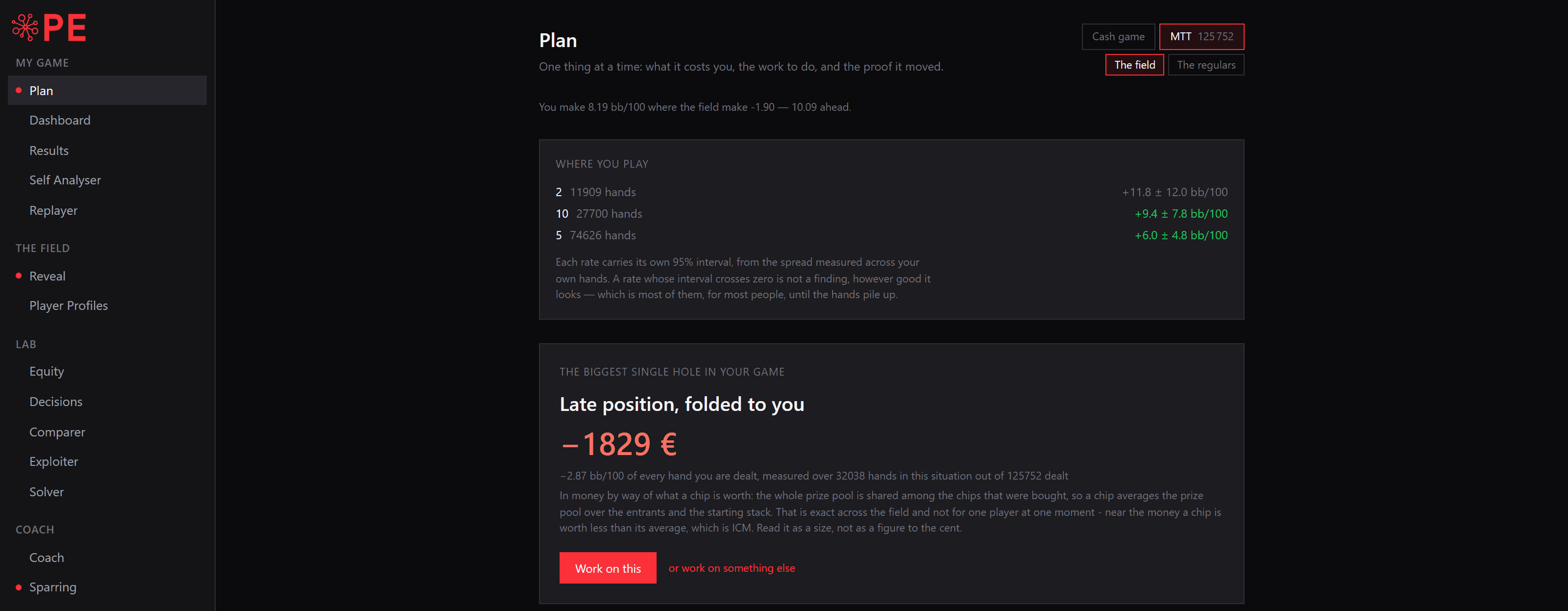
That is where the free Plan module helps. It picks the situation that measurably costs you the most compared with the players at your limits, then runs a cycle: the statistic before, five training sessions, 150 new decisions in that situation, then a verdict. If nothing in your game is leaking measurably, it says so: "Nothing in your game is leaking measurably."
That is a very good answer. It means there is nothing to work on in that cycle and you do not go looking for one just to feel productive.
How to set poker goals for a month
Here is a practical monthly template you can use.
Step 1: choose one result goal, but do not make it the main one
You can write down a bankroll or profit expectation if you want, but treat it as a side note. Do not let it become the measure of success.
For example:
- "I would like to be profitable this month"
That is fine as a wish. It is not enough as a goal.
Step 2: choose one volume goal
Make it realistic for your schedule.
Examples:
- "I will play 12,000 hands this month"
- "I will play 16 sessions this month"
- "I will finish every week with at least four logged sessions"
If you miss the number because life happened, that is still useful information. It tells you the month was not built as planned.
Step 3: choose one study goal
Make the study goal repeatable.
Examples:
- "I will do eight 45-minute review sessions"
- "I will review 10 marked hands every Sunday"
- "I will spend 30 minutes after each session on one recurring spot"
The goal is not to consume content. The goal is to create change.
Step 4: choose one leak to fix
This is the core of the month.
Pick one spot and define its baseline:
- what the number is now
- what sample it comes from
- what you will check later
Example:
- "My fold to flop c-bet in this spot is too high. I will work on it, then check the same statistic after 150 more decisions."
You do not need a perfect target. You need a better number than before, and enough hands to tell whether the move matters.
Step 5: set the review date before the month begins
Write down the date when you will decide whether the month succeeded.
Example:
- First day of the month: record baseline
- During the month: play and study
- Final day of the month: compare the same statistic again
Do not wait until you feel ready. Put the verdict on the calendar.
How to judge your goals without fooling yourself
This is where most players go wrong.
They pick a goal, live through the month, then rewrite history based on the bankroll result. That is how you fool yourself without noticing.
Use these rules instead.
1) Judge the goal you actually set
If your goal was volume, do not replace it with profit after the fact.
If your goal was study, do not claim success just because you booked a winning month.
If your goal was a technical leak, judge that leak.
2) Use the same measure before and after
If you measured one spot in big blinds per 100 hands before the month, measure the same spot the same way after the month.
Do not swap the measure halfway through because the first number was inconvenient.
3) Respect the sample size
A small sample can lie to you in both directions.
That is why the Dashboard module is valuable. It shows win rate with its margin, and it tells you when the sample does not yet settle anything. If the headline says, "Not enough hands to call it yet," believe it.
That is not a failure. It is honesty.
4) Separate process from outcome
A good process can still produce a bad result in the short run.
A bad process can still produce a good result in the short run.
So when you review the month, ask two separate questions:
- Did I do the work I planned?
- Did the number move the way I wanted?
You need both answers. One without the other is not enough.
5) Do not move the goalposts
This is one of the biggest traps in poker improvement.
If you set a goal to reduce a leak, and you get close, do not suddenly decide that the real goal was something else.
If you planned 8 study sessions and you did 6, do not redefine success after the fact.
A useful month is one where the verdict is clear, even if the verdict is uncomfortable.
A simple monthly checklist
Use this checklist at the start of the month:
- One volume goal
- One study goal
- One technical leak
- One baseline number
- One review date
- One final verdict
That is enough.
You do not need ten goals. You need one month with a clear plan and a fair review.
The best poker goal is not "make more money"
If you remember only one thing, remember this:
A money target is a wish. A measurable goal is work.
A good poker month is built from numbers you can control and numbers you can verify. Volume gives you the sample. Study gives you the change. One technical focus gives you direction. The review date keeps you honest.
If you want a simple workflow for that on your own hands, the free Dashboard module shows you your win rate with its margin and how much rake you pay per 100 hands, the free Self Analyser module shows which situations cost you the most, and the free Plan module turns one leak into a before-and-after cycle.
That will not promise you a win. It will give you something more useful: a way to know whether your month was real.
Do it on your own hands.