
A lot of poker players ask the same question in a different way: how good do I need to be before poker can pay my bills?
The honest answer is that it is not a question of hope. It is a question of arithmetic.
If you want poker to become income, you need to know five things about your own game:
- Your win rate, in big blinds per 100 hands
- Your hands per hour
- Your hours per month
- Your stake, which sets the value of one big blind
- Your rake and your variance, which can turn a nice-looking edge into something far less stable
1. The basic formula for poker income
For cash games, the starting point is simple:
Monthly poker result in big blinds = win rate in bb/100 × hands played in the month / 100
Then turn that into money by multiplying by the value of one big blind.
So if you play NL100, one big blind is $1. If you play NL200, one big blind is $2. If you play NL500, one big blind is $5.
If your win rate is already net of rake, this gives you your result. If your number is pre-rake, subtract rake first.
That is why rake matters so much. A player can look strong on paper and still clear very little after the room takes its cut.
2. A few examples, because the stake changes everything
Let’s use one simple example and keep the volume realistic.
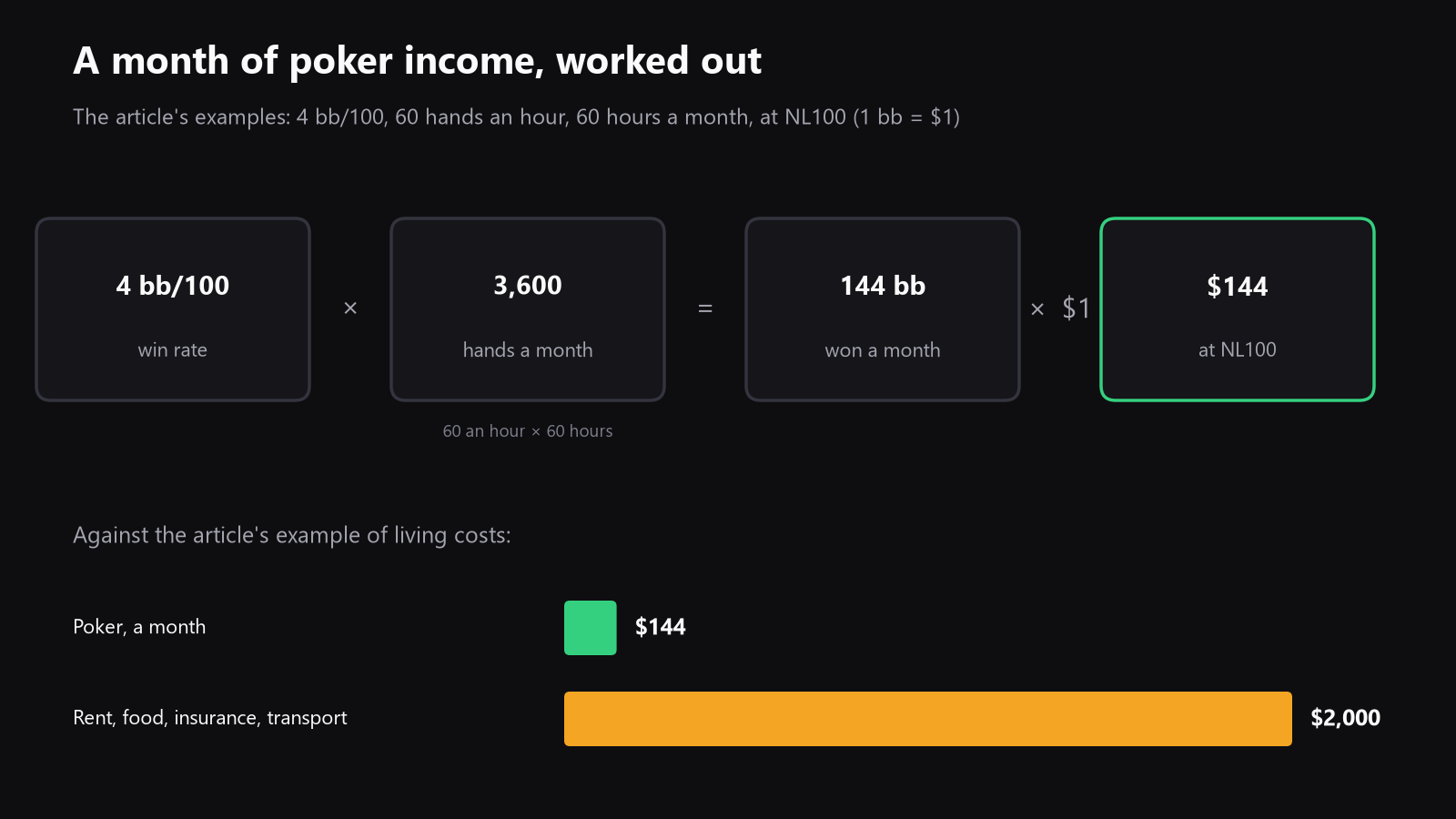
Say you play 60 hands per hour and 60 hours per month. That is 3,600 hands in a month.
Now suppose your win rate is 4 bb/100.
That gives:
- 4 × 3,600 / 100 = 144 bb per month
Now convert that into money:
| Stake | Value of 1 bb | Monthly result at 4 bb/100 and 3,600 hands |
|---|---|---|
| NL25 | $0.25 | $36 |
| NL100 | $1.00 | $144 |
| NL200 | $2.00 | $288 |
| NL500 | $5.00 | $720 |
This is the first hard lesson.
The same skill level means very different money at different stakes. A win rate that looks decent at low stakes can still be a tiny income.
If you want a living, not a hobby that pays for coffee, the stake has to be high enough for the edge to matter.
3. Why rake can make or break the plan
Rake is not a side note. It is one of the main numbers.
Imagine you think your raw edge is 7 bb/100, but rake costs you 4.82 bb/100. That leaves you with only 2.18 bb/100 net.
At NL200, 60 hands per hour, that becomes:
2.18 × 60 / 100 × $2 = $2.62 per hour
That is the kind of number that changes the whole conversation.
You may still be a winning player, but you are nowhere near a reliable living unless your volume, stake, or edge is much bigger.
This is why the free Dashboard module in Poker Exploit matters. It shows your win rate in bb/100 with its margin, the rake per 100 hands, and whether the sample is actually decisive. On one screen, you can see whether your result is real, or just a small sample dressed up as certainty.

The free Dashboard module in Poker Exploit matters for the same reason.
A Dashboard can read, for example, 9,028 hands, +412 big blinds, +4.6 ± 8.2 bb/100 and rake 4.82 bb/100.
That margin is the real lesson. If the margin is larger than the win rate, you do not yet have enough hands to know what your true level is. You may be a winner, a breakeven player, or even a loser after more hands. The sample does not settle it yet.
4. The monthly number is not the number that matters most
A lot of players do the math once and stop too early.
They calculate an average monthly profit and forget that rent is due every month, not on the average of twelve months.
That is where variance enters the picture.
Poker income is lumpy. You can have profitable months and losing months even if you are a solid winner in the long run. A downswing can last long enough to destroy a plan that looked fine on paper.
This is why the real question is not only, “What is my expected income?”
It is also:
- Can I survive the bad months?
- How many bad months can I absorb?
- How much cash do I need outside the poker bankroll?
You need two buffers, not one:
- A poker bankroll, to survive the game itself
- A living-expense buffer, to survive your personal bills while the variance does its work
If your rent, food, insurance, and transport cost $2,000 per month, and your poker result swings by thousands of dollars, then a small bankroll is not enough. Even a positive long-term edge can fail you in practice if you cannot pay your bills during the downswings.
5. Why monthly expenses must be in the formula
Suppose your poker math says you can make $1,200 per month on average.
That sounds fine until you ask the next question: how much do you spend every month?
If your living costs are $1,800, then your poker average does not cover your life. You are still short $600 every month before tax, before emergencies, and before any bad run.
If your living costs are $900, then the same result still leaves only $300 a month on average, before tax, before emergencies, and before any losing month.
So the real test is:
Expected monthly poker profit minus monthly living expenses = your actual cushion
If that number is thin, you are not living from poker. You are subsidizing a risky income with luck.
6. What a serious poker living plan looks like
If you want to know whether poker can support you, answer these questions with your own numbers:
- What is my win rate, and what is the margin around it?
- How many hands do I really play per hour?
- How many hours a month can I sustain, without burning out?
- What stake am I actually beating, after rake?
- What is my average monthly spending?
- How many months of living costs can I cover if the downswing lasts?
- If I drop below my current stake, what happens to my income?
If you cannot answer those questions, you are not yet planning a living. You are guessing.
The free Results module in Poker Exploit helps with the part that often gets ignored: it shows your curve, your money by month, the rake next to the result, and the all-in EV line. That does not pay your rent for you, but it gives you a clearer picture of what your results really mean.

7. A quick reality check on volume
Volume matters as much as skill.
A player who wins 5 bb/100 at a low hand rate may make very little. A player with the same win rate but much higher volume can make far more.
For example, at NL500, with 5 bb/100 and 60 hands per hour:
5 × 60 / 100 × $5 = $15 per hour
At 200 hours in the month, that is $3,000.
That is only a monthly average. But notice what it requires:
- A high stake
- A real edge
- Plenty of volume
- Enough emotional and mental stamina to play 200 hours
And that is still only the average. It does not remove variance.
8. If you play tournaments, the math changes
Tournament poker is a different business.
Instead of bb/100, you usually think in ROI, average buy-in, field size, and the number of tournaments played per month.
That makes the income much spikier than cash games. One deep run can change a month. Several losing sessions can also happen even if you are a winning player.
So the right question in tournaments is not, “What is my hourly win rate in bb/100?”
It is:
- What is my ROI?
- What is my average buy-in?
- How many tournaments do I play per month?
- How much can my bankroll and living reserve absorb?
The Results module in Poker Exploit shows ROI and ITM for tournaments, because poker income is not one single number. It is a combination of edge, volume, and how much swing you can afford.
9. The short answer
Can you make a living playing poker?
Only your own numbers can show whether poker covers your costs, and nobody can promise that it will.
You need:
- A win rate that survives rake
- Enough hands and hours
- A stake where the edge becomes real money
- A bankroll that can take a downswing
- Living expenses that do not outgrow your edge
If you want to know whether your own game clears that bar, start with your own hands and your own costs. That is the fastest way to turn poker from a vague dream into a serious calculation.
Do it on your own hands.