
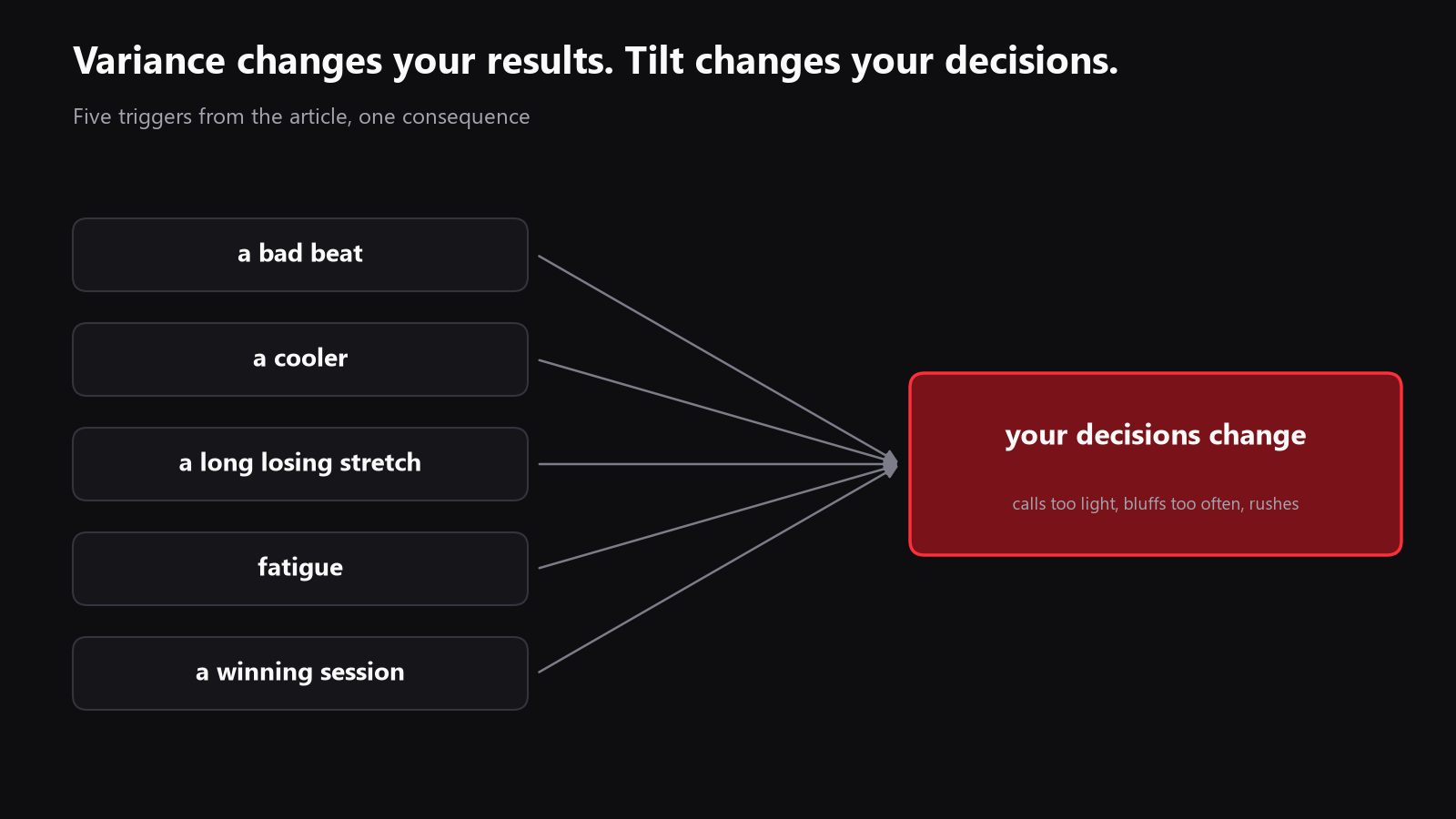
Tilt is not just anger. In poker, tilt is a change in decisions after something happens to you, usually a bad beat, a cooler, a long losing stretch, fatigue, or even a winning session that makes you feel invincible. The feeling can be frustration, relief, boredom, revenge, or overconfidence. The poker problem is the same either way: your decisions change.
That is why tilt matters so much. You do not need to feel out of control to be on tilt. You can be calm, polite, and still play worse than usual because something has shifted in your process.
What tilt really is
A bad beat does not matter because it hurts your feelings. It matters because, after it, you may call a little too wide, bluff too often, stop value betting, or start rushing decisions. A cooler does the same thing. So does a night where nothing goes your way. So does being tired after work. So does a heater, when you start thinking the cards owe you action.
That is the key idea:
- Variance changes your results.
- Tilt changes your decisions.
If your strategy changes after a trigger, that is tilt, even if the trigger was a perfectly normal poker hand.
Here are the most common forms.
Revenge tilt
This is the classic one. You get stacked in a hand that felt unfair, and the next few pots become personal. You start forcing action. You want to win back the lost pot right now.
Typical signs:
- calling too light because you want to see a showdown
- bluffing into ranges that do not care
- 3-betting hands that should just be folded
- stacking off too easily because you want the chips back
Revenge tilt is especially dangerous because it feels justified. You are not “going crazy.” You are “getting it back.” That story is exactly what keeps it alive.
Fear tilt
Not all tilt is aggressive. Some players tighten up after a loss. They stop value betting thinly. They give up too many pots. They see monsters everywhere.
Fear tilt often shows up as:
- missing thin value bets
- overfolding in spots where you should continue
- checking back too much
- avoiding close decisions because you do not want another bad outcome
This type of tilt can be hard to notice because it looks disciplined. In reality, it is often just fear wearing a tight-aggressive costume.
Autopilot tilt
Sometimes tilt is not emotional at all on the surface. You are simply no longer paying full attention. You click too fast. You stop asking the right questions. You play the hand you “meant” to play before the flop, not the one that is actually in front of you.
Autopilot tilt often appears after a long session, late at night, or after a boring stretch where you are not fully engaged.
Winning tilt
Winning tilt is real too. You run hot, you feel unstoppable, and suddenly normal discipline feels unnecessary. You loosen up because the table feels soft. You chase extra action. You stay in when you should quit.
This is one of the reasons good players can still leak money while winning. The danger is not only that you feel bad. The danger is also that you feel too good.
Fatigue tilt
Fatigue changes decisions in a very practical way. You tank less, but not in a good way. You forget table context. You miss sizings. You use default lines when you should be thinking.
Fatigue tilt often overlaps with late-hour play, which is why results by hour can be so revealing.
Why tilt is hard to notice while you play
While you are in the session, your brain is not a neutral observer. It wants a story. “I am just unlucky.” “This table is impossible.” “I have to punish this player.” “One more orbit and I will be back.”
Those stories can be true in the moment and still lead you away from good poker.
That is why tilt is easier to spot after the session than during it. In the moment, ask yourself whether you feel annoyed. After the session, ask whether your frequencies changed.
The free Dashboard screen is useful here because it shows your win rate in big blinds per 100 hands with its margin, the run inside its cone of variance, and a headline that tells you whether the sample settles anything yet. If the screen says, “Not enough hands to call it yet,” that is a warning against turning a normal downswing into a mental-game story too early.

How to recognise tilt in your numbers
Do not try to identify tilt by memory alone. Use three checks after the session.
1. Look at the time of day
The free Results screen breaks your results down by hour of the day. That matters because tilt and fatigue often hide in the hours where you lose more.
If your graph looks fine overall but your late sessions are clearly worse, that is a clue. For example, suppose you play 2,000 hands in your usual evening slot at +2 bb/100. That is +40 bb. If the same volume late at night is -8 bb/100, that is -160 bb. The gap is 200 bb over the same hand count.
That does not prove tilt by itself, but it tells you where to look.

2. Look at the situations that cost you the most
Tilt is often selective. You do not suddenly play every spot badly. You usually leak in a few places.
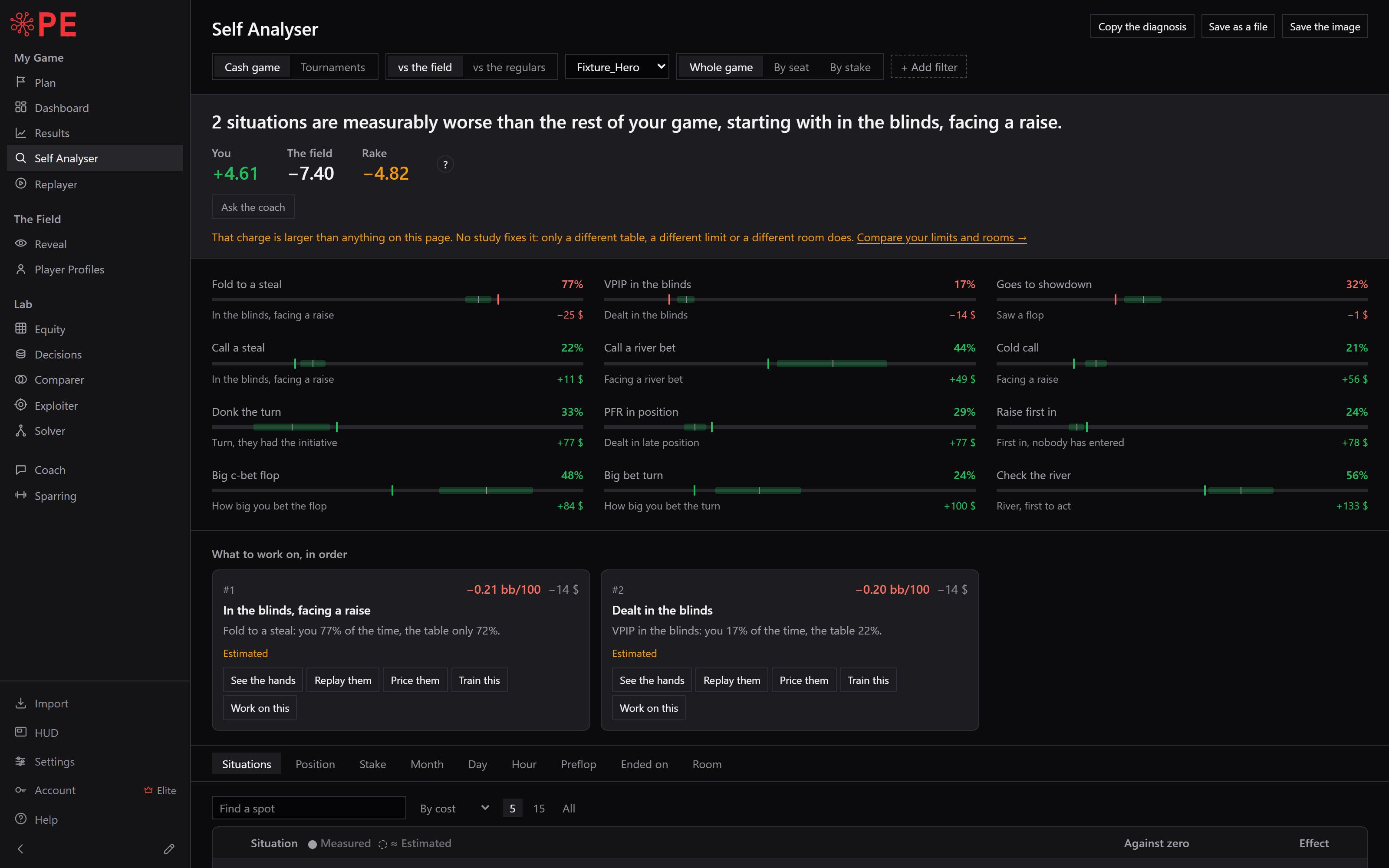
The free Self Analyser screen breaks your game into about thirty-five situations, from preflop to river, by position, and gives each one a cost in big blinds per 100 hands. It also tells you whether a spot separates from noise.
That matters because tilt often shows up as a few ugly outliers:
- too many loose calls after a bad beat
- too few value bets after a rough stretch
- too much aggression in some river spots
- too much folding when you should keep pressure on
If one spot is clearly worse than the others, that is more useful than a vague feeling that “I played badly tonight.”
3. Compare before and after a trigger
This is the cleanest way to think about tilt.
Pick a trigger you know you react to. Maybe it is getting stacked with an overpair. Maybe it is losing a big pot with a set. Maybe it is playing after a long day at work. Then compare your decisions before and after that trigger.
A useful question is not “Did I feel tilted?” It is “Did my decisions change after that hand, that hour, or that level of fatigue?”
If the answer is yes, you found your tilt pattern.
A routine to prevent tilt
You do not beat tilt with one perfect rule. You beat it with a routine.
Before the session
- Set a start time and a stop time.
- Decide how long you will play, in hands or in minutes.
- Decide what fatigue looks like for you.
- Decide your stop rule before you start.
- If you are already angry, rushed, or exhausted, do not sit down.
A stop rule should not only be about money. It should also be about decision quality. If you know that you get sloppy after two hours of play, then two hours is your real danger zone, even if you are winning.
During the session
When you feel the trigger hit, do not negotiate with it.
Try this:
- breathe once and slow down
- finish the current hand normally
- take a short break, or end the session if the trigger was strong
- do not jump stakes
- do not chase the next pot
- do not decide that “one more hand” will fix anything
If the problem is emotional, more hands are usually the wrong solution.
If the problem is fatigue, more hands are also the wrong solution.
After the session
This is where the real work starts.
Review three things:
- what triggered you
- what changed in your decisions
- what the numbers say
Then write one short note. Not a diary entry. Just one line:
- “After the river cooler, I started overcalling.”
- “My late sessions are losing more than my daytime sessions.”
- “I stop c-betting too often when I feel behind.”
That note is useful because it turns a vague mood into a concrete leak.
What to do when tilt starts in real time
If you notice tilt during a session, the goal is not to prove that you are strong enough to keep playing. The goal is to stop the leak.
Use this simple sequence:
- Recognise the trigger.
- Finish the hand.
- Stand up or pause.
- Do not restart until your thinking feels normal again.
- If it does not feel normal, end the session.
A good rule is to stop when you can feel yourself moving from poker decisions to emotional decisions.
That might sound simple, but it is hard in practice because tilt often tells you that the next table, the next orbit, or the next buy-in will make the bad feeling go away. Usually it does the opposite.
How the free tools fit this process
You do not need fancy software to understand tilt, but the right numbers make the pattern easier to see.
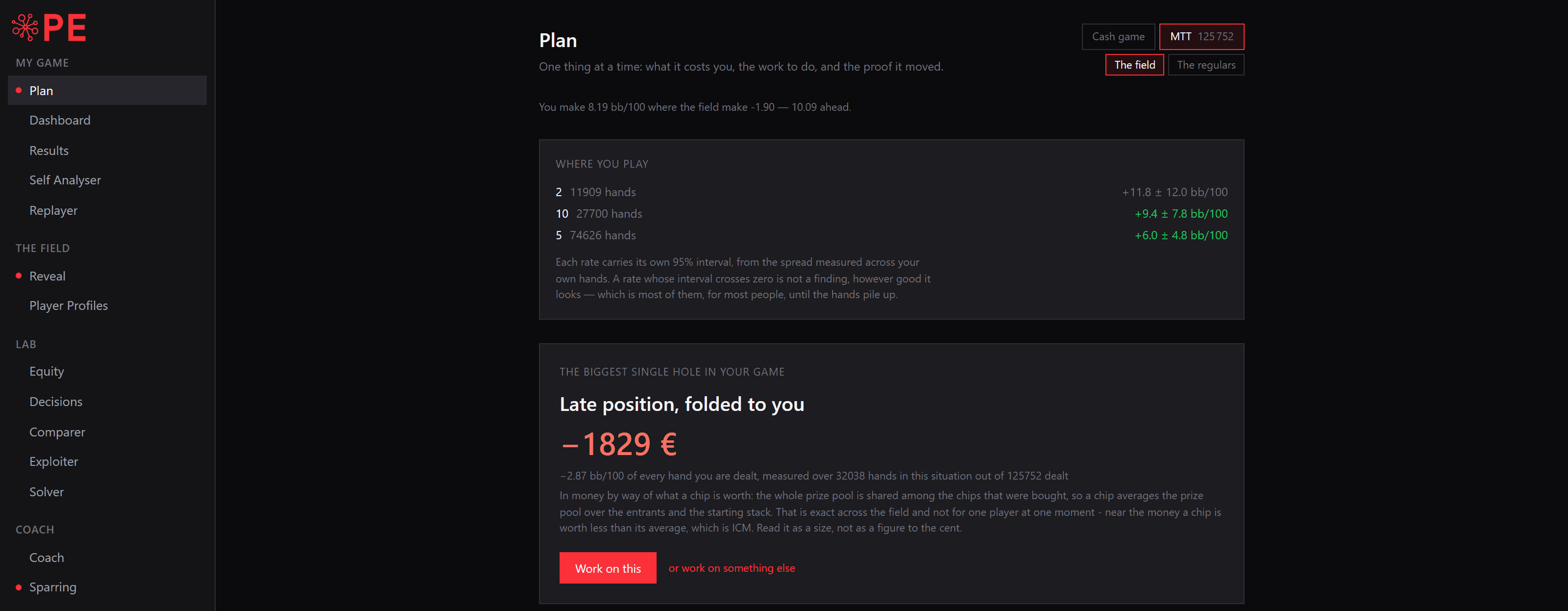
The free Dashboard screen shows your win rate, its margin, and the run inside its variance cone. The free Results screen shows your profit by month, by career, by room, stake, position, and hour of the day, plus the rake next to the result and the all-in EV line. The free Self Analyser screen shows which situations cost you the most. The free Plan screen then picks the situation that measurably costs the most compared with players at your limits and runs a cycle: where you stand before, five training sessions, 150 new decisions in that spot, then a verdict.
That is useful for tilt because tilt often leaves a footprint in a small number of spots. If the damage is measurable, you can work on it. If the numbers do not separate from noise, you do not need to invent a problem that is not there.
The short version
Poker tilt is a change in decisions after a trigger. It can be aggressive, passive, fearful, distracted, or overconfident. You spot it best after the session, not by feeling alone, by checking your results by hour, the situations that cost you the most, and whether your decisions changed after bad beats, coolers, long losing stretches, fatigue, or winning.
If you build a simple routine, set a stop rule, and review your numbers honestly, tilt becomes much easier to control.
Do it on your own hands.