
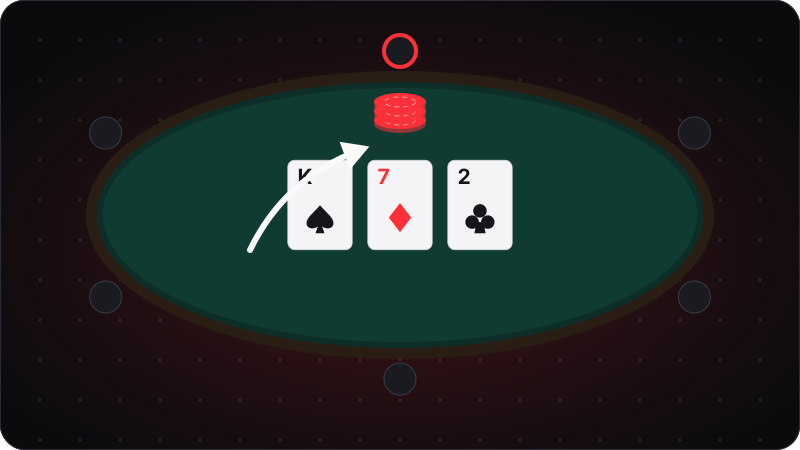
The continuation bet, or c-bet, is the flop bet made by the preflop raiser after taking the lead before the flop.
It is one of the first postflop concepts you need to understand, because it sits at the center of almost every decision you make on the flop. If you raise preflop, you do not automatically need to bet the flop. A good c-bet is not a habit. It is a choice.
The right question is not "Can I c-bet here?" The right question is "What does betting do for my range, my hand, and this board?"
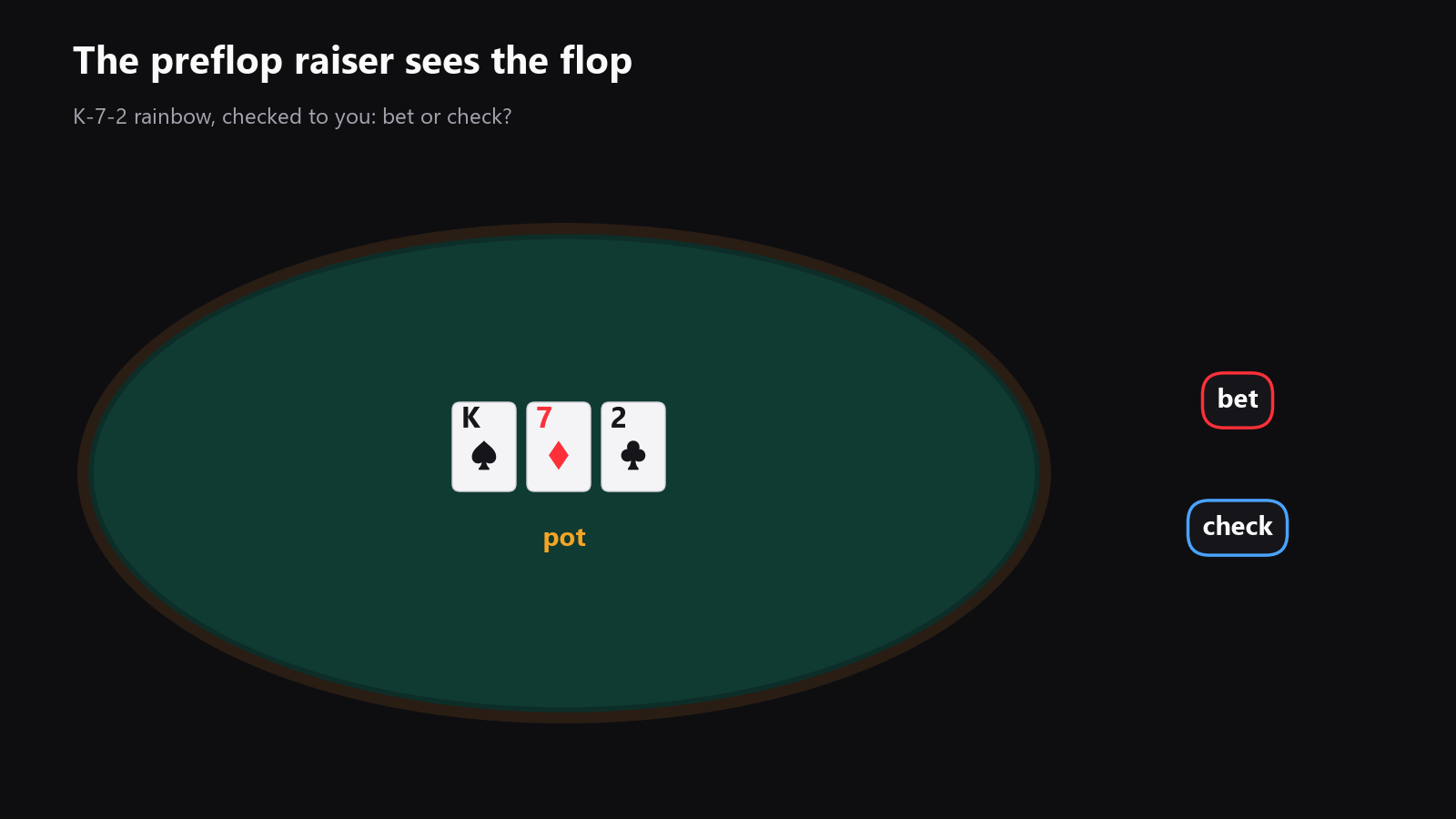
What a c-bet is supposed to do
A flop c-bet usually has one of three jobs:
- make worse hands fold
- get called by worse hands
- deny equity to hands that have some chance to improve
If your hand does none of these things well, checking is often better.
That is why a c-bet is not the same thing as "showing strength." Sometimes the best continuation bet is small and frequent. Sometimes the best play is to check a hand that has some showdown value. And sometimes the best way to pressure the caller is to bet larger because the board is wet and the caller has many draws.
A simple way to think about it:
- bet when your range has an advantage on the board
- check more when the caller's range connects better
- bet for value when worse hands call
- bluff when you can make better hands fold often enough
When you should c-bet
The best c-bet spots usually share one or more of these features.
1) The board helps your range more than theirs
If you raise preflop and the flop comes A-7-2 rainbow, you usually have many strong aces, overpairs, and high-card hands. The caller has more weak pairs, suited connectors, and missed hands. On boards like this, betting small and often makes sense.
On a board like 9-8-7 two-tone, the caller usually has more strong made hands and more draws. Your range is less comfortable. Checking becomes much more attractive.
2) You have fold equity
A bluff works when the opponent folds often enough. If the pot is 10 bb and you bet 3 bb, you are risking 3 bb to win 10 bb. In simple terms, your bluff needs folds often enough to justify the risk. The smaller the bet, the less fold equity you need.
That is one reason small flop c-bets are so common on favorable boards. You risk less, so you can profit with a wider range.
3) You can barrel good turns
A strong c-bet is not only about the flop. It should also set up future streets.
If you bet a hand with backdoor flush or straight potential, or a hand that can improve on many turns, you keep options open. If you bet only hands that are already strong or complete air, your bluffing range gets too narrow and easy to play against.
4) You are heads-up, not multiway
The more players see the flop, the less automatic your c-bet should be.
Against one caller, a c-bet can work as range pressure. Against two callers, the bet becomes much more value-heavy. Multiway pots hit somebody more often, so your bluffing frequency should drop sharply.
When you should check
Checking is not weakness. It is often the strongest decision.
You should check more often when:
- the board favors the caller
- your hand has enough showdown value to avoid building a big pot
- your hand is vulnerable to a raise
- you want to protect your checking range
- the pot is multiway
- you are out of position and do not want to bloat the pot with a marginal hand
A useful example is a medium-strength pair on a coordinated board. Betting may fold out the hands you beat and get called by hands that have you in bad shape. Checking keeps the pot smaller and gives you better control.
A very important idea
If you always c-bet your strong hands and your bluffs, but always check your medium hands, your range becomes easy to attack.
You need some strong hands in your checking range, and some medium hands in your betting range. That balance matters more than memorizing one fixed frequency.
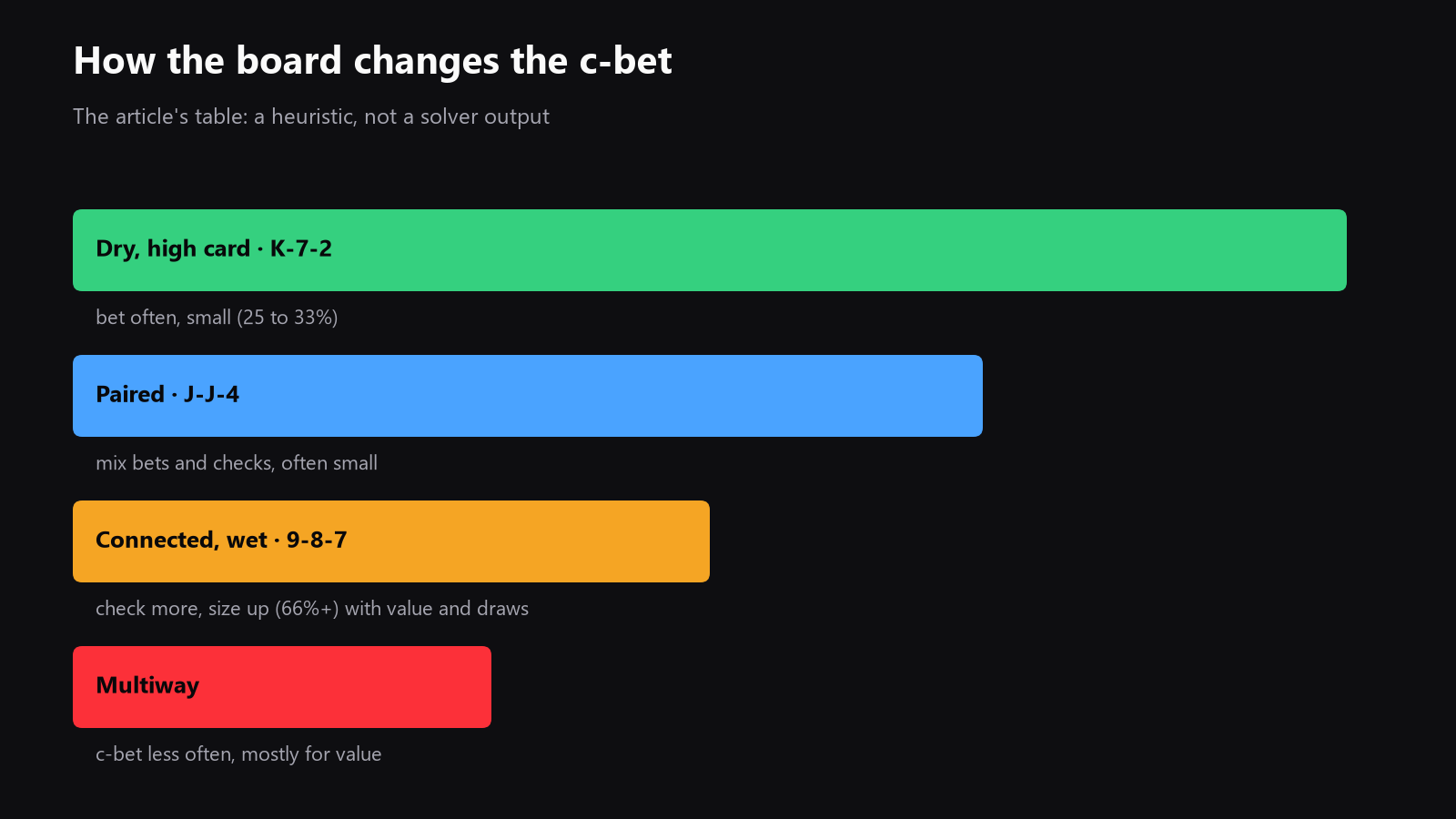
How board texture changes the c-bet
Board texture is one of the biggest factors in c-betting.
Here is a practical way to think about it:
| Board type | What usually happens | Typical plan |
|---|---|---|
| Dry and disconnected, especially high-card boards | The preflop raiser often has the advantage | Bet more often, usually smaller |
| Paired boards | Many hands miss, but the board can be awkward | Mix bets and checks, often small |
| Connected and wet boards | The caller connects well with the board | Check more, bet more selectively, size up with value and draws |
| Multiway boards | Somebody usually has something | C-bet less often, mostly for value |
Examples
- K-7-2 rainbow: often a good small c-bet board
- A-9-3 rainbow: often another strong c-bet board
- 9-8-7 two-tone: often a much worse c-bet board
- J-J-4: depends a lot on positions and ranges, so mix more
The board matters because poker is a game of range interaction, not just hole cards. A hand that is strong in absolute terms can still be a bad c-bet if the board helps the caller more than it helps you.
How position changes the c-bet
Position changes everything.
In position
When you have position, you get more information on later streets. That makes small c-bets and delayed aggression more useful.
You can also check back more often with hands that have some showdown value, because you are less punished than when you are out of position.
Out of position
Out of position, checking becomes even more important.
If you bet too much out of position, you risk building a pot without the advantage of seeing what the caller does next. You also face raises more awkwardly. So out of position, you should usually be more selective and less automatic.
A simple rule of thumb:
- in position, you can c-bet a wider range on good boards
- out of position, you should check more often and keep your betting range tighter
What size should a c-bet be?
There is no one correct size. The size should match the board, your range, and your plan for later streets.
Common sizing ideas
Small size, around 25% to 33% pot
Use this when:
- the board is dry
- you have a range advantage
- you want to bet often
- you want to risk less with bluffs
This size is common on boards like A-7-2 rainbow or K-8-3 rainbow.
Medium size, around 50% pot
Use this when:
- the board is more dynamic
- you want to protect your value hands
- you want to charge draws
- you do not want to bet very wide
Larger size, around 66% pot or more
Use this when:
- the board is wet
- the caller has many draws and pair-plus-draw hands
- your value hands need protection
- your bluffs benefit from extra pressure
Large flop c-bets are usually more polarized. They are more often value hands or strong draws, not random air.
The big mistake
Many players use the same size everywhere.
That is a leak.
If you always bet one-third pot, you make your line too predictable. If you always bet two-thirds pot, you may be risking too much on boards where a smaller bet would work just as well.
A simple framework you can use in real hands
Before you c-bet, ask yourself these five questions:
- Did I raise preflop?
- Does this board help my range or theirs?
- Am I heads-up or multiway?
- Does my hand benefit more from betting or checking?
- What size makes sense for this board?
If the answer to most of these points is "yes, this board and spot favor me," a c-bet is often good.
If the answer is "no, the caller connects well and my hand does not want to face a raise," checking is usually the better choice.
Common c-bet mistakes
1) C-betting automatically
If you raise preflop, that does not mean you must fire every flop. Automatic c-bets are easy to exploit.
2) Betting too big on dry boards
On dry boards, a large bet often risks too much. A smaller bet can achieve the same goal for less.
3) Betting too often multiway
The more players are in the hand, the less your flop bet should become an automatic move.
4) Ignoring your hand's future
Some hands want protection. Some want pot control. Some want to bluff with backdoor equity. If you do not think ahead to the turn, your c-bets become random.
5) Forgetting the opponent type
Against a player who folds too much, your bluffs gain value. Against a player who calls too much, your value bets gain value and your bluffs lose value.
A few practical examples
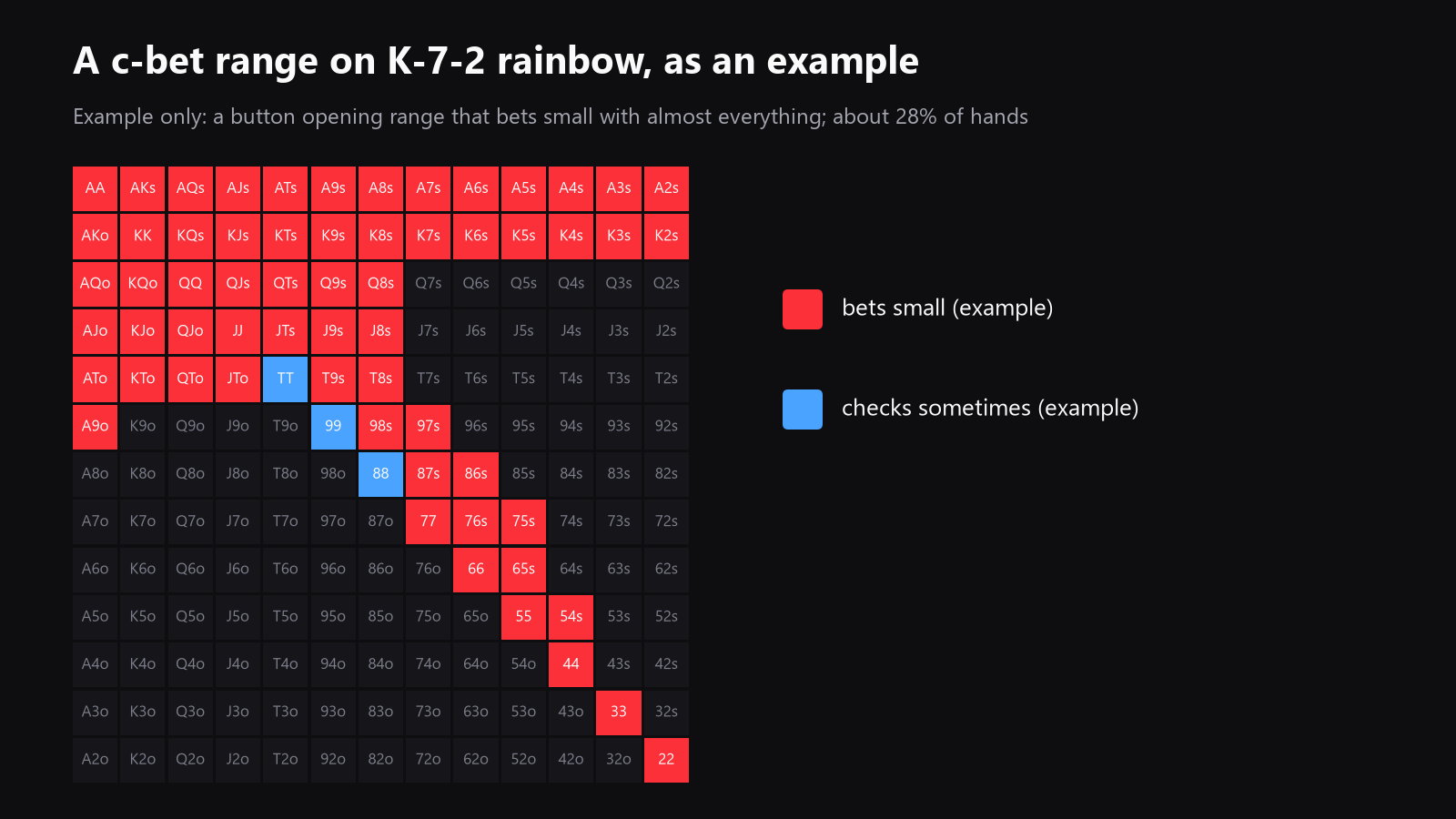
Example 1: Button open, big blind calls, flop K-7-2 rainbow
This is often a good spot for a small c-bet.
You have many strong kings, overpairs, and high-card hands. The big blind misses a lot more often. A small bet can pressure weak pairs and unpaired hands.
Example 2: Button open, big blind calls, flop 9-8-7 two-tone
This is a much tougher c-bet board.
The big blind has more straights, two pairs, sets, and strong draws. Your range is under more pressure, so checking more often is sensible.
Example 3: Early position open, one caller, flop A-9-4 rainbow
This is usually still a strong c-bet spot, but you do not need to bet every hand.
If you have ace-high, overpairs, or hands with backdoor equity, betting can work well. If your hand is a weak pair with poor future prospects, checking may be better.
The short version
If you want one simple rule, use this:
- c-bet more often on dry boards that favor the preflop raiser
- c-bet less often on connected boards and multiway pots
- bet smaller when your range advantage is clear
- bet larger when the board is wet and your value hands need protection
- check more when the caller's range connects well or when your hand prefers pot control
If you want to study this spot away from the table
The easiest way to improve your c-bets is to review your own hands, not just memorise general advice.
In Poker Exploit, the Self Analyser module helps you see where your postflop leaks are by situation, and the Solver module lets you study a spot away from the table. If you want to know whether your c-bets are too frequent, too small, or too automatic, that is the kind of question those modules are built for.

The best c-bet is not the one that looks aggressive. It is the one that makes sense for the board, the ranges, and the future streets.
Do it on your own hands.