
A mixed strategy is one of the most misunderstood ideas in poker theory.
People often hear, “This hand mixes,” and assume it means the hand is somehow too hard to classify, or that a solver likes to “randomize for balance.” That is not the core idea.
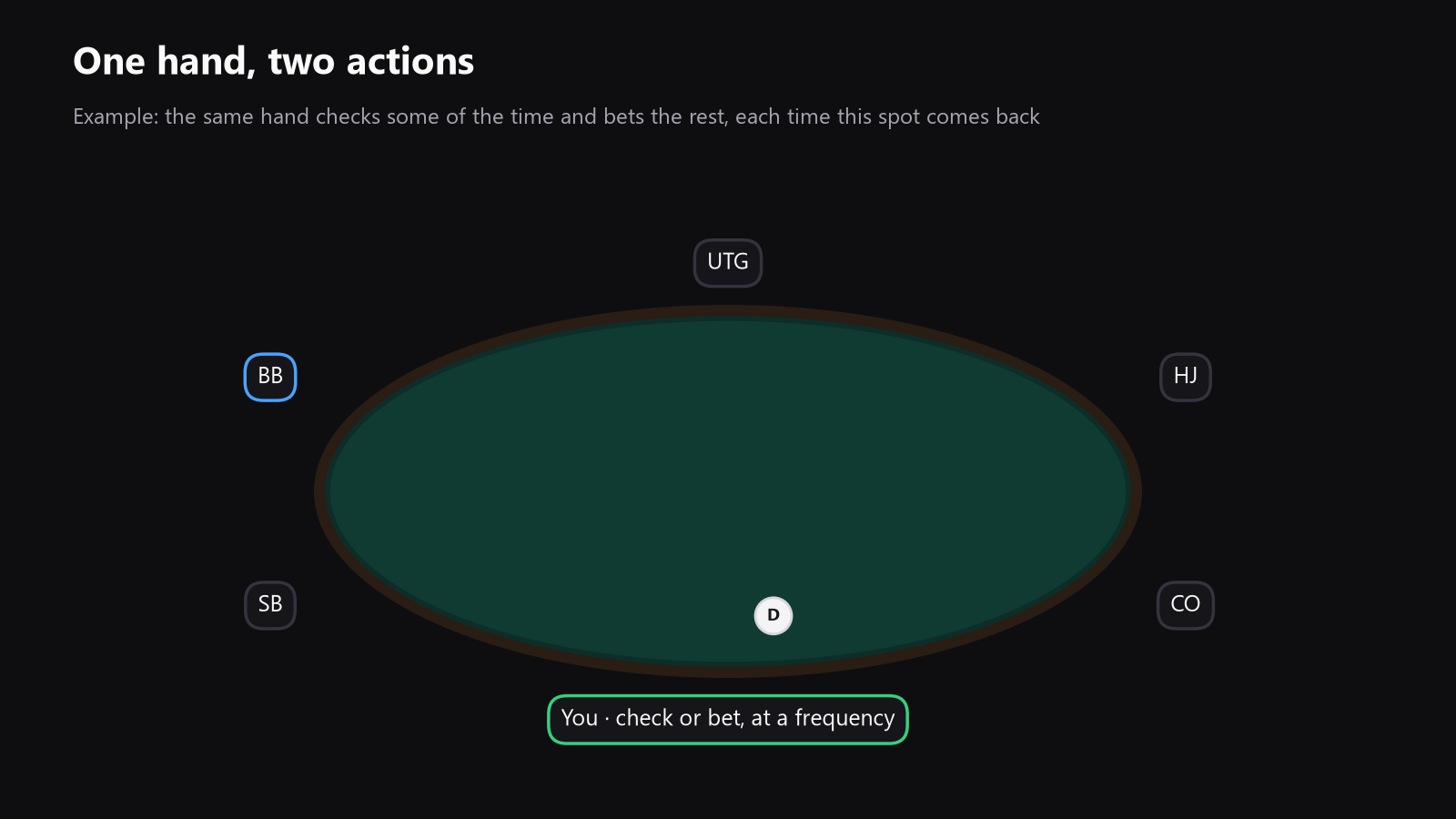
At equilibrium, a hand is mixed only when its available actions have exactly the same EV. If one action were even slightly better, the hand would always take it. The mix exists because the opponent should not be able to exploit your choice between the actions.
In other words, a mixed strategy is not randomness for its own sake. It is a controlled way to make your opponent indifferent too.
What a mixed strategy really means
When a solver mixes a hand, it is not saying, “This hand is half bluff and half value because that looks elegant.”
It is saying something much stricter:
- Action A and action B have the same EV.
- Your opponent cannot gain by assuming you always choose one of them.
- The frequency of each action is chosen to keep the opponent from attacking that branch of the game tree.
That is why “mixed” does not mean “weaker” or “less certain.” Sometimes the strongest hands mix. Sometimes medium-strength hands mix. Sometimes weak hands mix because they can profit as bluffs only part of the time.
A useful way to think about it is this: a hand mixes when the spot has no clean winner. The hand is on the border between two actions.
Why equilibrium mixes at all
Poker is a game of ranges, not isolated hands.
If you always bet the same class of hands, your opponent can adjust. If you always check the same class, your opponent can adjust. Equilibrium uses mixing to make those adjustments unprofitable.
That happens for a few main reasons:
1. Range construction
Your betting range needs enough value hands and enough bluffs.
If you bet too many weak hands, your bluffs become easy to punish. If you bet too few weak hands, your value bets get paid too often and your checking range becomes too weak.
A mixed strategy helps build the right ratio.
2. Blockers and removals
Some hands block the strongest calling hands, or block the hands that would continue aggressively. Those hands can be better as bluffs, but not always enough to always bet.
Other hands unblock folds, or retain too much showdown value to be thrown into a bluff every time. Those often land in the middle and mix.
3. Future realization
Some hands are good now and bad later, or the reverse. A hand may have enough value to check, but enough pressure to bet, depending on runout and stack depth.
That is especially true in multi-street spots, where turn and river cards change the shape of the node.
4. Protecting ranges, not just hands
Sometimes the goal is not what one exact combo does, but what your whole range looks like. A mixed strategy can keep both your betting and checking ranges difficult to attack.
Mixed hands live at the combo level
People often speak loosely and say, “A5s mixes” or “this pocket pair mixes.”
More precisely, the mix usually happens at the combo level.
One suit may bet more often because it blocks different hands. Another suit may check more often because it unblocks folds or keeps better backdoor potential. So even when you talk about a hand as mixed, the real engine is often the individual combo.
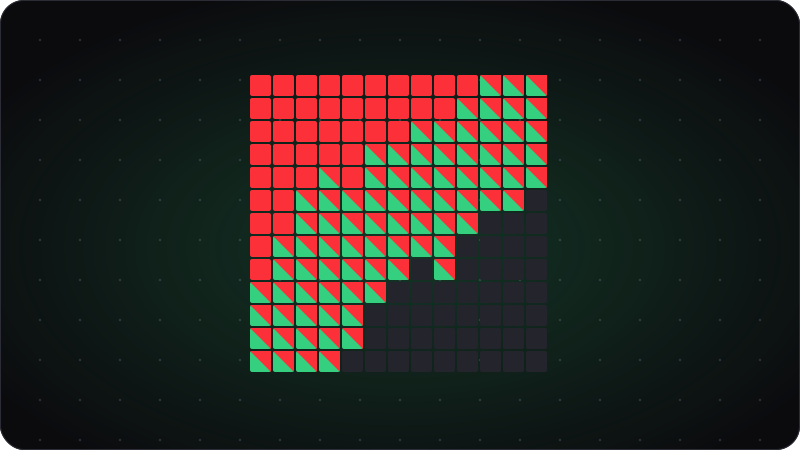
That is one reason a strategy grid is so useful. A 13x13 hand matrix gives you the big picture, but the detail lives in the suit-specific edges.
A simple example of frequency arithmetic
Let’s use the classic bluff example.
If you bluff 5 into a pot of 10, you risk 5 to win 10.
Your bluff breaks even when:
5 / (10 + 5) = 33.3%
So the bluff needs folds 33.3% of the time to show immediate profit. The defender’s minimum defense frequency is:
10 / (10 + 5) = 66.7%
That means the defender should continue at least 66.7% of the time, on average, to avoid being exploited by a pure bluffing strategy.
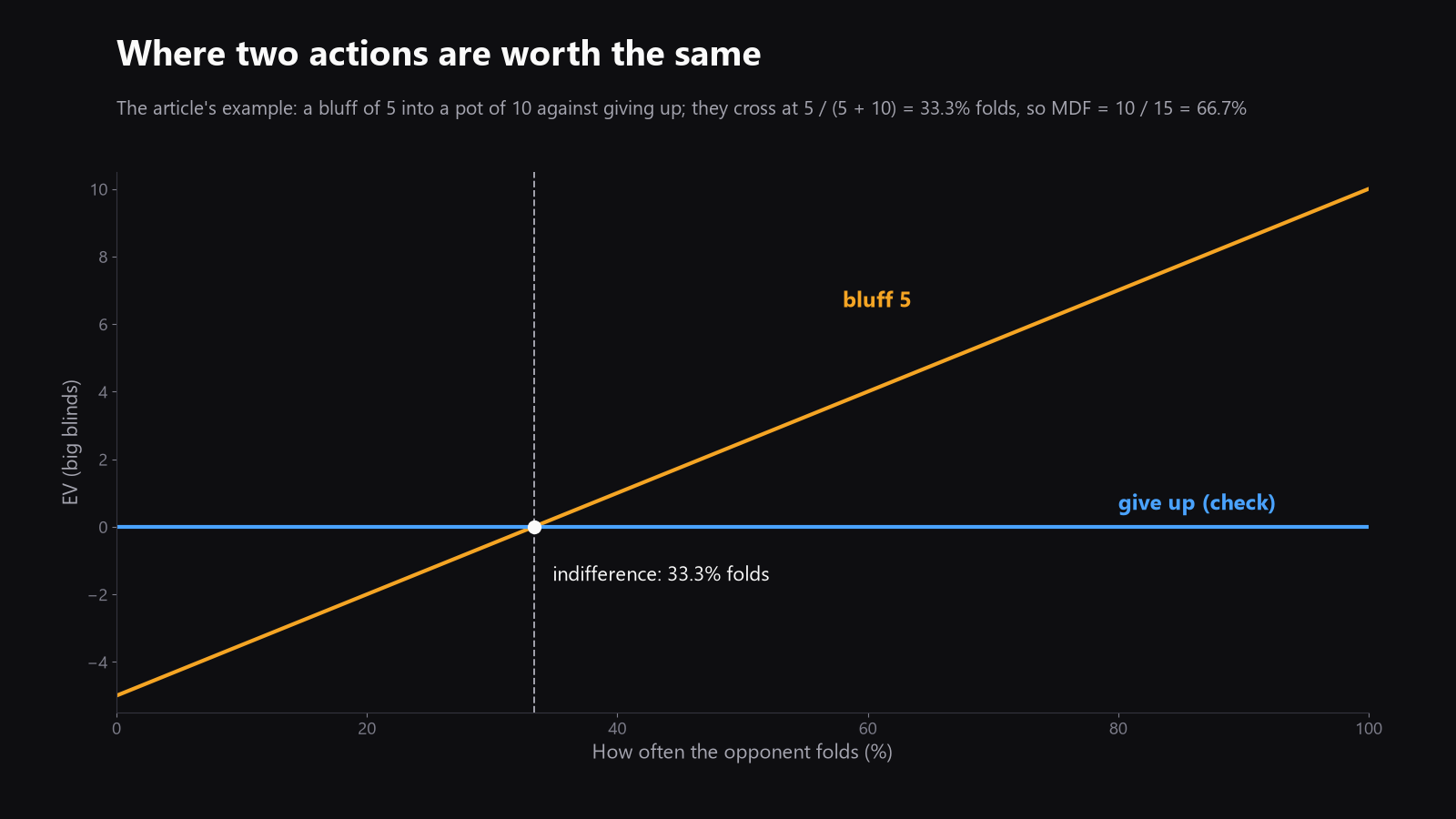
This is the kind of arithmetic that explains why frequencies exist.
If the betting side knows the caller continues too rarely, bluffs become too profitable. If the calling side knows the bettor bluffs too often, calls become too profitable.
Equilibrium sits where neither side can improve by moving unilaterally.
Bluff-to-value ratio in the simple river case
In a one-street spot, the bluff-to-value ratio is tied to the size of the bet.
For a bet of 5 into 10, the bluff-to-value ratio is 5:15 = 1:3, so you have 1 bluff for every 3 value hands.
That does not mean every real hand tree works like a toy river model. Multi-street lines, stack depth, blockers, and future play all change the exact mix.
But the toy model is still worth learning, because it shows the logic behind the frequency.
How a human can follow a frequency
This is where many players get stuck.
You do not need to “feel” the right mix. You need a repeatable way to carry it out.
A randomizer helps with execution. It does not tell you whether the spot is mixed. That distinction matters.
If a spot is mixed, a randomizer can help you choose the correct line often enough. You can use:
- a number generator,
- a suit-based rule,
- a clock or timing method,
- or any consistent system you can actually follow.
What matters is not perfect randomness. What matters is that, over time, your frequencies are close enough.
A practical example
Suppose a solver-like output says a hand should bet 70% and check 30%.
You do not need to hit exactly 70.0000%.
If you can carry out something close, you are usually fine. In fact, at the table, simple execution often beats precise theory that you cannot reproduce reliably.
This is especially true in live play or fast online play, where speed matters and mistakes from hesitation are expensive.
When a pure strategy costs almost nothing
This is one of the most important practical lessons.
If a hand is mixed 52/48, or 55/45, or even 60/40, playing it one way only often costs very little in practice.
Why?
Because a mixed hand’s actions have exactly the same EV, whatever the split. In a solver’s approximate figures, they can look nearly equal, and that is why playing one pure line often costs very little.
That is also why you should not overreact to tiny solver splits.
Pure strategy is often a good trade when:
- the mix is very close,
- the spot is hard to randomize in real time,
- the rake is large,
- the player pool is not punishing frequencies well,
- or a simple line reduces your own mistakes.
In real games, a clean exploit that you can execute well can be better than an exact mix that you will misplay.
What a solver screen can teach you
If you want to study this away from the table, the Solver module shows the strategy of a spot as a 13x13 grid of starting hands, with actions and result figures. That makes mixed hands easy to spot.
You can see at a glance which hands are pure, which are split, and which are close enough to mixed that a practical pure line may be acceptable.

The important part is not to copy a number blindly. The important part is to learn why a hand mixes:
- Is it near indifference?
- Is it protecting a range?
- Is it a blocker-driven bluff?
- Is the frequency just a thin numerical edge?
Once you know that, the grid becomes a teacher instead of a chart to memorize.
Common mistakes with mixed strategies
Here are the mistakes I see most often.
1. Thinking randomness is the goal
No. Indifference is the goal. Randomness is only the tool.
2. Mixing hands that are not actually close
If one action is clearly better, a mix can quietly leak EV. Do not force balance where the hand has a real preference.
3. Copying frequencies without understanding the node
A mix that is correct on the flop may be wrong on the turn. A mix that is correct in position may be wrong out of position. A mix that works at one stack depth may fail at another.
4. Ignoring the population
Against your actual player pool, pure exploit often matters more than theoretical balance.
If the field overfolds, bluff more. If the field overcalls, value bet more. If the field is indifferent, then frequency work matters more.
This is why a study tool that looks at real hands is useful. The Reveal module shows what the players at your limits actually do, and the Coach and Sparring modules let you study hands you have already played, away from the table. They are for review, not for live help.
The short version
A mixed strategy means a hand sometimes takes one action and sometimes another because the actions have the same EV.
If one action is better, the hand should always take it.
A randomizer helps you execute a frequency. It does not tell you whether a spot is mixed.
And if the mix is thin, a simple pure line often costs very little, especially when you play it cleanly.
That is the real practical takeaway:
- learn why the hand mixes,
- know how to approximate the frequency,
- and do not overpay for precision when the EV difference is tiny.
If you want to go further, study the spot away from the table, then test whether the hand is truly mixed or just close to it.
Do it on your own hands.