

Playing against nits is usually good news.
A nit is one of the easiest opponents to understand, because their game is built on one idea: avoid trouble. They enter too few pots, they 3-bet too little, they continue too carefully, and they rarely turn a hand into a bluff. That makes them predictable.
Your job is not to “outplay” a nit in fancy spots. Your job is to take the free money they give away, and to stop donating in the one place where they are strongest, when they finally show aggression.
What is a nit?
A nit is a very tight, usually passive player.
In practical terms, that means:
- they play few hands
- they open too little preflop
- they 3-bet rarely
- they fold too much when facing pressure
- they prefer calling over raising
- they do not build many big pots without a strong hand
That does not mean they are easy to beat in every single pot. It means their range is narrow, and their mistakes are repetitive. Against a nit, the edges come from understanding where that narrow range is weak, and where it is strong.
The most important thing to remember is this: nits do not need to bluff much to look scary. They only need to show aggression once or twice for many players to start paying them off.
That is the leak.
How to spot a nit quickly
You usually spot a nit from two kinds of clues: preflop and postflop.
Preflop signs
A nit typically shows:
- low VPIP, meaning they play few hands
- low PFR, meaning they raise even fewer
- low 3-bet frequency
- high fold to 3-bet
- a lot of folds from the blinds
If you are using the HUD module in Poker Exploit, those are exactly the kinds of stats it shows on the table: VPIP, PFR, 3-bet, fold to 3-bet, flop c-bet, and fold to flop c-bet. That is enough to tell you whether the player in front of you is really tight or just on a short quiet run, once the sample is large enough.

Postflop signs
A nit usually:
- checks a lot
- c-bets less often than aggressive players
- folds too much to flop pressure
- rarely takes creative lines
- becomes much stronger when the pot gets bigger
That last point matters. The danger is not that a nit is aggressive too often. The danger is that when they do get aggressive, many players still call them down as if nothing has changed.
How to attack a nit
There are four main adjustments.
1) Steal their blinds more often
This is the first and easiest adjustment.
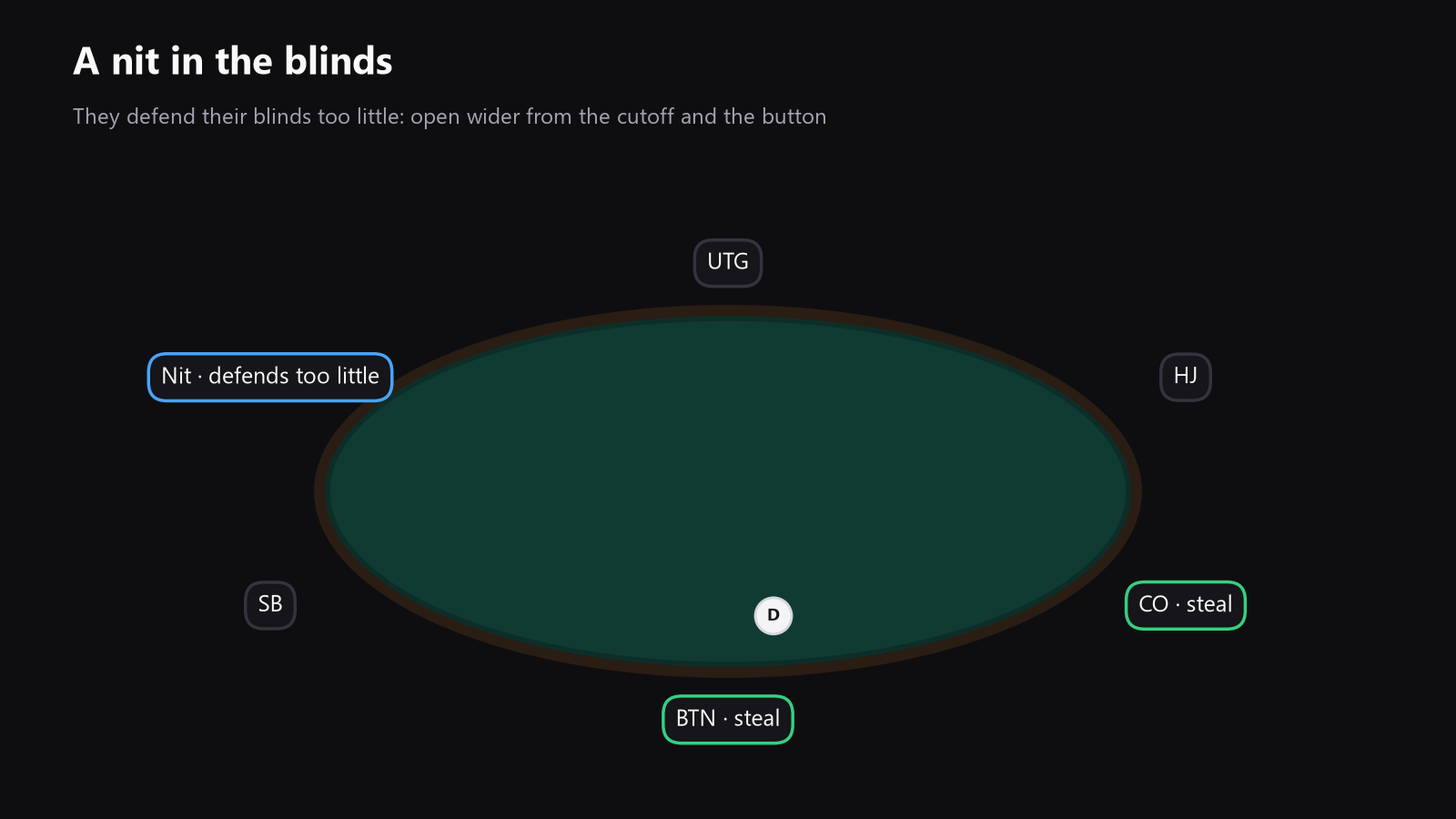
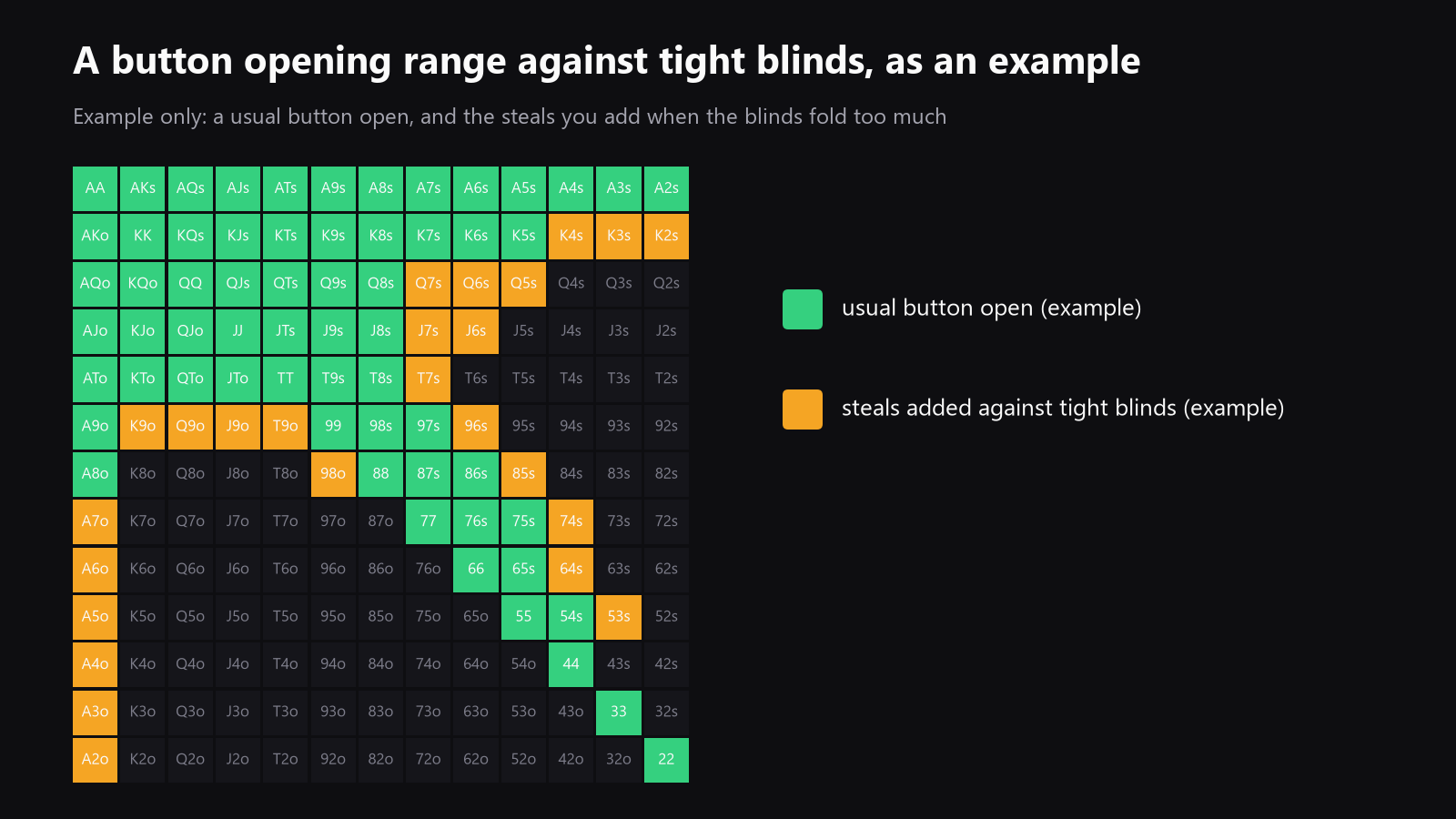
If a nit is in the blinds, they usually defend too little. That means you can open wider from late position, especially from the cutoff and button. You do not need to attack every hand from every seat, but you should absolutely widen when:
- you are in position
- the players behind you are tight
- the nit gives up blinds too often
- the pot will often be heads up after the flop
Why does this work? Because a nit protects their blinds badly. They do not fight back enough preflop, and they do not create enough postflop trouble to make your steal unprofitable.
If they limp a lot, isolate them wider in position too. Against a limp-caller nit, you want hands that can make value and realize equity well heads up.
2) Value bet your strong hands, and check back marginal ones
This is where many players go wrong.
Against a nit, your value bets get paid less often because they continue with worse hands less often than looser players do. So when you have a clearly strong hand, bet it. With marginal value hands, checking back is often better.
But do not turn every medium hand into a bluff just because the opponent is tight. A nit’s folds are profitable when they actually fold. If they call, their range is usually stronger than average. So your bluffing plan should be selective.
A good rule is:
- bluff the spots where their range clearly misses
- avoid spewing into ranges that are still strong
- do not turn a hand with showdown value into a bluff unless the line really supports it
Against nits, the best bluffs are the ones that attack capped ranges. The worst bluffs are the ones you make because you are uncomfortable checking back marginal hands.
3) Fold more when they show aggression
This is the biggest adjustment, and the one many players refuse to make.
When a nit raises, 3-bets, check-raises, or suddenly barrels later streets, that action is usually much stronger than people want to admit.
Why? Because passive players do not reach for chips often without a reason. If a nit has been calling, checking, and avoiding trouble all hand, then suddenly wakes up, their range is often weighted toward value.
So against a nit:
- respect their 3-bets more
- continue tighter against preflop aggression
- fold more versus flop raises and turn check-raises
- be very careful when they choose river aggression
This does not mean every raise is the nuts. It means you should start from a disciplined assumption: their aggression is honest until proven otherwise.
One pair, even top pair, is often not enough to stack off against a nit. Many players lose money here because they refuse to fold a hand that “looks strong enough.”
It often is not.
4) Stop paying them off
This is the main leak against nits.
A lot of players make this mistake in their head:
“They are so tight that they must be bluffing when they bet big.”
Usually it is the opposite.
A nit’s big bet on the turn or river is often the part of their range you should fear most. If you keep calling because you do not want to believe it, you are doing exactly what they want. They make money when you refuse to let go of second-best hands.
This is especially true on later streets:
- flop action can still include some protection bets
- turn action becomes more honest
- river aggression is often the most value-heavy line of all
Against a nit, a bad call can erase several good small pots. That is why discipline matters so much.
Street by street adjustments
Here is a simple way to think about it.
| Spot | Adjustment | Why it works |
|---|---|---|
| They fold blinds too much | Open wider in late position | They defend too little |
| They limp a lot | Isolate in position | Their limps are weak and passive |
| They open from early position | Continue tighter | Their range is stronger |
| They c-bet too little | Stab more when they check | They miss and give up often |
| They raise on flop, turn, or river | Fold more | Their aggression is usually value-heavy |
| You have medium strength and they barrel | Consider folding | One pair is often not enough |
Common mistakes players make versus nits
Mistake 1: Calling too much preflop
If a nit opens from an early position, their range is usually much stronger than yours. Calling too wide out of position is a slow leak. You are not winning enough pots after the flop, and you are often reverse dominated when you hit.
Mistake 2: Trying to “prove” they are bluffing
Many players call down because they feel insulted by a nit’s aggression.
Do not do that.
Poker is not about proving a point. If the line is strong, fold. You can win the hand later.
Mistake 3: Underusing late-position steals
If a nit is folding too much from the blinds, and you keep folding a good button or cutoff spot, you are leaving money on the table. These are the easiest pots to win against them.
Mistake 4: Giving them credit in the wrong place
A nit is not automatically strong just because they are tight. They are strong when their line says they are strong. The key is to distinguish between:
- hands they enter preflop because they are good enough
- hands they continue with because the board and action fit them
- hands they suddenly get aggressive with because they actually have it
The last one is the one that costs you the most when you ignore it.
A simple example
Imagine a very tight player who limps or folds a lot, then calls your flop bet, then check-raises the turn on a board that got no more draw-heavy.
A lot of players talk themselves into calling because the pot is already big.
Against a nit, that is exactly how you donate.
If they were passive for two streets and now want to raise, you should assume you are facing a much stronger range than average. Unless you have a clear reason to continue, fold and move on.
That single fold can save more money than all the small pots you won earlier.
The short version
If you want the whole strategy in one sentence:
Against nits, win the small pots, steal the dead money, value bet your strong hands, and let them keep the big pots when they finally wake up.
That is how you beat very tight passive players.
A quiet way to study this better
If you want to confirm these patterns on your own hands, the HUD module and the Reveal module in Poker Exploit are made for that.
The HUD module shows the raw stats that help you spot a nit. The Reveal module shows what players at your limits actually do by street and spot, so you can see the field's patterns more clearly and stop guessing.
That is often the difference between “I think this guy is tight” and “I know what the field at my limits does in this spot.”
Final takeaway
Nits do not win by outplaying you everywhere. They win when you get impatient.
So do the opposite:
- steal their blinds
- pressure their weak ranges
- value bet when you are ahead
- fold when they fight back
- never pay them off out of pride
If you can do that consistently, nits stop being annoying opponents and become some of the easiest money on the table.
Do it on your own hands.