

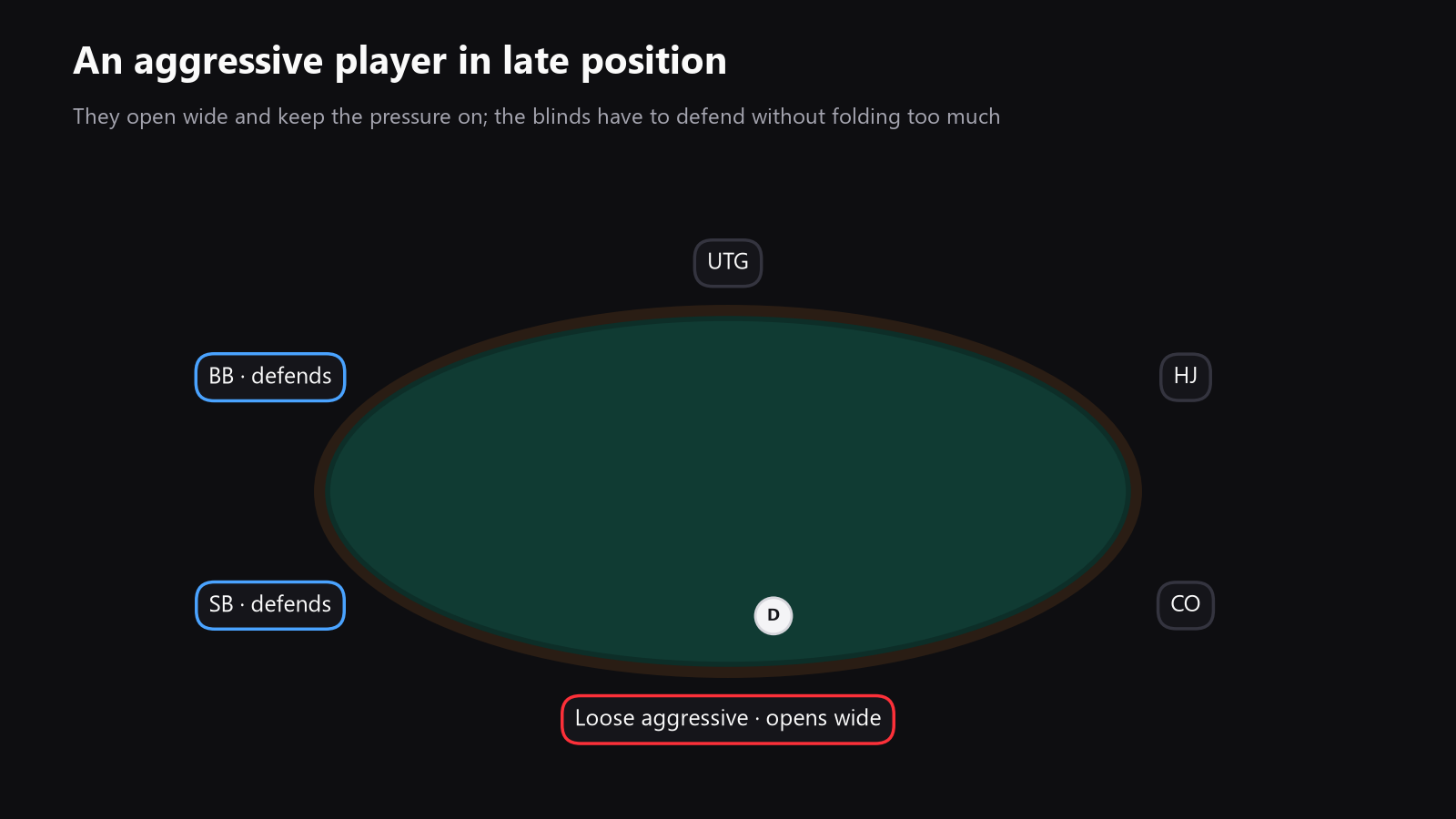
Aggressive players can be frustrating because they do not let you sit quietly and wait for a premium hand. They raise, they c-bet, they barrel, and they make every pot feel bigger than it should. But aggression is not the same thing as strength.
That is the first adjustment you need to make.
Against some opponents, aggression is a weapon used well. Against others, it is a leak. Your job is not to “beat aggression” in the abstract. Your job is to identify what kind of aggressive player you are facing, then punish the part of their game that is too wide, too thin, or too stubborn.
First, separate the strong regular from the maniac
Not every aggressive player is a wild gambler. Some are solid regulars who apply pressure in the right spots. Others are players who simply bet too much.
A strong aggressive regular usually has a plan. They enter pots with a coherent range, they choose boards well, and they do not spew their stack just because they dislike folding. They may attack more than average, but their bets make sense across streets.
A maniac is different. A maniac often:
- enters too many pots
- raises too often without enough value
- keeps firing on bad turns and rivers
- makes large bets in spots that do not need them
- shows down far too many weak hands, or none because they finally give up after burning money
The easiest way to tell them apart is not by one action, but by the whole pattern.
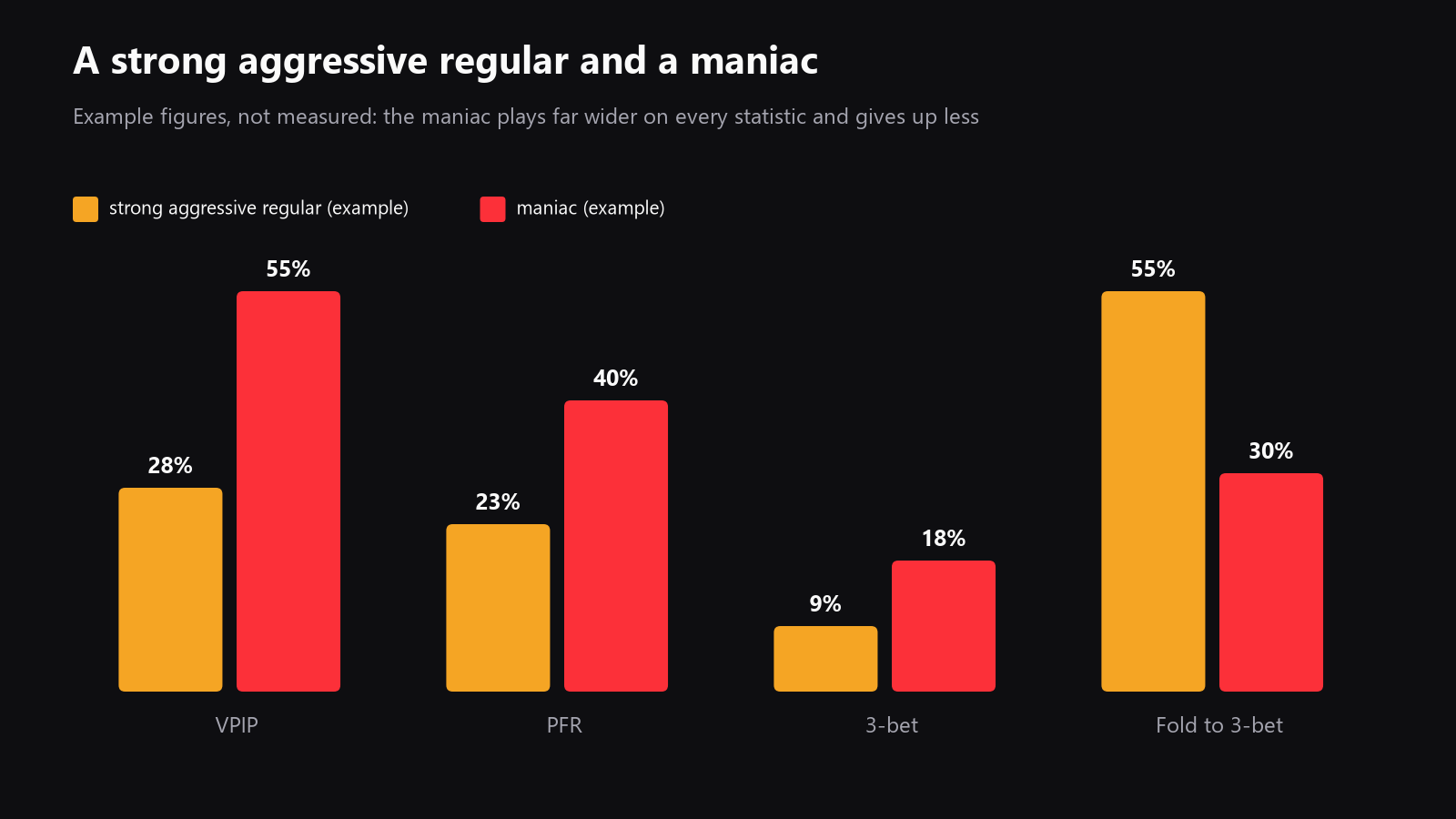
If you use the HUD module, look at the basic observed stats it shows: VPIP, PFR, 3-bet, fold to 3-bet, flop c-bet, and fold to flop c-bet. Those numbers do not tell you everything, but they help you separate a player who is simply active from one who is out of line.
A player with a wide gap between VPIP and PFR is usually passive preflop: they are putting money in the pot without raising much. A maniac looks more like high VPIP, high PFR close to it, and a high 3-bet. If those numbers are paired with lots of postflop aggression, you may be facing someone who likes action more than discipline.
If you want a bigger picture, the Reveal module shows what players at your limits do overall from real hand histories. For one opponent, the HUD module and Player Profiles give you the stats, notes, and colours. That matters, because labels like “LAG” or “maniac” are only useful if they match what the player truly does in the pool you are playing.
What you should not do
When someone keeps betting into you, it is tempting to respond in the worst possible ways.
Common mistakes:
- folding everything that is not top pair or better
- hero-calling every street with no plan
- trying to “teach them a lesson” with random bluffs
- 4-betting just because you are annoyed
- slowplaying forever and missing value
Aggression changes ranges, not your emotions. If you let the pressure decide for you, you will either overfold or overdefend. Both are profitable for the aggressive player.
Your goal is simple:
- value bet them wider when they call too much
- bluff less when they do not fold enough
- bluff catch more when they overbluff
- trap when they continue too often and protect their range poorly
- 4-bet when they attack too wide and cannot continue correctly
How to play against a strong aggressive regular
A good aggressive regular is not trying to punt chips. So against that player, you need cleaner logic.
1) Defend more carefully preflop
Do not panic-3-bet hands that play badly out of position just because the opponent is active. Against a real regular, position matters even more. Hands that can realize equity and continue on many boards are better than hands that only look pretty.
When they 3-bet a lot, widen your continuing range in a controlled way. That does not mean “call wider with anything.” It means choose hands that do well against their value and bluff range, especially hands that can make strong top pairs, strong draws, or comfortable bluff-catchers.
2) Trap more in the right spots
If a strong aggressive regular c-bets too frequently and barrels boards that favor your range, some hands become more valuable as traps. A trap works when:
- your hand is strong enough to continue against several streets
- the board is unlikely to kill action
- the opponent has enough air to keep bluffing
- raising now would fold out too much of the part of their range you want to keep in
Do not trap because you are scared to bet. Trap because you expect them to keep betting.
3) Bluff catch with structure, not courage
Calling down lighter against aggression is often correct, but only if the story makes sense.
Ask yourself:
- what value hands does this line represent?
- what bluffs does this player actually reach the river with?
- did the board help their range or yours?
- are they betting big because they are polarized, or because they bet everything?
Against a strong regular, your bluff catchers should come from hands that block value or unblock missed draws when possible. More important than the exact hand class is the plan: if you call turn, can you call many rivers too, or are you guessing?
4) Use 4-bets with purpose
A lot of players 4-bet too much against aggression because they hate being pushed around. That is expensive.
Against a strong regular:
- 4-bet more for value if they 3-bet too light and continue too wide
- use bluff 4-bets only when they fold enough to 4-bets and when your blockers matter
- do not turn every decent hand into a 4-bet just because you do not want to play postflop
Your 4-bet strategy should pressure their weakest continues, not merely express your frustration.
How to play against a maniac
Against a maniac, the game changes. You are not trying to out-bluff them as much as you are trying to let them hang themselves.
1) Call more, especially when your hand has showdown value
If the opponent is overbetting and barreling too much, many hands that would be weak against a tighter player become good bluff catchers.
Examples of hands that often improve in value:
- top pair with decent kickers
- overpairs on boards that miss the maniac’s obvious value region
- second pair in lines where the opponent can have many missed draws
- strong ace-high or king-high bluff catchers in the right runout
You still need a plan. A bluff catcher is only good if the opponent has enough missed hands and enough tendency to fire them.
2) Let them continue
Do not always raise the flop just because you hit something. Maniacs often love action. If you raise too early, you may fold out the bluffs and keep only the better hands.
Sometimes the best line is to call flop and let them continue on turns and rivers. That keeps their air in the pot and lets them donate more.
This is especially true when:
- they c-bet almost automatically
- they fire multiple streets too often
- the board has many scare cards for them to bluff on
- your hand is good but not strong enough to stack off comfortably right away
3) Value bet thinner
Against a maniac, value hands should often be bet for three streets, even when they are not monsters. If they call too much or raise too light, you do not need to protect some perfect balance. You need to get paid.
Missing thin value is one of the biggest leaks in player pools that overfocus on “not getting bluffed.” If someone pays off too often, make them pay.
4) Do not bluff too much
This sounds obvious, but many players get baited into bluffing maniacs because they think aggression must be met with aggression.
It does not.
If the opponent does not fold enough, your bluff loses value fast. Choose your bluffs carefully, preferably with good blockers and clear fold equity. Otherwise, let them be the one burning chips.
How to keep your nerve when they keep betting
The emotional part matters. Some aggressive players win pots before showdown because they make you feel uncomfortable.
You need a routine:
- Put the action into categories: value, bluff, or merged/protection.
- Ask what worse hands call and what better hands fold.
- Look at stack depth and board texture.
- Decide in advance what rivers you continue on, if the hand reaches that point.
If you reach the turn without a plan, the river becomes an emotional decision. That is where aggressive players make money.
A useful mindset is this: you do not have to “prove” anything in the hand. You only have to make a profitable decision.
Practical adjustments by situation

In position
You can call a little wider, especially against players who barrel too much and give up too rarely. In position, you control pot size more easily and get more information. That makes bluff catching and delayed aggression much stronger.
Out of position
Be more selective. Out of position, marginal hands get harder to realize. Against an aggressive player, that means:
- defend with hands that can continue on several runouts
- avoid hands that flop “sort of something” and then hate pressure
- use more check-calls when your range can withstand it
- avoid turning every medium-strength hand into a bluff-raise
Deep stacks
Deep stacks make aggression more dangerous for both sides. Your opponent can put more pressure on later streets, but they also risk more when you trap correctly. Deep is where board texture and range advantage matter the most.
Shorter stacks
When stacks are shorter, aggressive players lose some of their ability to keep barreling forever. In those spots, preflop decisions matter more, and your value continues become clearer. Avoid fancy lines that only work if there are enough chips behind.
A simple rule of thumb
If the aggressive player is strong, respect the story and continue with hands that play well against a balanced range.
If the aggressive player is a maniac, let them overdo it, call down more often, and value bet hard when you have it.
The mistake is to treat both player types the same.
Where the program helps
If you want to make this more precise, the Reveal module shows how the players at your limits actually act in the spots that matter. That is useful because “aggressive” is too broad a label on its own.
And if you want to check whether a line is genuinely costly in your own game, the Plan and Self Analyser modules can help you see what costs you the most, instead of guessing. You are not trying to become fearless. You are trying to stop losing money in the same spots.
The bottom line
Playing against aggressive players is mostly about discipline:
- do not overfold to pressure
- do not overhero call without a plan
- trap when they keep betting too wide
- 4-bet when they attack too loosely
- value bet thinner when they pay too much
- identify whether you are facing a skilled aggressor or a maniac
Once you stop treating every big bet as a threat, aggressive players become much easier to handle. Some of them are applying pressure correctly. Others are simply helping you win bigger pots.
Do it on your own hands.