
If you search for a final table deal calculator, you are usually asking two questions at once:
- What is my stack worth in money right now?
- Should I sell future tournament variance for a safer payout?
A final table deal is the answer to both. It is an agreement among the remaining players to split some or all of the remaining prize pool instead of playing every payout spot out. Sometimes the deal is simple, sometimes it is negotiated, and sometimes one place, the trophy, or a small amount is left to play for.
The key idea is not complicated: a deal turns future tournament equity into cash now.
What a final table deal actually is
A deal is not a strategy decision in the hand. It is a money decision between hands.
At a final table, the payout jumps can be large. One bustout can be worth more than many hours of play. That is why players talk about deals near the end of a tournament. They are not asking, “What is the best poker line?” They are asking, “What is my tournament equity worth in dollars, and how much of it do I want to lock in?”
There is no single correct way to split a prize pool. The most common methods are:
- Chip chop, which divides money by chip counts.
- ICM chop, which divides money by stack value under ICM.
- Custom deal, which is any negotiated split that is not strictly one of the two above.
Chip chop: the fast, rough split
Chip chop is the simplest idea. You first give each player the last prize still to be paid, then split the rest in proportion to the chips each player has.
That is easy to compute, easy to understand, and easy to negotiate around. It also ignores one big tournament truth: chips are not cash in a tournament. A chip is worth less when you already have a big stack and more when you are short, because payout jumps make survival matter.
Here is a simple example.
Three players remain, with $10,000 left to share:
- 1st: $5,000
- 2nd: $3,000
- 3rd: $2,000
Stacks:
- Player A: 500,000 chips
- Player B: 300,000 chips
- Player C: 200,000 chips
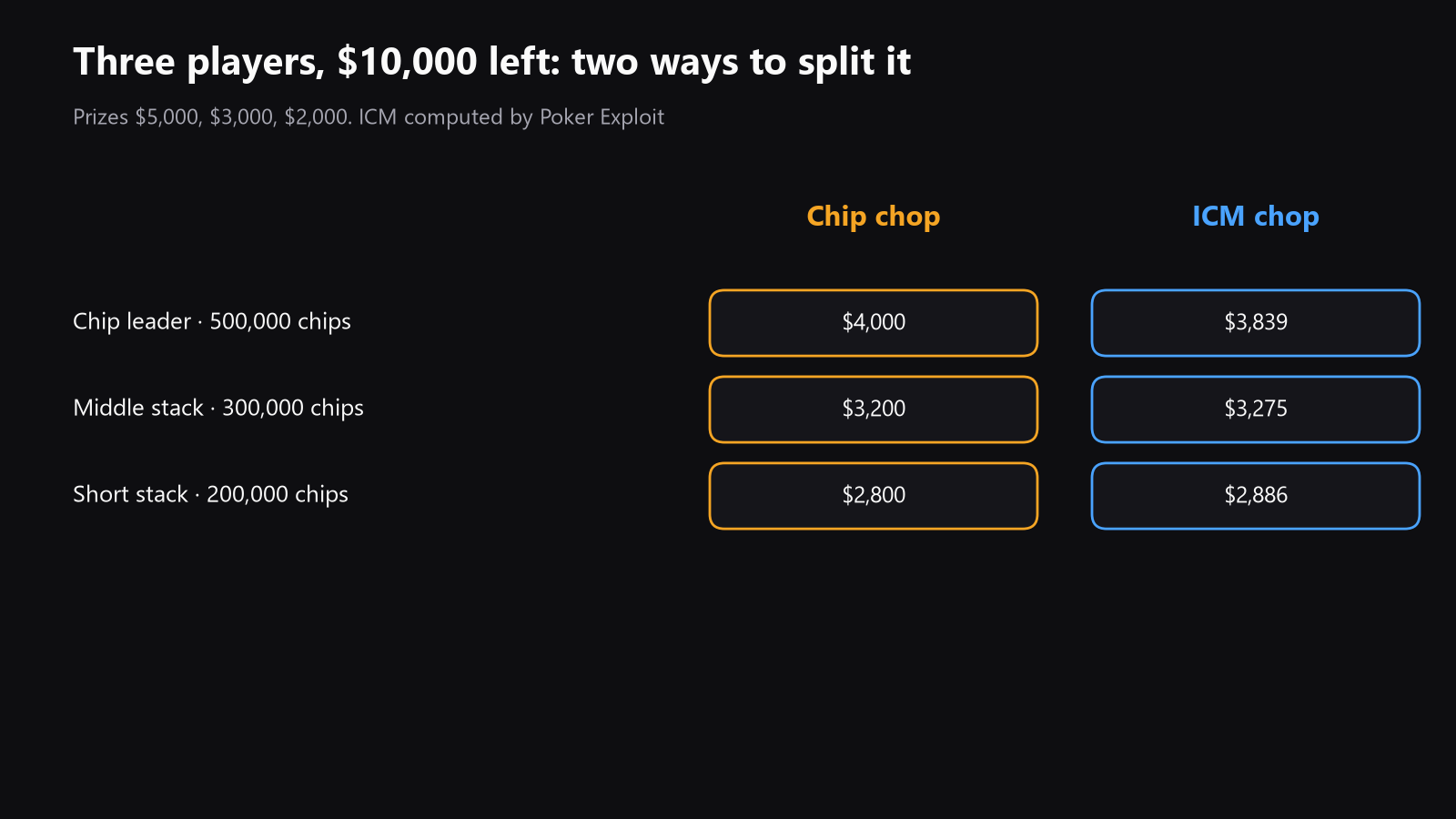
A common chip chop gives each player the $2,000 locked in for the last place paid, then splits the remaining $4,000 by chips:
| Player | Chips | Chip share | Chip chop |
|---|---|---|---|
| A | 500,000 | 50% | $4,000 |
| B | 300,000 | 30% | $3,200 |
| C | 200,000 | 20% | $2,800 |
Chip chop is quick, but it is blunt. It usually favors the bigger stacks more than ICM does, and it usually pays short stacks less than ICM does.
ICM chop: the tournament split most players mean by fair
ICM stands for Independent Chip Model. In plain English, it values each stack by the chance that stack has of finishing 1st, 2nd, 3rd, and so on, using chips only.
That is the classic tournament model. It does not use:
- player skill
- position
- blind pressure
- table dynamics
- future edge
It only looks at chip counts and payout places.
That is why ICM is so useful at final tables. In tournaments, your stack is not worth its raw chip count. A short stack can be very valuable if the next bustout moves you up a big pay jump. A huge stack gains less from one more chip than a short stack does from surviving one more hand.
Computed with Poker Exploit, the same example above gives this ICM chop:
| Player | Stacks | ICM chop |
|---|---|---|
| A | 500,000 | $3,839 |
| B | 300,000 | $3,275 |
| C | 200,000 | $2,886 |
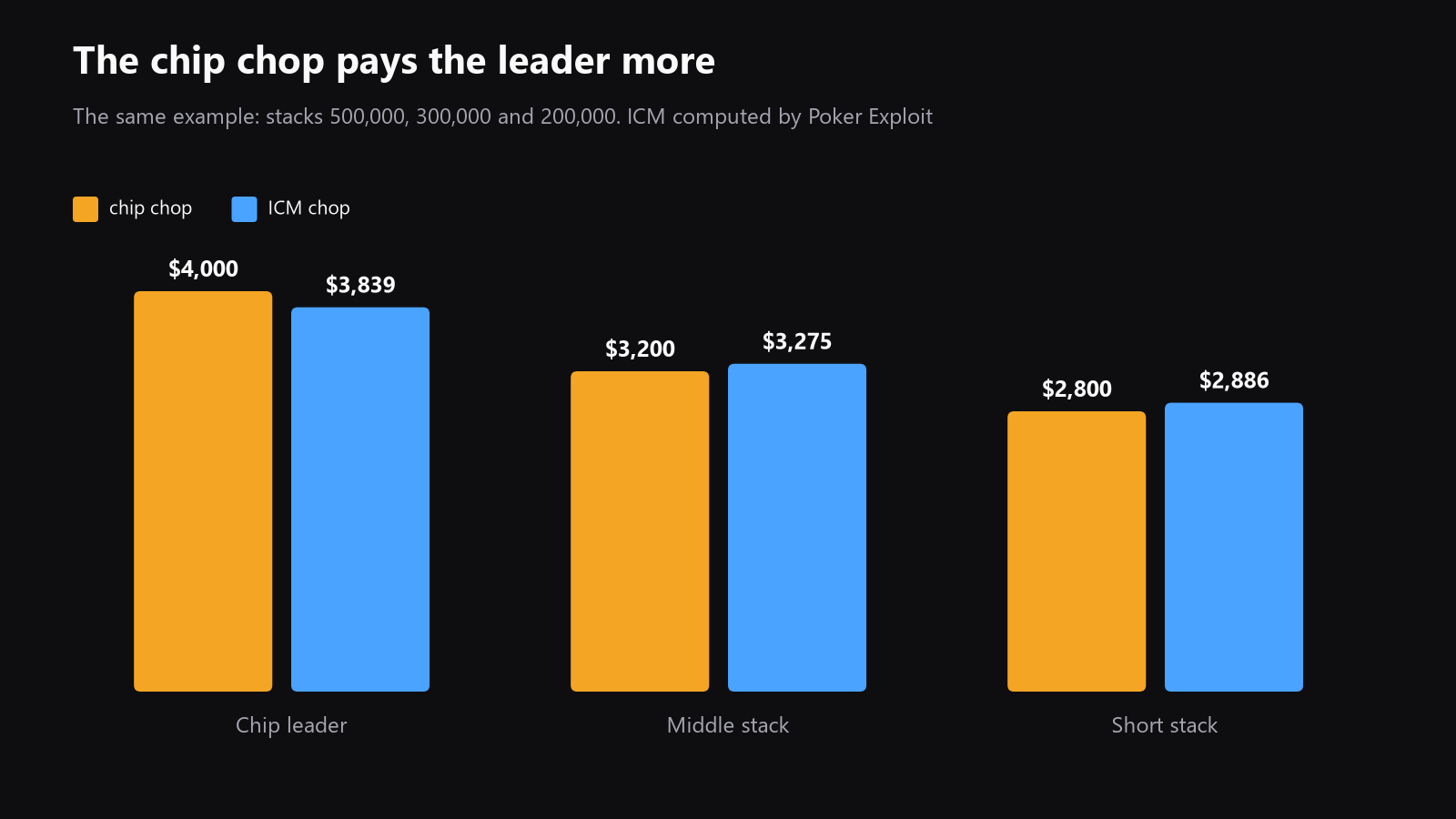
Compared with chip chop:
- the chip leader gets $161 less
- the middle stack gets $75 more
- the short stack gets $86 more
That is the usual shape of an ICM split. It protects the shorter stacks more than chip chop does.
Who each method favors
A good way to remember it is this:
- Chip chop usually favors the bigger stack relative to ICM.
- ICM chop usually favors the shorter stack relative to chip chop.
- When stacks are very close, the difference is small.
- When pay jumps are large, the difference grows.
Why?
Because chip chop treats every chip as if it had the same value. That is a cash-game mindset.
ICM says the last chips in your stack are not worth the same as the first chips in your stack, because tournament payouts are non-linear. Losing from 20 big blinds to 10 big blinds is not the same as losing from 200 big blinds to 190 big blinds.
This is why a short stack often likes ICM more than chip chop. It is also why a chip leader often likes chip chop more than ICM.
When a deal is worth taking
There is no universal rule, but there are clear patterns.
A deal becomes attractive when the money you lock in is worth more to you than the future value you sell.
That future value can come from two places:
- Your stack still has tournament equity
- You still have an edge over the field
So ask yourself these questions.
1. Are the pay jumps big?
If the next jump is meaningful, a deal becomes more valuable. A single bustout can change your payout a lot, so converting some of that uncertainty into cash makes sense.
2. Are you short?
If you are the shortest stack, the deal is often more attractive. Your stack has less room to use pressure, and your path to the top prize is narrower. ICM usually says your chips are worth more than chip chop gives you, so a fair ICM deal can be good business.
3. Are you the chip leader with a real edge?
If you are the biggest stack and you play well, continuing can be worth more than a pure ICM deal. ICM does not know that you are better than the other players. It does not know that you can pressure the medium stacks, pick better spots, and extract more value from future hands.
That is an important point. A deal can buy out your edge. If you are the best player left, your stack is worth more than ICM alone.
4. Is the table tough or soft?
If the table is tough, future EV is lower and a deal is more attractive.
If the table is soft and you think you can outplay people, play on can be better.
5. Do you want certainty more than upside?
This is the human side of the decision. Sometimes the difference is not about pure math. If the money is already life-changing, locking it in can make sense even if the theoretical edge says continue.
A deal is often worth taking when:
- you are short and facing a big pay jump
- the table is tough
- your edge is small
- you are tired
- the remaining variance matters more to you than the extra upside
A deal is often worth refusing when:
- you have a big edge
- you are the chip leader
- the remaining field is weak
- the payout structure still leaves a lot of value on the table
- the proposed split is below your realistic equity
What to check before you agree
Do not agree to a final table deal until the numbers are clear.
Check these points first:
- The exact prize pool Make sure you know what money is left to split.
- The exact payout ladder Know the remaining places and how much each place pays.
- The exact stacks Use the same chip counts for everyone.
- What is included Check whether bounties, tickets, trophies, or side prizes are part of the deal or separate from it.
- The method Is the split chip chop, ICM chop, or a custom adjustment?
- Your own edge Ask yourself whether continuing is worth more than the deal if you play the rest of the event out.
- The room procedure Final table deals depend on the event rules, so make sure everyone is working with the same approved process.
A good habit is simple: write the numbers down, then negotiate.
A quick way to think about the math
A deal is not magic. It is just tournament equity turned into money.
- Chip chop is the fastest estimate, but it is rough.
- ICM chop is the standard tournament estimate, and it is much closer to reality.
- Custom deals are only as good as the assumptions behind them.
If you want a practical way to study this type of spot, the Results module in Poker Exploit shows tournament ROI and ITM, the Decisions module gives push, fold or call with a short stack, and the Exploiter module includes ICM. It all works on your own hands, offline, so it helps you think before you sit in a final table spot, not during a hand in progress.
The simple rule of thumb
If you want the shortest possible answer, it is this:
- Chip chop is simple and usually better for the big stack than ICM.
- ICM chop is the standard fair split and usually better for short stacks.
- A deal is worth taking when the certainty you lock in is worth more to you than the future edge you sell.
The best final table deal is not the one that sounds good. It is the one you can justify with the numbers, the stack sizes, and your own edge.
Do it on your own hands.